

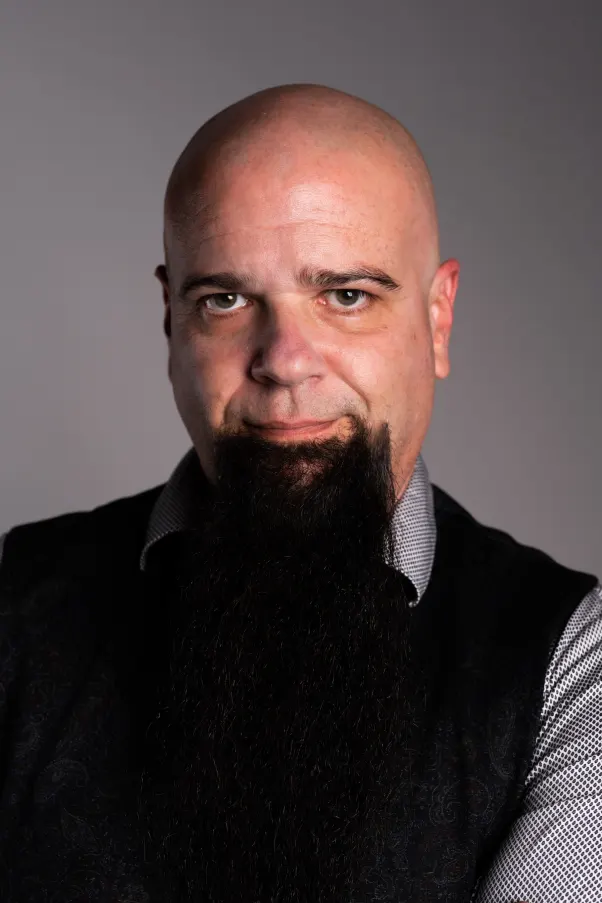

We caught up with the brilliant and insightful Len Noe a few weeks ago and have shared our conversation below.
Len, appreciate you joining us today. Can you open up about a risk you’ve taken – what it was like taking that risk, why you took the risk and how it turned out?
Most people talk about taking risks as if they’re clean, simple moments, switching careers, moving somewhere new, starting a business. My biggest risk wasn’t any of those. I chose to turn myself into the research.
Several years ago, I made the decision to selectively augment my own body for the purpose of offensive security research. I have implanted 11 microchips into my hands and arms. Not as a gimmick, not for show, but because I saw a gap no one was addressing. Everyone liked to theorize about the future, about implanted technology, cybernetic vulnerabilities, the merging of human and digital systems. Very few were willing to personally step into that space. I felt that if I was going to speak about the next generation of cyber threats, I needed to understand them from the inside out.
It wasn’t a glamorous choice. There’s no instruction manual for what happens when technology and biology start to mix. It’s uncomfortable. It’s unpredictable. And it forces you to confront who you are when the world sees you as something unfamiliar.
That decision also came with real personal cost. I lost friends. Some family relationships never recovered. I’ve been called out on extremist websites and labeled everything from reckless to spiritually dangerous. When you challenge the traditional boundaries of what people think a human should be, you quickly find out who can handle that evolution and who cannot.
But the outcome of that risk, the part people don’t always see, is that it fundamentally shifted the conversation in cybersecurity. Today, I’m recognized as a subject matter expert in transhumanism and human-integrated technology. Companies, governments, and security teams now look at my work as a preview of what’s coming, not science fiction. That same risk that once cost me relationships is now opening doors and helping organizations understand the emerging threats tied to augmented humans.
It wasn’t an easy path, and it definitely wasn’t the safe one. But taking that risk allowed me to shine a light on a future we all need to be prepared for, and sometimes that’s worth every step outside the comfort zone.
As always, we appreciate you sharing your insights and we’ve got a few more questions for you, but before we get to all of that can you take a minute to introduce yourself and give our readers some of your back background and context?
For readers meeting me for the first time, I’m Len Noe. A divergent research engineer and pentester focused on the security challenges that emerge when human beings and technology begin to truly merge. My work centers on understanding how implants, bio-integrated devices, and augmented capabilities introduce new attack surfaces, and helping organizations prepare for risks that most still don’t realize are coming.
My path to this field was far from conventional. Before I ever had an implant or took a professional role, I lived on the other side of the digital line. I spent years as a blackhat hacker and cybercriminal, learning how systems break because I was the one breaking them. Layered on top of that, I spent significant time in motorcycle club culture. A world that teaches you discipline, loyalty, and the consequences of your choices in ways textbooks never will. I don’t glorify those years, but I also don’t run from them. They shaped the instincts I rely on today and gave me a perspective most people in cybersecurity simply don’t have.
Eventually, I made the decision to step out of that life and redirect everything I’d learned toward something constructive. Offensive security became my way forward. Pentesting allowed me to use my mindset and skills to strengthen defenses rather than exploit them. Over time, I gravitated toward divergent research, exploring angles others overlooked and questioning assumptions that the industry tended to take for granted.
That mindset ultimately led me into human augmentation. As technology started shifting from devices we hold to devices we integrate, I saw a gap in the research: almost no one was examining the offensive implications of these systems. So I made a personal and professional commitment to selectively augment myself, turning my own body into a living research platform. It wasn’t about shock value, it was about gaining a firsthand understanding so I could speak with accuracy, not speculation.
Today, I work with companies, government teams, researchers, and global audiences to illuminate the next wave of cybersecurity challenges. What sets me apart is that my work is rooted in lived experience: I’ve been a blackhat, a club member, a researcher, and now an augmented human. That combination gives me a perspective that is difficult to replicate.
I’m also proud to share that I published my first book, Human Hacker, with Wiley Press. A deep dive into the psychology, technology, and vulnerabilities tied to human-integrated systems. Additionally, I’m the subject of the documentary I AM MACHINE, which explores my journey, my work, and the evolving relationship between humanity and the technologies we adopt into our bodies.
What I want potential clients, followers, and readers to know is this: my mission is transparency, education, and preparation. We are moving into a world where the boundary between human and machine is becoming increasingly blurred. My role is to help organizations and individuals understand that shift, recognize the risks, and build defenses before adversaries exploit them.
If my work expands someone’s perspective or strengthens their security posture, then every part of the journey, past and present has served a purpose.
What do you think helped you build your reputation within your market?
A big part of my reputation comes from the fact that I never approached this field like someone who followed a straight, polished path. Everything I do is anchored in experiences that forced me to understand risk, human behavior, and technology in ways that aren’t taught in any formal program.
Before I ever stepped into professional cybersecurity, my life had already exposed me to the realities of consequence, structure, and survival. My years as a blackhat and my time around motorcycle clubs gave me a very direct education in how people think, how systems fail, and how quickly situations can change. Those lessons stayed with me. They taught me to observe details others overlook and to anticipate moves long before they happen. That kind of grounding is difficult to replicate, and it became a defining part of my voice in this field.
When I shifted into legitimate work, I didn’t try to reinvent myself into someone spotless. I focused on transforming what I already knew and applying it with intention. That transparency and willingness to own my past helped people understand that my insights come from experience, not theory. Over time, that built trust.
Another key factor was approaching research differently. Instead of waiting for the industry to tell me what was important, I followed the patterns I saw emerging. That mindset is what eventually led me into human augmentation and the decision to study integrated technology from within my own body. Taking that leap positioned me at the front of a conversation the security community wasn’t fully having yet.
Publishing Human Hacker and being featured in the documentary I AM MACHINE helped broaden my reach, but the real foundation of my reputation was laid long before any of that. It came from a lifetime of learning things the hard way and then choosing to turn those lessons into something useful for others.
What sets me apart isn’t just what I research; it’s the path that taught me how to think, analyze, adapt, and approach problems without relying on the traditional blueprint. That grounding is what shaped my reputation and continues to influence everything I do today.
Can you share a story from your journey that illustrates your resilience?
One of the clearest examples of resilience in my journey came during the period when I first began augmenting myself. Up to that point, my life had already taken multiple sharp turns. Leaving behind a criminal past, stepping out of motorcycle club culture, rebuilding my identity inside legitimate cybersecurity. Those shifts required their own kind of resilience, but what happened during my early augmentation work pushed me into an entirely different arena.
When I chose to implant technology into my body, I knew it wouldn’t be universally accepted. What I didn’t expect was just how quickly people I cared about would distance themselves. Friends I’d known for years stopped returning calls. Some family members made it clear they didn’t understand or support what I was doing. And before long, I found myself being written about on extremist websites, accused of everything from moral corruption to literal “mark of the beast” rhetoric.
It would’ve been easy to retreat at that point. To say the research wasn’t worth the backlash. To strip everything out and return to a version of myself that made other people more comfortable.
But resilience is built in the moments when you choose purpose over approval.
I stayed the course. I kept documenting my work, expanding the research, and using myself as a case study so others could learn about the security implications of human-integrated tech. It was isolating at times, but it also clarified something important: resilience isn’t just surviving adversity. It’s continuing forward with clarity even when the world around you isn’t ready.
Years later, that same work is the reason I’m invited to speak globally. It’s why companies and government teams seek out my perspective on emerging threats. It’s part of why my book Human Hacker exists, and why my story became the documentary I AM MACHINE.
The very thing that once cost me relationships and brought public judgment is now the reason organizations trust me to help them navigate a future they’re just beginning to understand.
Resilience, for me, has never been about staying tough. It’s been about staying committed. And that commitment turned what could’ve been the most discouraging chapter of my life into the one that defined my career.
Contact Info:
- Website: https://www.i-am-machine.com
- Instagram: @lennoe213
- Facebook: https://www.facebook.com/len.noe.142/
- Linkedin: https://www.linkedin.com/in/len-noe/
- Twitter: @hacker_213
- Youtube: https://www.youtube.com/@Hacker-of9hn