

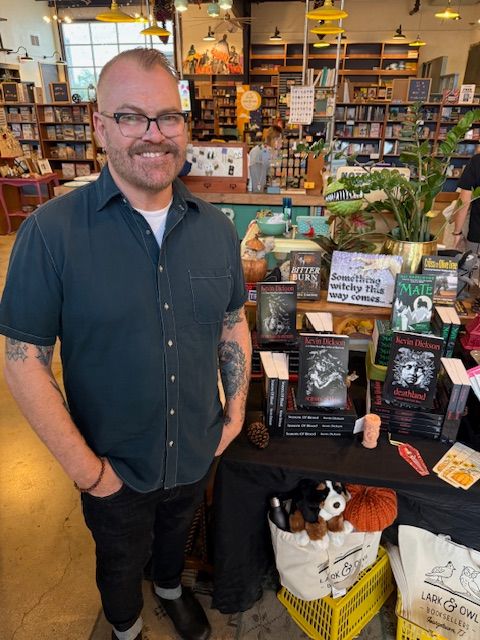

We caught up with the brilliant and insightful Kevin Dickson a few weeks ago and have shared our conversation below.
Kevin, appreciate you joining us today. What were some of the most unexpected problems you’ve faced in your career and how did you resolve those issues?
As an adult living with undiagnosed ADHD, it was getting increasingly difficult to cope with the strenuous effort of writing novels. This was compounded by the fact that I set myself a very difficult goal with my Vampire State novels: I set out to write a trilogy, in three years. It was during the writing of the first book, From Him To Eternity, that the symptoms of ADHD worsened, so I sought psychiatric advice, and unfortunately, the doctor that I saw, once he heard that I had already published several novels, said that anyone who could complete a novel did not have ADHD. Disheartened by the lack of diagnosis, I completed and released the first two books in my trilogy, but once it came time to write the third book, my symptoms had worsened, and I subsequently missed several important deadlines due to ADHD. As soon as I released the third book, Deathland, Amazon informed me that I was now in Amazon jail, and would not be permitted to run any preorders for upcoming books for twelve months. At the same time, Instagram began to throttle my outreach unless I paid them, taking the wind completely out of my sails. After a small flurry of promo, I gave up. I felt defeated, and decided to retreat for a while and get myself together. Now, six months later, I have indeed been diagnosed with rather severe ADHD, and am learning the tools to cope. I am working on a standalone novel, not set in the Vampire State world, and once it is complete, and my sentence in Amazon Jail has ended. I will release it. Being an author was my goal since I was a small child, and I am happy and relieved that I am able to return to it, because I’m a storyteller at heart.
Awesome – so before we get into the rest of our questions, can you briefly introduce yourself to our readers.
For many years I was an entertainment journalist, first in Australia, where I was born, and then, in Los Angeles and New York. During my time in New York, I became friends with Caroline Manzo, a Real Housewife, and she asked me to ghostwrite her autobiography. That experience led me to quit journalism to focus full time on writing. My first novel, Blind Item, made the LA Times best seller list. Its sequel, Blind Item, suffered from lack of support and tanked. After that, I spent several years on projects that my publisher greenlit, until lockdown happened and my publisher closed down. It was during that time that I decided to self-publish, and to work on my dream project, Vampire State, a series of novels set in an all-female society of vampires. My goal was to update the tired vampire tropes, by adding in a lot of feminism, existentialism, sexual identity and intelligence. I loved creating a world that was entirely mine, filled with fascinating fictional people, basically it’s the anti-Twilight: Well written, ruthless, funny and heartbreaking. The three books – From Him To Eternity, Seasons Of Blood and Deathland – are all out in the world now, and the most rewarding thing about it is that every day, I receive messages from someone, somewhere in the world, who has fallen in love with my vampire women. I deliberately included some big surprise twists in each book, and people seem to love second-guessing where I’m going, and then writing to me with their theories, before the twists. People have sent me updated maps of New York’s Upper West Side, and google street images asking if this or that building is where the main vampires live. A couple of people have gotten it right. It’s insanely rewarding to complete a dream project, and then have people get so invested.
Is there something you think non-creatives will struggle to understand about your journey as a creative?
One thing about writing books that seems to freak people out is just how poorly the industry pays you. People who don’t enjoy books will ask me to do weird things like figure out how much I got paid hourly to write a book. The answer horrifies them, because for most authors, it’s well below the average minimum wage. Even for my best seller, I was paid thirty five thousand dollars as an advance, and given the accounting methods of the major publishers, I still have not recouped my advance, eight years later. That book still sells and is on five thousand “to be read” lists on Goodreads. I write complicated books, and my favorite part of the process is refining a novel, draft by draft. I usually do six or seven drafts before I’m happy with a novel. If I did no other job, it would be at least a year-long process. Then you have to pay an editor, and commission a cover image, get new headshots taken, and send out copies for review. What people don’t always understand is that for me, these stories are always percolating in my brain. A million ideas will bounce around my mind, all day every day, until one starts to repeat. It’ll be a good idea, and once I acknowledge it, that idea will snowball into a novel. The only way to free myself of this loop in my brain is to write it. That process opens a door to a whole world, and I get to live in it and find out what happens next. I don’t write for profit, I write because to me, these stories force themselves into existence and I’m just the vessel. I’ve never tried to write a deliberately commercial book, and I don’t think I could commit to that approach. Despite the low payday, I love what I do and I’m willing to work odd jobs to survive in order to continue doing it.
What can society do to ensure an environment that’s helpful to artists and creatives?
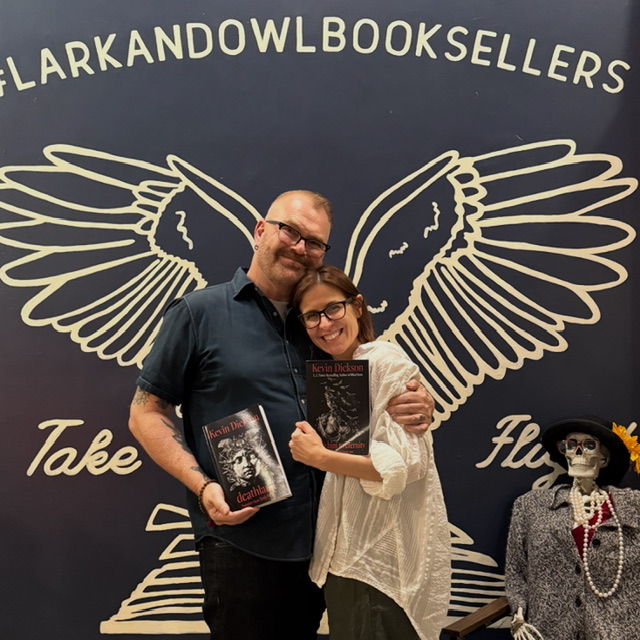
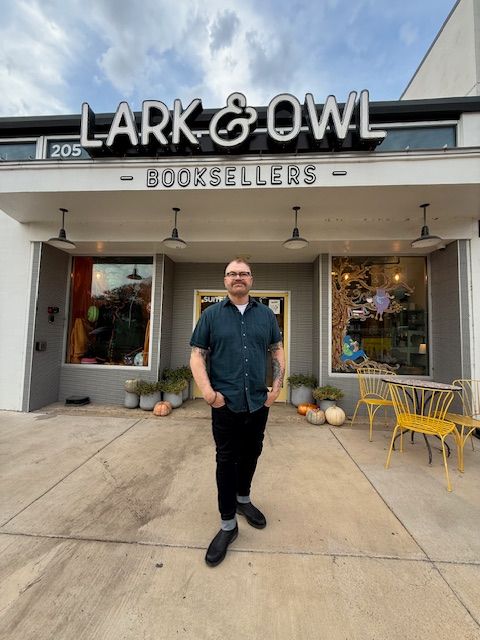
The twenty-first century has been increasingly difficult for artists. The internet has enabled no-cost sharing of music, art, books and film, while at the same time, corporate accounting has made it almost impossible for all but the most successful artists to make a fair living from their work. This is why physical media is so incredibly important. If you enjoy an artist, in any field, and you have the financial ability to purchase their work, then you should buy a book, record, painting or print, directly from them. It’s literally the only way that independent artists can profit from their work. It’s also super helpful to attend events – concerts, book readings, art exhibitions – and post photos online, tagging the artist. The algorithms that exist in the social media sphere are rigged against small artists, and the only thing that seems to grow an online presence is the grass roots support of people who discover the work and champion it. When I played in a band, I made sure to promote every band that supported my band. As an author, I attend readings and bookstore events. I always try to buy directly from creators, because then, they get the most profit delivered directly to them. I hype stuff up to my friends. I don’t ever try to find an artist’s work for free, because I know exactly how much heavy lifting goes into creating a book, an album or an artwork. With the world becoming increasingly obsessed with finding hacks to obtain things for free, it’s more important than ever to nurture and support the artists whose work you enjoy. To this end, most recently, I have been gifted some incredible support from two amazing women: from Jane Estes, who runs the incredible bookstore Lark & Owl, in Georgetown, TX, who invited me to come speak at her store, and from Ali Hazelwood, a publishing powerhouse who very graciously agreed to host my event. To be able to travel and meet people who love my books, and feel so supported, is truly nurturing. It’s why artists create and it helps us feel like we’re not just tossing our work out into the void.
Contact Info:
- Instagram: @kevin.dickson.author
- Other: https://thechewtoys.bandcamp.com
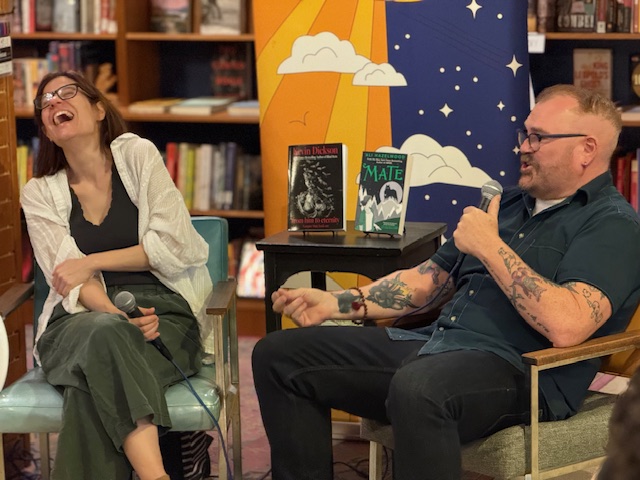
Image Credits
All photos by my husband George Castro.