

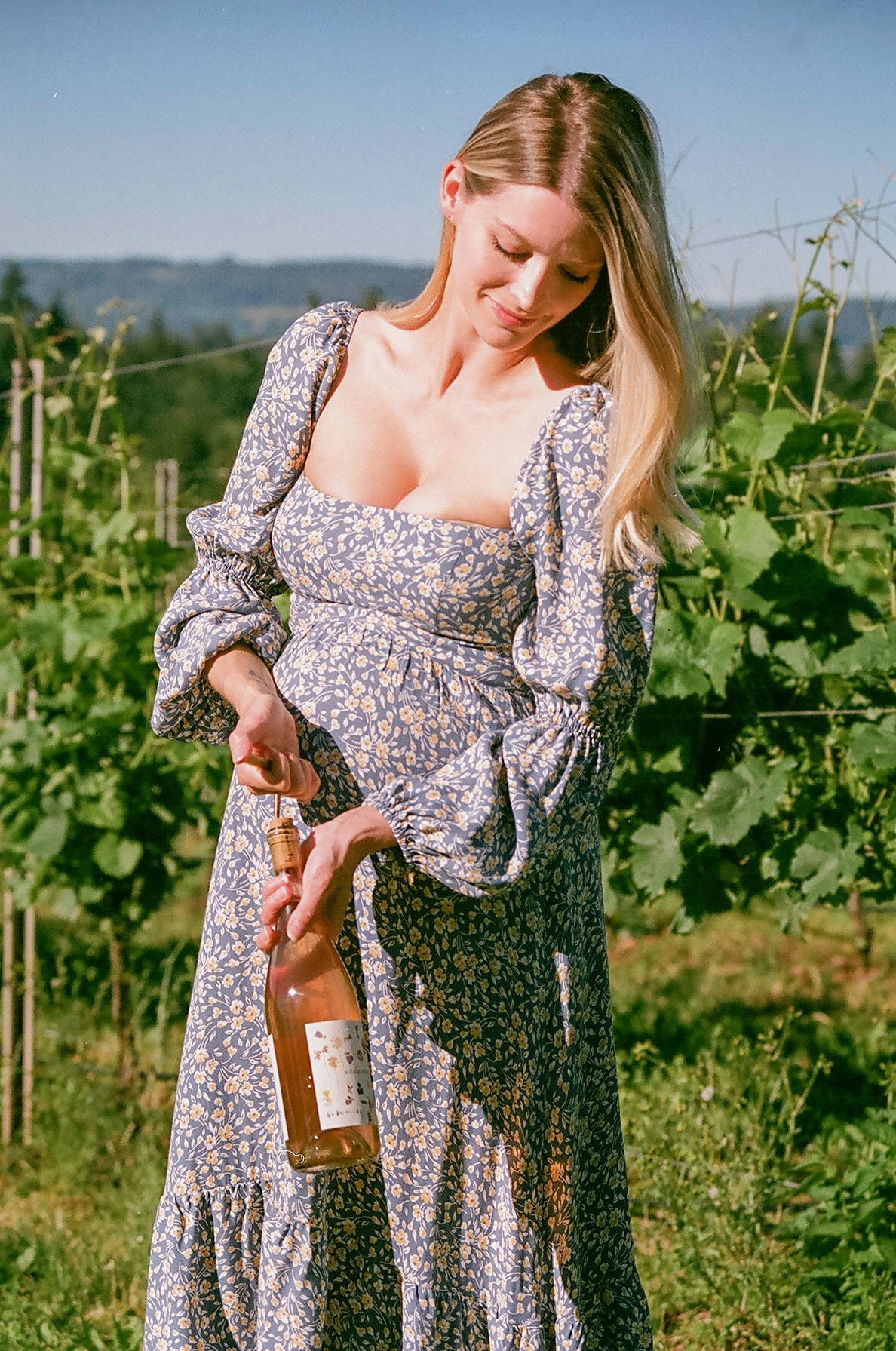

We’re excited to introduce you to the always interesting and insightful Kayla Borgen. We hope you’ll enjoy our conversation with Kayla below.
Kayla , appreciate you joining us today. Coming up with the idea is so exciting, but then comes the hard part – executing. Too often the media ignores the execution part and goes from idea to success, skipping over the nitty, gritty details of executing in the early days. We think that’s a disservice both to the entrepreneurs who built something amazing as well as the public who isn’t getting a realistic picture of what it takes to succeed. So, we’d really appreciate if you could open up about your execution story – how did you go from idea to execution?
It’s hard to believe that when I first met my husband I was drinking Barefoot wine (no judgement to those who still enjoy it!) Robert, my husband, had studied wine at UC Davis before going on to to make wine in California and New Zealand only to find himself back in his home state of Michigan making hard cider at the same cidery where I would begin working as a graphic designer and brand manager. We fell for each other almost instantly over a mutual love for working on projects together with Lana Del Rey playing in the background. We soon found that while we loved creating products together, him making the beverage and my designing the packaging and promoting it, the work environment was toxic and not a place we saw ourselves in long-term and we started to consider Oregon.
Apparently the universe agreed because when we were on the fence about what our next move would be — Robert had always had a fascination with Oregon wines and I had never truly left Michigan — an offer came through on our house and the buyer wanted us to include ALL of our furniture and decor thus making the decision to drive across country a lot more manageable. So we packed our dogs into the truck and drove to Portland with just a small U-Haul filled with Robert’s books and my small collection of antique mirrors.
7 years, 3 homes and a lot of learning, both about wine and each other, later we found ourselves in Salem, Oregon, right in the middle of the Eola-Amity wine region. Our home is an 1870’s farmhouse with one of the original farmstands of the area where, once upon a time, families would come and pick peaches and exchange niceties with Mrs. Lindbeck, who I’ve heard had two sides; her sweet customer service side and her tough, entrepreneurial side. Mr. and Mrs. Lindbeck raised a family and a business in this home and when we stumbled across it, though a little dilapidated, we felt that passion instantly and knew we wanted to revitalize the homestead and honor their legacy.
Botaneity was a concept from way back in Michigan, but with no clear roadmap on how to reach it, so it just sat buried in the soil of our minds without much sunlight or water until we moved to Salem. While the peach orchards that once surrounded our home have since been developed into housing (prior to our acquisition) we started to brainstorm how we could launch a wine brand and, perhaps more importantly, how we could make this new homestead work for us.
Many would say that hard work is the secret to success and while I do not disagree — we have certainly put in our long days — I would argue that persistence and luck play just as large of a role. Robert was able to get a job as a winemaker for Stangeland vineyards where the owner was kind enough to allow us to use his space to start our label. with even more luck we would meet a vineyard owner willing to trade half of his grapes in exchange for Robert’s expertise, those grapes would become our very first vintage.
I have to interrupt all of this blissful happenstance with some reality: winemaking is not glamorous. I joke that Hallie and Annie’s dad in The Parent Trap gave us unrealistic expectation of what it was like to run a wine brand, at least for small, grassroots brands like ours. With that said, we had to ensure that we had multiple streams of revenue in order to build this dream of ours. The cost of labels, bottles, marketing, and not to mention our mortgage and other bills, meant that we couldn’t rely just on our small batch wine to support us.
The first projects we tackled when we bought the home were to revamp the basement level into an Airbnb and revitalize the old farmstand to offer goods from our garden and local artisans. Those projects along with our “day jobs” — Robert working for Stangeland and my freelance graphic design work — allow us to propel Botaneity, no matter how slow it may seem some days.
People think we’re crazy and, to add to their sentiment, we have a baby on the way! But when it gets challenging, and it can get really challenging at times, we always look at each other and remind each other how thankful we are to be artists chasing their dreams and doing it together.


Great, appreciate you sharing that with us. Before we ask you to share more of your insights, can you take a moment to introduce yourself and how you got to where you are today to our readers
Botaneity is the idea that slow living and great wine can bring a community together.
We believe wine is meant to be shared with friends over bread & effervescent conversation. Thoughtfully made with minimalist methods and an emphasis on sustainable farming, our wines are a love letter to Mother Earth & those friends who gather around our table.
Great wine begins in the vineyard. With a focus on sustainable farming, our grapes are sourced from thoughtfully-farmed vineyards in the Willamette Valley. We allow the character of our wine to shine through with minimalist intervention in the cellar to create natural wines that are equally as approachable as they are elegant and elevated.
Our goal is to highlight the beauty of the everyday, of the seemingly mundane. Dinner on the back porch can be a celebration when you invite your neighbors and share a bottle of wine. Your morning can be magical when the sun shines through the window just right while you fry up some eggs from the backyard. The small moments in life are all interconnected and contribute to the greater journey that is happiness.
Our first vintage, ‘Ménagerie’, a Rosé of organically-grown Pinot Noir from the Dundee Hills of Oregon, is available online at botaneity.com and at select, thoughtfully-curated bottle shops and restaurants throughout Oregon.
We are 1% for the Planet® certified, meaning we are part of a global network of businesses, individuals and nonprofit organizations tackling our planet’s most pressing environmental issues.


How’d you build such a strong reputation within your market?
To be completely transparent, Botaneity is still in its infancy and we are actively working every day to grow our reputation and following. With that said, this is actually my third business. My first business, The Crimson fox, was created when I decided to leave my 9-5 graphic design job and begin designing on a freelance basis. My second business, Detroit’s Future Is Female, was created shortly after when I recognized a need to empower other aspiring female entrepreneurs. I built both of these brand up back home in Michigan. Once we moved to Oregon, I found it challenging to run a Michigan-focused brand from a distance and, after a couple years of trudging through during the pandemic, I decided to sell Detroit’s Future Is Female. I have continued to run The Crimson Fox, my freelance design business, which has been a primary source of revenue for our household.
All this to say that I believe building a brand and reputation requires two things: genuine passion and persistence. If you are not passionate about what you are doing, you will lose the will power, on the hardest days, to push through. The passion is the anecdote to all the road bumps ahead, and there are a lot of them! You need to persist, despite all the setbacks, and eventually you will be rewarded.
We’d love to hear the story of how you turned a side-hustle into a something much bigger.
I truly believe in starting slow. When I started my first business, The Crimson Fox, I dropped from a full time job down to part-time job while building my freelance design clientele. I worked from home and never rented an office in order to keep my overhead low. Now that my design business is thriving, I have been able to leverage that to help supplement the cost of starting Botaneity, our wine brand. If you don’t have investment capital and need to fund your dreams on your own, you have to be creative and patient.
Contact Info:
- Website: www.botaneity.com
- Instagram: @botaneityfarm
- Facebook: @botaneityfarm
Image Credits
Emily Krouse