

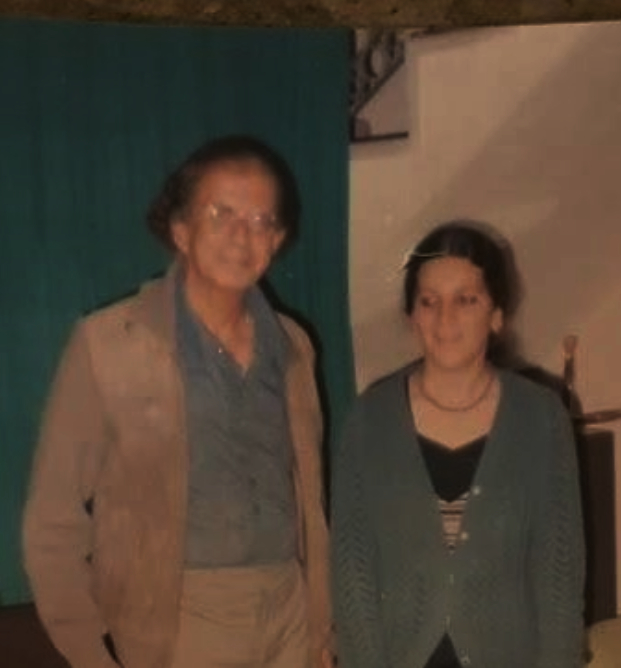

We’re excited to introduce you to the always interesting and insightful Kavita Ezekiel Mendonca. We hope you’ll enjoy our conversation with Kavita below.
Kavita, thanks for joining us, excited to have you contributing your stories and insights. Looking back on your career, have you ever worked with a great leader or boss? We’d love to hear about the experience and what you think made them such a great leader.
My first boss was an amazing guide, friend and mentor — deeply engaged in the welfare of her team of English lecturers at a College in Bombay. She was kind, but clear about goals and directives. She had the human touch and one could go to her with any problem, classroom issues, as well as personal problems. She taught me what it was to be a real leader. It set the tone for my career in teaching.
At 22, I was the youngest of a 14-member team. She made me feel respected, included and welcomed and I always went away reassured that I had something valuable to offer to students. The entire staff at that college created an atmosphere of respect and inclusiveness. There were no big egos there, even though most of them held PhDs, and one was a renowned Poet.
As always, we appreciate you sharing your insights and we’ve got a few more questions for you, but before we get to all of that can you take a minute to introduce yourself and give our readers some of your back background and context?
I was born and raised in a Bene Israel Indian Jewish family in Bombay. Here in Canada, people are completely surprised that there are Jewish people with their origins and roots in India. According to legend, there was a shipwreck off the Konkan coast of India. The passengers of the ship were said to have been fleeing some sort of persecution. Seven couples are said to have survived the shipwreck. The villagers thought they were dead and placed them on the funeral pyre, when they discovered they were still alive. The strangers were light skinned and curly haired and remembered three things: The Shema, which is the prayer of the Jewish people (I still recite each day), the Sabbath, and eating Kosher food. They were known as the Shanivar Telis or the Saturday oil pressers, since they did not work on Saturdays. I have written poems in which I record the origins of my ancestors in verse. They arrived in India over two thousand years ago.
My name Kavita means poem in Hindi, which is an Indian language. My father Nissim Ezekiel gave me this name since he was a poet. It is quite unusual for a girl from a Jewish family to have this kind of name. It was meant to be symbolic, and I like to think also somewhat prophetic. I was steeped in poetry from childhood. Poetry was front and center of my father’s life and I was surrounded by it. I began writing poetry from an early age and like most children, my poems were in rhyme.
I graduated from Queen Mary school, obtained a bachelor’s degree in English and French literature from St Xavier’s college and a master’s degree in English and American literature from the University of Bombay. Later during a sabbatical year from the international school at which I was teaching, I obtained a master’s degree in education from Oxford Brookes University in Oxford, England.
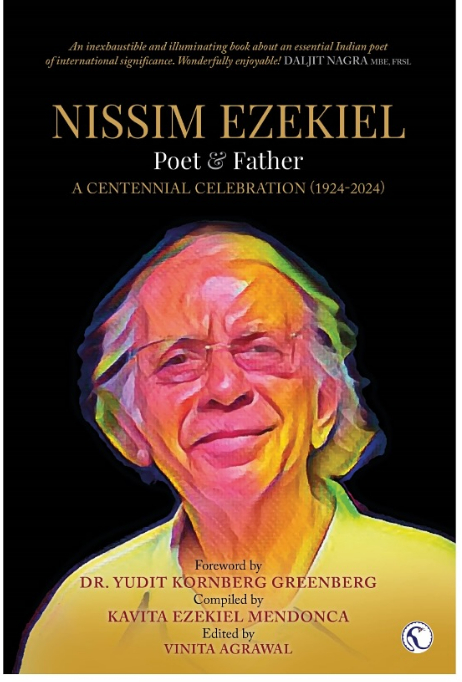
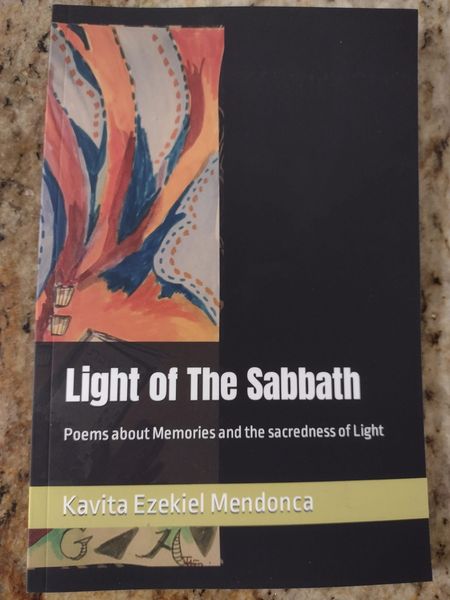
I have dedicated over four decades to teaching High School English Literature and Language, both in Indian colleges in Bombay and an international school in Mussoorie, India. Coming from a family of educators, my passion for teaching was deeply influenced by my grandparents and parents, who instilled in me the importance of education and mentorship. This background strongly inspired my love of the profession. My grandfather was the principal of a college and taught Botany and Zoology there. My grandmother founded and ran her own school for disadvantaged children in an impoverished area of Bombay. She was a role model for me when I was a young girl. I watched her teach and interact with the teachers and students with love and care that went far beyond the classroom. My father was the Vice Principal of a college and later Professor of English and American Literature at the University of Bombay, now Mumbai, and my mother was a teacher in a private school in Bombay. Both my parents were wonderful teachers and laid the foundation of my dedication to the profession. At the International school located in the mountain town of Mussoorie in the North of India, the courses I found most fulfilling to teach to teach were Creative Writing, Poetry, and an elective course on Twentieth Century Literature. I published my debut collection of poems “Family Sunday and other Poems” in 1989. With two young children and a full-time teaching load, I found myself with little or no time to do any serious writing of my own. After I retired, I was able to dedicate more time to writing and published a book of poems titled “Light of The Sabbath” and compiled a Centennial Volume titled “Nissim Ezekiel Poet & Father” in honor of the birth centenary of my father who was an internationally renowned poet, fondly remembered as the Father of Modern Indian Poetry in English.
In addition to teaching English, after my return from a sabbatical year at the Oxford Brookes University in England, I served as the Career Counsellor for High school students, guiding students on their future career paths. This is a role I found to be most rewarding. Students inevitably brought personal issues into my office while discussing career paths, and for me to be able to provide a safe space to listen with empathy has been a privilege. To know that students have confidence in you, in sharing intimate details of their lives, is a special feeling. I have also taught French and Spanish in private schools in Canada. Here I discovered a love for teaching languages and the culture of the countries where these languages are spoken. The classroom has always been my home and my relationship with my students is my biggest priority, much more than the material to be delivered. My continued conversations with my students on social media are an indicator of my personal involvement inside and outside of the classroom. To know that I had a part in shaping young lives is something I hold dear.
To summarize, I was able to carry my love of poetry and literature into the classroom with passion and instill that passion into my students. These two subjects translate into Life lessons beyond the pages of the books which they studied. Later, when my situation allowed, I was able to once again write and express my thoughts and experiences in verse and non-fiction.
What do you find most rewarding about being a creative?
The most important aspect of being a poet and a writer for me is the desire to share my story, the story of the many and varied phases of my life that is, with readers. I believe every individual has a story to tell and must tell it at some point in their lives. When readers enjoy my poems and can visualize themselves in the places I’ve lived in, the homes I’ve grown up in, the emotions and inner struggles and joys associated with my experiences, the Indian Jewish culture and customs, the Indian and Canadian culture I describe in the poems, then I feel a sense of fulfillment. I don’t write with the reader in mind. I write impelled by the need to express the momentous events, those which change you at an elemental level and experiences of my life, those which impact you at a very deep level, the things that shape my world view. My poems are written mainly to preserve family history and legacy. They are about everything I see around me, the sounds I hear, the smells I ‘inhale’ the things that have profoundly touched my heart, soul and mind, the ideas that have influenced me. They are dedicated to the city of Bombay where I was born and raised. Other themes in my poetry include childhood, love, loss, Nature, my Bene Israel Indian Jewish identity, and my Indo-Canadian identity as well, and of course my memories of the mountain town in Mussoorie, nestled in the foothills of the Himalayas, where I spent sixteen years of my life. Another reason for writing is my love of words, inherited from an early age through my father who was a poet. When I don’t write I become restless. I am a slow writer and have to do a lot of ‘brooding’ before I write. My mind is always active, and when I don’t or can’t write, I read.
Is there mission driving your creative journey?
By common consensus my father, the late poet, playwright, art critic and mentor, Professor Nissim Ezekiel was fondly known as the Father of Modern Indian Writing in English, specifically in the area of Poetry. In honor of his birth centenary in 2024, I compiled a Centennial volume which was published in October 2024. The book was edited by the well-known Indian poet Vinita Agrawal and published by Pippa Rann Books & Media UK. It is a memoir anthology with tributes from fellow poets he mentored and some of my students who met him when he visited the International school where I was teaching. He was invited to speak at the High School assembly and also address students in my Advanced Placement English class. The Centennial Memoir celebrates my close bond with my father and also has a section with around thirty poems dedicated to him. I worked on the book for over three years and that consumed most of my time. Preserving my father’s legacy is my mission in life, and an important driving force for my own work as well. Sometimes, I respond to prompts if they speak to me in terms of something that touches or moves me. I love writing poems about my Bene Israel Jewish identity and the city of Bombay where I was born and raised. Most of all, I love to write as much as I loved to teach. If one loves what one does and has a passion for it, the writing is honest and sincere and without any pretensions. My love of words was an integral part of my childhood as my father recited poetry in our home with great gusto and enthusiasm. He wrote poetry, sang poetry (like Joyce Kilmer’s poem ‘Trees’) and celebrated all things poetic. Our small home was full of books and magazines, even the clothes cupboards were full of books which invited the silver fish to thrive in the warm humid Bombay air!
Contact Info:
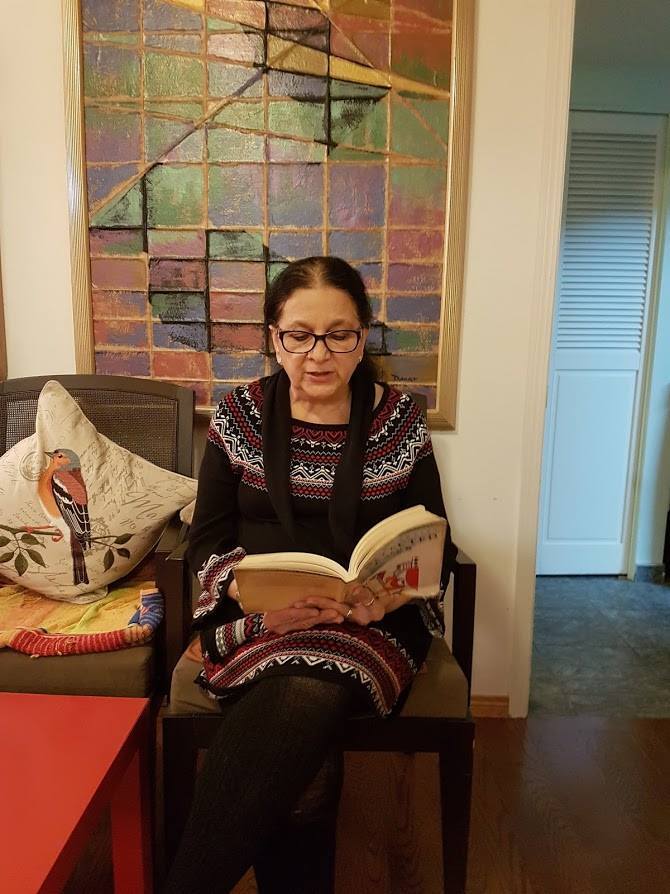
Image Credits
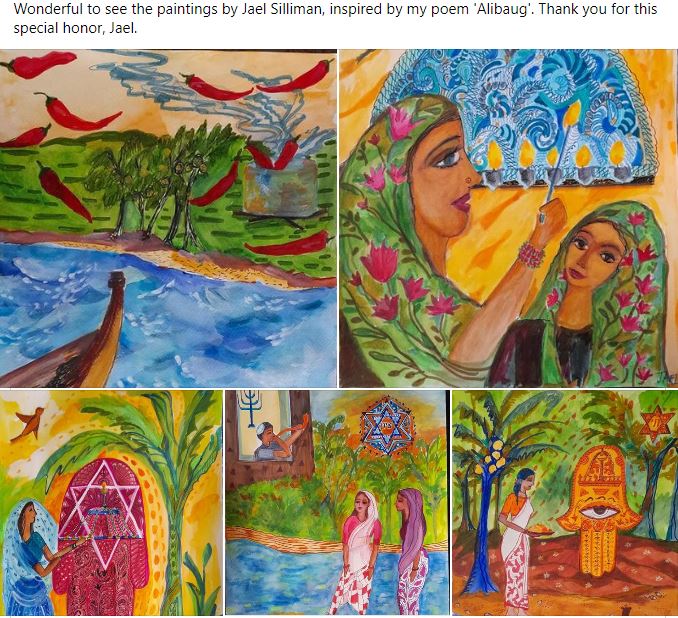
Kavita Ezekiel Mendonca The collage of illustrations is painted by Jewish artist Jael Silliman. They are based on my poem ‘Alibaug’ the village close to where the Bene Israel Indian Jews first arrived and settled. My uncle owned a grain mill there and I spent many happy days of my childhood with his family.