

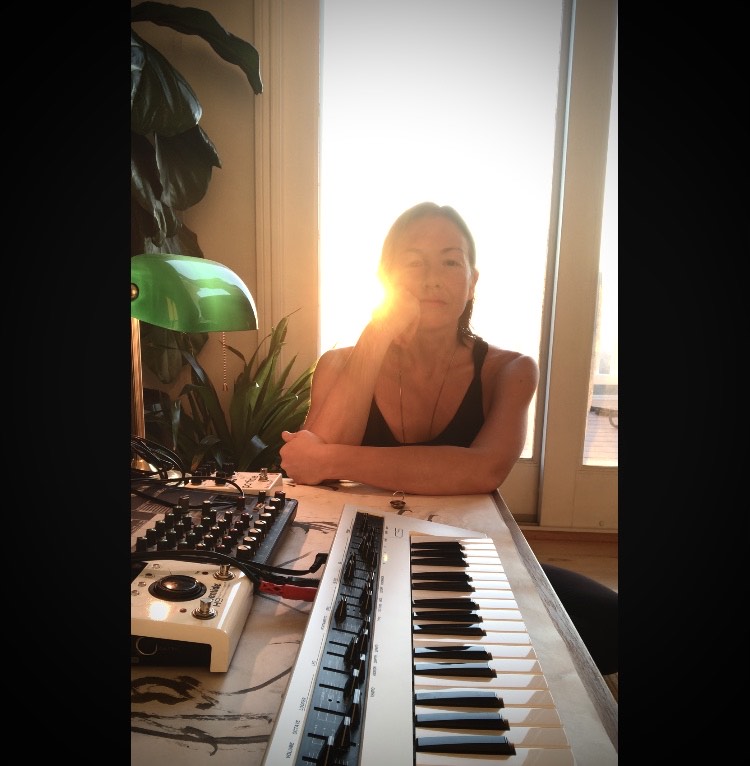

We’re excited to introduce you to the always interesting and insightful Kaitlin McSweeney. We hope you’ll enjoy our conversation with Kaitlin below.
Kaitlin, thanks for joining us, excited to have you contributing your stories and insights. Did you always know you wanted to pursue a creative or artistic career? When did you first know?
I started drawing at a very young age, 2 or 3, and was obsessive about it, though I’ve been multimedia oriented my whole life, figuring out and attempting to create with whatever materials or tools or instruments I could get my hands on. I was later to making music because I lacked belief in my ability to do it: I was bullied heavily growing up and didn’t summon the courage to try singing until 7th grade. The choir teacher at my school pulled me aside one day and asked, “Why are you trying to sing? Isn’t there something else you might be better at?”. That moment stuck with me both because of how hurtful it was, but also because I remember not knowing how to answer her question other than “I have to sing”.
I think this was the moment I knew I not only wanted to be an artist, but that I was one. Art, and I include music as an art here, is what I do best, it’s what I have to offer. Of course “art” is a hugely difficult to define word; I’m always redefining what it means to me. The desire to be “professional” did not come about until much later, not until my 30s really. And it comes more out of a feeling of necessity than desire. Being paid and known for my work allows me to do more of my work and less working for others.
In my 20s I was just wildly making things and performing and touring, like my life depended on being as productive as possible; getting every idea out. There was also a dose of feeling the need to prove that I was an artist, which came from the hurt I still carried from people discouraging me and bullying me when I was younger. It was if I was in a constant battle, never letting my guard down and never allowing myself to feel good enough, which uprooted me from the whole reason I did art in the first place; as a way of connecting with and exploring what it was to be alive, and the joy of doing so.
I think there was also a fear in the background that if I became professional I would lose creative freedom. Perhaps this is true for some, though I have met and see so many people who have become professional artists without sacrificing their integrity. So it is possible, though what you keep in integrity you perhaps sacrifice in creature comforts and spare time.
And though I didn’t feel it essential to who I am, becoming a professional artist has required me to face and work with my inner chaos so that I can be more consistent, resilient and conscious of what I am doing. I must be organized enough to meet deadlines and communicate well while still making time for practice, solitude and rest. I must take care of myself physically, emotionally and mentally and maintain mutually respectful and supportive relationships with others, for the more I engage with the world in a professional way the more I need and lean on my closest connections. It is more than getting paid to do your art, for me it’s a whole lifestyle transformation.
In these ways becoming professional has pushed my growth as an artist and as person forward, or open rather, in many directions. I’ve become reconnected to the practice of creating from a place of authenticity and taking joy in the process. Perhaps this is the answer that I didn’t have for my teacher: “I need to sing so I grow.”


As always, we appreciate you sharing your insights and we’ve got a few more questions for you, but before we get to all of that can you take a minute to introduce yourself and give our readers some of your back background and context?
I’m a visual artist, musician and writer. I also work in the healing modalities that have helped me along my own creative path (yoga, meditation, astrology, tarot).
I am not a brand, and I say this with no disrespect to those who have branded themselves and their services. I realize there is great value in developing a brand, yet this isn’t the right way for me.
What I create isn’t a product for me, it is me: moments of my time here. So I consider working with another, whether collaborating or teaching or offering my skills, a relationship, and apply the same ways of being as I do to all relationships: Appropriate boundaries, clear communication, respect for each others’ time and energy, presence and listening, and a commitment to solution based thinking.
Most of the work I’m most proud of is collaborative, and I deeply value working together with my clients or creative partners rather than for them or them working for me. I believe there is more potential in treating each other as equals than trying to win over each other. Creating possibilities by pooling our diverse knowledge often allows something greater than either of us could imagine alone to emerge.
I am most interested in working with those who have different skills and perspectives than me on projects that push the expectations of the medium or modality. I’ve collaborated with animators, dancers, programmers, developers, biologists, poets, classical musicians, filmmakers and visual artists.
Currently my focus is on my electronic collaboration with Kevin Balcora, called Wisdomfacade, my solo compositions including scoring soundtracks for short films and animations, and reconnecting with my ancestry by studying Javanese Gamelan music and dance.
Wisdomfacade started in 2018 as a playful experiment. At the time Kevin and I were dating and had connected out of a mutual love of experimental electronic music. We started jamming together and these jams became the tracks of our first album, Conclusions From Youth. We broke up in 2022 and everything was up in the air, but by early 2023 we decided to continue playing music together as friends. We’re currently working on our set-up, writing new material and preparing to play live again. We have a tentative show in LA for Lunar New Year 2024.
As for my solo work, I scored a short experimental film by animator Guido Devadder in 2022. “Hungry Ghost” has been touring the international film festival circuit since 2022 and has won multiple awards, including ‘Best Experimental’ and ‘Best Soundtrack’. The experience has sparked my desire to do more work scoring films, which I hope to pursue in 2024.
I also was a performer this past summer in Noisepop’s Summer of Music Festival, which featured musicians every Saturday performing in various parts of San Francisco. I took the festival as an opportunity to experiment with my own songwriting process, treating each performance as a studio session. I was interested in how the songwriting process would show up differently when in public as opposed to being in solitude. During one of these performances I met Danny Bozella of Mothership Studios and was invited to record using the same spontaneous songwriting approach. Danny is also a musician and the resulting tracks, soon to be released, are truly a collaboration between us, with me providing the material and Danny contributing to the texture of spirit of the sound. I plan to continue developing the material from this summer, eventually distilling it into a solo album.
This fall I began studying Indonesian Gamelan and Balinese dance. My grandmother was born in Java. She was part Indonesian and part Dutch, and loved music like I do. When she was 11, she and her family were placed in concentration camps. She was in the camps until the age of 16. The terrible experiences there never left her, though she remained creative and supportive of my creativity. I was her caretaker during her last years, and she often spoke of gamelan. I’ve been hesitant to explore it out of the feeling that I’d be an imposter, but decided to try this year. Gamelan Sekar Jaya and Gamelan Sari Raras have been so warm and welcoming that my fears have been replaced with a love for the complexity and beauty of the music and dance. I hope to travel with Gamelan Sari Raras to Indonesia in 2024.


Let’s talk about resilience next – do you have a story you can share with us?
In high school I was completely immersed in music, singing with the choir, and it gave me incredible joy. As graduation time came, I prepared to apply as a voice major to college but was confronted by immense fear and inadequacy.
My math grades weren’t good enough for me to go straight to a 4-year so I attended community college abandoned my dream of studying music, thinking English would be a more practical major. Though I won’t blame anyone for this choice, many of the voices that led to this decision were not my own: “You won’t survive as an artist!” and “do you know how hard it is to make a living doing that?” and the like. At the time I didn’t have the presence of mind or the confidence to stop and consider the people who said these things: none of them were artists who had earnestly prioritized their art, and most of them weren’t artists at all.
I remember driving to the community college one day listening to Jessye Norman singing Strauss and feeling a great dread like I was making a terrible mistake, but in my fear I shoved the feeling away. I got into the habit of shoving many feelings away in order to stick with my plan.
By the time I transferred to U.C. Berkeley, I was full of suppressed feelings, fears and resentment. The pressure of the workload and the intensely social lifestyle, along with deeper issues I wasn’t even aware of yet, caused me to breakdown. I developed a severe eating disorder that became life-threatening. One of my friends had the courage and persistence to wake me up to the danger of my behavior, and I started my recovery.
One of the first things I came back to was art: drawing. Then when I was physically strong enough I began singing again. I was shocked at the resilience of not only my creativity but my body. At 22 I feared I’d destroyed my ability to sing, and yet there it was willing to come back. At that time I vowed to never devalue or abandon my creativity again, no matter what others said or what fears I’d be faced with. It was no longer up for question, it was a matter of survival.
In order to do this, I had to build on my natural resilience and tolerance. I couldn’t just dive into art and music- I needed to connect with and understand what drove my self-destructive patterns, what hid behind my fears, and what tools I could use that would truly support healing and not just distract from pain.
Though I stopped the eating disorder behaviors in 2006, I spent the next decade gradually unraveling my tangles, replacing cigarettes with yoga, alcohol with water, partying with practice.
In 2016, my friend and ex-partner Ben Runnels was one of those taken in the Ghostship fire tragedy that happened in Oakland, California. The pain and shock of it ran through many in the bay area arts community and beyond. Part of why he and I had broken up was he wanted to pursue his project Introflirt completely, and this was something I didn’t understand and even resented.
Though what happened to him is incomprehensible to me, looking back I am glad that he chose his art over our relationship. I understand now that it was the choice he had to make for himself. I often think of him as I move forward, and draw inspiration from how dedicated he was to being true to himself.
There are times when I feel like giving up, or I feel especially hurt by criticism or rejection or feeling like I’m putting my work into a void. Then I think of Ben and how he felt those things too and persisted because he loved it. We don’t know how much time we have left, how can we not spend it doing what we love?
It has been intensely hard work, but I am so incredibly thankful to be here and to be able to love myself and feel the joy of simply creating again. It has been worth every step.
It is difficult to make a living as an artist, but as I learned the hard way, not as difficult as abandoning what gives you joy.


Do you think there is something that non-creatives might struggle to understand about your journey as a creative? Maybe you can shed some light?
I don’t believe in non-creatives: I believe everyone is creative, but many are afraid to not be good at something, or to be embarrassed or humiliated. I don’t blame them, but something people may not know about artists is many of us are always walking the edge of what we know and what we do well in order to develop our work and skills. We are almost always in an exposed state- whether towards others or to ourselves. At the heart of why many of us create is a radical curiosity and desire to explore, a state many of us have had to reclaim and must choose to connect with again and again through life’s challenges.
Pain is really a voice asking for change, and seeing it this way has helped me work with all sorts of pain; physical, emotional, relational… At the heart of feeling “not being good at something” or feeling embarrassed is feeling hurt; pain. Many, if not all, creatives have had to embrace their pain.
We often hear of people turning to art after a devastating experience or losing their way. I believe a big part of this is because they were forced into listening to and developing a relationship with their pain, and in doing so found the key to their joy. When we connect with what truly brings us joy, we care less about what others think. Fears drop away and a desire to share emerges.


Contact Info:
- Website: https://www.kaitlinmcsweeney.com/
- Instagram: https://instagram.com/captainmcsweeney?igshid=MzRlODBiNWFlZA==
- Other: I’m on Threads as @captainmcsweeney
Image Credits
All other photos taken by me.