

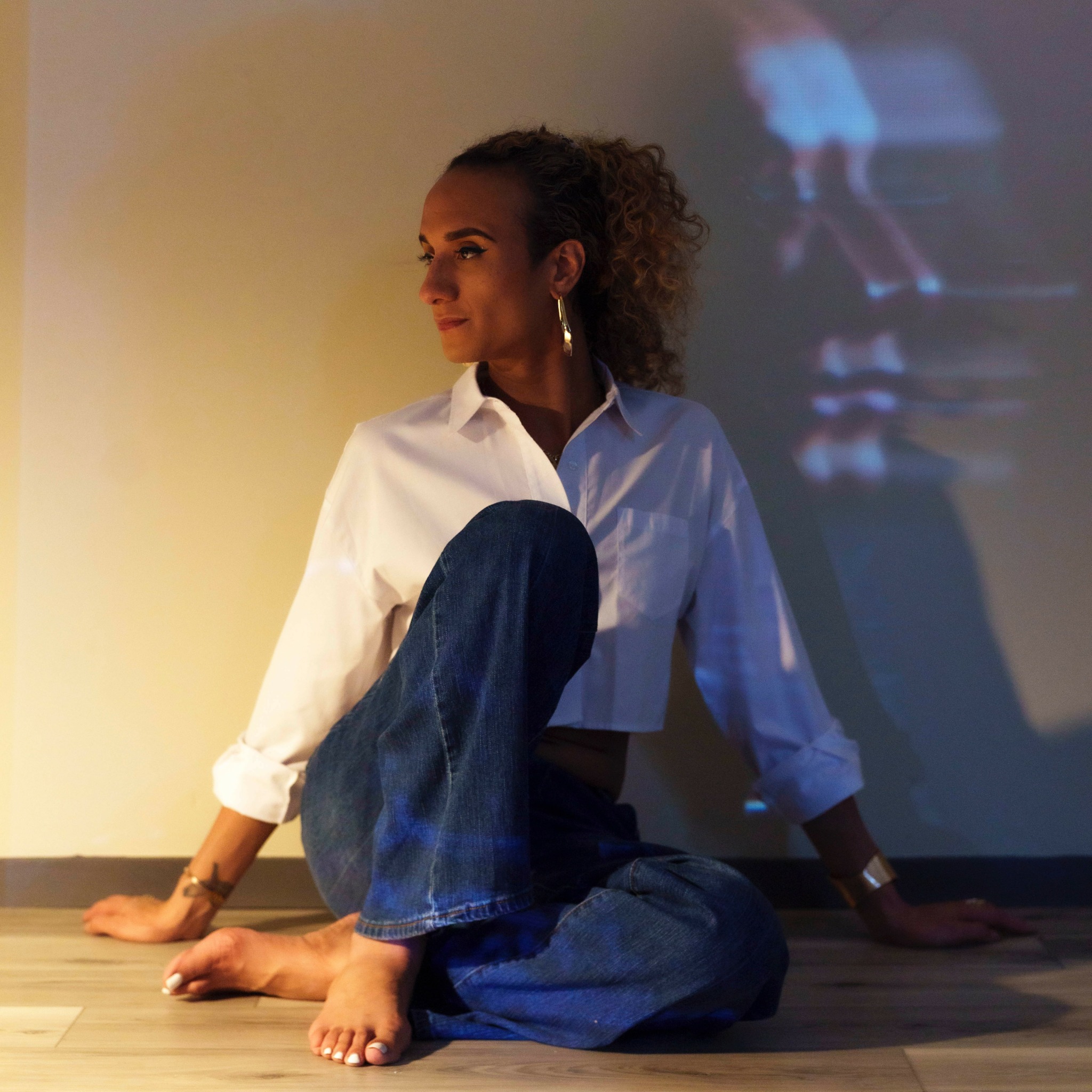

We’re excited to introduce you to the always interesting and insightful Justy Marcoviche-Garnett. We hope you’ll enjoy our conversation with Justy below.
Justy, thanks for joining us, excited to have you contributing your stories and insights. What’s been the most meaningful project you’ve worked on?
My new studio album LOVECHILD is absolutely my most meaningful project to date. It’s not just a record to me — it’s a restoration project, a spiritual excavation, and the culmination of a story I inherited long before I was born. My parents met in the late ’80s at The Warehouse, the birthplace of Chicago House Music, and their love story was as explosive as it was short. They both passed away by the time I was three, both victims of the HIV/AIDS epidemic, so I grew up holding fragments of who they were, mostly through music.
When I started working on LOVECHILD, I didn’t realize how much of my own history I was stepping into. I found an unreleased demo my father recorded in 1989 and ended up finishing it with him, decades after his passing. That collaboration became ‘ROOM FOR TWO’. I wrote songs from the perspective of my mother, imagined conversations they never got to have, and allowed myself to grieve and celebrate them at the same time. The process took five years — not only because it was complicated musically, but because it asked for so much honesty from me.
What makes LOVECHILD meaningful isn’t just the art itself — it’s what the project allowed me to do. It moved me to reconnect with my ancestry while also releasing a lot of weight I’d been carrying since childhood. It also revealed to me the power of collaboration and how building trust with other artists can take your craft to another level. By the time the album was done, I felt closer to my parents, but I also felt free in a way I never had before. I was able to say “goodbye” in my own language. LOVECHILD is the project that helped me step into my identity, my artistry, and my power as a storyteller.


Awesome – so before we get into the rest of our questions, can you briefly introduce yourself to our readers.
For folks who might be meeting me for the first time, I’m a queer, Trinidadian-American singer, songwriter, producer, and event curator based in Chicago. My work sits at the intersection of storytelling, community building, and world creation. My path into the industry started very early. I grew up classically trained on seven instruments, but over the years I discovered that my purpose wasn’t just to make art — it was to build the infrastructure around art. I’ve always existed in both worlds: the artist and the organizer.
Beyond my creative work, I’ve spent years in live entertainment, including leading the Blue Man Group Chicago team under the Cirque du Soleil umbrella — an experience that shaped my approach to production, community, and large-scale artistic collaboration.
I’m also the Founder and CEO of HBX Productions, a company designed to support independent artists and community-centered events. HBX focuses on the things emerging creatives often struggle to access: production support, event curation, project management, strategy, and a reliable creative ecosystem. The goal is simple — no artist should feel unsupported or alone in the process of bringing their work to life.
Alongside HBX, I serve as the Director of Performing Arts at Hairpin Arts Center, where I help shape programming that uplifts Chicago artists through performances, workshops, and community-driven events. What sets me apart is that my work — whether musical, organizational, or collaborative — is all rooted in legacy, accessibility, and creating spaces where artists can thrive.
If there’s one thing I want people to know about me and my brand, it’s that everything I create is done with community in mind. Whether it’s an album, a film, or an event through HBX, my mission is to build a creative home that inspires wonder and curiosity and empowers artists to tell their stories fully and fearlessly.


Can you tell us about a time you’ve had to pivot?
I’ve had to pivot more times than I can count — in art, in work, and in life. My path has never been a straight line, and honestly, I don’t think most artists’ paths ever are. I’ve taken so many detours to get to this moment, and I’ve tried to treat every one of them as preparation, even when the work had nothing to do with entertainment on the surface. Every job, every role, every season sharpened me creatively in ways I didn’t expect.
My years in event management were the biggest pivot, and one of the most transformative. I never planned on becoming an operations lead or managing large teams, but that chapter ended up teaching me how to build experiences, communicate clearly, problem-solve under pressure, and nurture community — skills that eventually became the blueprint for HBX Productions. That’s when I realized I didn’t have to keep my worlds separate. I could bridge them. I could build an ecosystem where my love for music, storytelling, production, and people could support each other instead of competing for space.
But I also think it’s important to say the quiet part out loud: artists are often forced to pivot because our society isn’t designed for creative people to thrive. We’re expected to work twice as hard for a quarter of the stability. Many of us take on extra jobs, side careers, and entire second identities just to keep our art alive. It’s exhausting. It can lead to burnout. And I’ve experienced that more than once.
What I’ve learned, though, is that a pivot doesn’t mean you’ve failed. It doesn’t mean you’re off track. Sometimes it’s the thing that keeps your dream alive long enough for you to return to it. What matters is finding your way back to your craft — even if it’s through the side door, even if it takes years, even if the path looks nothing like you expected. Every pivot I’ve taken led me to LOVECHILD, to HBX, and to the community I’m building now. And I’m grateful for all of it.


Is there something you think non-creatives will struggle to understand about your journey as a creative? Maybe you can provide some insight – you never know who might benefit from the enlightenment.
I think one of the biggest things non-creatives struggle to understand is why artists are willing to sacrifice comfort, stability, and predictability for something that looks, from the outside, like chaos. People will often say, “Why don’t you just take the secure job?” as if the choice is that simple. What many don’t realize is that sometimes those “secure” opportunities feel like a slow death to a creative spirit. They may offer financial safety, but they disconnect us from the thing that keeps us emotionally, spiritually, and mentally alive.
For artists, investing in ourselves isn’t indulgent — it’s survival. Following creative instincts isn’t irresponsible — it’s alignment. And choosing work that honors our internal world isn’t avoidance — it’s preservation. Some artists can compartmentalize and work roles that don’t feed them creatively, and others simply can’t. Neither path is wrong. But both require understanding and compassion, not judgment.
What I wish more people understood is that society depends on art far more than it realizes. We turn to music, film, literature, and performance to heal, to escape, to celebrate, to grieve, to feel connected. Art raises our children, holds our memories, teaches our histories, and shapes our futures. So if we rely on art to keep us alive, why don’t we nurture the artists who make that possible? We are essential workers and should be treated as such.
Supporting a creative’s journey isn’t just supporting an individual dream — it’s supporting the emotional and cultural health of the entire community. We don’t need artists to “do it all.” We need them to do what they do best: create.
Contact Info:
- Website: https://www.soundsofjusty.com
- Instagram: https://www.instagram.com/justyontop
- Facebook: https://www.facebook.com/soundsofjusty
- Linkedin: https://www.linkedin.com/in/voiceofjmg/
- Youtube: https://www.youtube.com/@soundsofjusty


Image Credits
Mac MacDonald, Tatiana Ivanova, and Marcey Abramovitz