



Alright – so today we’ve got the honor of introducing you to Josh Miller. We think you’ll enjoy our conversation, we’ve shared it below.
Josh, appreciate you joining us today. How did you get your first job in the field that you practice in today?
Honestly, it was hard for me to find work in the mental health field. I had pigeon-holed myself with bible college degrees, and there weren’t many professional organizations willing to take a risk on me. Looking back, I totally get it. My education had been basic at best, with a majority of my time focused on theology and other bible related courses. Which was a real bummer since I didn’t even want to go into ministry.
I’m sure you’re wondering why I would go to a bible college with no intent to go into ministry, and that is a very valid question. Unfortunately, it’s an entirely different story for an entirely different time. But since that context is important to this one, I’ll just say that I felt pressured to go.
When I graduated, I was a mess. I had no idea what I wanted to do or even what I could do, so I took a job waiting tables while I scouted out better opportunities. It was pretty disheartening. I knew I didn’t want to work at a church or any other type of faith-based organization, so that severely limited my options. Most applications garnered quick replies along the lines of, “Your education doesn’t meet the necessary qualifications.” I was technically a Qualified Mental Healthcare Provider (QMHP), but there really wasn’t another professional way of saying they didn’t like my Christian Counseling degree. Again, I feel compelled to mention that they were absolutely not wrong in their judgements.
After about a year of searching, I applied on a whim to a community mental health crisis service someone recommended. My qualifications met the requirements, and I had an interview. Then I had another interview. They asked for my transcript. And then there was a third interview. It was clear they didn’t know what to make of my background, so I knew I had to sell it.
In my fourth and final interview, I was honest but firm. I told them I knew I could do the job, and I knew I could do it well. All I needed was to be given the chance (and additional training to make up for my deficit). They listened to my little speech, and then offered me the job. I’m fairly certain they had called to offer it to me regardless, but I like to believe standing up for myself made a difference.
I’m not going to lie, it was a hard job. We ran a mental health crisis hotline for 7 counties, and provided in-person crisis management in the community. Training for the position started with 2 weeks of intense, all-day coursework on crisis management and mental health with the director of the program. Then 2 weeks of field training partnered with a supervisor, and then 2 more weeks of training on the hotline. I learned more in those 6 weeks of training than I did in the entire 4 years of getting my degree, and I didn’t stop learning for the 2.5 years I worked there.
Altogether, I’m glad I worked there and I’m so grateful it was my first job in the field. It set the stage for the work I do now, and the experience was invaluable. I wouldn’t say it was worth the trauma, but it was definitely worth the time.

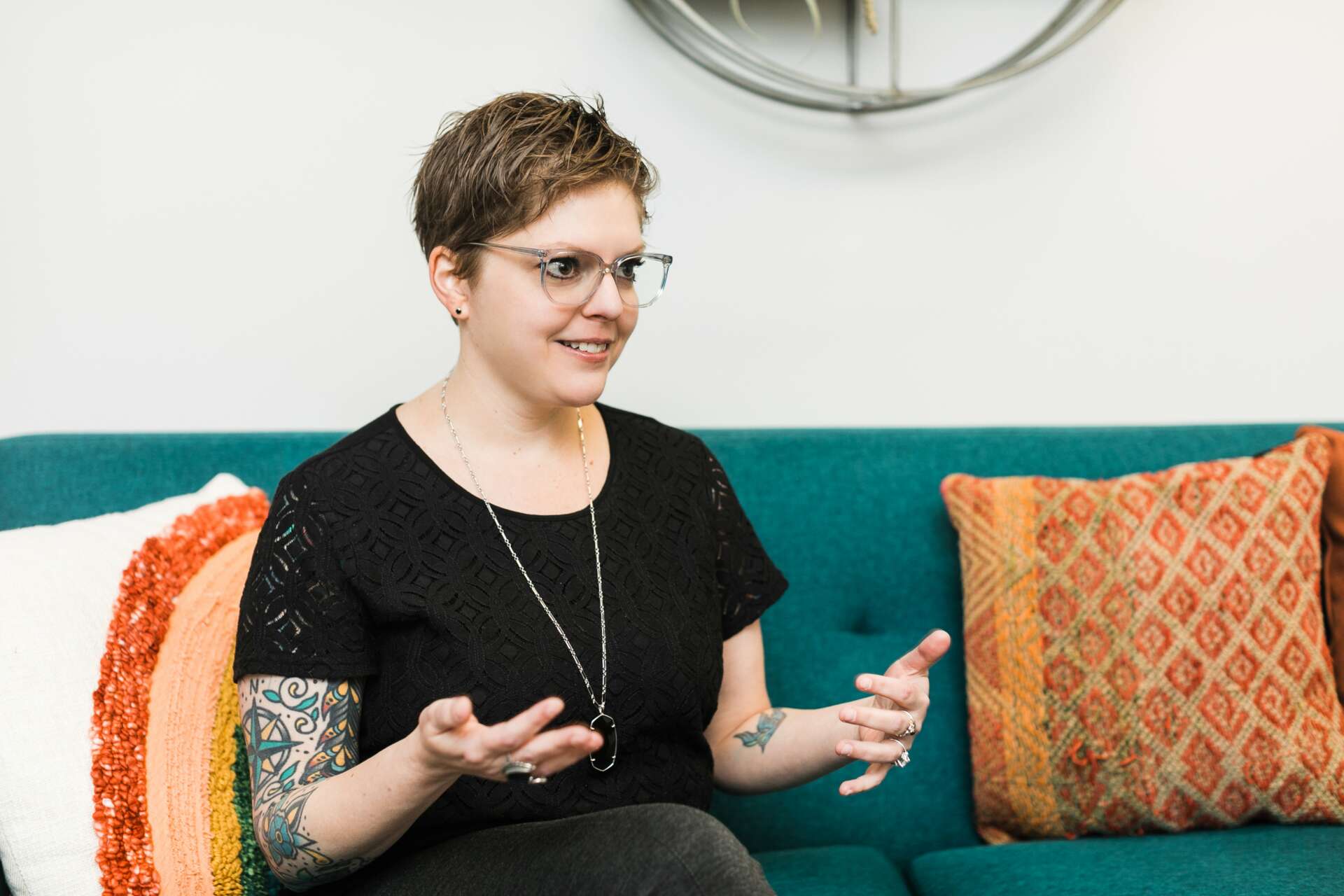
Josh, love having you share your insights with us. Before we ask you more questions, maybe you can take a moment to introduce yourself to our readers who might have missed our earlier conversations?
Sure thing! I’d love to give a bit of background on the business.
While working at the crisis agency, I met Anna Clark-Miller who eventually became my business partner and chosen family. We shared many of the same concerns around the accessibility of mental health education, and our shared experiences really helped us align on what a business model for proactive mental healthcare might look like.
We, as a society, have to start learning about mental heath concepts as early as possible or at least be open to the information as adults. I’m not just talking about diagnoses or what depression feels like, but really starting at the fundamentals of human connection and development. What are coping skills and why do we need them? What is human emotion and how does it connect to behavior? What is mindfulness? What is identity and how do we create it? What about the effects of trauma? Biases? How do we develop our belief systems? Exploring these concepts and others like them help us understand ourselves. Building a holistic understanding of ourselves helps us build an understanding of others, and vice versa. Our understanding of ourselves and others informs the way we perceive and interact with the world around us, and sets the stage for all interactions, opportunities, career paths, relationships, and more. It can help us unlearn problematic systems, processes, and worldviews that can cause or perpetuate harm.
Pulling from our years in mental health work, we developed our signature Empathy Equation™ that’s the foundation of all our trainings and coaching sessions. It’s an easy to understand and implement method of understanding and expressing empathy, which we believe is the bedrock of all human interaction and connection. Honestly, I think that’s partially what sets us apart from other companies that offer similar services.
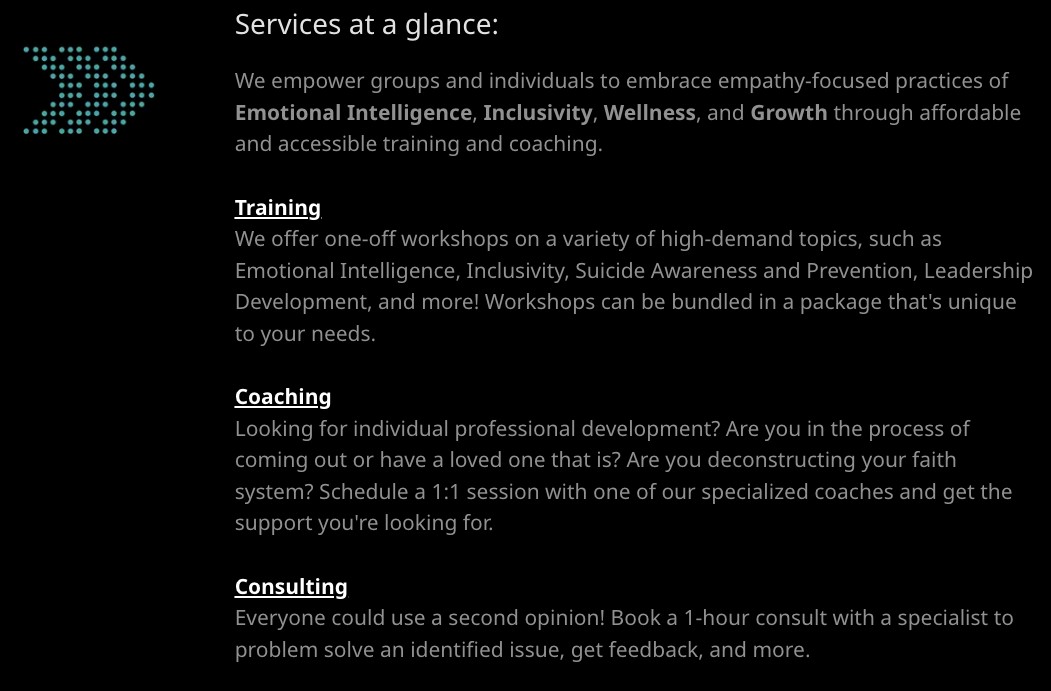
We understand the power of intentional connection. We don’t want offer a one-size-fits-all option, because the human experience cannot fit into a single size no matter how stretchy it may be. What our clients need are unique to them, so we offer customizable training solutions for each individual, team, community, or corporation. They can book one of our individual workshops that cover a variety of high-demand topics, or bundle a few together to create complete training packages without any extra fluff. If they already have the educational foundation a training would provide, they can book coaching sessions instead! We even bundle coaching sessions into the training packages. No matter what’s booked, all of our offerings include at least an overview of the Empathy Equation™ to give every client an inclusive, intentional, and empowering experience.
I know that seeing charged terms like “inclusivity” can be scary for some potential clients, so I want to be sure to clarify that our goal is not to change someone or their beliefs. Our goal is to create the potential for change through education and coaching support, but it’s up to each individual to determine if they’d like or need to take action.
So, If you want a strong leadership team founded on mutual understanding and healthy communication, an inclusive or empathetic workplace or faith community, personal and professional development coaching with someone that understands and cares, or any number of other trainings rooted in mental health… Let’s chat!
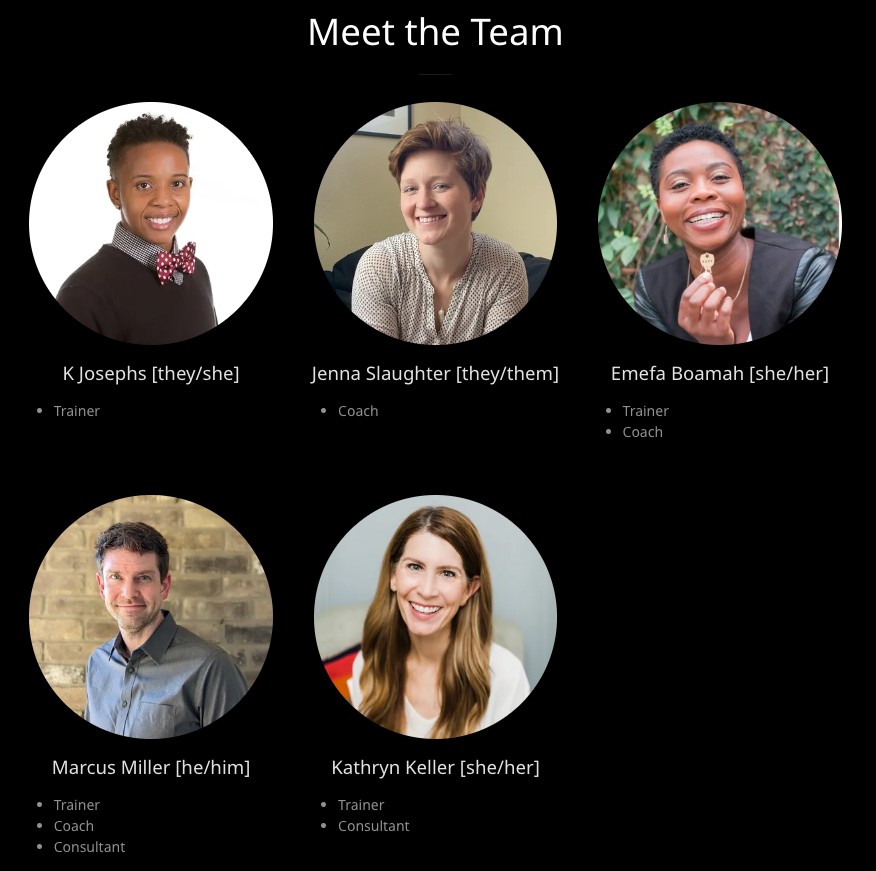
Any stories or insights that might help us understand how you’ve built such a strong reputation?
It’s always been through authenticity. And let me tell you, that’s hard when you’re unwelcome in many spaces within your market.
I can’t tell you how many times I’ve had gatekeepers on LinkedIn tell me I’m not professional by virtue of just existing as an out queer person. I have to be mindful of the way I dress when presenting to my corporate clients in their executive spaces. I always have to ensure any client in a faith community that I’m not interested in challenging their beliefs, and I have to remain aware they may terminate the contract when they realize my “lifestyle” is against said beliefs.
Even still, I won’t hide myself.
My commitment to authenticity is the platform I built my business on, and the reason many of my Coming Out and Allyship coaching clients come to me. It’s why our corporate clients trust us to train their teams.
Do you have any insights you can share related to maintaining high team morale?
Lead with curiosity and vulnerability. Ask questions instead of making assumptions, and stay in a space of learning. You may be a manager, but a manager title does not an expert make. Your team has so much to teach you if you’re intentional about finding the opportunities to learn.
Let your team show up authentically by doing the same. Your team wants to trust you, which means they have to know you. Vulnerability doesn’t require a “Bring Your Diary to Work Day,” but it does require you to be an imperfect human and to be okay with it.
If you need help balancing being a human with being a boss, ask for help. Seek out a mentor or sign up for one of those online courses on LinkedIn. Schedule a coaching session with us or book a training for your team. There are so many ways to get support, so I’d encourage you to seek some out.
Contact Info:
- Website: empathyparadigm.com
- Instagram: @itsJosh_Dangit
- Linkedin: https://www.linkedin.com/in/josh-miller-06898966/
Image Credits
Brooke Ogilvie Photography