



We were lucky to catch up with John Patrick Villalon recently and have shared our conversation below.
John Patrick, appreciate you joining us today. Let’s jump to the end – what do you want to be remembered for?
I love realism or verisimilitude in the media that I consume. When I watch movies or play video games, I always think of how we could build a movie’s designs in the real world or make the design more functional. One of my goals starting as a concept designer was to create vehicles that feel functional and lived-in. I think I’m close to having functional designs, but I feel I am lacking in the “art” department.
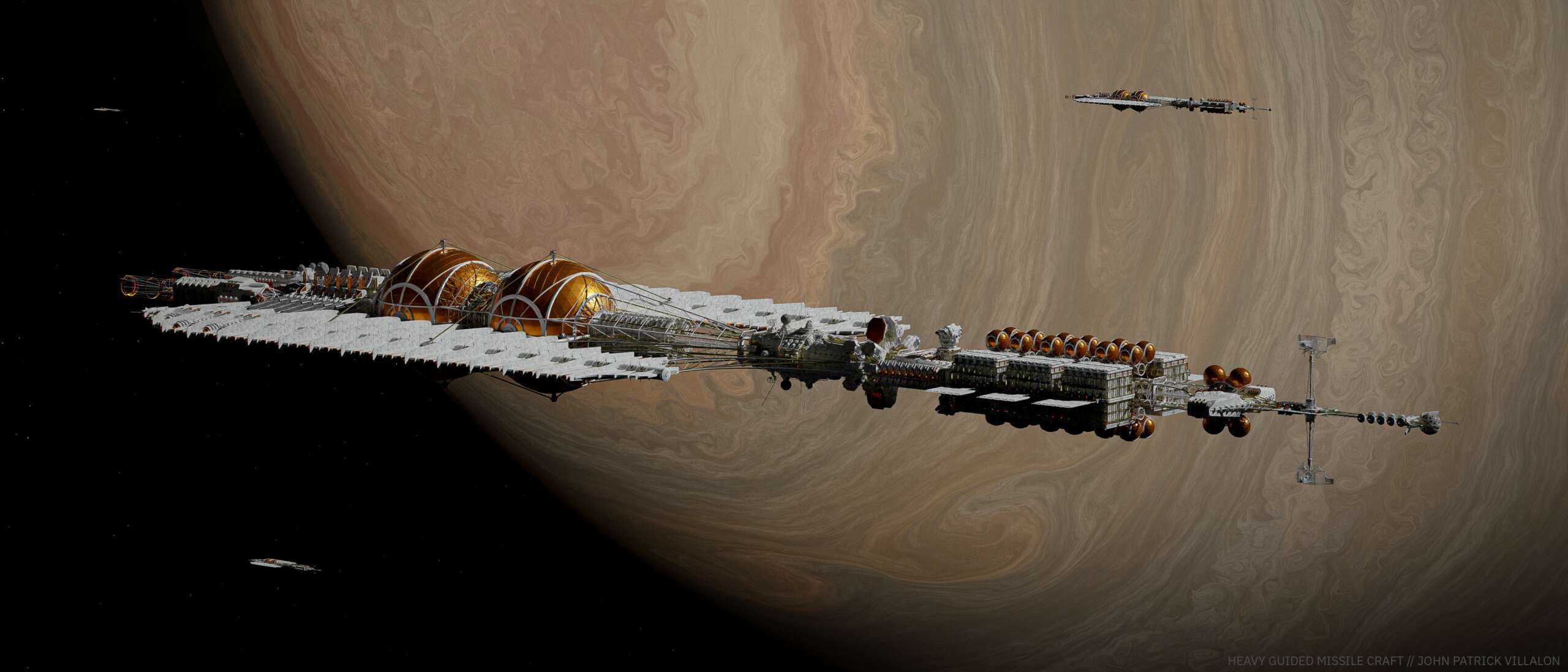
All that said – I would want to be remembered for my hard science fiction designs and how my work was able to bridge that gap between realistic engineering concepts and artsy, concept designer-style ideas. I’m doing my best to incorporate our modern sciences and engineering principles and I hope people notice this when I publish my works.


John Patrick, love having you share your insights with us. Before we ask you more questions, maybe you can take a moment to introduce yourself to our readers who might have missed our earlier conversations?
Hello! My name is John Patrick Camiling Villalon. I am a Concept Designer who studied Industrial Design in Melbourne and a Mechanical Engineering Diploma in Singapore. I grew up in the Philippines, but migrated to Singapore in 2010, Melbourne in 2016, and Singapore again in 2022.
In 2015 while I was still studying engineering, my friend, Juelle, introduced me to the world of Entertainment Design. She showed me that there’s a job where people create designs for movies and games. Juelle recommended Feng Zhu’s YouTube channel and Scott Robertson’s book, How to Draw, as starting points and I rigorously went through them. I shifted to Industrial Design where I learned basic design skills, and watched online tutorials from John Park to complement my studies. Since graduating, I’ve been taking mentorships under Art Train Academy to refine my design skills while working as a freelance concept designer.
As a Concept Designer, I specialize in believable Hard Surface designs such as firearms, vehicles, and spaceships. My works also generally fall in the category of Hard Science Fiction – which is sci-fi that leans heavily toward science-possible ideas. If a client needs any of these concepts idealized in a way that fits the realism of their settings, I can ensure that my designs would fit these requirements of believability while making them look “pretty”.
One example was when I designed my realistic starship based on a theoretical rocket engine designed for Mars missions. No one had done any designs using this rocket engine, but I chose to do it because I wanted to see how well I could turn engineering ideas into concept art. People seemed to like the pieces that I have made, especially those who are into realistic sci-fi. I like to think I did well on this one.
Another example is when I modernized a famous Halo SMG and designed it in a way that makes sense within the game’s world. The SMG’s original design lacked the functionality of a real firearm, which is fine for most sci-fi games (and most of the time it doesn’t matter). But if a client wants more realism, I can help them with that.

Any resources you can share with us that might be helpful to other creatives?
The earliest resources I used were books, YouTube videos, and Gumroad tutorials – which seemed adequate then. But what I really needed was a tight community where I could have gotten support in any form, whether that be design feedback, motivation, or just friendship. Doing concept design (and most other things, really) is significantly easier when you have people who could do the same activity with you.
Nowadays, there are a lot of concept art community channels on Discord where you can share your work and get feedback and I also have my group where we could talk about almost anything else that’s not design. Highly recommend you get into a community and get close to them when possible.


What do you find most rewarding about being a creative?
Problem-solving is the most satisfying part of any project because it forces you to learn more about a topic and apply that knowledge to solve a design issue. It is the part where you get to explore in the form of 2D or 3D sketches and churn out dozens of design iterations until a satisfying solution is found. It is also the most foundational design skill because making things look pretty is not enough, it has to satisfy the design brief’s narrative and gameplay considerations.


Contact Info:
- Website: https://www.jpvillalon.com/
- Instagram: https://www.instagram.com/jpv_art/
- Linkedin: https://www.linkedin.com/in/johnpatrickvillalon/
- Twitter: https://twitter.com/JPNomnom