



We were lucky to catch up with Jody Grunden recently and have shared our conversation below.
Jody, appreciate you joining us today. Can you open up about a risk you’ve taken – what it was like taking that risk, why you took the risk and how it turned out?
The biggest risk I’ve ever taken was going out on my own and starting my own firm. I worked in public accounting for three years and quickly learned that it wasn’t for me. It was a lot of travel, long hours, and late nights. My kids were young at that time, and I didn’t want to miss them growing up. So, to prevent that from happening, I left public accounting and tried the corporate world. It was slow and boring, and I found it to be like the movie Groundhog’s Day. I tried working for a smaller firm after that but found that I was still limited on what I could do. After one year, I left to start Summit CPA Group with my partner, and Summit’s co-founder, Adam Hale. If I wanted to do things differently, I had to start the firm that would do just that.
I had no experience in running a business. At that same time, my wife left her law practice and decided to start her own business. We had very little money in the bank, two young kids, and were in the process of building a house. Talk about taking a risk! I was ambitious, a little naïve even, but I had a passion about changing the way people think about accounting. And so, throughout my journey to do that, there has been one risk after the other. I could open a firm and do exactly what every other CPA firm was doing. But instead, I took each risk as a challenge to create something different.
1. No more hourly billing
We got away from hourly billing quickly and introduced flat-fee pricing. In doing so, we got rid of the busy season that is typical in the accounting world. However, initially we didn’t know how to price it and almost went out of business because we didn’t price our services high enough. But once we figured out the pricing, we were able to scale the business and really get traction on our growth.
And since we stopped billing hourly, we changed the way we pay our employees. Our employees are paid on a variable compensation, creating an entrepreneurial opportunity.
Our team is compensated based on the size of their book of business rather than an hourly rate. For example, if someone has a baby and needs to scale back, they have that opportunity to do so.
2. No more suits and ties
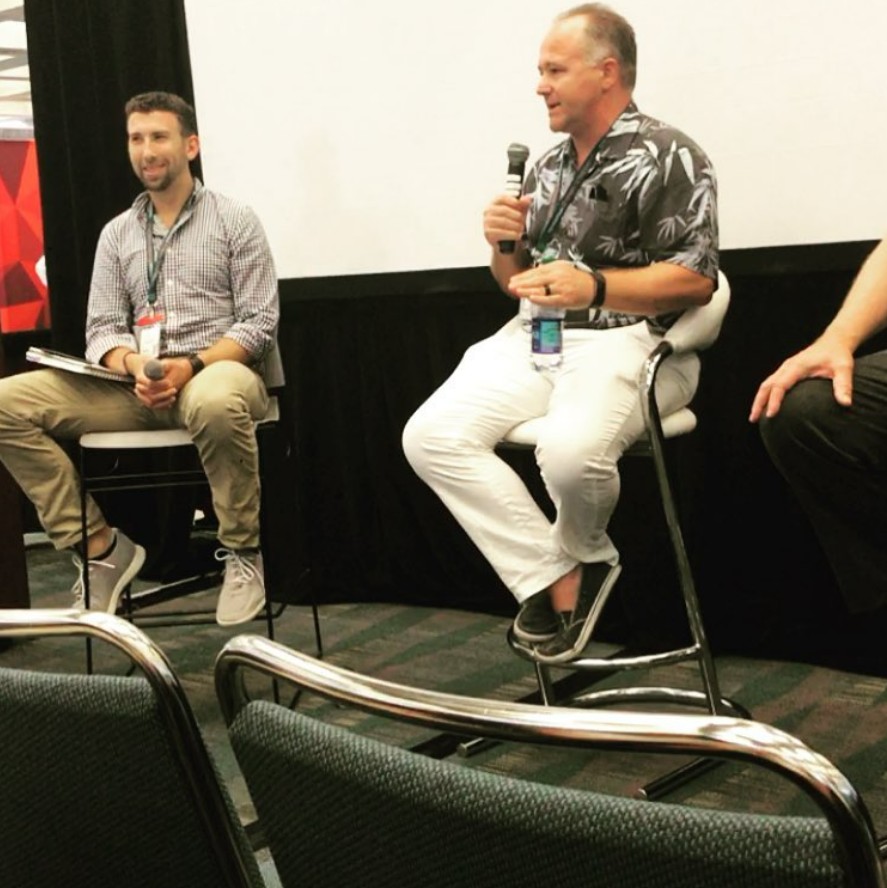
Suit, tie, bowtie, suspenders, nope! We got rid of that. We want to be approachable. We’re not in the business of traditional accounting so why should we look like traditional accountants? Besides, you start your own business so you can wear whatever you want, right? So, for me, it’s a wardrobe of Hawaiian shirts.
3. Proactive vs. reactive
We wanted to work with clients more on a consulting basis and really help them scale their business (proactive), rather than only meeting with them at the end of the year for taxes (reactive). We had to figure out how we could meet with clients on a regular basis. That’s when we introduced cash flow management.
4. Enter, Virtual CFO Services
We introduced what’s now called Virtual CFO services. This was a huge risk, as it was completely outside the box in the accounting industry. Now a lot of accounting firms are trying to implement Virtual CFO services. We’ve even created a course where we teach firm owners how to do it.
5. Narrow focus
We decided to focus on professional services and in particular creative agencies. We started to really narrow our market, which again was another risk because most people believe you should be able to do everything for everyone because the market is bigger. But once we narrowed our focus, we gained footing and started picking up clients quickly. One of our first clients was Lullabot, a fully remote company, which was unheard of in 2011. That got our wheels spinning on our next risky move.
6. Going virtual
Going fully virtual didn’t happen as I anticipated. We were a small brick-and-mortar firm in Fort Wayne, Indianna with 18 employees. We had just picked up our first Virtual CFO client halfway across the country, which proved we could work with clients virtually outside of our geographic location. How can we reach out to people across the country and really market our services as such a small firm? When I started looking into going fully remote, I was met with resistance from my team.
Since they didn’t want to leave the office, I sent everyone home to work for a few weeks so that we could remodel. If they wanted to work at the office, it might as well be a fun place to work, right? However, when it was time to come back, nobody wanted to! We hadn’t even hung the sign on the door. It was at that point, 2012, that Summit went fully remote. Forbes Magazine featured Summit in an article about remote companies. As a result of that article, the resumes started piling up, and we were able to start hiring people remotely.
7. People over profits: happy employees
Some resistance I was met with when we went fully remote was company culture: How can you have a strong company culture when you’re not physically together? Company culture is very important to me. We implemented company-wide retreats to ensure everyone gets to connect. Once a year, we get together as a firm, in person, just to hang out. We might have a guest speaker, but the main point of this retreat is to build company culture—we eat dinner together, grab a beer, and just get to know each other on a personal level. From airfare, lodging, and planned activities, these events are a large expense. But at Summit, we believe in people over profits and having happy employees is the foundation of a successful company.
8. Building the firm of the future with Anders CPAs + Advisors
In April of 2022, we took perhaps one of the biggest risks in Summit history; we merged with Anders CPAs + Advisors. My goal for Summit is to be a $50 million firm. We have doubled our size every three years since 2010, so in three years we would be about a $20 million firm. Aligning with Anders, really accelerates our growth and puts us on the trajectory to reach a more aggressive$50 million goal.
Great, appreciate you sharing that with us. Before we ask you to share more of your insights, can you take a moment to introduce yourself and how you got to where you are today to our readers
I’ve been in the accounting industry my entire career. I started Summit CPA Group in February 2002 in Fort Wayne, Indianna with my partner, Adam Hale. Our mission was (and still is) to change the way people think about accounting. We wanted to be different from your traditional accounting firms—no busy season and no suits. We wanted to come alongside clients and help them grow their business.
Unlike most CPA firms, we didn’t stick our last names on the business. We wanted something bigger than Grunden and Hale. Fort Wayne is known as the Summit City. So, we started tossing around the name Summit, and it seemed to fit our mission and vision. My purpose is to help clients reach their summit, that pinnacle goal. Back then in 2002, we were just a two-person shop. I always knew Summit was going to be much bigger than the two of us, and we did just that. We were able to build a professional service business that wasn’t reliant on either one of the founders.
That’s what I’m most proud of because, through that process, we have cultivated a company culture that empowers employees to make decisions on their own and have autonomy over their work. That culture is like a ripple effect, as we’ve been able to impact so many clients and their families, even clients’ employees and their families, throughout our journey.
Since we didn’t want to be a traditional accounting firm, we knew we had to offer something different; enter, Virtual CFO services. We provide CFO services to small to midsize companies, virtually. We take an advisory approach and help business owners make informed decisions. We do this through dynamic forecasting, KPIs, and cash flow management. We are constantly doing modeling for them so that they always know where the business stands. And of course, it’s “Virtual” CFO because Summit is a fully remote company—no brick-and-mortar building for us—so we meet with all of our clients virtually.
Our service is designed for businesses between $1 million to $20 million. Most small businesses can’t afford to hire a full accounting team; that’s where a Virtual CFO comes into play. Our clients get a team of financial, accounting, and tax professionals to help guide them through their business journey, and at a fraction of the cost compared to hiring a full-time team.
Summit is one of the only virtual firms to offer this kind of dynamic service to clients. We also utilize an impressive tech stack that allows us to deliver high-quality service to our clients.
Any advice for managing a team?
The top three things I encourage business owners to develop and implement within their team are trust, autonomy, and candor. High morale comes with trust, as trust is the foundation of everything. A culture that is very profit driven is not good for morale or trust.
When we went fully remote, we had to learn that the hours that we worked didn’t make any difference. We didn’t want to be managing people’s hours, so we had to pivot and figure out a way that we could still deliver products to our clients with high client satisfaction and high employee morale.
Since we moved away from an hourly billing requirement where “every hour counts”, our projects became more deadline driven. That’s where autonomy comes in. We trust our employees to get their work done; it’s as simple as that. We don’t micromanage or ask for a timecard.
Candor can be a little harder though. At Summit, that’s one of our core values. Every new employee at Summit has a check-in with their manager and a member of the HR team every two weeks during the first 90 days of employment and then again at six months. During these meetings, they receive candid feedback that helps them grow as an individual and as a team member. Being candid helps to manage expectations and encourages authentic transparency.
Managing a remote team and keeping a strong company culture with high morale is something I was told couldn’t be done. But I am proud to prove the naysayers wrong. Summit has an incredibly strong company culture, and I believe this is one of the reasons we’ve seen so much growth and success over the past 20 years.
How’d you build such a strong reputation within your market?
I think thought leadership has helped build my reputation in the market. I am a huge advocate of this as a way to educate business owners and help them scale their business. We generate a lot of content, such as blogs, articles, and podcasts that we push out through our website and other third-party sites. I also present at several conferences and events worldwide.
Education is the best avenue to help business owners. Why hoard that information internally and keep it a secret? My approach is to teach business leaders how to be profitable, even if they aren’t one of our clients.
Business owners who need more than the educational tools and resources we provide, they reach out to us. That’s when they become clients. This is part of our inbound marketing strategy. And that’s really been a key to our success—sharing information freely with everybody.
We even teach out competitors! After conferences and events, I always have owners of CPA firms who want to discuss implementing Virtual CFO services. That’s when we created our course, The Virtual CFO Playbook, which teaches CPA firms how to do exactly what we do.
I love it when associates, and even strangers, reach out to me and say how a presentation, article, or podcast really helped them improve their organization and the different steps they put in play because of the education that we’ve provided them. That’s what it’s all about.
Contact Info:
- Website: https://www.summitcpa.net/
- Instagram: https://www.instagram.com/summitcpa_group/
- Facebook: https://www.facebook.com/summitcpagroup
- Linkedin: https://www.linkedin.com/in/jodygrunden/
- Twitter: https://twitter.com/jgrunden
- Youtube: https://www.youtube.com/channel/UC8CssPEpiO3FfJ7JjXhI1Nw