


We caught up with the brilliant and insightful Jeff Ertz a few weeks ago and have shared our conversation below.
Jeff, looking forward to hearing all of your stories today. We’d love to hear your thoughts about making remote work effective.
Post production is tricky. It’s a canvas of constantly moving parts, with logistical, technical and creative needs all intertwined. And over the past decade, a lot of tools have popped up that have helped shift collaboration on these fronts into a more hybrid model, where the work is carried out on-site by some and remotely by others. This hybrid shift started to happen naturally at Red Thread, and the department I head up – post production – has remained almost entirely remote since the pandemic.
Thankfully, I had put a remote post production workflow in place a few years before the pandemic, so it was common for some of us to already work from home and pretty easy for us to slide into it full-time. Now, most of my servers and systems are on the other side of the country and everyone in post, whether we’re in an office, on-site or at home, works on them.
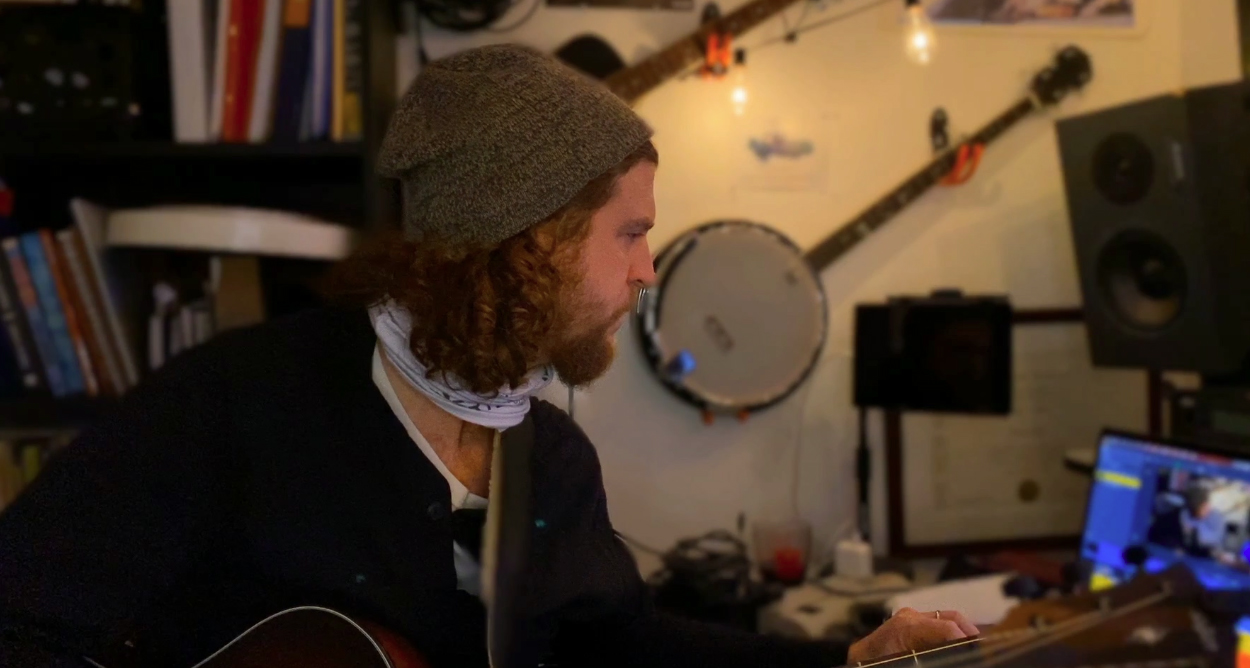
While I do spend some time on set, most of my work day is now spent in my basement studio, where I’ve set up a wall of equipment to do most of my sound and picture work. When my workload increases and we have to look to freelancers, not being bound by one office space affords us some of the best talent wherever they live. We’ve spent the few pandemic and post-pandemic years tweaking the system to improve the user experience, which is now surprisingly good, and folks who are used to bouncing from one company to another can do all that moving around virtually. The end result is more time for everyone.
While having more time is definitely a major positive aspect of remote work, it inadvertently can increase the amount of work I do throughout the day. It’s a double-edge sword. I’m able to break to pick my kids up at school, take them to sports, cook them dinner, spend time with my wife and have some time to myself in the morning. But the workday can become interlaced, and I find myself working late into the night often. Those breaks throughout the day, while giving me a more holistic and balanced day-to-day, keep me working longer. Thankfully, I love my job, I love to create, and I have always been a storyteller, so keeping that momentum is what sustains me.
Jeff, love having you share your insights with us. Before we ask you more questions, maybe you can take a moment to introduce yourself to our readers who might have missed our earlier conversations?
I’ve been working in broadcast, film and event production for over 20 years now, and my wife still has trouble describing what I do for a living. Maybe it’s because I refer to everything I work on as a show, whether or not I’m editing for a live event, post-supervising a film, sound designing a co-branded spot, engineering a recording, or performing my music with a band. It also may have to do with the multiple creative and technical roles I assume in working on an array of content. The common thread through all of the work I do is that I’m always creating, telling a story, and actively trying to solve a puzzle whose pieces keep changing.
After many years of stress as a freelancer, in the early 2010’s I began full-time with the amazing small agency that had introduced me to the production business when I interned there back in 2005. I had never sought out a job in this industry, but the post-undergraduate income writing for a daily newspaper and composing music on the side had not been cutting it. Red Thread brought me on as an intern the first year of my Media Studies Masters program at The New School in New York, and also hired me for my first post-graduate industry gig as a production assistant on a Starz television show. It’s funny what can happen when you don’t know what’s ahead but let your interests, passions and inquisitiveness carry you downstream. At the end of my week as a PA on “Head Case”, the assistant director had cast me as “the photographer’s assistant” in a scene that ended in supermodel Paulina Porizkova tossing me to the ground.
After PAing for a while, I moved more into post production, mixing documentaries and editing shorts. Little by little, I began to work on more diverse projects and doing different things, like working with Red Thread to create Cyndi Lauper’s Give A Damn campaign; cutting the OG “Stripped” iHeartRadio concert videos that includes the premiere of Alysia Keys’ Empire State of Mind Part II; winning accolades for a short documentary “Spinnaker” that I cut and scored; testing and implementing remote shoots during the pandemic; and traveling around the world for corporate broadcast events while playing at every open mic I can along the way.
More recently, I started performing my music more frequently, focusing on writing and recording. Over the years I’ve been able to place some music in shows, film and retail programming in Europe, but in the near future I’m working to build a more proper sync catalog (for licensing my music), reviving some old compositions, and release as much of it as I can before most music programmed is created with AI tools. I’ve also been experimenting with and using some of those tools already for music, sound design/mixing and video editing, trying to keep creating with them to stay ahead and hopefully not go the way of print media.

What’s the most rewarding aspect of being a creative in your experience?
I think the most rewarding part about being an artist and creative is that, for me, the creative act itself lends some insight and understanding to some aspect of this crazy world. This can be literal learning and/or almost a spiritual learning. For example, cutting the short documentary “Spinnaker” taught me all about humpback whale entanglement and coastal conservation. The act of trying to score it with manipulated whale and environment sounds plus some instrumentation gave me something more profound that I really can’t quantify. The process can be therapeutic. But it’s that feeling of awe and understanding about a story, a subject, a process, etc. that gets me excited for what’s next. And it enables me to expand my approach with some of the more repetitive work, either by trying new techniques, software or approaches. Even when I perform my own songs or play covers, I’m always playing them differently so that they’re always fresh. It’s like I’m always trying to create, even when the work is done, and that proofers way more value to me than whatever it is I’ve just created or facilitated.

Let’s talk about resilience next – do you have a story you can share with us?
In the production world, like some other industries, you’re only as good as your last job. If your last gig was successful, it usually led to another. But if you did a bad or lackluster job, you weren’t asked back. So there’s a lot of pressure, particularly when you’re freelancing, which basically amounts to working your ass off to line up work while working on whatever projects you’re currently juggling.
Really early in my career, a colleague had recommended me as a shooter/editor to a friend. Next thing I knew, I was hired as one of 7 camera people shooting a performance and interview of Alice and Chains, a band I had loved growing up. I was also slated to edit a few performances from other bands that happened the previous week. Now I was confident about my editing chops, but my camera experience was next to nothing. But you can’t ever say no, even when you don’t. I was freaking out.
I had about a week until the gig, so I learned as much as I could about what cameras we were shooting on and watched as many of the previous shows I could to get a sense of their style. And since this was before ChatGPT and the like, I had to piece together what I was required to do with the camera.
When I got to set, all of the cameras were laid out on a table, ready to be assembled. I fumbled for quite a while, kind of looking over my shoulder to see which way the batteries need to go in, and what menu settings the other ops were looking at. Only three cameras were needed for the interview portion, so I had some extra time to get to my stage left position and set up.
Somehow, I got the camera up and running, figured out the headset and was ready to go. Once we started shooting, the technical director kept firing quick commands in my ear that I couldn’t quite follow. So I did the best I could, trying out some moves I made up on the fly between performers and instruments.
Once the band left and we started breaking down our cameras, the producer came over to talk about my upcoming work there. It was clear I wasn’t a very good camera op, but I cut a few videos the next couple of days as we previously discussed, painstakingly obsessing over detail as if to make up for my camerawork. Thankfully, my editing work passed muster, and I ended up freelancing regularly there for over a year, helping to shape the product along with the individual edits. Every evening I did an overnight edit, which was delivered to radio and TV networks at 6am, I arrived while the last bit of shooting was going on with some of the same crew from my failure as a camera op. Every time I went into that space, I remembered how thankful I was that that wasn’t my last gig.
Contact Info:
- Website: https://www.jeffertz.com
- Instagram: https://www.instagram.com/jeffertzmusic
- Facebook: https://www.facebook.com/jeffertzmusic
- Linkedin: https://www.linkedin.com/in/jeffertz
- Youtube: https://www.youtube.com/@jeffertzmusic


Image Credits
frankfurt2022-12-08 17.20.03 – Jackie Eagan
benNjeffBHD23 – Samori Etienne