

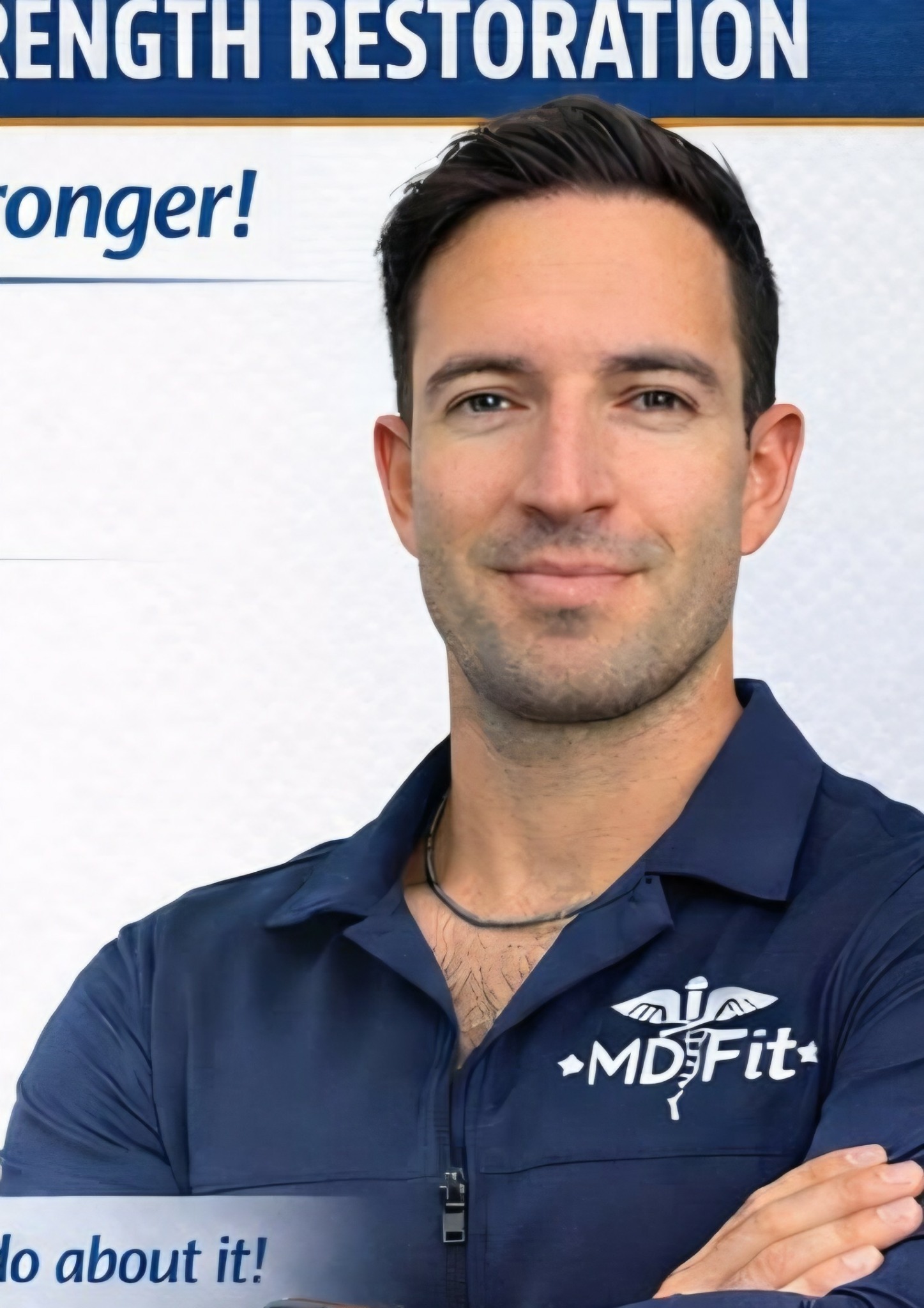

Alright – so today we’ve got the honor of introducing you to Jared Caban. We think you’ll enjoy our conversation, we’ve shared it below.
Hi Jared, thanks for joining us today. We’d love to hear about how you went about setting up your own practice and if you have any advice for professionals who might be considering starting their own?
I didn’t start MD Fit because I wanted to be an entrepreneur—I started it because I got fed up with what I was seeing in traditional medicine.
I went through the full medical training pathway. You’re taught how to diagnose, how to prescribe, how to manage disease. But what I kept running into—over and over—were patients stuck in a loop. Pain meds, injections, referrals, temporary relief… and then right back where they started. Nobody was actually rebuilding people.
That didn’t sit well with me.
I’ve always had a strong background in exercise physiology and performance, and I started realizing that the gap between rehab and real-life performance was massive. Patients would “graduate” from PT or chiropractic care, but they weren’t actually ready to move, train, or live without pain. That gap—that’s where MD Fit came from.
In the beginning, it wasn’t some big polished launch. It was me, a small space, and a very clear idea:
Fix the root problem. Build people back up. Don’t just manage symptoms. I started working with a handful of clients—mostly referrals, people who had “tried everything.” Shoulder pain, low back issues, hip dysfunction—people who had been stuck for years. And the results spoke.
That’s what built the foundation. Not marketing. Not branding. Outcomes.
Main Steps to Establish the Practice
Define the model (this is where most people screw up) I wasn’t opening a clinic. I wasn’t opening a gym. I built a hybrid: rehab + performance + recovery.
Start lean I didn’t overbuild. No massive lease. No unnecessary staff. I proved the concept first—one client at a time.
Develop a system Anyone can “train” or “rehab.” I built structured protocols—movement correction, neuromuscular reeducation, progressive loading. Repeatable. Scalable.
Leverage credibility My MD, MSc, and CCEP weren’t just letters—they were leverage. When you combine clinical knowledge with real results, people listen.
Referrals over ads Early growth came from trust, not marketing spend. If you fix people, they talk.
Key Challenges
Let’s be honest—this wasn’t smooth.
Breaking away from the traditional system You’re stepping outside the accepted pathway. That creates skepticism—from peers and patients.
Educating people Most people don’t understand why they’re in pain. You have to rewire their thinking before you can fix their body.
Wearing every hat Early on, you’re the clinician, the marketer, the operator, the cleaner. There’s no shortcut around that. Resisting the urge to scale too fast This is where people kill their business. If your system isn’t tight, scaling just magnifies your problems.
What I Would Do Differently
I’d be more aggressive—earlier.
I would have documented everything from day one (content, case studies, before/after outcomes) I would have built systems for scale sooner, not just delivery. I would have leaned into strategic partnerships earlier (gyms, schools, organizations) But I don’t regret starting lean. That’s what gave me control and clarity.
Advice to Young Professionals-
Here’s the truth most people won’t tell you:
Don’t start a practice just because you can. Start because you see something broken—and you know how to fix it.
If you’re considering it:
Get very clear on your model If you sound like everyone else, you’ll get lost. Master your craft first. Results are your currency. Without that, nothing else matters.
Start smaller than you think, but think bigger than you’re comfortable with Prove it. Then expand. Learn business whether you like it or not Being great clinically doesn’t mean you’ll succeed. Be prepared to be misunderstood If you’re doing something different, expect resistance.
At the end of the day, MD Fit was built on a simple principle:
People don’t need more treatment. They need transformation.
And if you can deliver that—consistently—you don’t just build a practice.
You build something that actually matters.


Jared, love having you share your insights with us. Before we ask you more questions, maybe you can take a moment to introduce yourself to our readers who might have missed our earlier conversations?
My name is Dr. Jared Caban. I’m an MD, MSc, and Certified Clinical Exercise Physiologist—and I run MD Fit Performance & Rehab.
But the title doesn’t really explain what I do.
I operate in the space between medicine and performance—the place most people fall through.
How I Got Into This
I came up through traditional medicine, and like most people in that system, I was trained to diagnose and manage disease.
But what I kept seeing didn’t make sense.
Patients weren’t getting better—they were getting managed.
Pain meds, injections, repeat visits. Temporary relief, no real solution. And then they’d get discharged from PT or chiro and still not be able to move, train, or live without pain.
At the same time, I had a strong background in exercise physiology and performance. I understood how the body should move, adapt, and rebuild.
That disconnect—that gap between “you’re cleared” and “you’re actually functional”—is where I built MD Fit.
What I Do
MD Fit is a hybrid performance and rehab system.
We don’t just treat pain—we rebuild people.
That includes:
Neuromuscular reeducation
Movement correction and dysfunction mapping
Strength and performance training
Soft tissue and recovery work
Progressive return-to-performance protocols. It’s not random workouts. It’s not generic therapy. It’s structured, intentional, and built around how the body actually adapts.
The Problems I Solve
Most of my clients fall into one of two categories:
The stuck patient
They’ve tried PT, chiropractic, injections
They feel “better,” but not fixed
Pain keeps coming back
The former athlete or active adult (40–65 especially). Used to move well, now dealing with limitations
Doesn’t trust their body anymore
Wants to get back to strength, confidence, and performance
What I solve is simple, but not easy:
I close the gap between rehab and real life.
I take people from:
Pain → Function
Function → Strength
Strength → Performance
Most systems stop at step one or two. That’s why people relapse.
What Sets Me Apart
A few things, and I’ll be blunt about it:
I don’t operate in a single lane I understand medicine, but I also understand movement, loading, and adaptation. Most providers only understand one side.
Everything is systemized This isn’t guesswork. There are progressions, protocols, and clear paths forward.
I don’t chase symptoms If your shoulder hurts, I’m not just looking at your shoulder. I’m looking at how your entire system is moving.
I push when it’s time to push A lot of rehab keeps people in a fragile mindset. At some point, you have to rebuild capacity—not just avoid pain.
What I’m Most Proud Of
Honestly—it’s not the credentials or the business.
It’s the people who come in frustrated, limited, and skeptical… and leave moving like themselves again.
The guy who thought he’d never lift again.
The woman who couldn’t get through a workout without pain.
The client who finally trusts their body after years of setbacks.
That’s what matters.
What I Want People to Know
If you take anything from this, it’s this:
You’re not broken—you’ve just been managed instead of rebuilt
Pain is usually a signal, not the root problem
You can get back to high-level function—but it requires the right approach
And about MD Fit as a brand:
This isn’t a volume-based clinic.
This isn’t a random fitness program.
It’s a results-driven system built on:
Clinical understanding
Performance principles
Real accountability
If someone is looking for a quick fix, this isn’t for them.
But if they’re ready to actually fix the problem and rebuild their body the right way—That’s exactly what we do.


Other than training/knowledge, what do you think is most helpful for succeeding in your field?
Here’s the truth—training and knowledge are the baseline. Everyone in this field has some level of that. It’s not what separates you.
What actually determines whether you succeed comes down to a few things most people either ignore or never develop.
1. Pattern Recognition
You have to be able to see what others miss—fast.
Not just symptoms, but movement patterns, compensation strategies, behavioral habits. Two people can present with the same pain and need completely different solutions.
If you’re just applying textbook protocols, you’re average.
If you can read the body in front of you and adapt in real time—that’s where results come from.
2. Communication
If you can’t get buy-in, nothing else matters.
You’re asking people to change how they move, how they train, how they think about their body. That’s uncomfortable. Most will resist it unless you can clearly explain:
what’s wrong
why it’s happening
and exactly how you’re going to fix it
People don’t commit to what they don’t understand.
3. Consistency and Standards
Most practitioners are inconsistent.
They have good days and average days. That doesn’t work in this field.
You need a repeatable system where every client gets a high standard of care—every time. That’s how you build trust and scale something beyond yourself.
4. Emotional Control
You’re dealing with frustrated people. People in pain. People who have failed multiple times before they ever walk in.
If you ride the emotional rollercoaster with them, you’re done.
You need to stay:
objective
calm
solution-focused
Even when progress is slow or setbacks happen.
5. Business Awareness
This is where a lot of talented clinicians fail.
Being great at what you do doesn’t mean anyone will find you, trust you, or pay you.
You need to understand:
positioning
pricing
client experience
retention
If you ignore this, you stay small or burn out.
6. Willingness to Challenge the Status Quo
If you just follow the system as it exists, you’ll get the same outcomes the system produces.
I built MD Fit by questioning what wasn’t working—why people were stuck, why they kept relapsing, why “cleared” didn’t mean capable.
If you’re not willing to think differently, you won’t create anything meaningful.
Bottom Line
The people who succeed in this field aren’t just knowledgeable.
They’re:
observant
clear communicators
disciplined
emotionally steady
and business-aware
And most importantly—
They’re obsessed with getting real results, not just going through the motions.
That’s the difference.


Learning and unlearning are both critical parts of growth – can you share a story of a time when you had to unlearn a lesson?
One of the biggest lessons I had to unlearn was this:
Not all pain is fixable through movement, muscle work, or rehab.
That sounds obvious on paper—but when you’re in this field, especially when you’ve had success helping people out of chronic pain, you start to believe that if you just find the right angle, the right correction, the right progression… you can fix it.
That belief will get you in trouble.
The Backstory
This one hit close to home—my own mother.
She had hip pain that referred down into her leg and lower back. The first time it showed up, it resolved within a few weeks. Movement improved it, strength helped, and everything pointed toward a mechanical, muscular issue.
So when it came back a few months later—after she’d been more stagnant—I assumed it was the same thing.
That was my mistake.
I treated it like a repeat problem. Same framework. Same progression. And to be fair, there were moments it looked like it was improving.
But something wasn’t adding up.
She went through about five weeks of tough, consistent work with me. And instead of a clear upward trajectory, it plateaued… and in some ways, worsened.
That’s when I had to step back and admit something I didn’t want to admit:
This might not be a movement problem.
It turned out arthritis had progressed to the point where conservative care wasn’t going to solve it. She ultimately needed surgery.
The Lesson
What I had to unlearn was the idea that:
If I’m good enough, I can fix everything.
That’s not true.
And if you hold onto that belief too tightly, you risk:
delaying the right intervention
putting people through unnecessary work
and missing the bigger picture
What Changed After That
It made me sharper—but also more honest.
Now I look at things through a slightly different lens:
Is this truly a functional limitation, or a structural limitation?
Is progress linear and sustainable, or forced and temporary?
Am I helping—or am I trying to prove something?
There’s a point where discipline and persistence become denial.
Good practitioners know how to push.
Great practitioners know when to pivot.
The Takeaway
Movement and rehab solve a lot—but not everything.
And part of doing this at a high level is having the humility to say:
“This is outside the scope of what I can fix conservatively.”
That doesn’t make you less effective.
It makes you trustworthy.
And in the long run, that matters a lot more than being right.
Contact Info:
- Website: https://Mdfitsrq.com
- Instagram: https://www.instagram.com/mdfit_jaredcaban?igsh=NXc0ZTE1YjJ2Y29p
- Facebook: https://www.facebook.com/share/1Dz28xS19o/
- Youtube: @mdfit_jaredcaban

