

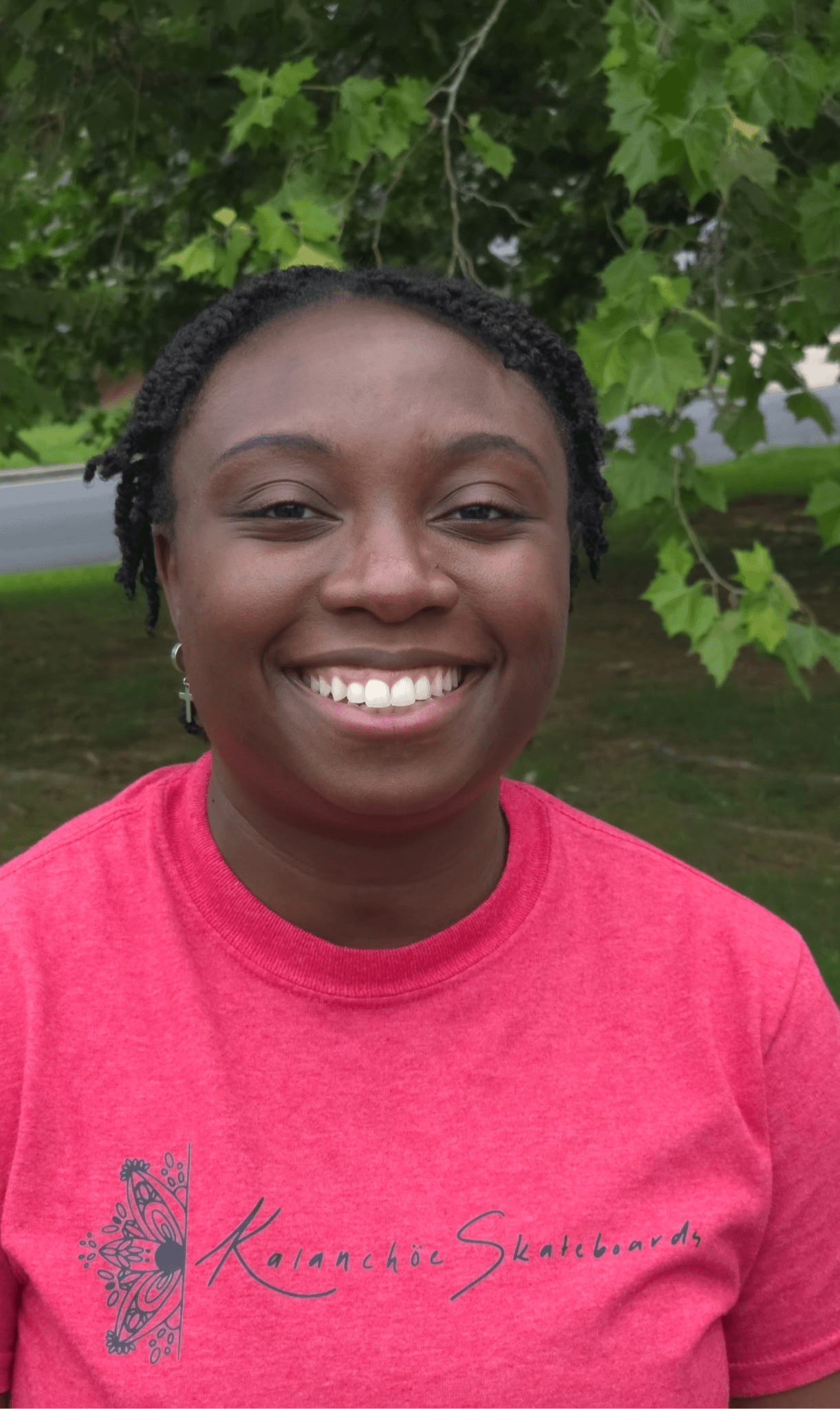

Alright – so today we’ve got the honor of introducing you to Grace Djokoto. We think you’ll enjoy our conversation, we’ve shared it below.
Hi Grace, thanks for joining us today. How did you come up with the idea for your business?
Kalanchoe Skateboards grew out of my own journey into skateboarding. When I first decided I wanted to learn, I walked into a local skate shop excited to buy my first skateboard. Instead of being welcomed and guided through the process, I felt dismissed by the salesperson. It was a discouraging experience, but it didn’t stop me from pursuing skateboarding. What it did do was make me much more aware of the environments where I felt comfortable and the kinds of people I wanted to surround myself with.
I started asking myself what a skateboard brand would look like if women and nonbinary skaters were the focus from the very beginning. Not as an afterthought, but as a community worth investing in and celebrating. I saw an opportunity to create products and a brand experience that made people feel seen, supported, and excited to participate in skateboarding.
What convinced me this was a worthwhile endeavor was that the problem wasn’t a lack of interest in skateboarding. The problem was that many people didn’t feel represented or welcomed by the industry. Skateboarding continues to grow and attract a more diverse audience, yet much of the market still speaks to a narrow demographic. I believed there was room for a company that could serve an underrepresented community while staying true to the creativity, individuality, and freedom that make skateboarding special.

Awesome – so before we get into the rest of our questions, can you briefly introduce yourself to our readers.
My name is Grace, and I’m the founder of Kalanchoe Skateboards.
I started skateboarding in 2014 while I was a sophomore in college. I had been interested in skateboarding since childhood, but it wasn’t something I was allowed to do growing up. Once I was old enough and had my own money, I bought a cheap skateboard and started teaching myself. It didn’t take long to realize that my board, with its plastic trucks and low-quality components, wasn’t going to get me very far.
I knew a proper setup would be an investment, so I visited a local skate shop hoping to get some guidance. Instead, I was met with a salesperson who was condescending and dismissive. While that experience was disappointing, it didn’t discourage me from skateboarding. What it did do was make me think carefully about the kinds of spaces where people feel welcome and comfortable learning something new.
Fortunately, I found another local shop, Ruin, which has sadly since closed. The experience could not have been more different. The staff took the time to answer my questions and help me build my first real setup. That board opened up an entirely new world for me. I spent my free time skating around campus and visiting local skateparks whenever I could.
While I was still in college, I started thinking about creating my own skateboard company. Part of that came from noticing that many deck graphics didn’t really resonate with me. But an even bigger factor was reflecting on my first experience in that one skate shop. I never wanted someone to feel unwelcome or out of place when they were simply trying to learn about skateboarding. I wanted to create something different.
I’m a bit of a nerd by nature. I have both a bachelor’s and master’s degree in chemistry, and when I become interested in something, I dive deep. Learning, sharing knowledge, and helping others discover new interests are things I genuinely enjoy. That mindset naturally carried over into skateboarding and eventually into Kalanchoe Skateboards.
Today, Kalanchoe Skateboards is about more than selling skateboards. It’s about creating products, designs, and a community that encourage people to explore skateboarding without feeling like they need to fit a certain mold first. I want people to feel comfortable asking questions, learning new skills, and finding joy in the process.
One thing that stands out to me is how many people are surprised to learn that I skateboard. Often, they’ll tell me they’ve always been interested in it but never felt like it was something for them. Those conversations reinforce why this work matters. Skateboarding has room for so many different people and experiences, even if that isn’t always reflected in the industry’s image.
One of the things I’m most proud of is getting my aunt on a skateboard. Nobody expected it, including her. Seeing her try something completely new and seeing the excitement and laughter it brought to everyone around her was incredible. Moments like that capture what I love most about skateboarding. It has a way of bringing people together, building confidence, and creating joy where people least expect it.
At its core, that’s what I hope Kalanchoe Skateboards represents. Skateboarding has been one of the greatest sources of joy in my life. If I can help someone discover that same joy, especially someone who never thought skateboarding was for them, then I consider that a success.

Can you open up about how you funded your business?
Kalanchoe Skateboards was initially self-funded. As it so happens, an incident turned into a financial blessing. Rather than spending the money immediately, I put it into a certificate of deposit (CD) and let it grow while I continued developing my plans for the business.
When the CD matured, I made the decision to invest those funds into launching Kalanchoe Skateboards. It was a meaningful decision because it represented taking money from an unexpected and difficult event in my life and turning it into something positive that I had been dreaming about for years.
Those funds allowed me to place my first production order, which included skate decks, t-shirts, and fanny packs. It also gave me the opportunity to host a launch party at a local skatepark, which was important because I wanted the brand’s introduction to be centered around community from the very beginning.

We’d really appreciate if you could talk to us about how you figured out the manufacturing process.
I work with third-party manufacturers to produce my products rather than manufacturing them myself. When I first started Kalanchoe Skateboards, I didn’t have prior experience sourcing manufacturers, so there was a lot of research involved. I spent time comparing different companies, evaluating product quality, reviewing pricing structures, and understanding what services they offered.
One of the biggest factors in my decision-making process was finding manufacturers that offered dropshipping and print-on-demand services. As a small business owner, I don’t have the space or capital to keep large amounts of inventory on hand. Working with manufacturers that can produce individual products as orders come in allows me to offer products without taking on the financial risk of purchasing large quantities upfront.
The manufacturers I work with today have been very supportive and have made it possible for me to operate at my current scale. Along the way, I’ve learned that choosing a manufacturer is about much more than finding the lowest price. Reliability, communication, product quality, and fulfillment capabilities are even more important. I’ve also learned that it’s important to order samples and understand exactly what customers will receive before offering a product for sale.
As Kalanchoe Skateboards continues to grow, I expect my manufacturing needs to evolve. For now, the flexibility of working with on-demand manufacturers has allowed me to focus on building the brand, connecting with customers, and creating products that reflect the community I want to serve.
Contact Info:
- Website: https://www.kalanchoeskateboards.com/
- Instagram: https://www.instagram.com/kalanchoe_skateboards/
- Facebook: https://www.facebook.com/profile.php?id=61577735745819
- Linkedin: https://www.linkedin.com/company/kalanchoe-skateboards/


Image Credits
Photos taken by Boshicu Page, Miss USA World Universal 25-26