

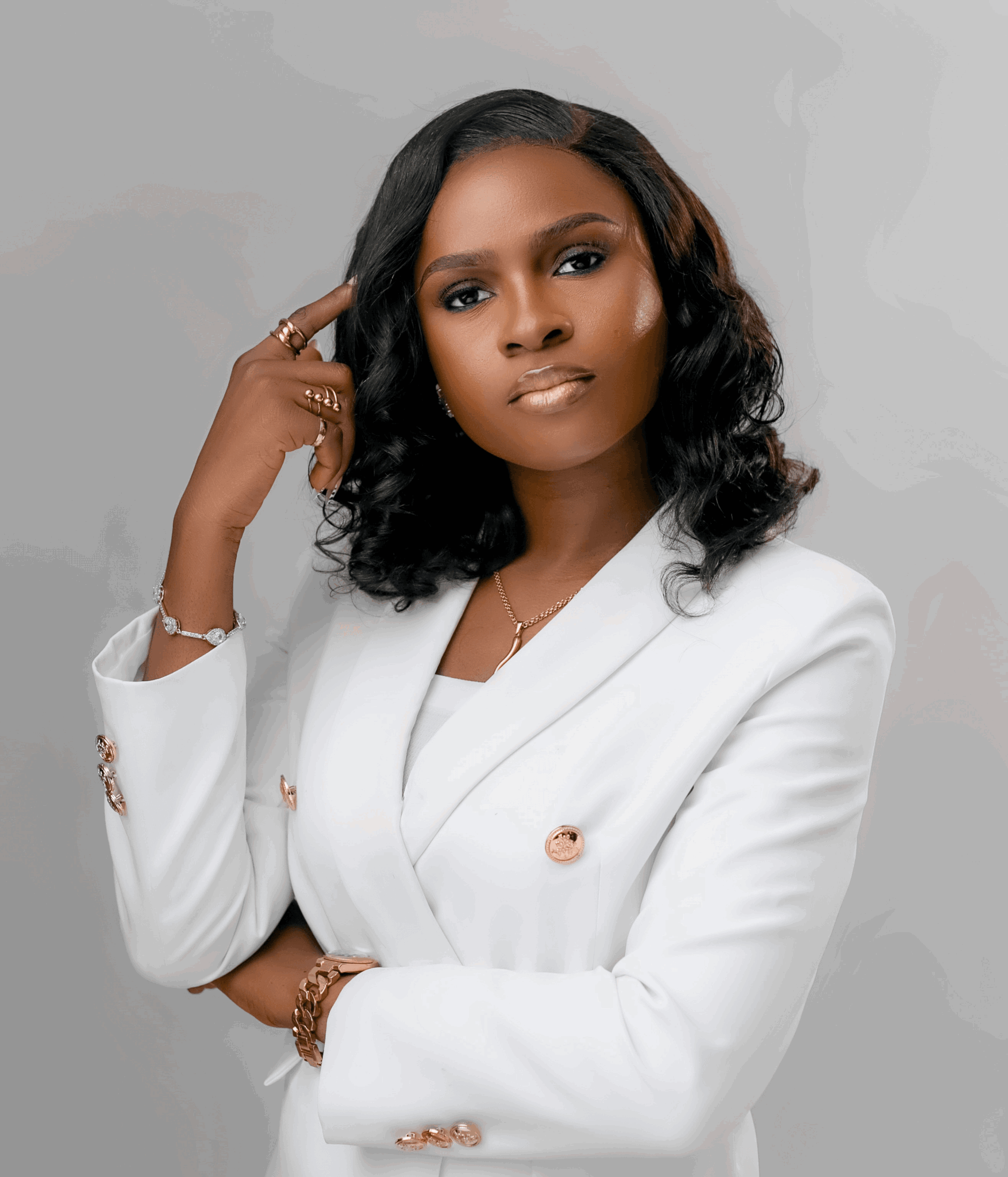

We’re excited to introduce you to the always interesting and insightful Glory Eguabor. We hope you’ll enjoy our conversation with Glory below.
Glory, appreciate you joining us today. We’d love to have you retell us the story behind how you came up with the idea for your business, I think our audience would really enjoy hearing the backstory.
The idea for Remote Tribe Africa came from my own experience of feeling stuck.
A few years ago,I was doing what many young people in Nigeria and many parts of Africa are told to do. I went to school, got my degree, and was trying to build a career. But like many people across Africa, I quickly realized that talent alone wasn’t enough. There were limited opportunities, competition was intense, and it often felt like your future was tied to where you lived.
Then I started working as a Virtual Assistant in 2018 but it was messy for me. I was figuring things out in a context that nobody seemed to be talking about like:
How do you get paid internationally when most payment platforms don’t fully support your country?
What do you do when the power or internet goes out in the middle of a client call?
How do you compete for global opportunities when your university never prepared you for how the modern workplace actually works?
I kept searching for guidance and kept finding content made by and for people in the West. It was good content. But it wasn’t my reality as an African.
Nobody was talking about the electricity or network issues. Nobody was talking about the bias some clients have the moment they see a Nigerian name or location. Nobody was building solutions for us specifically.
I kept asking myself: who is going to talk about this? Who is going to build something for the people who come after me?
Then 2020 happened.
The COVID-19 lockdown was an eye-opener in a way I didn’t expect. Suddenly the whole world was being forced into remote work. But for so many young Africans, especially women and youth already dealing with high unemployment and underemployment, this wasn’t just a work disruption. It was a moment of real economic vulnerability. And I watched it happen in real time.
I started talking about it on Instagram and Facebook. Just honest, practical posts about remote work, digital skills, and what was actually possible. The response was overwhelming. People had so many questions and so few places to go for real answers.
So I started training people. Virtually. Informally at first. Then more structured cohorts focused on virtual assistant skills, helping people earn income during the global shutdown.
12 cohorts later, with hundreds of students across Nigeria, Uganda, Kenya, and Africans in the diaspora, I realized this needed a bigger home.
In 2022, I launched Remote Tribe Africa officially. On the very first day, over 100 Africans joined our WhatsApp community. We started with a live Q&A, then webinars covering payments, CVs, LinkedIn, personal branding, the practical things people actually needed. It grew from there faster than I anticipated.
Today our community spans WhatsApp, Telegram, Facebook, LinkedIn, and Instagram (anywhere the people are) with thousands of members across 25 countries including Nigeria, Ghana, Kenya, Rwanda, Uganda, Zambia, Liberia, South Africa, Burundi, Cameroon, Benin Republic, Zimbabwe, the UK, the US, the UAE, and counting.
Was I solving a problem nobody else had identified? Not exactly. Remote work education existed. But it wasn’t built specifically for us. It didn’t account for our infrastructure challenges, our payment barriers, our geographical biases, the gap between what African universities teach and what the global market actually demands. That gap was the opportunity.
Remote Tribe Africa started as a way to bridge that gap. Africa has an enormous, talented, hungry youthful workforce. They just need access, the right information and a community that understood their specific reality and believed in what was possible for them.
I want to be honest about one more thing: When I started working remotely, people around me told me to get a real job. When I started the community, some people thought I was encouraging young people to be lazy and reject the local job market. I understood the concern. But I also knew what I had seen. People landing international clients. Receiving their first payment in dollars, euros and pounds. Getting hired by companies they never dreamed would look at them.
Today, that vision has grown beyond remote work alone. We help people develop digital skills, improve employability, prepare for the future of work, and access opportunities that can transform their lives. At its core, the mission remains the same: to ensure that where someone is born does not determine the size of their opportunity.
Seeing people land their first international client, receive their first foreign payment, secure a remote job, or gain confidence in their abilities still gives me the same excitement it did when I first started.
That’s what continues to drive me every single day.

Awesome – so before we get into the rest of our questions, can you briefly introduce yourself to our readers.
I am Glory Eguabor. I am a Workforce Development Consultant and the Founder of Remote Tribe Africa. But before all of that, I was simply a young African woman trying to build a career in a system that wasn’t designed with people like me in mind.
My academic background is in English and Literature. Language, communication, and storytelling have always shaped how I think and how I connect with people. I am currently completing an Executive MBA at a prestigious business school, which has sharpened the strategic and organizational lens I bring to my consulting and workforce development work. But honestly, my real education in this space came from doing the work itself.
I came out of university with solid qualifications and a lot of ambition. But like many graduates across Africa, I quickly discovered that qualifications alone don’t open the doors you expect them to. The job market was competitive, opportunities were limited, and the disconnect between what universities were teaching and what the global market actually needed was striking.
I found remote work almost by accident. And it changed the trajectory of my life.
I spent four years working as a Virtual Assistant, building my skills, finding international clients, and learning how the global digital economy actually works from the inside. It was during those years that I began to clearly see the challenges that were unique to Africans navigating this space. Payment barriers. Unstable electricity and internet. Geographical bias from some international clients. University curriculums that hadn’t caught up with the future of work. A general lack of exposure to global work standards and expectations. These weren’t small inconveniences. They were real obstacles that were keeping talented people out of opportunities they deserved.
And almost nobody was building solutions specifically for that reality.
That is what led me to start Remote Tribe Africa.
I began training people informally in 2020 during the COVID lockdown, running cohorts for virtual assistants across Nigeria, Uganda, Kenya, and the diaspora. The need was immediate and the response was undeniable. By Q1 of 2023, I launched Remote Tribe Africa officially as a full workforce development platform, and we have been growing ever since.
What we do at Remote Tribe Africa:
We are a workforce development platform built specifically for African professionals navigating the global digital economy. Our work operates across several areas.
Through the Future of Work Academy, we provide practical digital skills training, remote career coaching, and employability programs that prepare professionals for global opportunities. We do not just teach theory. We give people systems, tools, and roadmaps they can act on immediately.
We offer consulting services for organizations, companies, and institutions that want to develop their workforce, design employability programs, or build strategies around the future of work and digital talent in Africa.
We also provide policy advisory for governments and institutions working on digital jobs and remote work ecosystems.
We run the African Remote Work Festival, one of Africa’s leading events dedicated to conversations about remote work, digital careers, and the future of work on the continent. It brings together professionals, employers, policymakers, and thought leaders from across Africa and beyond.
We also work directly with secondary schools and universities, delivering career programs that prepare students for a working world that looks very different from what traditional education has been built around.
And at the heart of everything is our community, which now spans 25 countries across Africa and the diaspora, including Nigeria, Ghana, Kenya, Rwanda, Uganda, South Africa, Zimbabwe, Tanzania, Cameroon, the UK, the US, the UAE, and more.
The problem I exist to solve:
Africa has an enormous, talented, and hungry workforce as the youngest continent in the world, with a median age of about 19, and it is positioned to become the largest source of new talent entering the global workforce in the coming decades. But talent alone has never been enough. Access matters. Information matters. Having a community that understands your specific challenges and believes in your potential matters deeply.
The problem I solve is the gap between African talent and global opportunity. That gap is caused by lack of access to the right skills, the right information, the right networks, and the right belief that this is actually possible for someone from this continent.
I also solve a problem for organizations. Many global companies and institutions want to access African talent or invest in African workforce development but don’t know how to do it effectively or where to begin. I help them navigate that.
What sets me apart:
Most remote work education was built by and for people in the West. I built something from the inside of the African experience, because I lived it. I did not come to this work as an observer or a researcher. I came as someone who struggled with the same payment platforms that were rejecting my clients, the same power outages interrupting my calls, the same questions about whether an employer would take me seriously because of where I was from or hiring managers blocking me or shutting down an interview the moment I mention my country.
That lived experience is embedded in everything we build at Remote Tribe Africa. The curriculum, the community, the conversations, the solutions. They are all designed around the real African context, not an imported one.
I also operate at an ecosystem level. My goal has never been to help one person land one job. It has been to shift the narrative about what African professionals are capable of, and to build the infrastructure that makes global participation possible at scale.
What I am most proud of:
Over 10,000 professionals trained across 25 countries. But honestly, the numbers are not what move me most.
What moves me is the message from someone in a small city in Uganda who just landed her first international client. The young man in Nigeria who told me that before finding this community, he thought remote work was something that only happened to other people in other places. The woman from Kenya who came to one of our programs unemployed and left with a remote job and her first foreign payment.
Those stories are what I am most proud of. That is what this is actually about.
What I want people to know about me and this work:
I am not here to sell you a dream. I am here to show you a pathway and walk with you on it.
Remote Tribe Africa is not a motivational platform. It is a practical, grounded, community-driven ecosystem built to produce real outcomes for real people. We take the future of work seriously because we understand what is at stake for this continent.
If you are an African professional looking to break into global remote work or digital careers, this community was built for you. If you are an organization or institution that wants to invest in Africa’s workforce or access its talent, I want to talk to you. If you are a global employer wondering how to find and build trust with African remote talent, that is a conversation I can help you navigate.
Africa is not waiting to be discovered. Africa is ready. My work is simply about making sure the world knows it, and making sure our people are equipped to prove it every single day.

We’d love to hear the story of how you built up your social media audience?
I initially did not start with a strategy for “building an audience.” It started with just teaching and a passion to help JUST ONE PERSON so I went where my audience was.
I remember answering the same kinds of questions over and over again from people privately about remote work, CVs, where to start, what skills matter, how people actually get hired. At some point I realized I was repeating myself so often that I might as well just write it down.
I started on Facebook and Instagram because that was where they were. I was not thinking about algorithms or growth tactics. I was just answering questions. Literally, one FAQ at a time.
Questions I kept hearing from people around me about remote work. How do you find clients? How do you get paid? Is this real? Can someone like me actually do this? I would pick one question, answer it as clearly and honestly as I could, and post it. That was the content strategy.
At first, it was almost invisible. A few likes here and there. But something interesting started happening. People would message me saying, “This finally makes sense,” or “I’ve been confused for months and this helped.”
Then they started sharing it with friends. Then strangers started showing up. It grew slowly, but it felt organic, like people were finding something they actually needed rather than something trying to grab their attention.
Then I started making videos and everything shifted.
There is something about showing up on camera that builds trust in a way that text alone cannot. People could hear my voice, see my face, and feel that this was a real person talking to them, not a brand performing at them.
My following and my engagement grew significantly once I committed to video content. If you are sitting on the fence about showing your face online, I want to tell you gently: get off the fence.
For anyone starting out, my advice would be: Pick one platform and go deep before you go wide. Answer the questions your audience is already asking. Do not wait until you feel ready to show up on video. And stop trying to talk to everyone. Find your one person and speak directly to them. The right audience will find you when you stop trying to reach all audiences.
Also, don’t focus on numbers of likes and comments first. Focus on clarity and usefulness. Pick a specific problem you understand deeply and keep explaining it in simple ways. Be the person who explains one thing so well that people don’t need to Google it again.
Over time, your audience will grow around your consistency and it will build something much stronger over time.

What do you think helped you build your reputation within your market?
Our reputation has been built around RESULTS.
Reputation is not something you build by announcing yourself. It is something people build for you when you consistently show up and deliver.
I think our reputation came from something very simple: people started seeing results.
In this space, there’s a lot of information, motivation and noise. But many people still feel stuck after consuming it. We focused on being PRACTICAL. People knew that if they came to my content or our programs at Remote Tribe Africa, they wouldn’t just feel motivated with big promises ora strong advice, they would know exactly what to do next.
People in my community started calling me the Remote Work Queen. I did not give myself that title. They did. And that means more to me than any credential or award because it came from the people I actually serve. What I hear most, the thing that seems to stick with people long after a training or a session, is not a framework I taught them or a skill they picked up. It is a MINDSET SHIFT. People tell me we changed how they see themselves and what they believe is possible for them. That is the reputation I am most proud of carrying.
We focus on breaking things down step by step: What to do first. What to fix. What to stop doing. What actually matters when you’re trying to get a remote job or land international clients.
And then we started hearing the stories like… Someone got an interview after weeks of struggling… Someone landed their first client after months of uncertainty… Someone finally understood how to position themselves properly. Those small wins started building trust for us in a way no branding ever could. People don’t always remember your content, but they remember when your content helped them move forward.
A significant turning point though came when we started travelling from country to country holding country-by-country Remote Work Masterclasses. When organizations, institutions, and people across different African nations saw us showing up, investing in their communities, taking the conversation to them, something shifted.
We stopped being an online platform and became a movement people could see and touch. That visibility opened doors and built credibility in ways that digital content alone could not.
We also stayed consistent through seasons when the growth was slow and the income did not match the effort. That is the part nobody talks about enough. Reputation is built in the quiet seasons too. When you keep showing up even when the results are not where you want them to be, your audience notices. That consistency communicates something powerful: this person is not going anywhere.
But perhaps the most important thing that built trust with our community is the simplest. We were specific about who we were building for.
Our tagline is “By Africans, For Africans.”
And we mean it. We did not try to be a global remote work platform that happened to include Africa.
We planted our flag in Africa and built everything around the African experience. The challenges, the opportunities, the cultural context, the infrastructure realities. All of it. That specificity made people feel seen in a way that generic platforms never could.
When you speak to everyone, you resonate with no one. When you speak to your people, they claim you as their own.
So in this, word of mouth played a big role. When people start getting real outcomes like interviews, clients, or remote roles, they naturally talk about it. That credibility compounds over time.
We stayed consistent in showing up, And that’s what shaped how people see our work at Remote Tribe Africa today.
Contact Info:
- Website: https://www.remotetribeafrica.com
- Instagram: https://www.instagram.com/theremoteworkqueen
- Linkedin: Glory Eguabor | Remote Tribe Africa


Image Credits
Glory Eguabor