

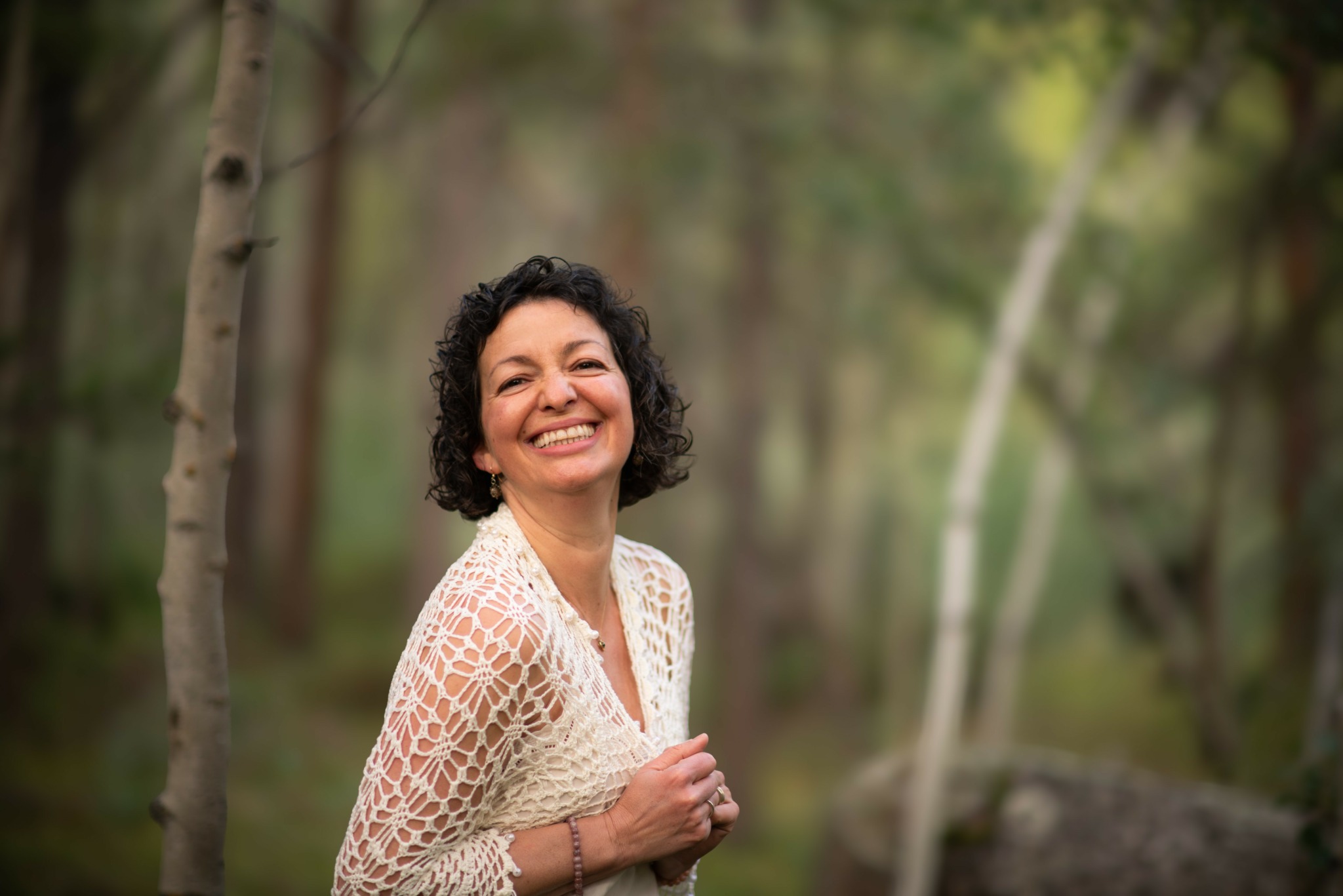

We caught up with the brilliant and insightful Galina Denzel a few weeks ago and have shared our conversation below.
Galina, appreciate you joining us today. Was there a moment in your career that meaningfully altered your trajectory? If so, we’d love to hear the backstory.
It was the fall of 2018. I had just returned from teaching an Emotions and Food Retreat in Europe—one of the first retreats where I applied my somatic skills to support women struggling in their relationship with food.
On this Monday, I was in my studio. My movement and bodywork studio was an oasis I had created both for myself as a practitioner and for my clients—a safe and nurturing environment where their nervous systems could land and let down. I saw people with chronic pain and supported them through gentle somatic movement, structural alignment, and trauma-informed touch. This was what I was born to do, yet something didn’t feel right.
As I sat on the cushy floor, stretching my spine slowly and deliciously—my bow to the body and an investigation into what was happening—I discovered two things.
On one hand, I was still absorbing the goodness and satisfaction from teaching the Emotions and Food Retreat. My body felt the rewards of a job well done. My heart was expansive and warm, as if it could hold the whole world inside itself. A light, nourishing overflow poured out like a river of love.
At the same time, something else was happening in my body—something completely different. I felt as if the walls were closing in on me, as if my beloved studio was crushing me. It was like an energetic earthquake—walls closing in, the floor collapsing—and I felt too small to do anything about it.
As a somatic practitioner, I pay attention to what my body communicates, but this experience stumped and confused me. This was the oasis I had created to grow my practice, to help people individually, just as I had always dreamed. And, as an immigrant to the U.S., this was my first business—the place I was proud to call a home for my work. Hundreds of people had received my care here and gotten better, returning to lives with less pain, more freedom, and more joy. Doctors in the clinic relied on me. Whole families came to me for help, and I loved supporting them all. So what on earth was going on?
Whatever was happening—if you picture the Johari Window—it was either a great unknown or a blind spot. I could feel something shifting, but I had no context for understanding it.
The ancient Greeks saw creative genius as a divine force—an external daimon that temporarily possessed and inspired a person, rather than something they owned or controlled.
In that moment, when the walls were closing in on me, I was being visited—perhaps for the first time—by a divine force that had other plans for my career. This is not to disown, minimize, or externalize my own dreams or creative desires, but to name more accurately what I experienced at the time. I had no idea what I was being called to do next, but that didn’t stop the daimon from visiting me.
As I write this, I remember the words of one of my teachers, who had lovingly confronted me a few months earlier:
“Galina, you keep telling me how much you love your studio and how much you love working with people with neuroplastic pain, and I know you are sincere. But I really think your studio has become your hiding place. There is more you want to create in the world, and this place will soon be too small for you. You can’t hide forever, you know?”
At the time, I thought she was confronting me for no reason—I even felt a little attacked. But looking back, her directness was exactly what my developing professional, creative self needed—an honest guide.
That night, I went to bed and had a dream. In the dream, I was in my studio, but the outer walls were the covers of a book—splashes of watercolor and italic letters. The book grew and grew, pushing the studio’s walls inward.
Claustrophobic and gasping for air, I woke up. And I woke up clear.
The puzzle had been solved by the dream-maker.
I had already started writing my book, Peace with Self, Peace with Food, based on my personal experience recovering from disordered eating. While I hadn’t set out to study Somatic Experiencing, NARM, or Somatic Practice to heal my relationship with food, after immersing myself in these modalities, my lifetime war with food and struggle with body image dissolved.
The retreat I had just returned from—the one after which my studio suddenly felt too small—was the third retreat where I had shared the same skills, tools, and insights that had given me peace with food and my body.
For most of my life, I had used food both to express and suppress my trauma. I had no idea there was a path to resolving these painful patterns, let alone one that had nothing to do with food, body acceptance, or body neutrality.
After the dream and the clarity it brought, I committed to writing my book—every morning at 5 a.m. for an hour and a half before work. It took another couple of years to find the perfect designer, one who could create the watercolor cover and illustrations just as I had seen in my dream, and a photographer who could give my book a body.
Partnering with Eli Nam and Debbie Baxter, and later my artist aunt Dina Papadakis – it took me and three artists to give my book life.
And that’s how Peace with Self, Peace with Food became a book, a method, and an online school.
Today, in 2025, I teach programs that help students create their own path to peace with food—one that honors their history, their body, and their dreams. In our team of 6 we mentor, support, and guide our students and I am so proud of what we are creating together.
I ended up closing my studio just six months after the dream of the walls crushing in. The creative genius that visited me wouldn’t have it any other way. I’m glad I listened.
As always, we appreciate you sharing your insights and we’ve got a few more questions for you, but before we get to all of that can you take a minute to introduce yourself and give our readers some of your back background and context?
Today, I am most proud of teaching a modality which honors the genesis of disordered eating.
I founded Pure Belonging after several years of teaching this work in retreat format, with the dream to get the peace with self peace with food message to more people who needed freedom from the trauma adaptations that lead to food suffering.
See, nobody gets an eating disorder because life was easy.
We end up struggling with emotional eating or disordered eating because this is how the body expresses or suppresses its suffering.
Without an understanding of trauma – shock, developmental or sensory system related, it’s very hard to make sense of why one struggles with food.
What we do best in my school is provide people not just with information, but also with a safe space where they can practice in small groups and individually the tools and skills which help reconnect them with their nervous system.
The nervous system is a unique compass with which to navigate our internal world – and I am so glad we have developed a method to address food suffering without asking people to restrict, go on specific diets or accept certain ideologies.
Working with the nervous system and the adaptive strategies which arise due to trauma imprints is the most intimate, honest and true way that I know to get to peace with food and one’s body.
What I want everyone to know is this: while there are no fast fixes and hacks to get to a place where you can listen to your body and respond in an attuned way, there is a clear path which can be followed. If you feel drawn to the language of the body, and to somatic work in general – what I teach may be just the right path for you.
At Pure Belonging we believe that something as seemingly simple as transforming our relationship with food has the power to free up enormous energy for life, connection and love, and that people suffer unnecessarily not just from the food behaviors like emotional eating, restriction and the eating disorders associated with them, but from the secondary harm of who they believe they are and what they can or cannot do, because of those behaviors.
When our relationship with food heals, all our relationships heal. We revolutionize what our students believe about food behaviors through providing empowering education, tools and processes to balance the nervous system, and by fostering authentic connection and community support. We make it possible for everyone to understand, have this information, feel empowered by it and trust to apply it. Healthy relationships, fun, play, connection and community become a springboard for building a life of embodied spiritual, mental, emotional, and physical health.
We do what we do with one idea in mind, that healing from emotional eating is meaningful: for the acceptance of self as we are, for our belonging to life and nature, and for our legacy of peace with food for our children and future generations.
One of the questions I ask myself all the time is? What is the right moment for this person sitting across for me to begin this work and where shall they start?
Some people begin with. my book, some with a 2 hour workshop, others come to a Master Class or dive. deeply into our 7 month intensive program and I am proud that I have a way to connect with my potential students no matter where they are in their journey.
Some people ask me why I don’t just do my work 1-1. It’s because relational trauma needs a relational space to repair. I can say honestly that I choose the kindest, most wonderful and good people to be in my groups and that as each of them learns our 12 principles for group communication – that we can build a field for healing that is like no other out there.
We also offer 1-1 work with my mentors, because a hybrid model works really really well, but I want everyone to know that the group field is magical and I will always include a form of group work in my school. This is also what was most missing for me when I was doing my healing – and I can tell you that my shame, self-blame and feeling bad about myself would have melted sooner if I had been with the kinds of people who are in my groups today.
Do you have any insights you can share related to maintaining high team morale?
I think being a leader is all about personal growth first and about leadership growth second. When I first formed my team I was a baby leader – scared of delegating, addicted to my idea of perfection, and terrified that my students would leave me if someone else was doing the 1-1 work.
At first glance it looks like these are all legitimate concerns, but addressing my fears through a therapeutic lens first, and then through a business coaching lens was really key.
It’s with my personal therapist that I was able to meet the vulnerability of loss of control and the knowledge that my fear had nothing to do with my team, and everything to do with how I kept myself safe. It’s with my business coach and CFO that we could look at the hundreds of hours that my team could work, so I could focus on writing the next book, creating a new program and helping more people.
I think maintaining high morale for me is three things: 1) having high expectations, but providing the training that makes meeting those expectations possible 2) showing appreciation, staying interested in my team’s process and staying open to learning from their experience working with our students 3) being able to make difficult decisions based on the values of my company, even when they are hard on me, on the team or on our students.
Can you tell us about what’s worked well for you in terms of growing your clientele?
For me, what’s helped most is offering my live presence to my readers and potential students.
Once a month a teach an introductory workshop live which shares the main ideas of my work and also allows readers and potential students to immerse themselves in somatic practice with me.
This gives people a chance to get to know me and see if they would like to continue further in our school.
Another amazing draw for new students is hearing student interviews with graduates. It has really been an honor that so many of my students have been willing to be interviewed and to share their experience so they can inspire others.
Those interviews are sent in my newsletter and also some of them live on my website.
Contact Info:
- Website: https://purebelonging.com/
- Instagram: https://www.instagram.com/galinadenzel/
- Facebook: https://www.facebook.com/purebelonging/
- Youtube: https://www.youtube.com/@peacewithselfpeacewithfood
Image Credits
Debbie Baxter, Mariah Ehlert