

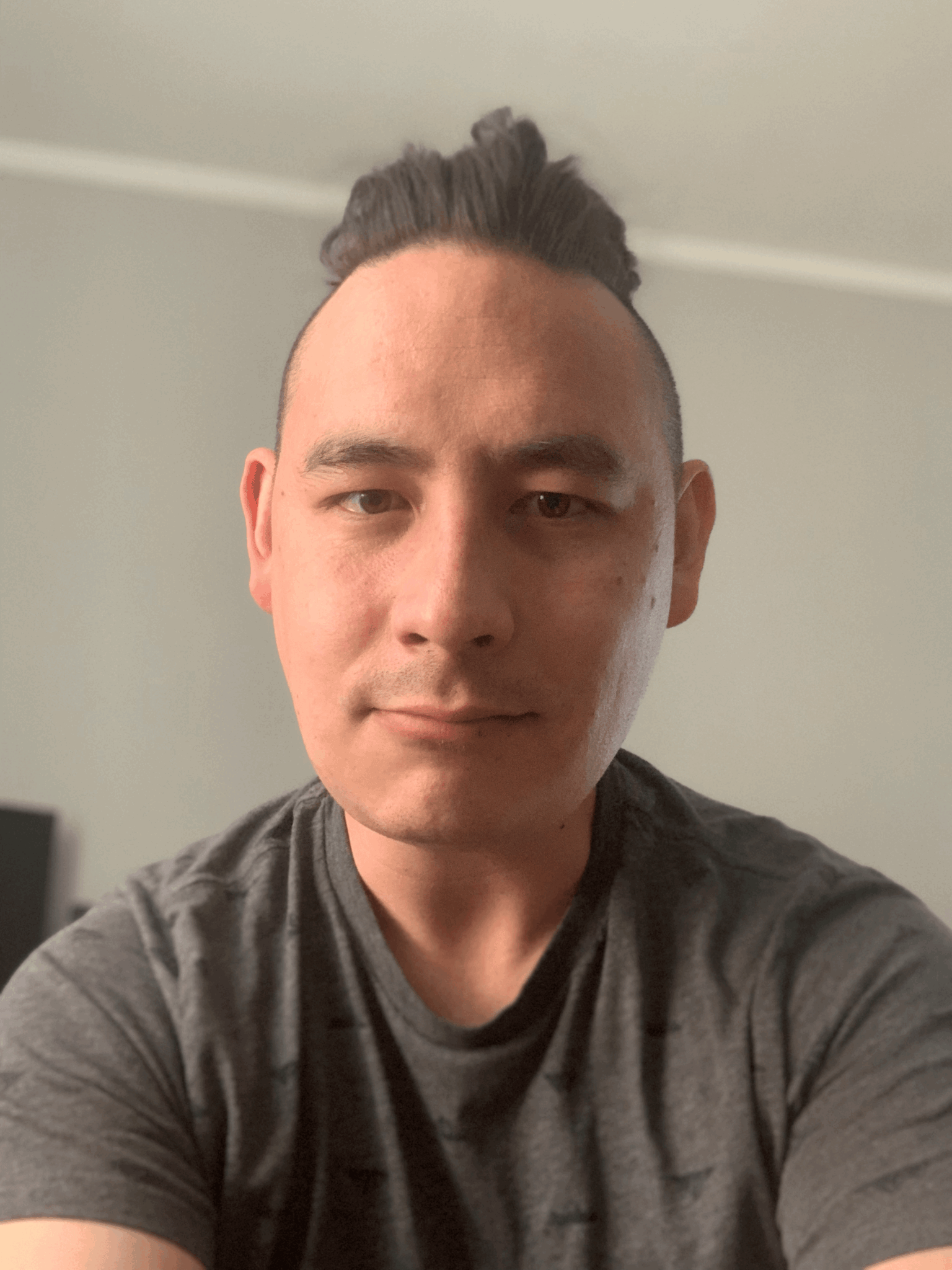

We’re excited to introduce you to the always interesting and insightful Fin Coe. We hope you’ll enjoy our conversation with Fin below.
Hi Fin, thanks for joining us today. Can you talk to us about how you learned to do what you do?
I’ve been writing my entire life.
That doesn’t mean I’ve been writing well that whole time, or that I’ve finished many projects, or that I don’t look back on my past work with dread and despair – but all of the shoddy, unfinished, derivative, voiceless work my past selves created still built up a foundation of habits. Some good, some bad, but it was all reps, all experience. And I can accept my awful early output as the meandering but necessary exploration for my artistic voice. It’s all led me to my core belief in writing: Whatever you do, do it on purpose.
When I start a project, I can start with any of these, but eventually need to answer all of the following:
– Is this a product? Something that I intend for broad appeal, clear marketability, and ease of deliverability? Or is it something for me first, the public second, and profit a distant and optional third? When I know which it is, I can set my expectations accordingly – I know how much time and resources to devote to a personal passion vs something for consumption; I’m very open to feedback with a product, because there’s less of my artistic self under scrutiny; I can attract and properly compensate the right kind of collaborator based on which outcome I’m working towards.
– What medium does this project belong to? When I taught playwriting, I encountered scripts that were better suited to the screen than the stage, or stories that could take fuller advantage of a purely audio medium. My own early prose fell prey to this pitfall, and learning about the different strengths and weaknesses of each form allowed me to better suit my stories to maximize that potential. It’s not impossible to adapt a story to any medium, but a song is made to be heard, and while you can turn that artistic impulse into a sculpture, you’re working against yourself.
– What is this in conversation with? As a younger writer, I strove for perfect originality; hearing vague thirdhand mention of a project that had anything in common with one of my ideas was grounds for me to abandon it under a cloud of gloom. I now understand all art, no matter how innovative, as being a part of an interwoven continuum of ideas. It has not stopped me from trying to stand out, but I no longer self-censor for fears of being insufficiently novel. After all, the idea itself is cheap – ideas simply come to us. It is the work, and the discoveries I make in the undertaking, that are uniquely me. And acknowledging that my work has inspirations and may some day inspire others, allows me to be clearer about what I am trying to say with each piece.
Awesome – so before we get into the rest of our questions, can you briefly introduce yourself to our readers.
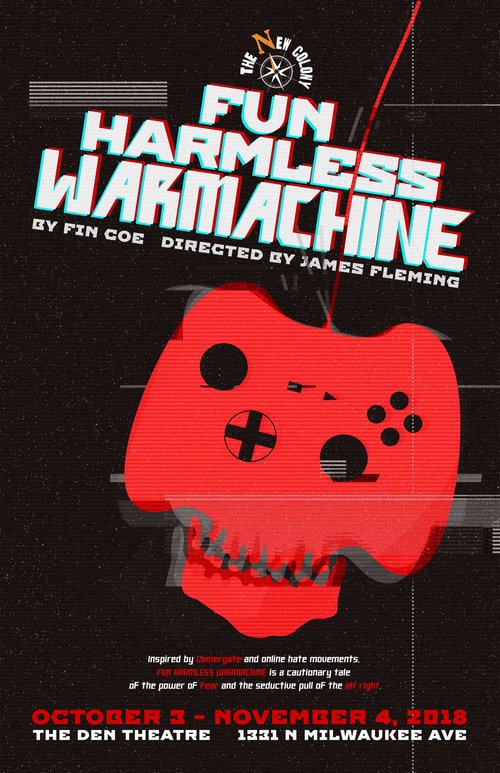
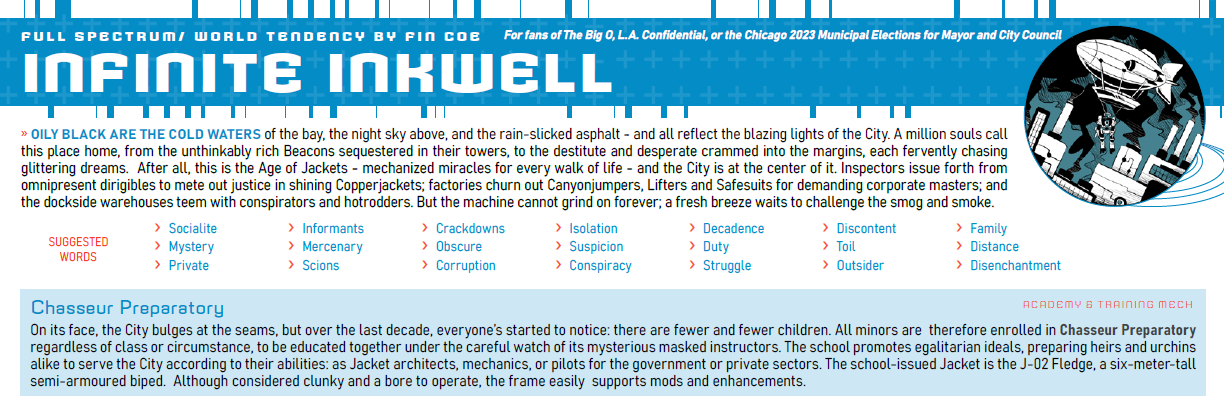
My name is Fin Coe and I live in Chicago, doing copy and technical writing by day, and writing for the theatre and tabletop games by night. Since coming to Chicago back in 2010, I have written sketch comedy, theatrical reviews, and short and full-length plays. More recently I’ve been able to teach playwriting, moved into a writing role in my professional capacity, and have written for small-press tabletop roleplaying games. I’ve worked for independent groups, storefront, not-for-profit, and across multiple industries, and my passion for the collaborative generative process, and refining through collective feedback, is what drives me.
I love discussing and sharing knowledge of the craft. Absolutely nothing I have ever made has not been tremendously improved by the time and feedback of test audiences, fellow cohort members, editors, the performers of my work – everyone who touches my work, no matter how lightly, has shaped it.
I also want to meet people where they are – when someone hasn’t read or seen or experienced a piece of art, my reaction is not to shame them for not already knowing it, but rather to rejoice that I get to share one of my favourite things with someone who has the once-in-a-lifetime privilege of experiencing it for the first time.
How about pivoting – can you share the story of a time you’ve had to pivot?
I am in my jock era and finally making art again.
Let me back up a bit. In 2023, after many attempts to steer my storefront theatre company back to financial and organizational health, it finally became impossible to deny: the company could not go on. After years of trying and failing to be the leader the organization needed, months of slowly winding down and putting down something that had given so many people joy and an artistic home, and after having to announce the closure of an inheritance I had been granted stewardship of, I did not want to make plays. I did not want to see plays. I didn’t want to think about plays, I didn’t even want to remember plays that I had loved, because I was simply one enormous raw nerve. I became emotionally paranoiac, assuming that everyone blamed me as much as I blamed myself. I had also been stuck indoors for years – and now I was stuck in my head.
So I started playing hockey. I had loved the sport as a child, learned to skate as an adult, and then largely put it aside to focus on my organization. But without that occupation of my mind and time, I was adrift, and I needed to get my feet moving. So that’s literally what I did. Healthy or not, I put off processing my artistic grief by transferring all of my eggs from the burning theatre basket and into a faintly ridiculous hockey basket. I say ridiculous because the level of hockey I play in is worse than whatever you’re picturing. I’m about twenty-five years too late to try and Make It. There’s no one in the audience, and we don’t change anyone’s lives or minds. The culture, especially coming from the arts, is either non-existent or actively atrocious.
But I was working on something, on myself. I was pushing. I was committed to something, I was feeling something. I was socializing, connecting, talking about growth and skill development. I found community and camaraderie, and my body felt less like a trap and more like an instrument again. And over time, it remembered what kind of music it was best suited to make.
Now I play hockey and write. Perhaps time would have healed the wound, but my sharp turn towards being a bro helped that hurt to scab over. The permission to be a novice again, to be a teammate rather than the leader, to fail without serious consequence – all of that helped me find my way back, wiser I hope, and able to avoid repeating my mistakes.
What’s a lesson you had to unlearn and what’s the backstory?
In the years prior to the Me Too movement and the social justice protests around and after 2020, the theatre scene in Chicago had already been grappling with how to handle abuses of power and put agency back in the hands of the marginalized and disenfranchised.
In an effort to be a good ally, I and many others in the community tried to find sets of rules to follow, and problematic terms, issues, or actions to avoid. But this was a shortcut – the evolution of an artistic community cannot be determined by a checklist. It requires constant discussion and revision, and buy-in from the community must be continually renewed. Most importantly, these issues raised complicated questions – and rather than trying to get around them, we needed to confront them head-on.
It’s temping to treat “Don’t Do Bad Things” as an unassailably correct idea, but it’s an incomplete one: one that results in doing fewer and fewer things because inaction is always easier.
What I learned the hard way was that every “No” must be accompanied by both a “Because” and an “Instead”. The alternatives may be difficult, limited, or even untenable, but problem-solving cannot happen by simply not engaging with a problem.
Contact Info:
- Website: https://www.velocimancer.com
- Other: BlueSky: @fincoe.bsky.social
Image Credits
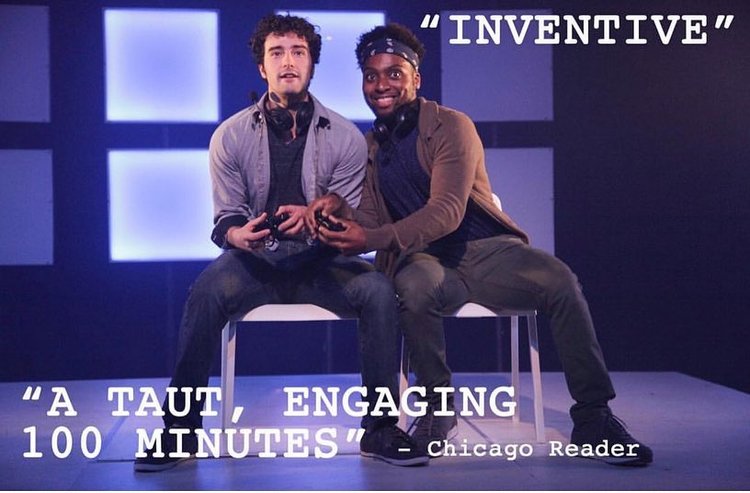
Fun Harmless Warmachine publicity photo by Elizabeth Schwartz