



We’re excited to introduce you to the always interesting and insightful Emanuel Grigoras. We hope you’ll enjoy our conversation with Emanuel below.
Hi Emanuel, thanks for joining us today. We’d love to have you retell us the story behind how you came up with the idea for your business, I think our audience would really enjoy hearing the backstory.
Most businesses that make it to the point where they have paying customers start with the awareness of a need – personal or perceived in others. I just moved to Canada and I was at the Toronto Public Library across the table from my friend, a professional writer. I just cashed in my once in a lifetime favor: feedback for my first English written novel. It was a painful experience, but, as he analyzed and explained the structure, hero journey, timeline, characters’ motivation and needs, my project manager alter ego was painting a different picture: I could make a software out of this.
It took another three years of research, going to industry related events, writer’s conventions, long conversations with famous professional writers to understand that no matter the status quo maintained by a publishing industry frozen in place, people were finding new ways to write, read. They did not even fought the behemoths anymore. They just went around them.
We looked and how the money were flowing. How writers and bookshops managed to retain more than the less than 20% breadcrumbs left by the big 5 publishers. The only way to move around the greedy monopolies were better tools. The people that were telling the story and the people that were selling that story to the reader started to discover that they could do it without the intermediaries.
While we could have done more, we were a group of middle aged people with fulltime jobs and families. We couldn’t just drop everything and follow the raving startup dream path. We decide to build a tool that covered just one phase – from idea to ePub – and focus on users that value time and need structure.
We weren’t the only ones offering writing solutions, but we could become the always open browser page for people wanting to have their research, character and location files, manuscript and other artifacts in one place, people which also understood the benefits of a project management approach. People for which time was a limited resource and wanted to get things done in an efficient way. Writers that wanted to finish their books there is.
Great, appreciate you sharing that with us. Before we ask you to share more of your insights, can you take a moment to introduce yourself and how you got to where you are today to our readers.
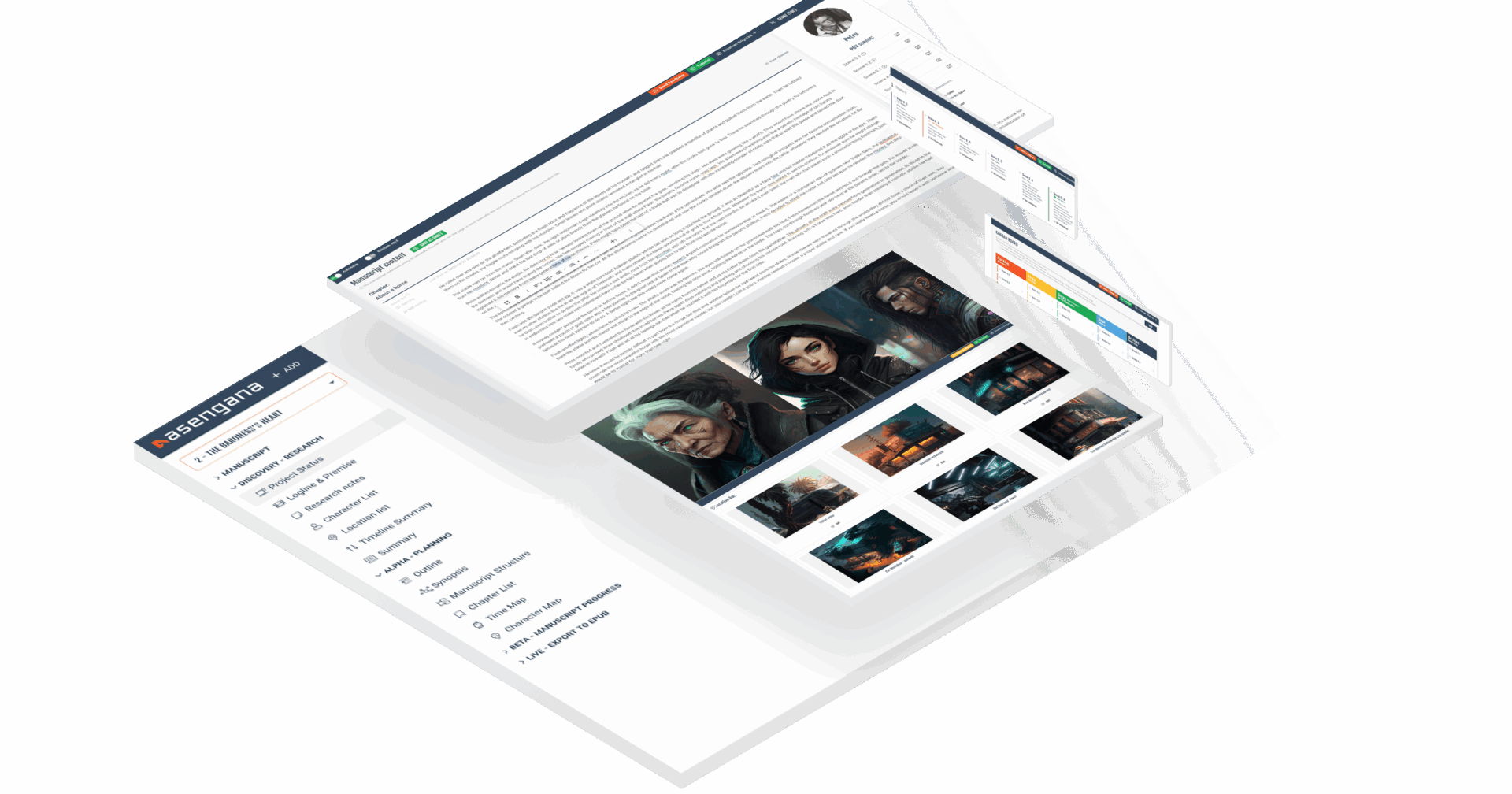
We started Asenagana from the need to have a better way to write books. We’ve built one platform with all the productivity tools you need as a writer in order to plan, write and actually finish your novel. Our backgrounds are in various industry as most of us changed at least once their career paths.
No matter if we started as lawyers, graphic designers, creative directors, or engineers, we all put on different hats required to build an online digital project and end up becoming part of a writer’s beautiful journey.
Now we can tell them: we’re here to support you. Start a new project – short story, novella, or novel. Do your research. Confidently plan for the elements of your book, no matter how complex: idea, outline, synopsis, plot structure, characters and sensory mapping of locations. Write your book. Use a Kanban to manage your time and your progress. Create your eBook. Start the next one.
How did you put together the initial capital you needed to start your business?
When you start something with the purpose of creating a disruption in an industry and offer new and hopefully better ways of doing things, you have two choices:
Use external resources: investors, borrowing vehicles, etc. You set a formal office, hire the specialists you need, generally have a minimum structure/physical presence that comes with specific costs: accounting, payroll, and so on.
Bootstrap: work with the resources you have. Prepare to split your life in three: professional life, personal life, and your start-up.
We chose to do it ourselves because we weren’t looking at burning strong and fast. We want it to build something that will work, will be low maintenance, and will last with full functionalities even if we decide to stop growing and just have it going indefinitely. It was about building a product to be used as long as we use human bodies and computer interfaces.
Time: while you’ll work full-time so you can make money from which you’ll allocate a part to your start-up, the personal time and your sleep will suffer. When you have a family, it’s mostly your sleep that gets cut.
Money: you have to explain to your significant one that you’ll take a risk and you’ll use a percentage of the money that should go into the household for your idea. You’ll start cutting your personal expenses and become a minimalist – you’ll stop indulging in 99% of the things you liked. My business partners and I were lucky. We got people in our life that are supporting us.
Health: Stretching your mind and body’s limits will take a toll. You’ll have many moments when you’ll just fall in a chair with your mind numb and your body aching for just one more minute of sleep asking yourself if it’s all worth it.
How’d you meet your business partner?
I’ve worked for many years as a project / product manager building digital products and solutions. Hundreds of projects and hundreds of people. With some of them, you built closer connections and when you tell them about your dreams, sometimes they will say: let’s make it happen.
We started with a lot of knowledge from previous jobs or from running other companies. You know how they say that you can chose two out of free: quality, low cost, speed? We decided to give up on fast. We gave Asengana the first place in our life after family and career.
Business knowledge: legal, strategy, finance. You have to create a business entity, to cover all the administrative needs for it to exist and function. You also need to decide how you will structure your five-year plan of developing a digital value chain to cover the entire publishing industry. What to develop first, how to price the services you offer and when to change that to fit your needs.
Industry knowledge and research: What the industry is missing or doesn’t get right and how professional writers are really writing. There is always a reluctance about the secrets of a trade. It takes time, perseverance, and a lot of luck to get them talking.
Software development knowledge:
UX and UI expertise – how a SaaS (Software as a Service) should look and work. How it will look and how will include all the needs of a writer to get to the final draft (this is our goal for the first phase)
Back-End and Front-End development
Technology (hosting, backups, security, etc) expertise
Graphic Design
Project management
We cover all these functionalities with a small team. It helps that we have experience in various domains and as core belief continuous learning.
Our fifth team member is the youngest and the one with the most interesting story. While we knew each other for years, we decided that we need a new developer. We found him online and we talked to him. He was knowledgeable but he also had that kindness that we all have. The fours of us worked on and off for the last 15 years and we never had the smallest argument.
The initial plan was to have him as an employee, but we’ve let him talk about how he will like to move forward with development first. He had his own ideas and they were different or even contrary to what we had. When he finished, we told him that we will scrap what we have and do everything the way he wanted it. Also, how about becoming a partner? If I look back now, we took a decision that might seem risky in 30 minutes. We never regret it and we’ve been friends and partners ever since.
Contact Info:
- Website: https://asengana.com/