



We were lucky to catch up with Drew Miller recently and have shared our conversation below.
Alright, Drew thanks for taking the time to share your stories and insights with us today. How did you learn to do what you do? Knowing what you know now, what could you have done to speed up your learning process? What skills do you think were most essential? What obstacles stood in the way of learning more?
After leading research and design teams for more than 10 years across a wide range of problem spaces at the consultancy frog design, I made the move to lead an in-house product design team at OJO. Based in Austin, TX, OJO provides a digital marketplace for home buyers, sellers, and owners to meet people wherever they are on their journey, offering personalized guidance every step of the way, including connecting them with a network of more than 30,000 real estate agents. Jumping-in at OJO, I was thankful for frog design’s rapid immersion and research-driven process, applied to often complex ecosystems, to help the design teams and frog’s clients to quickly develop bold new product visions. But while this experience helped me quickly ramp up to the complex real estate space, I quickly realized that my “craft” and design process would need to change dramatically.
OJO’s marketplace is driven by an underlying technology that is “fed” by real-time data like consumer behavior collected on our residential real estate search site, or by our tech-enabled connection specialists – real people who engage with our consumers directly. Our technology is also informed by the local market conditions, and the real-time performance and engagement of our Agent network. All this comes together to mean that we must provide both our consumers and real estate agents with great experiences, but also collect as much “signal” as possible to power and improve our two-sided marketplace.
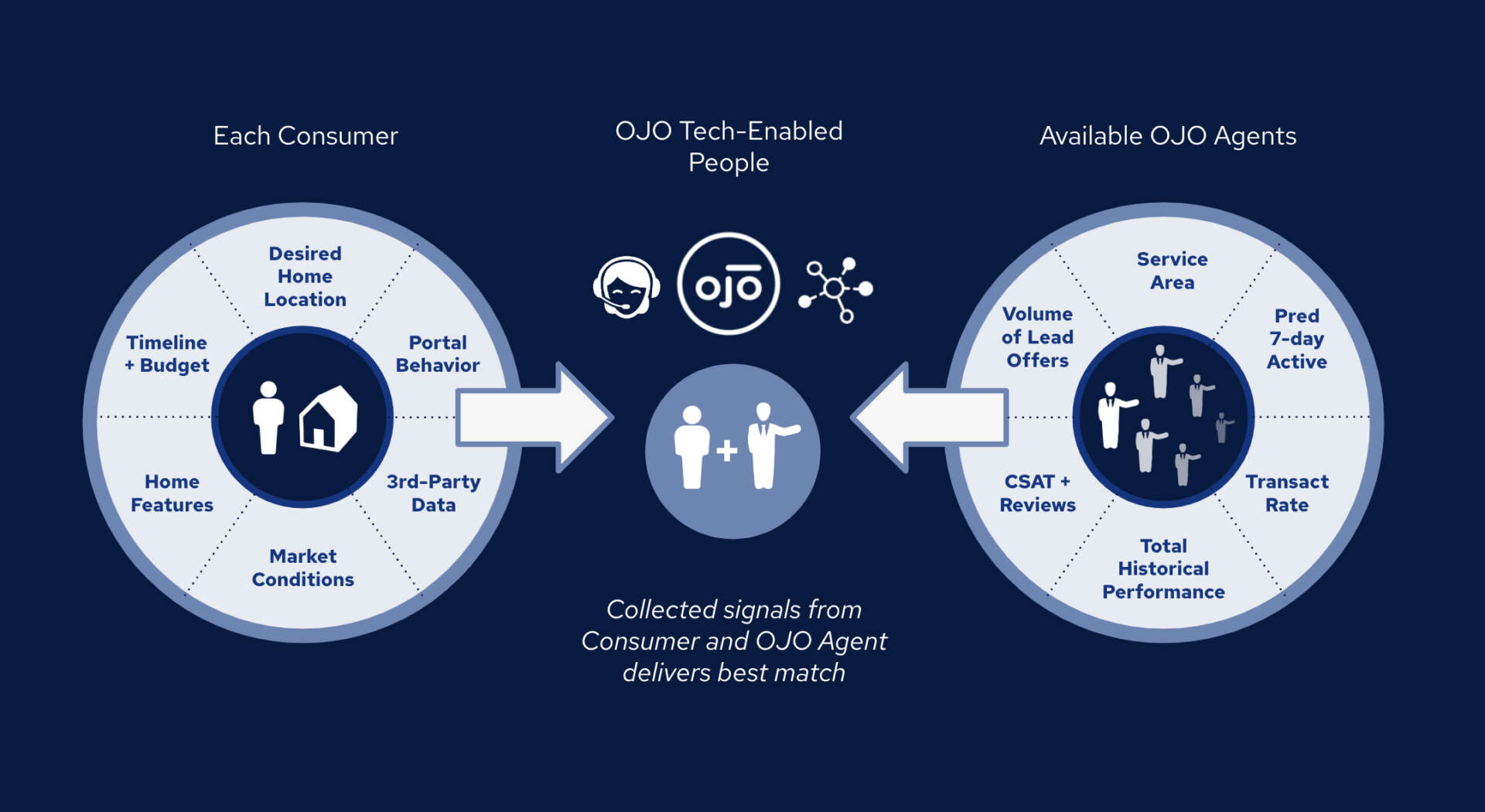
For my team of product designers, research insights – a sense of our users’ goals, needs and wants, successes and pain points within the experience – remain an incredibly valuable tool in our toolbox. But my team must also develop a fluency in the language of data – the funnels and branches of acquisition, engagement, and conversion – found throughout the product journey of the marketplace. This balancing act requires a very special kind of product designer – one who is not just comfortable, but is excited to be thinking with both sides of their brain – constantly rebalancing to build successful products. And as a leader, it requires me to learn (and re-learn on a daily basis) how to speak, direct and guide in a very different language than I was accustomed to. Thankfully, my partners in product, marketing, and engineering – are patient teachers and willing collaborators who teach me something new every day.
Awesome – so before we get into the rest of our questions, can you briefly introduce yourself to our readers.
I feel incredibly lucky that at each step in my career, someone looked at my resume – and was willing to take a chance on someone that didn’t quite fit the role. These chances taken, allowed me to bring a diversity of experience to the problems we would solve together, and personally grow faster with a broader set of context points to pull from.
Growing up surrounded by creatives on my mom’s side, and my father a successful design-build contractor and real estate developer – I straddled the two canoes. An “art-kid” who worked summers and after school on job sites and the drafting room – I got to college and fell head-over-heels for architecture. It opened my eyes to a new form of artistic expression, that used inhabitable space as the canvas, and aesthetics, engineering, and experience as the brush. It also introduced me to new digital technologies used to help architects externalize the spaces they envisioned behind their eyes. This passion for the design of physical space began to mesh with a recognition that newly-accessible technologies were also helping everyday people construct and navigate new interconnected “information spaces” – and that “architects” could play a huge role in their conception. As example, my graduate thesis at MIT used a digitally-hyperlinked but highly visual data space – to explore how the building design of 20th century architects informed their own furniture designs, but also how the technological advances of their time allowed them to build on each other’s previous innovations.
After graduation I got that first break – and was offered what felt like an obscure opportunity to design enterprise software UIs for configuration, pricing, and commission tools at Trilogy, a modest-sized company in Austin, TX – a city in a state I’d never been to. As the Web was emerging as a real consumer shopping channel – the company’s enterprise software quickly remixed into consumer-facing e-commerce tools that helped car shoppers (among others), configure their dream car and buy it completely online. Over the following 8 years I helped expand those consumer web-based automotive tools beyond configuration into local dealer inventory search, lead generation, and eventually predictive demand-sensing for many US and International carmakers.
Looking for a broader design opportunity, a former Trilogy friend introduced me to then frog design Global President and fellow Austinite, Doreen Lorenzo – who is now Assistant Dean at the University of Texas, School of Design and Creative Technology. Again, luckily – she and Mark Rolston – then Chief Creative Officer of frog (and now founder of Argo Design) were willing to take a chance and bring me on as a Principal Designer. Over my 10+ years at frog I was fortunate to get to work with a number of great companies like AT&T, Honeywell, Disney Parks and Resorts, and a host of healthcare, pharmaceutical, and insurance companies. frog design taught me how to build the right teams that could bring creative technology-and people-driven solutions to solve tough problems in complex ecosystems. It was a great education that prepared me for my shift into the real estate space at OJO.
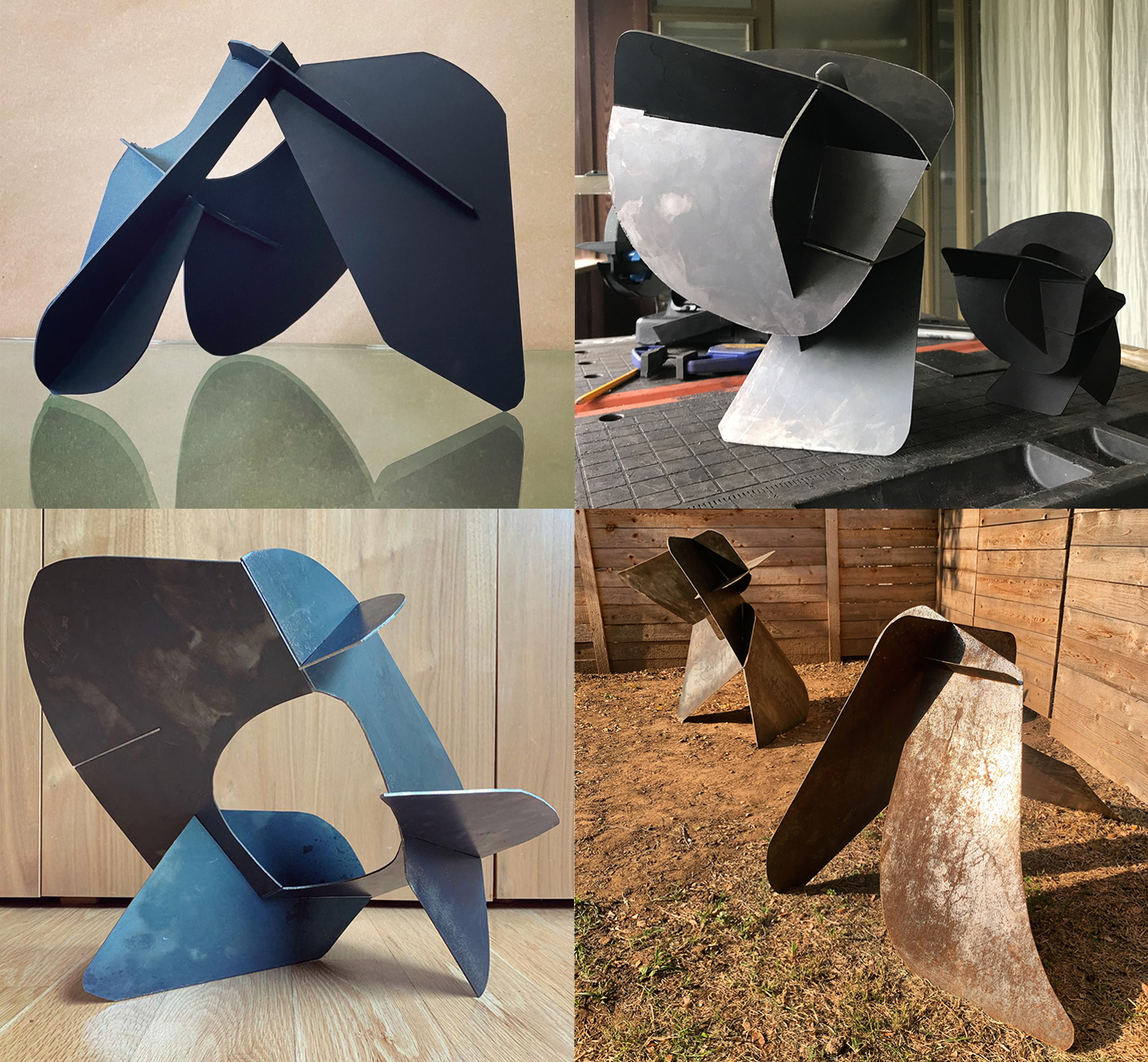
An odd thing – a few years ago I had an unremarkable accident that resulted in a surprisingly problematic concussion. During the frustrating month-long recovery in which I was told to avoid all screens or pages, I found that one of the creative outlets I could manage was to create small table-top sculptures of intersecting and slotted cardboard. Having studied minimalist abstract sculpture for a museum design project in graduate school, I was deeply moved at the time by the two-dimensional graphical qualities of these mostly monochromatic 3D constructions when viewed from different vantage points and lightning conditions. As I began to explore these concepts in my own pieces, I came to enjoy the almost meditative act of finding a balance between what was compositionally pleasing and structurally stable. Over the next several years, my cardboard constructions scaled-up into hand-cut-and-assembled free-standing steel constructions, and the relationship between the viewer’s body and the space they inhabit together, became a story I loved to tell. In a sense, their balancing act of experiential composition and technological utility are emblematic of both architecture, but of the digital products that my teams at OJO work to deliver every day.
We often hear about learning lessons – but just as important is unlearning lessons. Have you ever had to unlearn a lesson?
The lesson: Spacious, minimal, and clear UI design does not always make for a successful product experience. Huh?
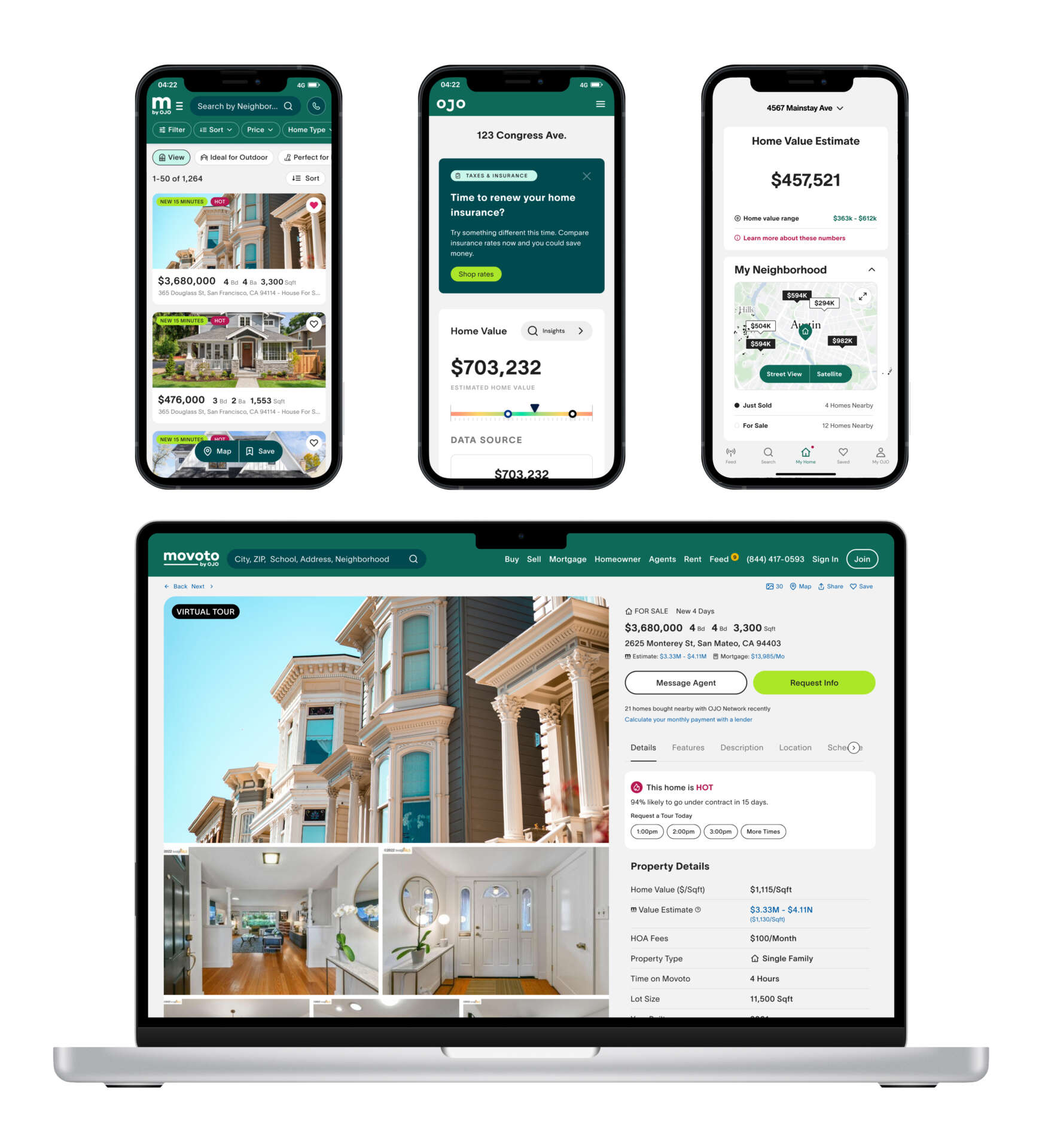
Early at OJO, when diving deep into UI improvement exercises for our consumer real estate search site , Movoto.com – I got patiently “schooled” by my seasoned product partners on hard-fought best practices for successful online acquisition, engagement, and especially conversion. As we worked together to redesign our main for sale property page it quickly became clear that not just my vocabulary was lacking, but that my UI designer’s compass was off. To my unfortunate surprise, my usually dependable visual and interaction designer’s intuition that led me towards a spacing-out of the overall page design, reducing both the volume of data and the competing calls to action – hurt rather than helped our product’s conversion efforts!
After many A/B tests I learned that like many things, a balance of competing goals needs to be found. First, a clear understanding how our consumers prioritized and processed the information about the home, was necessary to appropriately structure it. Second, search engines were also a primary customer, and pages needed to be structured in a way in which they liked to crawl and consume. Third, the right calls to action must be easily found, and their language needed to appeal to customers with different intents or at different stages of their buying journey. But most importantly, a mix of real consumer feedback and correctly instrumented iterative testing was the path towards finding that successful balance and retraining my intuition. Never stop learning, or be willing to re-learn what you think you know.
Have you ever had to pivot?
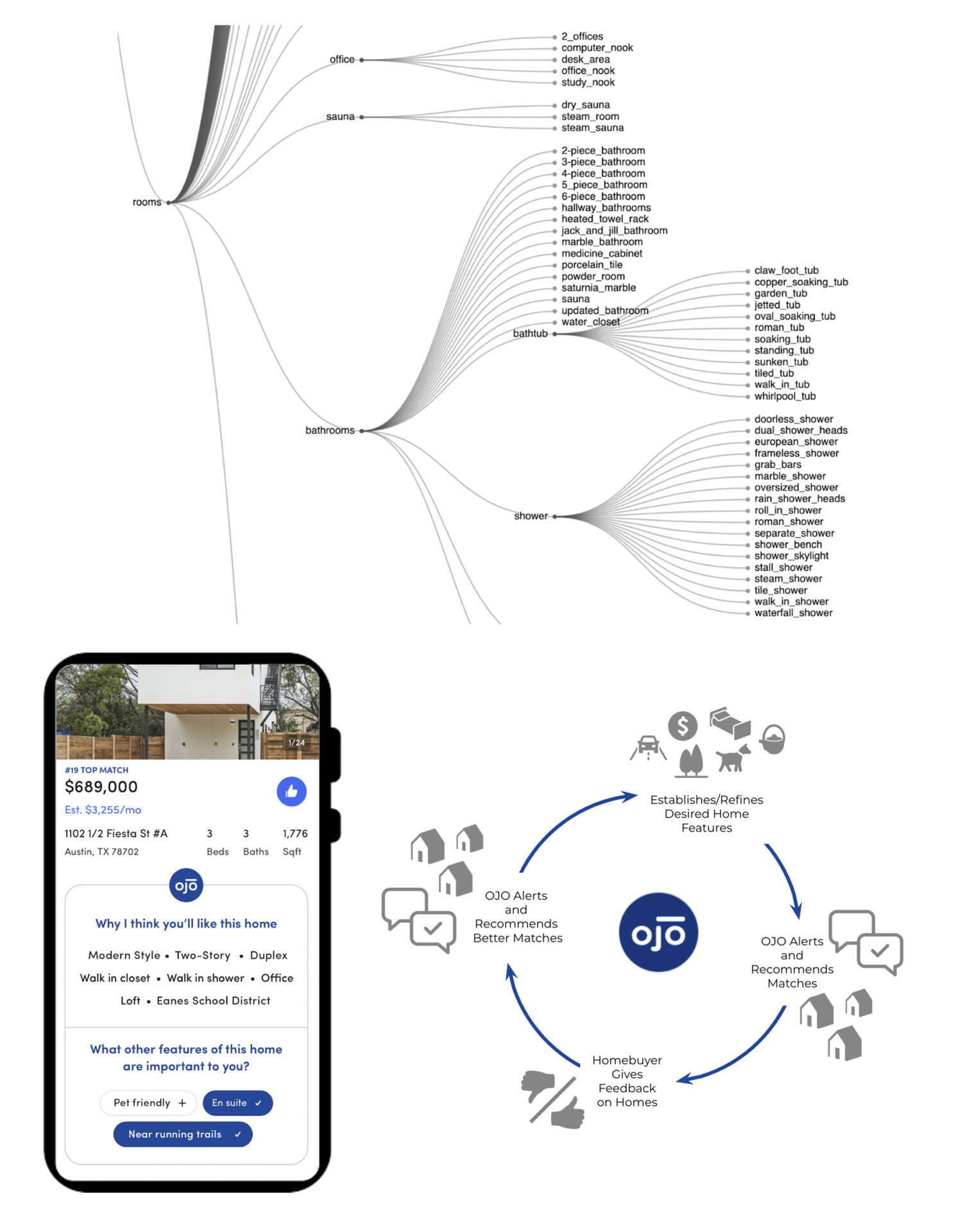
At OJO – one of our initial consumer-facing real estate app’s primary innovations was a powerful search and recommendation engine that indexed millions of descriptions of homes for sale from hundreds of Multiple Listing Services across the country. Once indexed, the engine would parse and normalize this data to derive a common set of more than 1200 home and neighborhood features that homebuyers might want in their new “dream home”. OJO was the only residential real estate portal where you could find a home with not just 3 bedrooms and 2 baths, but also with a “Chef’s Kitchen”, “Cathedral Ceilings”, “Lots of Light”, and that was “Staycation Ready”. Tell OJO what you were hoping to find and it would comb available home inventory 24/7 to alert you when homes with exactly those must-have and nice-to-have features that were important to you hit the market. It was a differentiated experience powered by cutting-edge technology. Consumers loved it and our product, design and engineering teams were thrilled to design, build, and bring it to life.
Then COVID completely up-ended the real estate market, for-sale home inventory dropped to 1/10 its normal levels. Buyers that could successfully navigate the bidding wars of 20+ offers, and could afford the 25, 30 or 40% premium over-listing prices – didn’t really care if they found their “dream” home – they just wanted ANY home. This dramatic change to market conditions made OJO’s differentiated search and recommendation engine less relevant to most consumer’s needs. While we could alert those that were still buying as soon as a home was available and match them to the best local agent, we needed to respond to this shift in market and buyer attitude. Many frustrated shoppers who did already own a home were digging-in, staying put, investing in making their existing home their “dream” home.
In this new consumer behavior, we saw a new opportunity. Rather than move, homeowners wanted to know and maximize the value of their existing home – whether “value” meant financial equity or making those upgrades, renovations, or additions they wanted or now needed. Alongside our buyer’s tools, we built a homeowner product – built on Digs, a small startup OJO acquired in 2020 – to quickly meet this need. Today we provide thousands of homeowners with a monthly home value report, help them track the mortgage equity they’ve built, keep on top of seasonal maintenance, and connect them with local professionals to help with everything from a leaky faucet to full-size renovations. Homeowners can also see how their home compares to those recently sold or newly listed in their neighborhood – inspiring their own projects or stirring a desire to make a move.
This shift was tough – especially on the design, product, and engineering teams who built the initial search and recommendation experience. But we all learned that the best experience and most cutting-edge technology is only as successful as the market that exists for it. And being nimble and responsive to the changing needs of your customer is the only actual path you can take. This outward focus drives our teams to always be thinking about what’s next.
Contact Info:
- Website: https://ojo.com/ https://www.movoto.com/ https://homeowner.ojo.com/ https://www.sculpturedrewmiller.com/
- Instagram: https://www.instagram.com/drewfmiller_sculpture/?hl=en
- Linkedin: https://www.linkedin.com/in/millerdrew/