


Alright – so today we’ve got the honor of introducing you to Don Sandusky. We think you’ll enjoy our conversation, we’ve shared it below.
Don, looking forward to hearing all of your stories today. What do you think matters most in terms of achieving success?
A generation ago, to build a branded consumer product the designer needed to manufacture, market, sell and fulfill directly. In today’s flat world, new products brought to market with that approach will likely get swamped by fast followers comprising a network of globalized colleagues. The innovator will likely watch as others create most of the financial value form the idea, leaving them disappointed and broke or worse. Today, the inventor needs to organize a globally competitive team (coalition of the willing) from the jump and build-in loyalty by ensuring that each member shares risk and reward. There’s suppliers, manufacturers, shipping, fulfillment, customer service, distributors, retailers, web stores, legal, accounting, tax… it goes on and on… Creativity is essential to recognize an unmet need and derive a new solution, but talents for persuasion and negotiation are essential to protect value for the creators but ultimately it comes down to each decision makers character. It’s never been easier to prototype a good idea and never more challenging to convert that idea into value.
Great, appreciate you sharing that with us. Before we ask you to share more of your insights, can you take a moment to introduce yourself and how you got to where you are today to our readers.
I’m a terrible entrepreneur, at the moment, maybe THE WORST. If an entrepreneurs purpose is to buy for X and sell for Y, where Y >> X, then the guy I saw selling water bottles outside Fenway Park two days ago is a far more successful entrepreneur than me, at the moment. By any rational measure I should have quit this current endeavor long ago. Even though I’m currently paying for my job, I do know what I’m doing, I can afford it and in the fullness of time, I may yet be revived.
I am probably an “ok” leader, and definitely have assembled a solid team around a solid sports product idea. We do know, for a fact, that we are adding stoke to peoples lives through novel sports gear, and we’ve been careful to invest in legal assets necessary to enable some elements of monopoly. In the context of the “Diffusion of Innovation” concept, we have delighted the “innovators” and are moving into the “early adopters”, so if we can survive long enough to reach the “early majority”, our financial rewards are inevitable.
In past lives, with different projects, I’ve been a good entrepreneur, and made it rain a few times. But for the last decade I’ve basically bought myself a stressful, complex and expensive job. Not quite caught in the “gamblers’ dilemma”, it’s been a long hard slog, yet there is light at the end of the tunnel and it could get really good… soon.
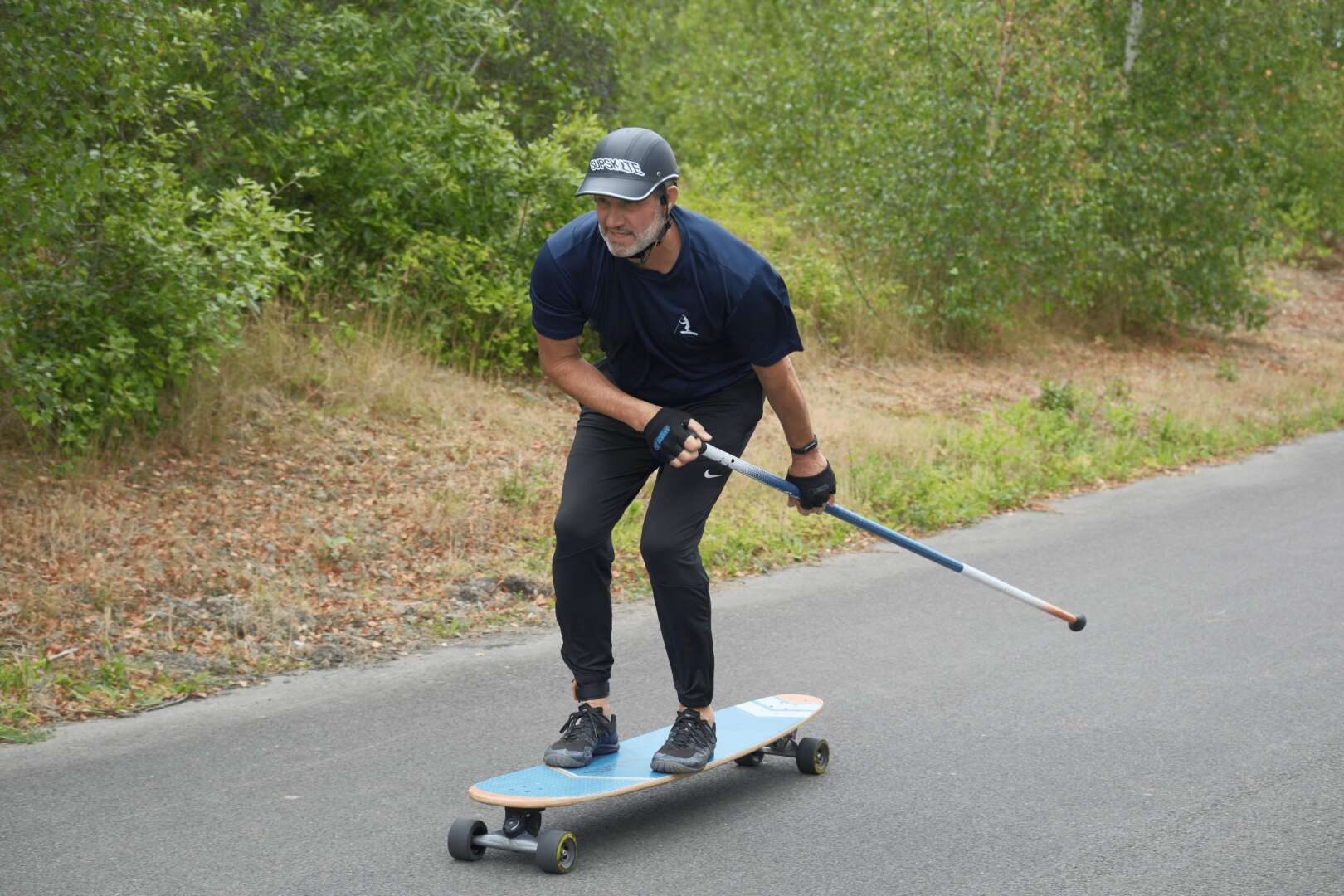
I own a small sports equipment business comprising three brands, Hamboards, SUPSKATE and HST Trucks. Some people have seen me on ABC’s hit TV, Show “Shark Tank” (Season 5, Episode 4), where we crushed-it and introduced our brands and sport to the American cultural zeitgeist. We sell mostly direct to consumer in the USA and via distributors in UK, Europe and Australasia. Our growth has come from cultivating community, athletes and competitive events. Our next growth phase will require our team to master code switching as we try to convince a broader set of people that our sport is accessible, fun and safe.
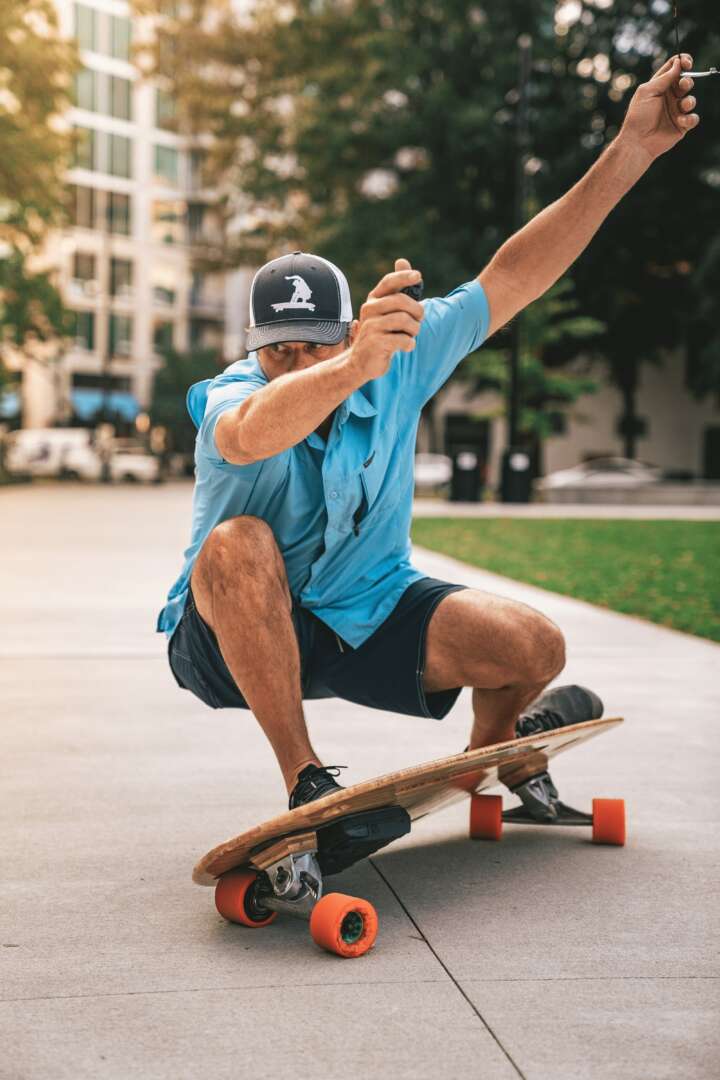
1) Hamboards are longboard surf skates designed for longboard surfers. They really feel like longboard surfing.
2) SUPSKATE are purpose built skateboards and skate poles designed for paddle board cruisers, surfers and racers.
3) HST is the enabling technology (turning mechanisms) that allows Hamboards and SUPSKATE riders to truly feel like they’re digging the rail into a wave (or an edge into the snow) with profoundly more board lean and turn than conventional skateboard trucks. You can’t “cheat” boards with HST trucks underneath. During carving s-turns, the riders center of gravity vector must remain perpendicular to the board deck and when it’s done correctly, the rider experiences an amazing connected sensation so they can propel themselves in a powerful and graceful manner.
The reader can learn from my journey, successes and failures and either gain inspiration or comfort knowing that even though they do everything “right” it may take more time, talents and treasure to achieve your goals than they expect. It may seem sacrilegious, but I’ve reconsidered my goals, adapting to my realized capabilities more times than I would like to admit. But since I’m a Libra, that comes naturally. My experience is one of building a “coalition of the willing” along the entire value chain (from materials suppliers to consumers/users) and continually rebalancing the “profit” distribution between and amongst all parties. It feels like we’re almost there after a decade.
We’d appreciate any insights you can share with us about selling a business.
This was the time I was actually a “good” entrepreneur.
I invented a core technology that enables inflated sports balls to maintain pressure & rebound for many years. It had to do with partial pressure physics and permeability. From the jump, this was an intellectual property play. My goal was to sell the patent and trademark to a major worldwide inflated sports ball brand. The objectives were to demonstrate the technology, enlist an existing company to adopt the technology, require that the licensee build our ingredient brand and with any luck, if the product was a hit, to present value the license royalties and take a buy-out. What I didn’t realize till much later, was that in order to drive-up the price I would have to invest in a plausible competitive alternative; the old “carrot and stick”. So instead of only selling the intellectual property (carrot), I also sold the company (stick).
The technology was trademarked Neverflat and was commercialized by Spalding. We not only patented the technology and came up with the Neverflat trademark, but we also designed, built and installed the manufacturing equipment necessary for Spalding to do what it does best; market and sell. It was amazing to see NBA and NFL stars pitching our gear on national tv. Our product was pitched to the American public as one of the best Holiday Gifts by National TV morning news personalities. It was the single fastest and most successful project I’ve ever worked on and I truly learned the power of partnerships. It was a huge hit and the royalty checks were stupefying.
Spalding changed hands, bough by a much larger company and the successors came to us to buy-out the contract, but their proposal was too heavily discounted. Since time was not our enemy, we declined the buy-out and invested our royalty payments to build our own soccer sports equipment company. After about two years invested in gear, we launched Primo Sport with novel latex soccer balls, inventive shin pads and premium keeper gloves each with new patented innovations; Nitroblock, Hexoflex and Carplguard respectively.
At our first trade show, we had Olympic, MLS and college athletes buzzing all around our booth. Within a week, meetings were requested by two multi-national soccer football gear companies, one German and the other from Boston. Two months of back and forth travel for meetings and gear demos ensued. The former was stingy and the latter was generous. After a couple more weeks we had a signed letter of intent to purchase our company for ~ four times the buyout offered by Spalding several years earlier and it was for the entire business, including all the technologies. After walking the due diligence gauntlet, proving that all the intellectual property was in order, the deal was done. The rest is history.
Let’s talk about resilience next – do you have a story you can share with us?
The only reason I got involved with my current business was to help my favorite California cousin nudge his wildly successful garage hobby into a competent skateboard manufacturing company. His intent was to create a Southern California Surfing lifestyle brand based on his bitchin’ skateboard shaper shop in Huntington Beach. Early days of YouTube and Instagram paired with their aspirational lifestyle and some friends that were REALLY good at film making got them way out over their skis. My cousin was making huge skateboards that looked and felt like longboard surfboards. And, the boards were breaking too often and he was hemorrhaging cash with each sale, hopelessly delinquent on California tax and Federal tax liabilities and incapable of handling their supply chain, manufacturing, fulfillment of the boards.
My promise was to help them make good sports gear without losing money, thereby saving the family jewels, and then stepping back behind the curtain so they could pursue their surfing lifestyle business vision. I am an engineer, materials scientist and sports gear designer, and I desperately wanted to get all that business stuff behind me so I could start focusing on re-inventing our boards, trucks and developing the skate pole idea.
It didn’t work out that way.
I did fix all the compliance and tax issues timely well. I sorted out the supply chain. But there was no way to avoid losing money by manufacturing these boards in Southern California. Something fundamental had to change. Further, I found myself not only funding a losing business but also financing a casual lifestyle for my Cousin, his sons and their friends. Our “shaper shop” was a hang-out and doubled as a hippie church from time to time. It was getting super dodgy.
In desperation, one late night, I sent an e-mail to the casting agency for ABC’s hit TV Show “Shark Tank” with a couple of our YouTube videos. We were almost immediately fast-tracked to film our audition in the Culver City studios and within a couple months we were were on one of the most popular TV shows, in one of the most watched episodes of 2013, season 5 episode 4. We got a TV deal with Robert Herjavec and it was really good TV.
The business was NOT ready for worldwide TV exposure. Turns out that just made things worse financially. It was too much like work and I stopped giving them “free money”. We never got a dime from our shark. When that bubble popped, it was the end. Within the next 18 months all the California cousins just quit. They were OUT. It was too much like work and there was no “free money” to hand out.
I was left holding the bag and they all just stopped. It was as if my hippie-surfer California cousins had ditched their “special needs” lovechild at my front door with a note that read: “Gone Surfing”. That was a life-altering, depressing and debilitating experience. It was devastating.
The way I illustrated resilience here was to survive, alone and abandoned, then to find new partners. One of my new partners is a world famous surfer named Abraham Paskowitz, third son of Doc Paskowitz who popularized their luddite surfing lifestyle raising a large family in a camper van. My other partner is Steve Ng, one of the smartest and most loyal human beings on the planet. These two partners saw what I went through and expressed not only empathy and sympathy, but they both put their backs into helping me build-out my vision for the gear. These guys gave me the time to focus on the gear; boards, trucks and poles…
Today, almost a decade later, we are in a VERY good position… Our gear is superb. Our brand is respected. Our community is growing… I can hardly remember the emotions I felt back in the dark days, it’s like “fog of war” now.
Contact Info:
- Website: www.hamboards.com, www.supskate.com
- Instagram: @hamboards, @supskatesports
- Facebook: https://www.facebook.com/hamboards, https://www.facebook.com/supskatesports
- Linkedin: https://www.linkedin.com/in/donsandusky
Image Credits
Matt Land, Malcolm Kirkaldie