


We were lucky to catch up with Dayana Stetco recently and have shared our conversation below.
Alright, Dayana thanks for taking the time to share your stories and insights with us today. Can you talk to us about how you learned to do what you do?
Of course. To clarify my answer, I need to provide some context so, please, bear with me.
I spent over thirty years of my life writing and directing plays while also teaching playwriting, comparative literature, and film. I directed plays both in my native country, Romania, and here, in the US. In 2001 I formed The Milena Theatre Group, an experimental physical theatre ensemble that produced original plays every year and had its final performance in 2022. I collaborated with artists to create abstract set designs, and worked with graduate students, musicians, folklorists, dancers, lighting designers, costume designers, theatre professionals and amateurs to stage plays that blended Eastern and Western performance techniques.
I studied everyone’s process and understood even more profoundly the importance of thinking visually.
I learned something from everyone I worked with: for instance, the extraordinary capacity of lighting and sound to communicate emotion, the impact of a silhouette on stage; the power of a prolonged silence.
Funding was always a problem – we depended on grants and, often, on the proverbial kindness of strangers – so I learned to make props, set pieces, even costume accessories because anything I could make myself saved money.
In 2018 I became an artist in residence at The Acadiana Center for the Arts. Every piece in my solo exhibit was a prop or a set piece for the play we were doing at the theatre housed in the Center. Over the years, my solo and group exhibitions served as a “prologue” to the plays I wrote and directed – where props and set pieces first appeared as standalone artworks. For me, artwork became an extension of theatre work.
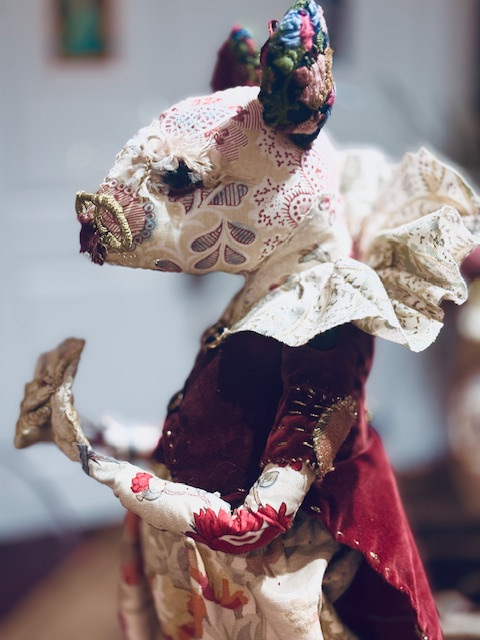
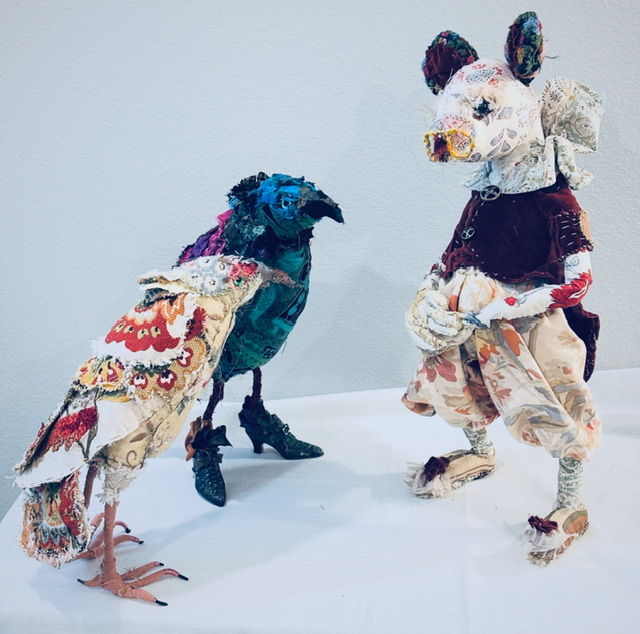
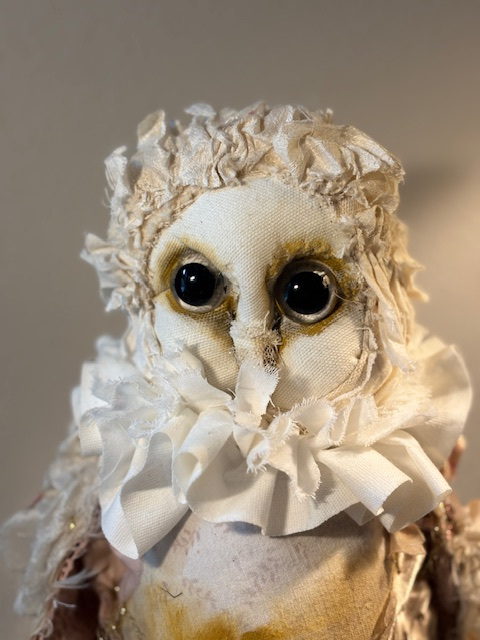
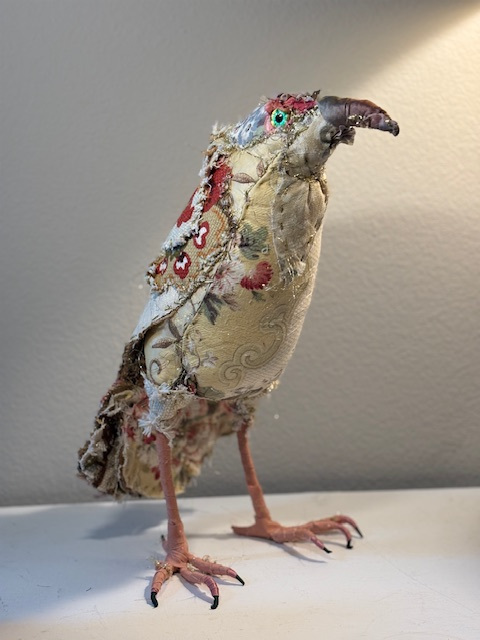
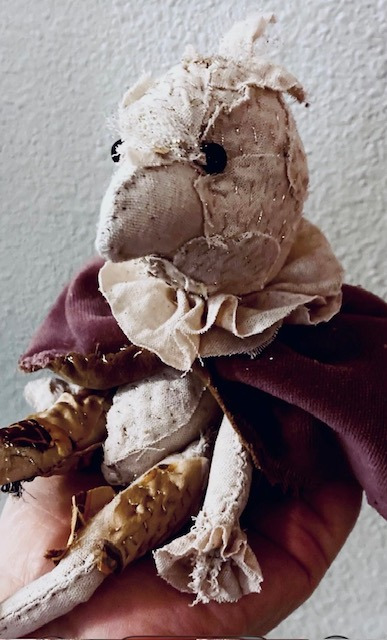
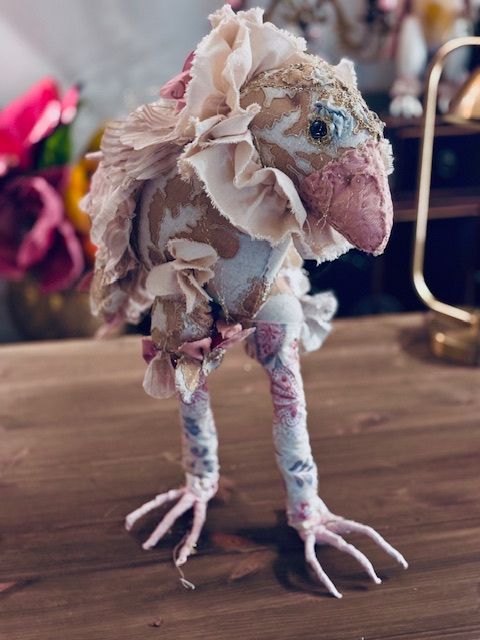
Once I retired and shut down the theatre group, I had more time to learn, to play, to think. Then several things happened simultaneously: I took some workshops with a few artists I admired and learned more about constructing silhouettes using wire armatures, wool, and fabric. I experienced moments of nostalgia – a sign of old age, probably – and remembered characters from the fairy tales of my childhood. I realized that, using everything I knew from theatre, literature, and art history, I could create a cast of characters that, like Sherlock Holmes’ street irregulars – clever, tattered, unloved – would belong everywhere and nowhere. I also knew that, having grown a little tired of crowds and noise, I’d prefer anthropomorphic characters to actual human silhouettes; the natural world to the real world. And that’s how D’s Irregulars – my Irregulars – were born.
When I go to art markets, I often place them on a miniature stage model and light them the way I would actors. Even when they’ re displayed in art galleries or museums, they retain a certain theatricality. It’s in their attitude and posture. Every one of them comes with a little notebook that contains their life story because, by the time they find new homes, they’ve lived through many adventures.
Great, appreciate you sharing that with us. Before we ask you to share more of your insights, can you take a moment to introduce yourself and how you got to where you are today to our readers.
I believe I answered these questions already when I described the path that led me to the creation of the Irregulars. One thing I didn’t mention is that I also work with paper. I create original monoprints and greeting cards. I also make tiny or gigantic paper flowers. Last year I had a lot of fun creating oversized paper flowers to fill a 6′ x 10′ space and transform it into a striking photo backdrop for guests at a gala. I am obsessed with Alice (more with her adventures Through the Looking Glass than Wonderland), and every time I make a fantastical or an oversized flower I think of the conversations Alice would have with it.
I keep a giant paper poppy in my apartment near the door to my study. It makes me happy every time I see it, as do the Irregulars that sometimes take over my space. They make me smile. They make everyone smile – it’s the reaction people have when they see the Irregulars for the first time.
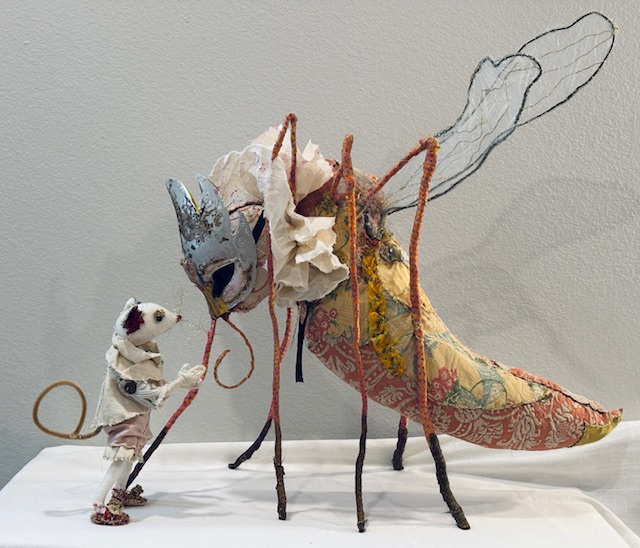
I sometimes create small spaces for my Irregular mice. I made a classroom for an art teacher mouse, an HR office for a stern HR officer mouse; an art studio for a tiny girl mouse who, at the time, was studying painting in Paris. When I need a painting or wallpaper for these mini interiors, I use my monoprints.
I love that the Irregulars don’t have a specific purpose and can belong in any environment. They’re there to intrigue, to bring joy, and be witty (this is accomplished by their connections to literature, theatre, and art history). They can sit comfortably on bookshelves, desks, or in an empty room corner – there when you need them, quiet and discrete when you don’t
I should mention that the Irregulars are not toys and they’re not suitable for small children, but they make perfect gifts for eccentric (but discerning) friends and acquaintances who have everything.
I should also mention that I rarely do commissions. I love creating characters that inspire me, that embody a story I want to tell. I value that freedom.
I enjoy making the unlikable lovable. For instance, I completed a series of small and large mosquitoes with fascinating life stories. A couple, made from rich brocades and velvets and wearing carnival masks, had just returned from their palazzi in Venice. Another mosquito, a recluse, used to be a Doge of Venice and often dreams of his days of absolute power. The smaller mosquitoes are members of a League of Extraordinary Gentlemen and gather for a glass of cognac and a cigar on the veranda every Thursday.
Last year I made a weevil, some flies, bees, and gnats. The gnats were existentialists. The weevil was a member of an itinerant commedia dell’arte group. I made a few moths too, but I have a bug phobia that made the experience a little unpleasant.
I’d love to have open studio days but since I work out of my apartment, that’s a little difficult. Not impossible though. A visit, by appointment, can be arranged.
How can we best help foster a strong, supportive environment for artists and creatives?
Well, ever since I started posting images of the Irregulars on Instagram trying to build an audience, I’ve been bombarded with calls for entries from various institutions and organizations most of which adopt a pay-to-play model. And while the entry fee isn’t substantial, if one enters several of these competitions, the total amount becomes a problem.
Some of these art shows are legitimate, some look sketchy, but the point is that participating in any event is expensive. The same goes for art markets and galleries as booth and shipping costs especially are often prohibitive.
What can be done? I don’t have a grand solution, but I’d love the opportunity to show work without paying for the privilege. An occasional free pop-up market for local artists would be nice.. Studio space that is not a third of my monthly income would also be great.
I keep thinking of the literary salons of the past where writers gathered to read new work. Could this model work for artists too? Perhaps there are some traditions we could revive.
Is there something you think non-creatives will struggle to understand about your journey as a creative?
Perhaps the problem starts with this division: thinking that people are creative or non-creative.
Having taught so many creative writing workshops, I have to say that if I or the University or the entire education system thought in these terms, such classes would seldom be taught.
The truth (not the absolute truth, but the truth as I have experienced it) is that one doesn’t know how creative one is. Often, students convinced that poetry was their genre discovered, throughout the course of the semester, that they had a talent for drama. Technical writers discovered a passion for poetry. Math and music majors who took a literary theory class found correspondences between all these fields.
I’m not saying that everyone is equally creative. I’m saying that everyone is a little creative and the role of education is to give everyone the opportunity to explore this creative impulse.
I think the same principle can be applied to art. There is a connection between the artwork and its spectator. Or not. One can’t force this connection as it is instinctive.
Would it help to explain my journey to someone who has no direct connection to art or to my work? Perhaps. Is there a place, a space where such a conversation can happen? Unfortunately, I can’t attend all the shows where my work is displayed and participate in such conversations although I would very much like to.
I think everyone would benefit from hearing a different point of view. If creative and non-creative people (to stay within the parameters of the question) found a new common ground at the end of their conversation, imagine what this could do for other fields (politics, tragically, comes to mind).
I don’t know whether my answers are helpful to anyone. I don’t know if I have definitive answers but I believe that starting a conversation is the most important thing.
Contact Info:
- Instagram: https://Instagram.com/ds_irregulars/
- Facebook: https://facebook.com/share/1H8rmthxiw/?mibextid=wwXlfr
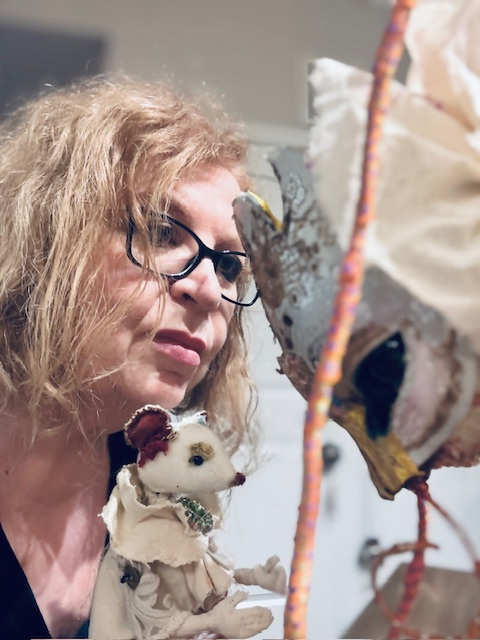
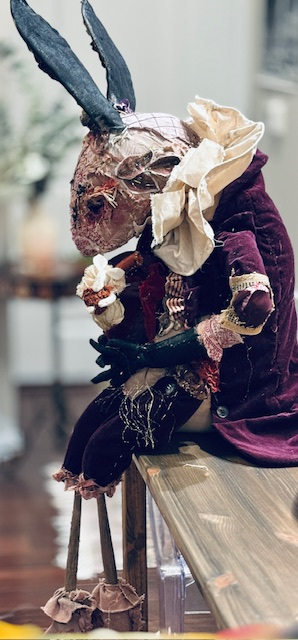
Image Credits
Dayana Stetco