



We were lucky to catch up with Daniela Godoy recently and have shared our conversation below.
Alright, Daniela thanks for taking the time to share your stories and insights with us today. What’s been the most meaningful project you’ve worked on?
My mom moved my older brother, sister, and me from Ecuador to the United States when I was 7. My dad followed us a few years later. I grew up in parallel cultures between the Hispanic/ Ecuadorian world and the Anglo, Caucasian English-speaking world in school. It wasn’t easy at first to find my place between the two cultures. Today, I’m ok with not fitting into either one perfectly now because I’ve come to celebrate and integrate the parts I like about each. But back in school and all through college, I didn’t know who I was or where I came from because I was never taught about my Ecuadorian history or roots officially in school and I often felt lost. It wasn’t until I graduated from Maryland Institute College of Art in 2012 that I got hired to work on the Jahuay Project changed my life. I was hired as a part of a research group led by my dad Musicologist Mario Godoy Aguirre for the Institute of Cultural Patrimony as a photographer to document the harvest ritual song of the Jahuay. The Jahuay genre was created by the indigenous people of the Chimborazo Province of Ecuador, and it dates back at least 500 years and was at risk of disappearing.
The Jahuay project changed my life because it taught me so much about myself and what still fuels my artwork day. I got to see firsthand a big part of my cultural heritage because my maternal grandmother was of indigenous descent from the Chimborazo Province and my entire family is from there too. I didn’t know much about that heritage because my grandmother chose not to teach most her kids ( my mother being the 12th of 13) the Quichua language so that they wouldn’t be discriminated against in school. Thus, we lost a great deal of our culture knowledge. While I would like to think things have changed some since my grandmother’s time, the truth is discrimination towards indigenous people still exists in Ecuador like in many other nations. I felt very privileged to be a part of the project because not many outsiders get to see indigenous rituals like that, much less are they invited into the communities due to how reserved those communities are.
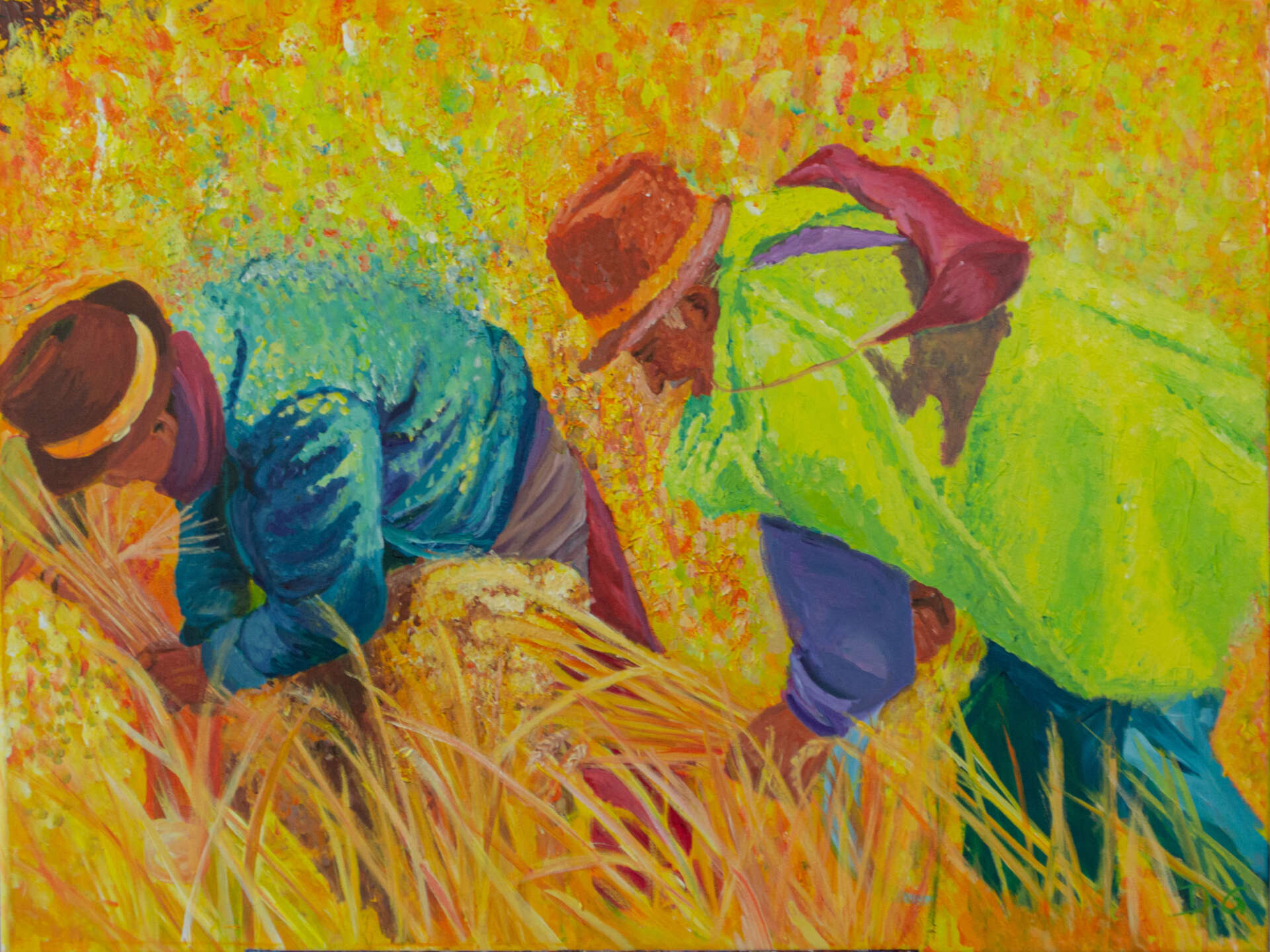
Once we completed the Jahuay project I created a 20-painting series depicting the harvest ritual song and its characters, which led to me doing 7 solo shows with my Jahuay series. My first international solo show was in Székesfehérvár, Hungary, and then six others in cities all over Ecuador. During my free time, for the Jahauy research project, I took candid pictures of the people there. With the idea of creating a portrait series with just the people.
Last year I finally got to create the portrait series challenging myself to two watercolor portrait challenges. My first was a 30-day challenge in which I painted a portrait daily. After that, I did my second challenge 4-5 months later, of only 10-days. Both challenges resulted in a total of 40 portraits and two art e-books.
What’s most exciting is that Friday, Nov 4, 2022, was the opening to my first solo show in the United States at the Main Street Connect, Apartments building in Rockville Maryland. It includes 14 of the 35 remaining paintings ( I sold some of them last year). The show at Main Street Apartments will run there until Jan 27th of 2023.


Awesome – so before we get into the rest of our questions, can you briefly introduce yourself to our readers.
The first time I told my mom I was interested in becoming a painter was when I was three. I had begged her to take me to one of her teacher workshops because I didn’t want to stay home. She reluctantly took me. She says that she had never seen a kid that age sit still for so long just watching. By the end of the workshop, I told her I was going to be a painter when I grew up. And here I am 31 years later and I’m still at it. Art fueled my life in school when my family moved from Ecuador to the United States in 1995. We had to adapt and learn a new language and new culture. Both my parents supported me in my dream of studying painting. After attending Montgomery Community College for three years, I completed my bachelor’s in painting at the Maryland Institute College of Art. I started working as a photographer immediately after graduating. I was hired by the Institute of Cultural Patrimony of Ecuador to be a part of the research group to document the harvest ritual song of the Jahuay in 2012. I created a series of 20 paintings that illustrated key moments and characters of the ritual. This in turn led to 7 solo shows where I got to exhibit the Jahuay series in Hungary and 6 cities around Ecuador from 2013-2015. I haven’t had much luck in exhibiting in the United States, until very recently.
The proudest moment in my career would have to be when my photo “Portrait of an Andino woman,” that I took during the Jahuay research project was chosen to be a part of a one-day exhibition at the Musee de Lourve Paris, France.” The show was entitled “The Documentary Selection,” July 13, 2015. Another proud moment was having two of my paintings in the permanent collection of the Museo del Pasillo in Ecuador since the museum’s opening on December 3rd, 2018.
I’ve tried working in “regular jobs doing translations and interpreting in Spanish and English. Although I have a native level of understanding in written and verbal fluency in both I felt suffocated in a world without the ability to create art.
My most recent wake-up call to make a change in my life came two years ago. At the beginning of the pandemic, we had the devastating loss of my uncle Marcelo. I realized that life is short, and we can’t sit around not living it to its fullest. It pushed me to commit to becoming an artpreneur full-time. I started doing commissions and set up a store to sell my paintings and prints, bookmarks, and a digital artbook through my online website store. The scariest part was when I created a YouTube channel where I occasionally create videos of my artmaking process. I beat my lifelong anxiety with public speaking by creating videos and it worked! My most recent live artist talk was Friday, Nov 4th at Mainstreet Connect in Rockville Maryland at the opening of my solo exhibition. The live stream is available on my Instagram.
Researching and creating art about my grandmother’s indigenous ancestry, helps me feel connected to her and enables me to honor those roots. Ultimately, I want to share this culture with the world, to share faces of the pieces of my history because in doing so they are no longer invisible to the world.
The most important thing I want people to know about my art is that although it focuses on my Ecuadorian Puruhá indigenous roots, I don’t in any way think that the culture I belong to, or chose to portray is somehow better or superior to others. I want to teach others through my painting that beauty can exist in cultures different than our own. I hope that this will spark an interest in them to become more curious and respectful of other cultures instead of judging them or placing stereotypes. My art is culturally humanistic because it aims to unite us in respecting and honoring the beauty we see in each other’s cultures, especially if they are different than our own.
What do you find most rewarding about being a creative?
I grew up not feeling seen or represented because in school I wasn’t taught much about international history. The closest thing to representation was being confused or lumped together with the Mexican culture. While we may technically speak the same language, (and all share similarities) I say technically because there are colloquial differences in every single one of the twenty Latin American countries. Growing up in a culturally diverse county like Montgomery County Maryland gave me a greater appreciation for a wide range of cultures than I could have imagined. My dad was always taking us to multicultural events and the Smithsonian museums, and I grew up mesmerized soaking in the cultures. I was constantly looking for traces of similarities to my own Ecuadorian culture. Although, I couldn’t find much about my heritage outside of my immediate family about my roots. I honor and learned to love and respect other people’s cultures through their music, foods, dances, etc. Today, the most rewarding aspect of being an artist is seeing how people’s mood changes when they see my art. To witness their smiles and to see their faces light up makes the hours upon hours of work worth it.
Having strangers connect to the art I create is my ultimate goal. I don’t always get the chance to give the whole cultural context of my work because people often find my work online. But, if the viewer feels represented, finding similarities to their family to their culture, my work has served its purpose.
I’m happy if viewers feel a connection to the work and represented who am I to tell them differently? It’s like I wrote in the artist statement for my watercolor series exhibition “The subjects in the paintings become a part of the artist and the viewer who perceives them.”


We often hear about learning lessons – but just as important is unlearning lessons. Have you ever had to unlearn a lesson?
The idea that I had to compete in the art world started my junior year in college when I transferred to the Maryland Institute College of Art. By the end of my time at MICA I realized that I had to unlearn this concept. I met amazingly talented classmates, and it was hard to not compare myself to them. Especially, since most of them had gone to private art high schools. While I had only been in the International Baccalaureate art program in my public high school. I fixated on the things I lacked rather than the ones I had. My lack of confidence ended up stunting my growth in my classes. My senior thesis professor incessantly told me to make big changes to my thesis work. Our thesis was a collection of work we had to present at the end of senior year. Without a passing thesis grade, we wouldn’t graduate. I ended up doing everything my thesis professor was telling me. By the end of the first semester, I had forgotten to use my creative voice. I felt lost.
It wasn’t until that winter break when my family and I went to spend Christmas in Ecuador that I gained clarity. I stayed longer than the rest of the family with my dad because he wanted me to experience the Pases del Niño ( impromptu parades) in Riobamba. The main one is on January 6th, which falls on Three Kings Day. It’s an event where groups usually of big families or dance companies dress up in traditional costumes of both the indigenous people’s culture mixed with Spaniard influences (the mixture of which results in the mestizo culture) is celebrated throughout the streets of Riobamba, the capital of the Chimborazo Province. The pases are these big impromptu parades that start around Christmas and continuously happened until Carnaval in February. I had never before seen so many colors or otherworldly characters in my life much less put together. The experience changed me.
I took so many pictures of the dancers in costumes I ran out of space in the first card and moved on to the second one in less than two hours. In a split second, I lost my dad in the crowd when I heard a familiar tune and a familiar voice. A chill ran through my spine, and I felt tears in my eyes from excitement. It was my grandfather singing (in both Quichua and Spanish ) a traditional “Three Kings Day,” a song with his accordion. I stopped and I knew that I had to find my dad. I found him and I was tearing up even more.
At that moment or maybe later that day I realized I needed to change my thesis to base it on that parade. I thought, screw my thesis professor’s opinion of my work. He didn’t seem to ever be satisfied with any of my classmates or my work. So why should I comply with what he wanted? I was going to paint something that I loved and that represented me. In my second semester, I got to work on four very colorful paintings that became my thesis. I stopped comparing myself to my peers and I started finding my voice. The most important thing that I learned at the end of my thesis was that in the art world there is an audience for every taste. Instead of comparing myself and competing with my fellow friends and peers. I started acknowledging the fact that everyone has their own viewpoint. None of us should try to imitate someone else because our experiences are all different. That teacher still gave me a 90% even though all the other thesis judges gave me a high “A”. You can’t expect to please everyone. One of the other thesis judges recognized that my work was inspired by the Ecuadorian culture ( because she had been there). And that meant more to me than anything.
We all inevitably see the world in our unique way. If we choose to do only what is in style when it’s not in our hearts only to compete in the “art world,” we are being insincere. We are cheating the world and ourselves by not expressing who we are in our unique voice or style. The only person I compete with today is who I was in the work before the one I’m starting. And I’m ok with having people not understand my work or even dislike it because I don’t do it for them. I work for those that see themselves represented in it. And those to whom my work brings joy to their faces. I learned long ago that I don’t have to please everyone. I just have to continue to shine my voice through my work and the right people will find me or themselves.
Contact Info:
- Website: www.danielagodoy.com
- Instagram: https://www.instagram.com/daniela_godoys_art/
- Facebook: https://www.facebook.com/DanielaGodoyB
- Youtube: https://www.youtube.com/channel/UC8n4yyVcYG7JeSI021HLkLw
Image Credits
1) Daniela Godoy headshot, By Daniela Godoy 11/12/22
2) Daniela Godoy and Cecilia Godoy at Main Street Exhibition Opening Nov 5, 2022 by Victoria Daniels, Nov 5th 2022
3) Daniela Godoy at the Opening of Watercolor Painting solo Exhibition at Mainstreet Connect, by Cecilia Godoy, Nov 5th, 2022
4) Danzante, Commission, Painting and picture by Daniela Godoy, September 2020
5) Daniela Godoy during artist talk at Opening of Watercolor Painting solo Exhibition at Mainstreet Connect, by Stacey Watson, Nov 5th 2022
6) Daniela Godoy with “Cantoras del Jahuay”(Jahuay singers ) at the Museo del Pasillo, Quito, By Myriam Vaca, May 17, 2022
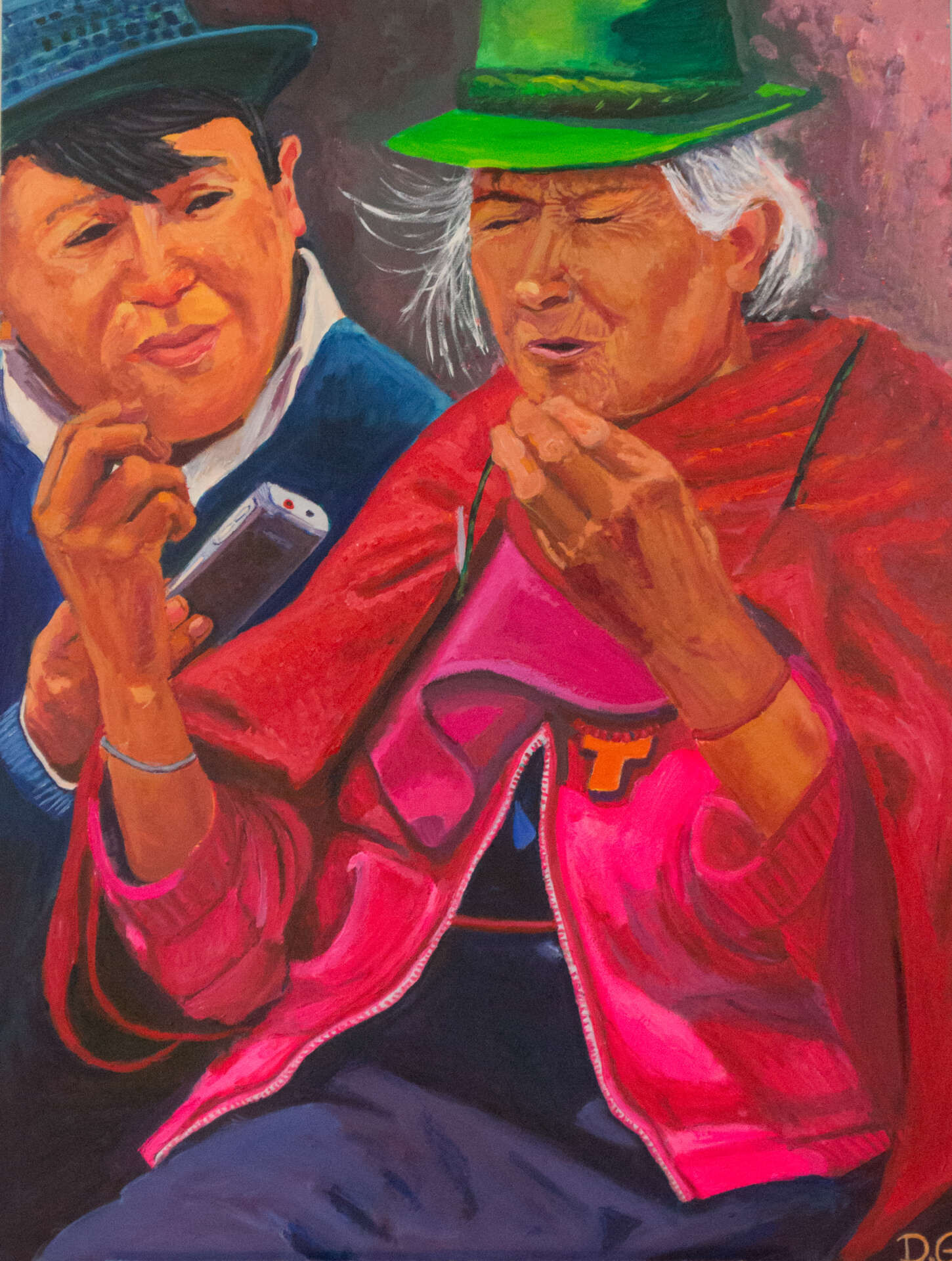
7) Wisdom, 30X40′, Acrylics on canvas, Febuary 2019, Painting & picture by Daniela Godoy
8) Daniela Godoy at ” Jahuay”, A Szabadművelődés Háza (Colors & Textures of Jahuay Cultural Center),Székesfehérvár, Hungary Oct 8th, 2013, by Mario Godoy Aguirre.
9)Cosechando/ Harvesting, Colors & Textures of the Jahuay series, Acrylics with molding paste on canvas 30X40′, March 2013, painting and pictures by Daniela Godoy ”