

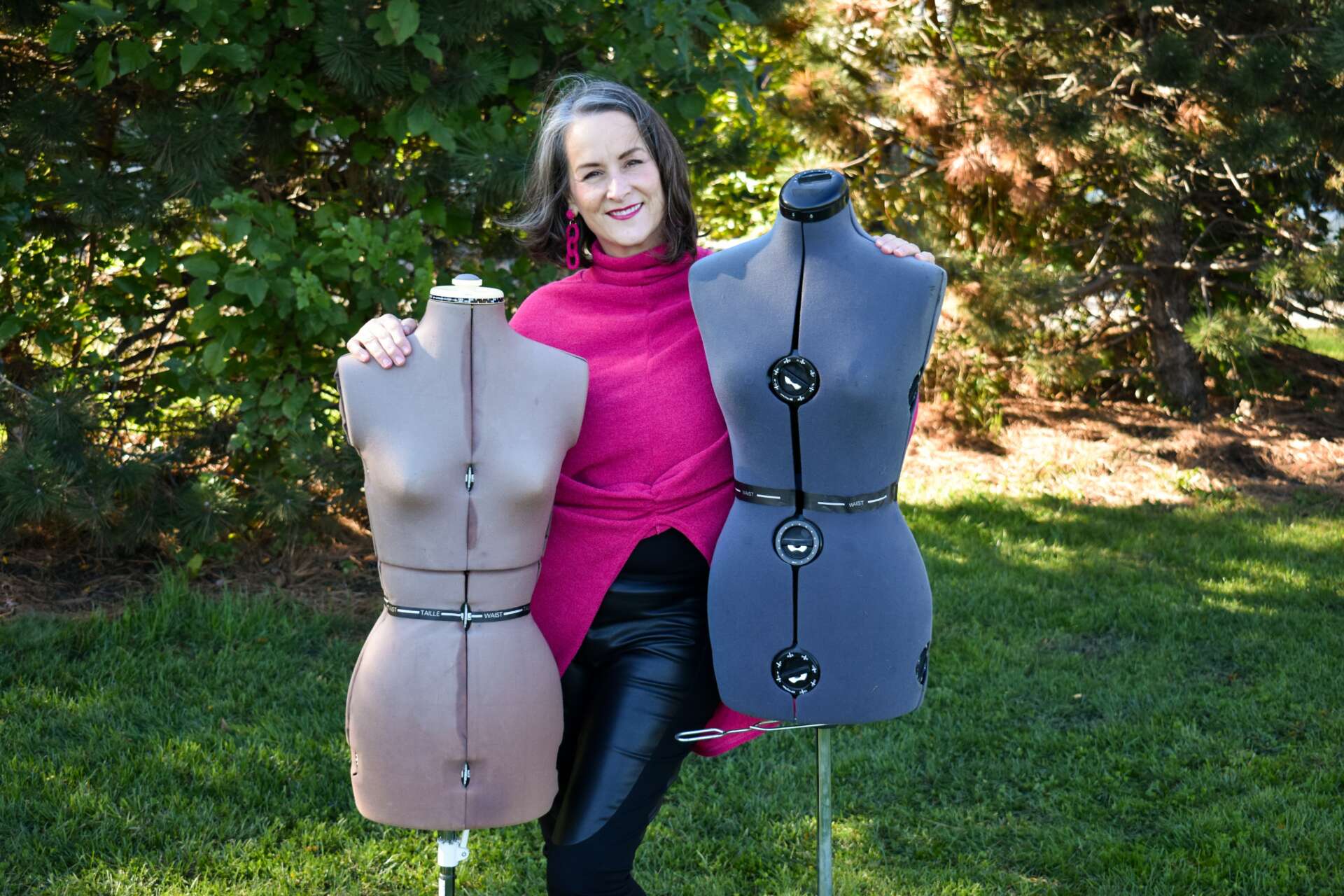

We’re excited to introduce you to the always interesting and insightful Dana Todd. We hope you’ll enjoy our conversation with Dana below.
Dana, thanks for taking the time to share your stories with us today Some of the most interesting parts of our journey emerge from areas where we believe something that most people in our industry do not – do you have something like that?
I believe that it’s not impossible to change the current garment industry, and that any brand can deliver clothing that fits any human body, at a price that most can afford.
There are deep seated beliefs in the fashion and garment industry about how things can and can’t be done, especially as it relates to improving sustainability through reduced production and better sizing. While everyone agrees it SHOULD be done, they absolutely don’t see how to evolve their business models, vendors, supply chain, and retail to support an industry that isn’t what we have now.
Here’s what they believe, and why they think it’s impossible to change:
– Retailers and brands must keep prices low enough for consumers to buy, and can’t sacrifice profit margins
– Can’t manufacture in the US because of high labor rates, and there aren’t enough sewists
– Bodies are too complex, you can’t accommodate everyone’s shape (especially women’s bodies)
– Factories require minimum order quantities in the hundreds per style, in order to secure low wholesale rates
– Technology doesn’t really solve for all the human tasks that are needed, and the systems don’t talk to each other
– We’d have to have billions of dollars invested to make an alternative supply chain for on-demand
The truth is, they’re right – if you only look at how things are done now.
When I first started this journey, trying to figure out how to make a blouse from idea to execution, I utilized an expert who showed me how things are done for American designers. There’s an extensive prototyping process that involves multiple people and companies and processes, and would potentially take months of back and forth. Most of the people I met were not using advanced technology, and I saw physical body forms, Excel spreadsheets, and paper patterns used to figure out the pattern and plan. And this was in the so-called sophisticated NYC garment district!
It got worse: to make the garment sizing (called “grading”) I would need to find an arbitrary fit model to be my “Size 6” and then define the pattern adjustments from there to accommodate size range. They will most likely have a standard body shape (slender hourglass for women, square or V shape for men). If I want a plus size or petite range, that’s a different model to hire, and potentially a separate base pattern made for each. There’s also fabric and finish selection, which can take a very long time because in most of the US you don’t have access to physical samples of textiles and buttons and such, and I’d have to choose virtually and wait for samples to be mailed and approved.
After weeks of this, I would finally have a prototype and it would cost upwards of $1000 for this single garment. I may or may not have a digital file of the pattern design, and it may or may not be graded to a full extended range. And because of body diversity, it’s still not going to fit about 20% of the population using standard grading methods.
After this stage, one would engage a factory – likely in China for the best rates, fabrics, and skill level. I’d be requested to make a minimum run of each style, and potentially each size. Usually, you can’t get away with less than 100 unless you are paying high cost per unit. And since brands are taught to build their business models on a retail markup of about 300%, they need to achieve the lowest possible cost per unit. So that’s at least another $10k for production of my blouse, and it might take months to get.
Even if you outsource the prototyping to a factory, it’s still going to take time. And once you offshore everything, you relinquish almost all visibility into how the clothes are made and how the humans in the process are compensated.
After learning all of this, I felt so defeated. I couldn’t see how I’d ever be able to find a way to make clothes accessible to all women’s bodies without overcoming all of those objections that traditional brands had. And I didn’t see how we could make technology that fit in between all the broken places in the system.
What we ultimately found, however, was a massive untapped supply of small makers and microfactories that wanted to help, and had experience in making custom-size clothing for women. Most of them have their own designs that would never make it into a traditional retail shop, because they can’t meet the stringent requirements and low prices that big retailers demand. We ignored the traditional wholesale/retail markup model, and built a marketplace where we would essentially share revenue with our suppliers and connect them directly to consumers for a more personal and transparent relationship. And we’re delivering the “impossible” in that everything is made to measure — no standard sizing or charts. It’s like Etsy, but highly specialized and with an experience that is uniquely tailored (pun intended) for this business.
So I’d say I’m right in my belief that there IS a way to produce well fitting clothing at an affordable price, and everyone involved can be compensated fairly — you just have to think (and build) differently!

Awesome – so before we get into the rest of our questions, can you briefly introduce yourself to our readers.
I got into this industry not because I love fashion (although I do), but because I saw a huge problem that I think I can help solve. My background is in technology and marketing – I have been building digital experiences since the commercial web began (1997!) and have acted also as a Chief Marketing Officer for many companies. When my body changed after menopause, I found that I couldn’t find many clothes to fit me that also had the professionalism and unique style I was looking for as an executive. When I researched, I found that I wasn’t unusual at all, and in fact 75% of women were frustrated with sizing in retail and online shopping. And these were women of all ages, all body types!
I was really surprised during my research phase to hear a creative director from a famous brand say “designers don’t want to make clothes for their mothers!” I got so mad, it gave me the catalytic energy to start Balodana, bootstrapped with my savings and a small amount from friends and family, and I built it with help from my talented cofounder Nisha Katti and our extended team. Because the truth is there are BILLIONS of mothers out there – and it’s not just moms: there are even more women who are frustrated with the options that the garment industry is churning out now.
I’ve become so much more cognizant of the global damage that the fashion industry causes. Balodana exists to make women happy, and also to save the planet. We think we can help do both, because they’re actually linked along the lines of overproduction and poor sizing methodologies. Overproduction leads to massive waste, human suffering and ecological impacts; and poor sizing leads to returns and customer unhappiness (and thus more waste).
It seems like such a simple thing, to make something that fits, but I’ve seen our customers express tears of joy when they put on something we’ve made and they no longer feel like their body is the problem. We’re teaching them to be in control of their own body data and their own fashion destiny.
At Balodana we believe that we can enable a “personal supply chain” to more closely connect consumers and makers, and that it can be made possible through on-demand production of personal-sized clothing. We believe this because we’re doing it now, on a small scale, and we’re working with partners who believe as we do and are putting their resources towards scaling and collaboration across systems worldwide.
Since we launched the Balodana marketplace in 2019, we’ve grown carefully and consistently, learning from each customer about how to improve. I’m proud to say we now represent makers in 10 countries, and our first-fit accuracy is 74% across all styles and body shapes. That’s incredibly high compared to traditional mass manufacturing, and we’re doing it without waste and with a good profit margin built in to help our makers pay their people well and invest in better quality overall.
I’m so proud of what we’ve achieved as a team, and we’re taking the challenge up a notch now to support other women’s clothing brands who want to offer extended or “infinity sizing” through our technology and network of specialty manufacturers. We believe they are missing out every day on at least 15%-30% of potential business because women can’t see themselves represented in the inventory or size charts.

What do you think helped you build your reputation within your market?
I’m a natural collaborator, and I’m also very committed to being in service to people in everything I do. Because we are a small and new brand, we decided to be more like Nordstrom than Target in terms of the level of personal service we provide for our customers. We bend over backwards to be concierges for the custom clothing journey, and we offer a very generous “Happiness Guarantee” that helps people know it’s ok to try something new. And it’s working, we have repeat customers and referrals, and we get such good feedback from customers. When we did a customer research project recently, one of our customers said that the reason they purchase from us is that they know “we have their back”!
In terms of my personal reputation in the garment industry, that’s where my collaboration skills come into play. I’m also a very fast learner. Since I was essentially an outsider and wasn’t a designer myself, I started making connections through the “back door” via technology and innovation. I found a whole world of people like me who are trying to find a different future for how things are done, and we are working together in many projects to start connecting the dots on data and method standardization. I have been invited to speak on a number of panels about our experience and approach, and we consistently promote our thought leadership and research findings to the industry.


Can you share a story from your journey that illustrates your resilience?
The COVID-19 pandemic was brutal for us. We had just started seeing sales traction on the marketplace, when suddenly everyone was hiding in their homes wearing pajamas for 2 years. We saw some of our makers leave the business entirely, as they were unable to run their factories and pay employees. No one felt like buying a party dress when there were no parties.
In May of 2020 when it became clear that we were going to be affected, I made the decision to bring on a big batch of interns who had found themselves abandoned by companies that had to cancel their internship programs. We focused their efforts that summer on going back to basics to fully understand our customers, and also developed new technology that would help to overcome the barrier of getting body measurements. I took extra jobs on the side to keep the company afloat. I spent hundreds of hours collaborating with potential partners and other tech startups who have a mission like ours. I committed myself to my spiritual practice to keep my mental health positive. I took time off when I needed to, to care for my mother who ultimately died of cancer.
Throughout 2021-2022, we opened up explorations of different business models, including offering fully bespoke items and a B2B service offering. We managed to survive and pivot, and now I believe we have an even more compelling opportunity to really impact the garment industry and help brands see an alternative to status quo manufacturing. When we showed our idea to brands at a huge industry trade show recently, the response was overwhelmingly positive, and we are feeling a fresh wind in our sails.


Contact Info:
- Website: https://balodana.com
- Instagram: https://www.instagram.com/balodana/
- Facebook: https://www.facebook.com/balodanafashion/
- Linkedin: https://www.linkedin.com/company/balodana/
- Twitter: https://twitter.com/danatodd
- Other: https://www.tiktok.com/@balodana_custom
Image Credits
Amparo Photography Rose Yuen Photography