

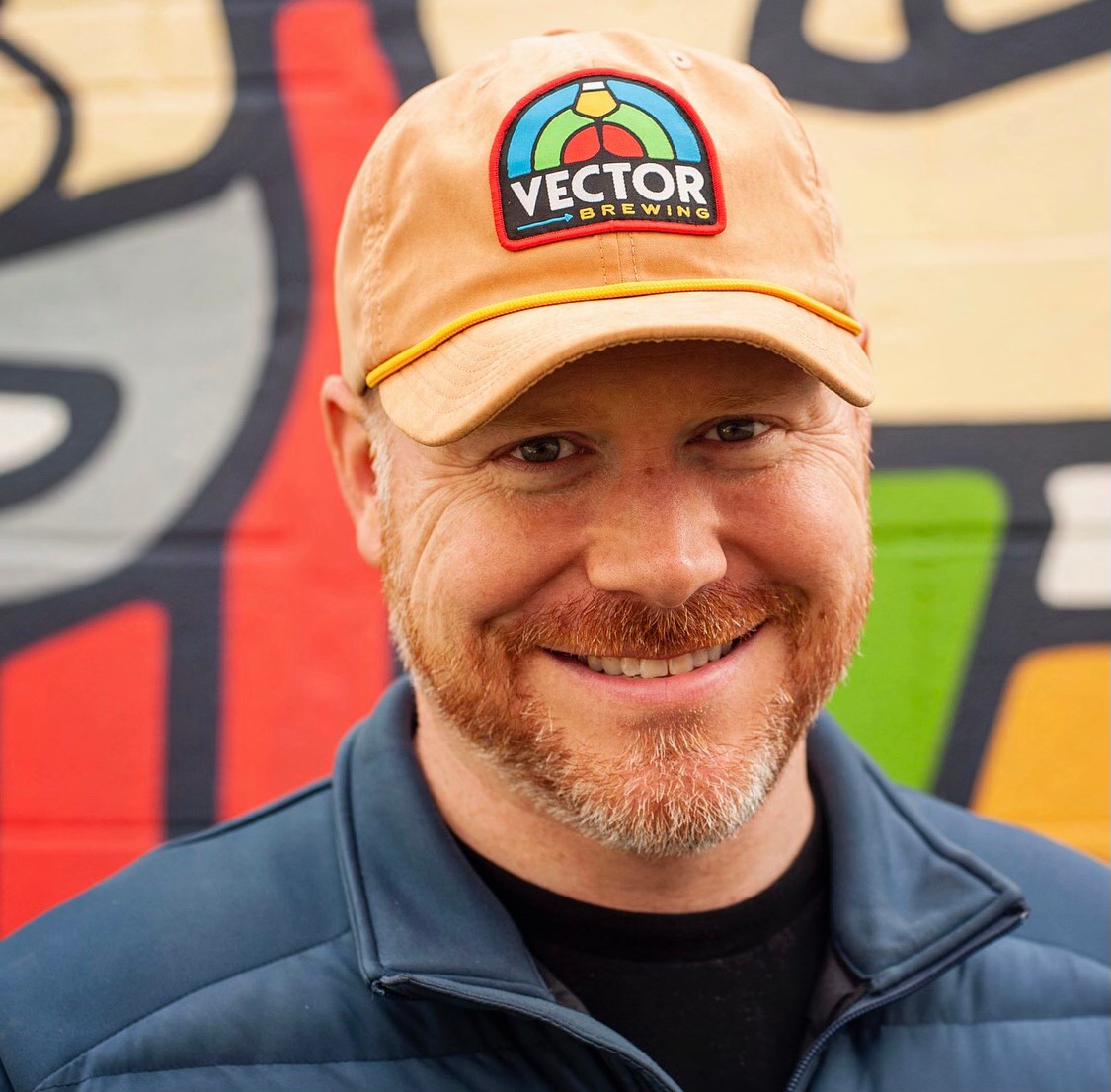

We caught up with the brilliant and insightful Craig Bradley a few weeks ago and have shared our conversation below.
Craig, looking forward to hearing all of your stories today. We’d love to go back in time and hear the story of how you came up with the name of your brand?
I get this question pretty often, and it’s a little hard for me to answer honestly. The name ‘Vector’ has a few meanings for me. First off (and probably the easiest for me to answer) is that it’s simply a reference to my old day job as a graphic designer. I work with vector art files a lot, both in my previous job as an art director and currently as the creative director for the brewery.
I love the idea behind a vector graphic – one that allows the artist to create a high-quality work of art, with clean lines and shapes that can be infinitely scaled to any size without losing resolution. My love of beer coincides with this ideal – creating clean and beautiful beers that can consistently shine on both small or large scale.
However the term vector also has a connotation in physics as a quantity that has both a magnitude and direction, such as force, velocity, and momentum. I like to think of beer as a means to a journey of discovery. There are so many different styles of beer in the world, so if we can play our part in helping build that path (or vector) for someone to discover their new favorite beer, then we’ve done our job.


Great, appreciate you sharing that with us. Before we ask you to share more of your insights, can you take a moment to introduce yourself and how you got to where you are today to our readers?
I never really set out to be in the beer and restaurant/hospitality business, but sometimes fate has a funny way of putting you on your own unique path. I was in the advertising world for a long time working as an art director in Dallas, when one day I got a home brew kit from my lovely wife (and now co-owner) as a gift. Not knowing much about home brewing, but being an avid fan of beer, I jumped at the opportunity to learn all I could.
Luckily I knew someone looking to start their own brewery in the Dallas area around that same time – Wim Bens, the founder of Lakewood Brewing Company in Garland. I would home brew with him in his garage in Lakewood, and after one thing lead to another, we were quitting our day jobs and starting Lakewood along with his wife Brenda Busch and our friend Trevor Pulver, the original sales director. My job was to essentially build the brand from the ground up, so we set out to do just that, and within a couple quick years, we had grown the brewery to be one of the leading brands in North Texas. My role in the early days would vary from making sales calls and store deliveries by day to doing social media campaigns and in-store graphics by night. We did everything back then, as any small business owner can attest to (and we still do!)
After 6 years at LBC, I finally got the bug to break off and do my own thing, with my own family, and create something smaller – a little more inclusive of the Lake Highlands neighborhood where we lived. Something with both beer AND food, and one that pushed me creatively. So I set out to create Vector Brewing with my wife Veronica and my good friend Tomás Gutierrez helming the brewery side of things. Our main goal was to never feel bored; never feel idle; never feel complacent in what we make. We always want to strive to make the absolute best beer possible, make the best pizza possible, and make it a place people are proud to call their own. It’s the kind of place we would want to hang out in, and I’m proud to have created this little gem in East Dallas.


What’s been the most effective strategy for growing your clientele?
For us, it all comes down to good ol’ fashion grass roots marketing. We’re a small business in a very close neighborhood, and we strive to be a true “third space” for our guests and neighbors. Every single day we have someone new walk through our doors, and our goal is to always have them leave with a positive experience so that they’ll tell their friends about us, and so on and so on. Great word of mouth beats a huge marketing budget any day. So what if you spend thousands of dollars getting your name out there – if your product stinks or the ambiance is less than stellar, that great marketing will backfire real quick and you’ll be sunk in no time. You gotta back it up with a quality experience.
Would you rather see an online banner ad about a new place that has “award-winning beers” and “delicious food” or hear from your best friend about the amazing new spot they went to? You’re more likely to hit up the spot with a glowing review from a trusted source!
Our loyal fans are the biggest asset we have, and we can’t thank them enough for spreading the good word.


Any insights you can share with us about how you built up your social media presence?
Social media is a beast all unto itself. I’m no social media guru, but there are a few tips I try to follow:
1. Keep it simple but creative. There’s no need to keep posting the same photo over and over again. Get creative with the post. Take a cool photo from a different angle. Use your friends or staff in the photos. You don’t have to be Ansel Adams either – any good smart phone works great, and most are better than a lot of digital cameras anyways.
2. Be true to yourself. Don’t be fake. Don’t pander. People will see through it. Be honest and truthful and to the point. Be humble. Be funny. Just be you. Folks will hear your tone through your copy. They know when they’re being spoken to by the business owner versus a robot.
3. Post consistently, but have something to say. I can’t stress this enough – it’s okay to skip a day. Consistent doesn’t mean every day, multiple times a day. Just try and post a few times a week at minimum, but always have something to say. Make it count. Be clear and concise. Make sure the information is useful and thorough.
4. Pick one or two social media platforms that you do well and/or enjoy and stick with those. Don’t try and force yourself into learning a new platform just because you think you need to do it. See #2 again. You don’t have to be everything to everyone. Know your market and know what they gravitate to.
5. I like to think of the 3 big platforms as this: Facebook (informational), Instagram (visual and aspirational), Twitter (conversational w/ fans). Everything else is filler – there are a ton that may or may not make sense for you and your brand, but you have to make that decision and what you’re willing to keep up with.
Contact Info:
- Website: www.vectorbrewing.com
- Instagram: @vectorbrewing
- Facebook: @vectorbrewingtx
- Twitter: @vectorbrewing
Image Credits
Craig Bradley, Veronica Bradley