

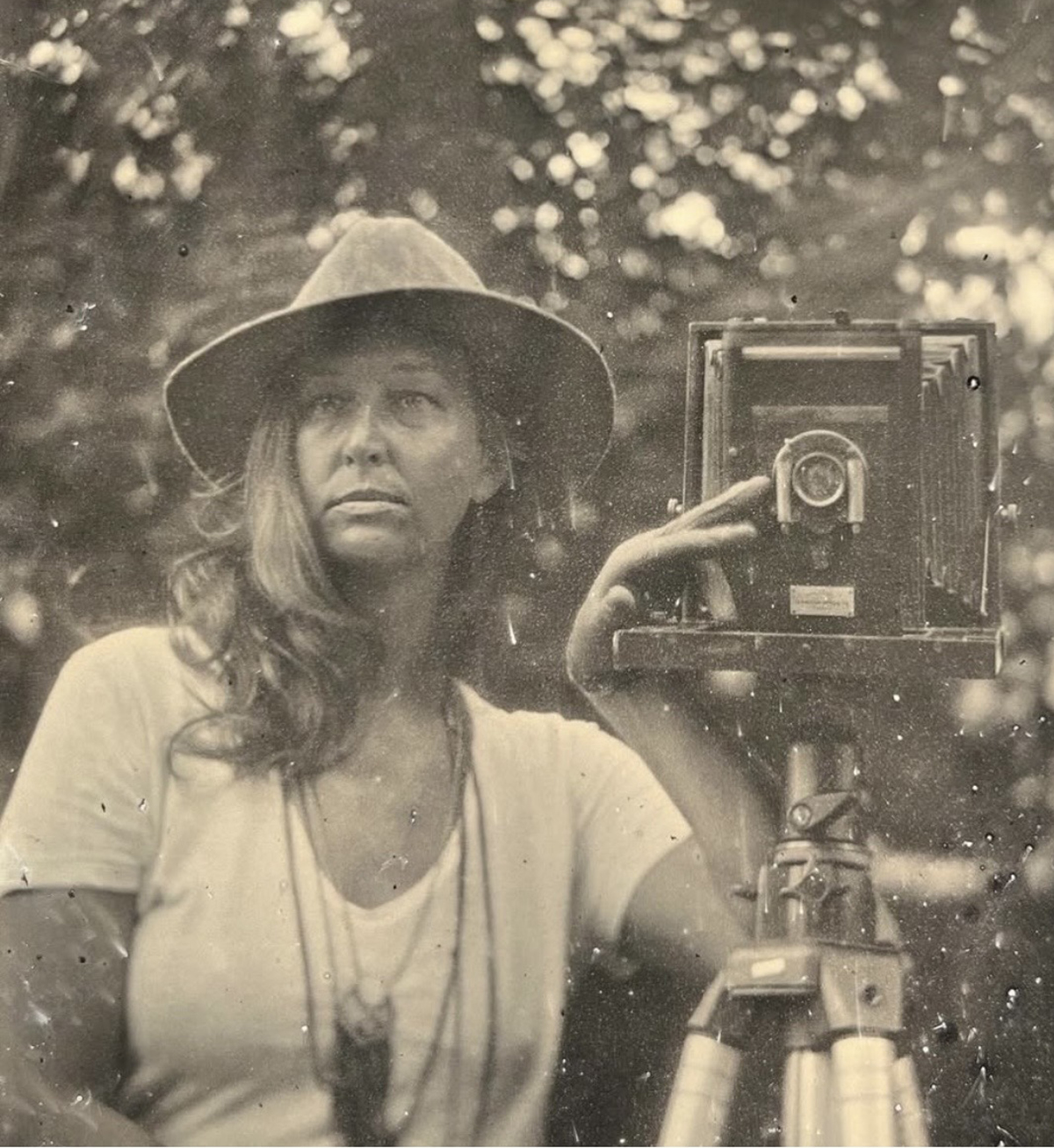

We recently connected with Courtney Robertson and have shared our conversation below.
Hi Courtney, thanks for joining us today. Going back to the beginning – how did you come up with the idea in the first place?
When I was younger, there was an old timey photo booth at the amusement park we went to every summer. I thought it was incredible that you could take a photograph that made you look like you were from another time.
Years later, I fell in love with wet plate collodion, the same photographic process from the Victorian era, and it felt like a full circle moment. I realized I could recreate that experience I loved as a kid for other people too, that sense of wonder and time travel that I felt then, and that other people could feel as well.
The more I started sharing the work publicly, the more I saw how deeply people connected with it. In a world where most images only exist on screens for a few seconds, people were drawn to something physical, slow, and handmade. That’s when I realized this wasn’t just something meaningful to me, it was something other people were looking for too.

Courtney, love having you share your insights with us. Before we ask you more questions, maybe you can take a moment to introduce yourself to our readers who might have missed our earlier conversations?
I work as a wet plate collodion photographer, using one of the earliest photographic processes from the Victorian era to create one-of-a-kind portraits on glass and metal plates that are made and developed by hand in real time.
I work with individuals, families, and events, often setting up in public spaces or doing commissioned sessions. What people receive is a physical portrait made through a slow, hands-on process that they are actively part of.
In 2019 I came across a documentary about Victoria Will’s tintype work at the Sundance Film Festival, and it really stayed with me. I didn’t have any photography background at the time, but I immediately felt like I needed to learn how to create images like that. It took me over a year just to begin to understand the process.
Originally, what pulled me in was the image itself. But making it is what really changed my relationship to it. It really feels like magic to me, like I’m making something out of nothing. I don’t really think of myself as a traditional photographer. It feels closer to being an alchemist.
One of my favorite parts about it is the shared experience. It’s not just about the final photograph, but about the memory of the day we made it together. It feels incredibly collaborative and fun and joyous and magical. It’s not just about the photograph.
What I offer is both the portrait and the experience of making it. Most people are curious when they first encounter it. In a world where most images are instantly created and quickly forgotten, this process asks for presence and time, and what it leaves behind is something lasting.
I also feel a real responsibility in working with this process. I’m proud to be a steward of it because it’s a dying art, and it allows us to create lasting, physical records of people that can be passed down through generations. Keeping it alive feels important to me.
What I love most is that it holds onto people in different ways. At times it can feel almost like spirit photography, a very raw way of seeing yourself. There’s an honesty in that which I really value.
More than anything, I’m drawn to all of it together, the process, the connection, and the fact that we’re creating something physical and lasting in a world that is mostly moving in the opposite direction.

Is there something you think non-creatives will struggle to understand about your journey as a creative?
I think one thing that can be hard for non-creatives to understand is that I didn’t really arrive at this through a straight career plan. It wasn’t something I mapped out in advance. It came from a moment of being deeply affected by something I saw, and then following that feeling for a long time without really knowing where it would lead.
There’s also a misconception that the “work” is just the final image. With wet plate collodion, the image is only part of it. A huge part of what I do is the process itself, the setup, the chemistry, the timing, and the interaction with the person sitting for the portrait. It’s very present tense. Nothing is automatic, and nothing is really repeatable in the same way twice.
I think another thing that can be misunderstood is why someone would choose to work in a medium that is so slow and so technically demanding in a world that values speed and convenience. For me, that slowness is actually the point. It creates space for something different to happen between people. It changes the energy of the experience completely.
It’s also not always easy to explain that the value isn’t just in the image as an object, but in what happens while it’s being made. A lot of people assume creativity is just about output, but for me, some of the most meaningful parts of this work exist in the time spent making it, not just the thing that comes out of it.
I think if there’s anything I’d want people to take from my experience, it’s that creative work doesn’t always follow a linear path, and it doesn’t always need to. Sometimes it’s more about paying attention to what genuinely holds your focus, even if you don’t fully understand why at first, and letting that lead you somewhere over time.

Can you open up about how you funded your business?
Funding my work wasn’t really a single moment of raising capital or making a big investment decision. It was much more gradual than that. The amount of equipment and materials needed for wet plate collodion is actually kind of wild when you first look at it, so I had to approach it very slowly.
I started with just one piece at a time. A camera first, then a tripod, then small bits of chemistry, then the trays, beakers, and everything needed to actually build out a working setup. It wasn’t something I could buy all at once, so it became a long process of collecting and learning as I went.
Because of that, the growth felt very organic. Each new piece of equipment made it possible to take the next step, and that rhythm shaped how I built everything.
Looking back, I think that approach really mattered. It taught me patience and made the whole thing feel more sustainable, because I wasn’t trying to rush to a finished version of it.
I also think there’s something important in that for anyone starting something that feels too big or overwhelming. You don’t have to have everything figured out at the beginning. Small steps add up over time, and slowly you build something real without needing to force it all at once.
Contact Info:
- Website: https://www.timetravelerphotography.com/
- Instagram: @Time_Traveler_Tintype


