


We caught up with the brilliant and insightful Christopher Allis a few weeks ago and have shared our conversation below.
Alright, Christopher thanks for taking the time to share your stories and insights with us today. Are you happier as a creative? Do you sometimes think about what it would be like to just have a regular job? Can you talk to us about how you think through these emotions?
The question of ‘are you happy being a creative’ is always present in my mind and always has been ever since I started playing music professionally.
I think having the upbringing I did (where both parents are musically talented) allowed me the ability to enjoy music for what it is – an incredible way to communicate and connect. Having that kind of exposure (in my case to all art) is a lot of what makes me who I am. It comes out in my playing and in my interactions with others. So, the love of art and the happiness the art provides hasn’t faded for me.
If I really look under the hood at this idea of happiness, I think a better term for me is contentedness or perhaps satisfaction. Happiness seems to rely so much on external factors. Contentedness seems more internal. Both feelings have definitely changed in subtle ways over time.
When I moved out to Los Angeles I didn’t have any expectations of playing because I thought it was a really impenetrable place. I didn’t have a huge cohort of friends and I’m rather introverted. I had a couple of people that began to vouch for me. Things began to change for me slowly. So, when I started getting calls; on part of me was ecstatic that I was doing anything and I said ‘yes’ to absolutely everything. I’ve always felt that way: say ‘yes’ until you have enough experience to know what to say ‘no’ to. But, that’s not happiness necessarily.
As I started getting work and began to make a name for myself, I was also beginning to deeply feel a sort of low-grade, chronic depression that was very hard to shake. It is something that had always been there but it grew a lot more pronounced around that time. I got diagnosed around that same time with something called dysthymia. I guess that’s the long way around of saying happiness is a real challenge. I am glad I have been able to find contentment though somewhat consistently.
Through the different experiences I have navigated over the course of my career, I think my approach is more educated now. Being a creative is still a ‘job’ and requires just as many skills as any other career. You are the entire ‘business’ yourself after all. From coordinating jobs, to getting paid, to dealing with personalities, to maintenance and upkeep (of yourself and your equipment)… there is a lot to deal with as a business owner. One skill that I feel is especially important in a small business is setting boundaries. I know when to say ‘no’ now and when to ask questions that I wouldn’t have earlier on in my career. I’m also smart enough to know what I’m a good fit for and what is perhaps too far afield. There’s a lot of humility that goes with that and I think that is one of the best lessons you could possibly learn. You lose a bit of your ego when you can do that. I often find that beneficial.
Another thing you need to understand is that this idea of ‘a regular job’ is more a reality than not for a lot of folks. I have had day jobs on and off throughout my musical career. The idea that ‘you aren’t a professional if you have a day job’ to me feels really outmoded in a lot of ways. The cost of living in any major city and the availability of (or lack thereof ) gigs sometimes means you need to have something to offset your living expenses. How you interpret and compartmentalize that is up to you. But, there are economics involved that can’t be ignored and if you are alone, then how do you cover all of your expenses? If you aren’t making enough doing your art then you have to have something to fall back on. That’s not selling our or copping out; that is making sure you and your art don’t suffer in the long run.
Your happiness, your contentment is dependent on you – no one else. Once you learn that, you can adjust your expectations and desires and focus to ensure that you can keep doing what you love to do and continue to learn.
This is what I’ve done and it is how I’ve been able to maintain my happiness (or more accurately, my contentedness) as a creative.

As always, we appreciate you sharing your insights and we’ve got a few more questions for you, but before we get to all of that can you take a minute to introduce yourself and give our readers some of your back background and context?
I’ve been playing drums since I was about 4 years old. My dad also plays drums/percussion and my mom sings. So, music was always around the house. I gravitated toward the instrument that early because I just thought they looked so cool. I was fascinated. I loved the sound. I think I knew what I wanted to do fairly early on. Formative years in every conceivable school band program offered, garage bands after school, then gigs with various groups where I grew up (Syracuse, NY), eventually led me to move to Los Angeles to see if I could make a go of being a professional musician in a major city.
Los Angeles has been home base now for a while I’ve done a lot of live and studio work with A LOT of different artists and producers in that time. It’s amazing to carve a niche out for yourself in a big town that is full of amazing players. I think I keep getting calls because I’m open-minded, show up prepared, have the right gear for the gig, and have a good attitude. If you leave a bit of your ego at the door, amazing things can happen.
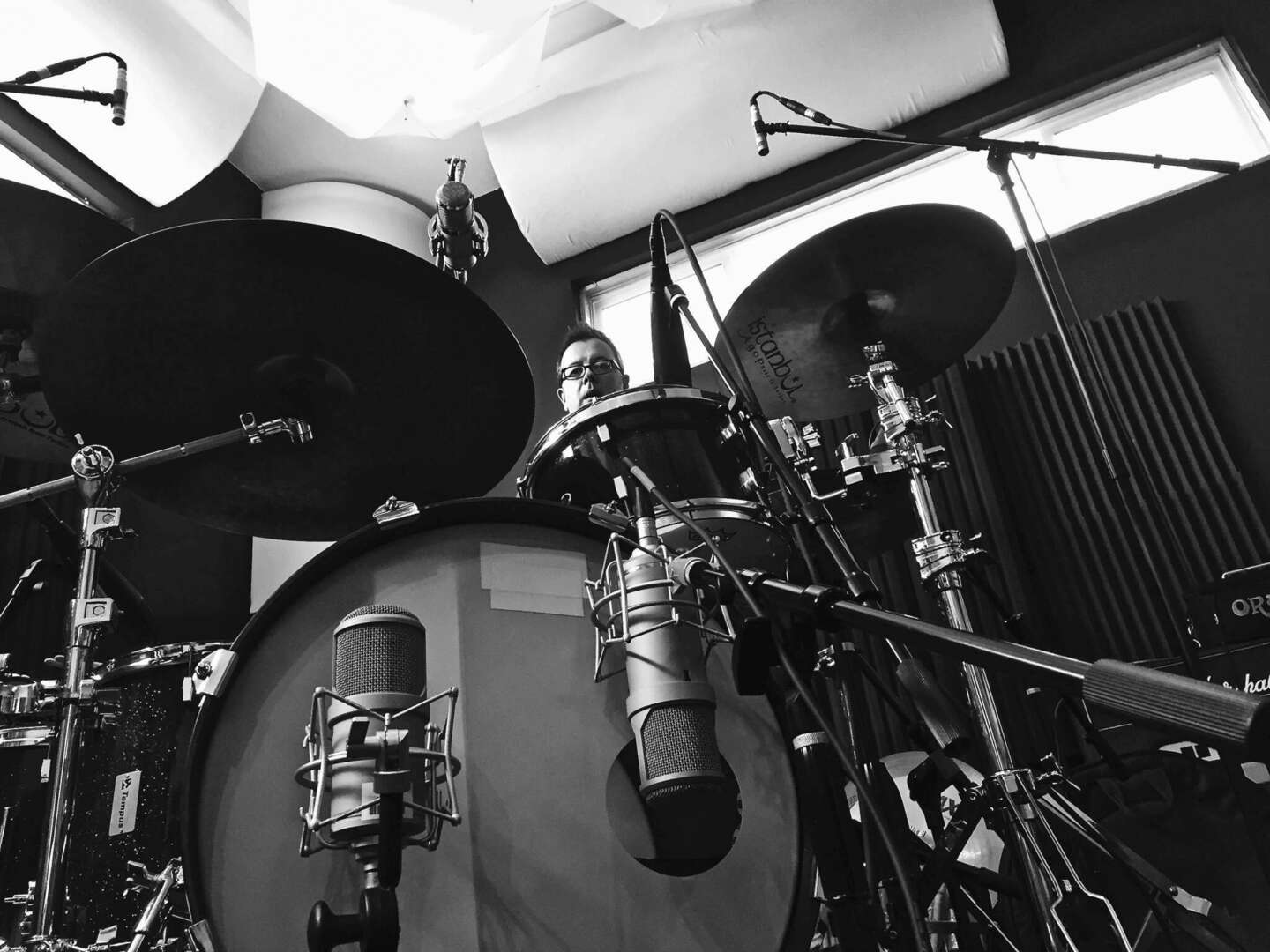
When things shut down during the pandemic, I realized I had an opportunity to develop another aspect to my career/business beyond simply being a player. So, I put together a remote drum recording rig for myself. As of 2022 I can track and collaborate with people and help bring live drums and percussion to their music.
My thoughts around it were: studios are expensive and with budgets being so tight, maybe I can do what a lot of my friends have done and create a system for myself so I can provide what I do to those that like what I do. At its most basic, I went with an analog front end as opposed to the very popular plug-ins and software based ways to create tracks now. I came up in analog so I wanted to build my system around that methodology. I am recording into Pro-Tools (and Logic) of course, but the idea was to have an analog signal chain until it hits the converters. I like the idea of the tactile feeling of turning a physical knob as opposed to a mouse move.
I’ve been an official Ludwig Drums artist for well over a decade and have amassed a really large snare drum and drum kit collection in that time. There are very few drumkit type sounds I don’t have at my disposal now. I love having that flexibility. The kind of mics I primarily use (Mojave and Austrian Audio) honestly capture what my drums sound like. I decided on 500 series units (BAE mic-pres and eq’s) because I didn’t have a lot of room for something like a traditional console or anything like that. My room is not very big and doesn’t have a ton of sonic ‘vibe’ so my choices for the front end give me the most bang for the buck. This combination gives me a nice rich, warm sound regardless of the gear I’m using.
It’s a combination of experience, good gear, and open-mindedness that has people calling me to work on their music. I like to talk with the person I’m working with and see where their influences are, where the emotions of the track (or tracks) are, and what they envision my drumming contributing to it. I don’t want my process or my results to feel cookie cutter and I want my clients to feel comfortable. I’ve found that developing a check list of questions and asking them ahead of time can really streamline the process and create a connection with the people I’m working with well ahead of any notes being played.
Ultimately, we’re all looking for results. The results I have created for the people I’ve worked with so far are consistent in tone and performance. There’s that old adage ‘work begets work.’ I think that is true to a large degree and I hope to be able to continue that success into the future.
What do you think is the goal or mission that drives your creative journey?
My desire/goal in my journey as a creative can be summed up with one word: longevity.
I want to continue to create and ply my craft for many more years. I want to grow as a player and as an engineer and translate the ideas I have in my head into the work I do (live and in the studio). I want those result to sound satisfying to those that listen.
I don’t feel that music is completely ageless. There is certainly stuff that I’m not going to get the call for. I’m kind of okay with that. However, I do think there is a longer shelf life for those of us doing this than some people may think.
The degree to which I am able to do that depends on not only how I take care of myself physically and psychologically, but also what my self-value is. Knowing that I have a certain baseline way I expect to be treated, a baseline weekly fee for touring, etc. are all things that help me stay focused on the music. That focus is critical because how I am able to connect with current music and trends that are constantly shifting and growing can take up a lot of bandwidth. I do appreciate that I may seem a less than appealing option for a younger artist just starting out that are touring, but in terms of creating that newer music… and bringing music from my (and previous) generation(s) to people – I absolutely believe there is a much longer path that we can journey on. That is exciting to me.

Is there something you think non-creatives will struggle to understand about your journey as a creative? Maybe you can provide some insight – you never know who might benefit from the enlightenment.
I think a lot of “non-creative” probably look at what we do and say “I just don’t get it. How do you make money? Do you have insurance? What about x, y, z…?” The very nature of creative work has always been somewhat exploitative and not necessarily valued in modern society; especially here in the US. I think you see if more everywhere now though.
In other countries you have opportunities for grants you can apply for in order to create your art (be it music, theatre, poetry, etc.). There is a long history of this kind of grant giving in Europe – this patronage to/for the arts. While you may be limited in what you can create in that type of scenario, you are still able to ply your craft in some fashion and maintain at least some of your daily expenses. Here in the US those models haven’t existed in the same ways. So, you are primarily funding your art yourself. You can’t assume a ‘record deal’ or some other such windfall. The business isn’t like that anymore and hasn’t been for some time. What you are looking at instead are models like Patreon or KickStarter, etc. So, someone who doesn’t have experience being a creative is looking at it as a huge outlay of money and time and sweat as some kind of ‘handout’ for something that may or may not be profitable.
What someone who doesn’t have a creative outlet doesn’t necessarily understand or appreciate is the willful desire to do that art regardless of the challenges that may come up. There is a certain stubbornness that a creative person has to simply make the art because that is what brings joy/contentment/happiness. If other people enjoy it or are inspired by it, so much the better. This can seem kind of antithetical to a lot of people raised on a certain work ethic that yields results like a big house, corner office, vacations, etc.
The will to create is not based on a dollar figure or profit margin. It is a desire. It is something within you that needs to come out. It doesn’t always make sense because art doesn’t always make sense. Art does make you feel though. That is a critical thing we need in the modern world. We’re so plugged into this digital culture now that we run the risk of forgetting how to feel in the moment. That’s why art is made and why it always will. Whether you’re listening to Bruce Springsteen or Taylor Swift or Radiohead – even those remarkably successful artists – there is a common denominator in all of them: the desire to create and communicate and have that art be experienced. For someone not in the arts, that’s always going to seem a bit strange. But, imagine how strange the world would be if we didn’t have art there to experience.
Contact Info:
- Website: https://www.christopherallis.com
- Instagram: @topherdrum
- Facebook: Christopher Allis
- Linkedin: Christopher (Topher) Allis

Image Credits
Topher on couch – Kaylynne
Topher action shot – Kendall Ruth
Topher Peek-a-boo and fiddling with knobs – Michael ‘Smidi’ Smith
Topher behind big drum kit with hands on ears – Circe Link