



We’re excited to introduce you to the always interesting and insightful Chris Hanebeck. We hope you’ll enjoy our conversation with Chris below.
Hi Chris, thanks for joining us today. Let’s start with a story that highlights an important way in which your brand diverges from the industry standard.
I have spent my entire career in the supply chain industry, have worked in management consulting for 10 years on three continents, another ten in tech startups and the rest as an operator running supply chain businesses. During this time, I have had the good fortune to come in close contact with many outstanding leaders and got to know the industry from a variety of perspectives.
One aspect that has always troubled me was that for a long time, we were not able to actually know what is going on when we ship something from one point to another, say from a plant to a warehouse or from a distribution center to consumers. It’s always been kind of a black box in that there was no or little data that could be collected. Drivers were sometimes asked to call in when they delivered something, but even that was the exception rather than the norm.
Everything changed when wireless communications gradually became available. About 20 years ago, fueled by newly available wireless technologies, a new class of systems emerged that are often called “supply chain visibility” applications. They allow companies to track the movement of trucks, trains, ships and airplanes by leveraging Global Positioning Satellite (GPS) data that pinpoints the truck or train on a map for users of such a system.
You were now able to look at a map on your screen and see exactly where all of your trucks are. This also allows you to calculate an estimated time of arrival (ETA) and, more importantly, to notify the recipient in case the truck will not arrive as planned. This is important because materials that are shipped to a manufacturer are often used in a production process. When they are late, it can lead to disruptions or even closing of an assembly line. The same is true for products that move to a retailer who may already have an empty shelf where your product ought to be. Every time a consumer looks for your product in a store, everyone loses money when it isn’t there.
Essentially, this is still where the technology is today. There are a lot of GPS tracking systems in use today. Yet, having the proverbial “dot on a map” doesn’t solve many of the most pressing issues when we talk about monitoring and managing freight that is moving from one place to another. Today’s supply chain visibility tools do not help you when you are missing documents or when you know what is going on, but nobody else does.
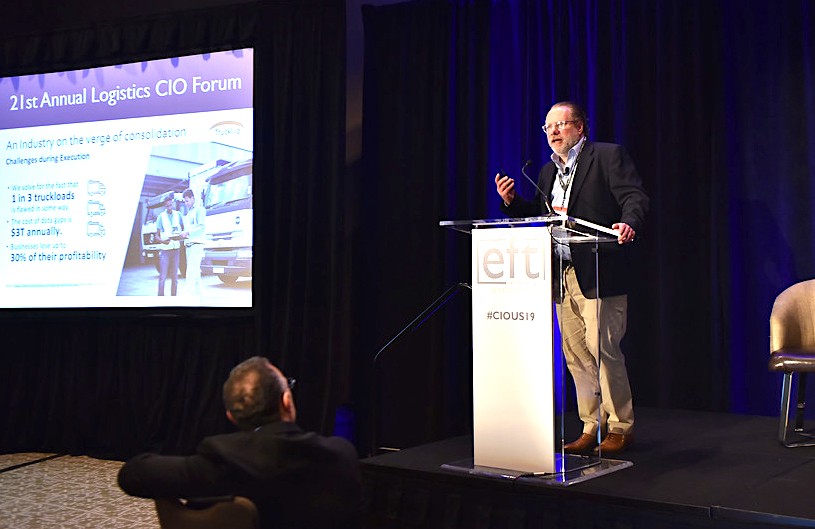
This is a huge problem for the industry. For example, we conducted a study with a F1000 company that ships about 600 truckloads of materials every day in America. 120 times a day a driver is late. Every time a driver is late, the recipient of the freight calls to find out where the driver is. More important, it isn’t just one call, email or conversation, but over a dozen. The production manager calls the warehouse, they call supply chain who calls procurement. They in turn call their sales contact at the manufacturer and the calls keep going until somebody reaches the driver.
On average, we found that there are 16 calls, conversations and emails between recipient and driver. In addition to the recipient, manufacturer and driver, there were third-party logistics providers (3PL), brokers, dispatchers and sometime transportation carriers involved. The cost to the manufacturer in employee time, lost productivity and so on was in the thousands of dollars every day.
We have to ask ourselves whether this is a productive way of working together. It also shows that the existing GPS systems, which are only available to one of these organizations, really help here. My own answer is no, as you can imagine. When I started Truckl, this was the problem we set out to solve. In the end, it turned out that a dot on the map would only scratch the surface to establish true supply chain visibility.
What we do differently from others today is that we have created collaborative dashboards that can be shared between all parties. Users can invite other organizations by just providing an email or a phone number and then those folks get their own dashboard on which all data about a transportation process is displayed. When drivers deliver freight, they also collect much more data than just dots on a map. They can get signatures; take photos and we can even integrate other sensors to collect data. Because everyone is looking at all available data, there no longer is a need for calls, emails and conversations.
Great, appreciate you sharing that with us. Before we ask you to share more of your insights, can you take a moment to introduce yourself and how you got to where you are today to our readers
Truckl is a software company that was founded on the realization that today’s transportation processes are highly inefficient. We have created a better way to monitor and manage freight by leveraging collaborative dashboards, motivational incentives for drivers, advanced mobile applications and blockchain technology.
Today we provide a unique solution to participants in a supply chain who are ready to dramatically improve their operations, free personnel from busy work, start to truly collaborate with partners and significantly improve the services they provide to customers.
Can you share a story from your journey that illustrates your resilience?
Great question. Many entrepreneurs will tell you that it is neither intelligence nor resources that make you successful in the end, although both greatly help, but rather your determination to not give up. Resilience is a key component in this equation. After all, it does not matter how much you want to do something, if you simply don’t have options left.
For us the biggest test so far came with the pandemic in 2020. We were well positioned, had just completed an accelerator program, there were several new projects planned and then by March COVID brought everything to a halt. First of all. we were lucky in many ways and given how many people lost their lives or loved ones what we experienced pales in comparison.
From a business perspective we had to immediately change our approach, stop a lot of work that was going on or planned and we knew that we would not be selling anything to anyone for at least a year. It turned out to be more than one and a half years in the end. Our ability to hunker down and keep working in every way possible and to leverage the time to have many incredibly valuable conversations with decision-makers in the industry became a key to who were are today.
For many entrepreneurs the rule of thumb is that you need at least two years of runway (in the bank) at no revenue when you start out. Anything short of that can quickly move you in a position where you may be forced to give up on a truly excellent idea before you have had a shot at success. Losing a little over 1.5 years to a pandemic was extremely tough, but also brought us much closer to having a great solution based on deep industry insights and decision-maker feedback.
Have you ever had to pivot?
That is an excellent question. If you get to build a business entirely on the basis of your very first ideas, you are simply luckier than a lottery winner. Successful businesses are often those that learn and adapt quickly. Conversely, one key mistake that entrepreneurs across all age groups and backgrounds can make is falling in love with a product or technology. The very notion of an entrepreneur as someone who has a highly positive outlook on life, doesn’t fold in the face of adversity and pursues what they believe is right goes against the concept of pivots.
The difference between success and failure may well come down to outlook, whether you are in love with the solution or the problem. In case of the former, you will likely run into trouble since your solution is seldom exactly what a market needs or wants. However, when you are in love with the problem, you will do anything to alleviate it, including changing your approach, your technology or your solution.
For us the most important pivot came when we realized that our approach to sales was completely wrong. As a solution provider who brings all parties in a supply chain together, we can literally go to anyone in a supply chain to sell. We thought so as well. And we were completely wrong. We began with targets we knew needed us the most and eventually realized that they did not know it. In fact, we often found that we were selling instead of seeking fit with target organizations, which is never really going to work.
Our pivot came in the form of redefining our entire approach to sales, beginning with how we identify targets and who we approach. We joined a growth accelerator program and underwent a complete reassessment of our go-to-market approach with some of the best experts in the startup space. Today we are 100% focused and we act with intent. It’s been a great experience in every way I look at it.
Contact Info:
- Website: www.truckl.io
- Linkedin: https://www.linkedin.com/in/hanebeck/