


Alright – so today we’ve got the honor of introducing you to Celeste Rehm. We think you’ll enjoy our conversation, we’ve shared it below.
Alright, Celeste thanks for taking the time to share your stories and insights with us today. We’d love to hear about when you first realized that you wanted to pursue a creative path professionally.
I was interested in becoming an artist at a very young age but I needed wider exposure to the arts and a good education first. Some artists might have an epiphany and suddenly declare they are artists. But for me it took years to find my vision. I decided to become an artist “when” I found my vision and had something to say. But just as important was “why” I chose to become an artist. This happened after being encouraged to make art for most of my life. I cannot stress the importance of how much positive words and encouragement matters in forming future artists. I believe that it was the support from family members and teachers along the way that kept me going in addition to my personal interest. When one has a vision and a desire to make art, that young artist will seek out what to do if encouraged to do so. But without the support of those close by or if living in an environment where making art is discouraged, then becoming an artist becomes more difficult.
My first positive “artistic experience” happened when I was in kindergarten. My teacher took me to the principal’s office to show him a drawing that I had done. She was proud of what I had drawn. This left an impression on me since validation from outside of oneself is a strong motivator. In fourth grade I was chosen to create a large mural drawing of a Greek temple that was displayed in the school hallways for weeks. When I graduated 6th grade, many of my teachers wrote encouraging words in my journal urging me to continue to make art. In junior high I submitted a drawing that was chosen for the cover of a school magazine. In high school I was voted class artist and given the opportunity to draw a pencil drawing of the teacher our graduating class chose as their favorite. They printed my drawing in our yearbook instead his photograph. To this day I feel honored to have contributed to my graduating class and yearbook in that way. All of these positive artistic experiences gave me confidence to pursue a career in the visual arts.
But the most important words I heard was when one of my high school art teachers suggested something that eventually steered the course of my life. The words that a teacher says to you matter. He told me to consider teaching art in college or in a university. Sometimes a life’s journey does not have a clear destination but when one is presented then a possible career path can be envisioned. I decided that teaching would be a good career choice for me even though I was told repeatedly how difficult being employed by a university might be. But I was both blessed and lucky. I had supportive teachers in my advanced undergraduate and graduate art classes who encouraged me and gave me good advice. After receiving my MFA from Pratt Institute, I was hired by the University of Colorado in Boulder where I taught painting and drawing classes for over 30 years and loved it.
I became a professional artist at the same time I began my university teaching career. I displayed my artwork in numerous exhibitions throughout my life all over the United States. But when I look back, I see that it was really all my teacher’s encouraging words and the support of my family that were most important giving me the “why” I chose to become an artist. For me the “when” I became an artist was a process of trial and error that took time to develop. But the “why” I became an artist was a direct result of those who believed in me.
Great, appreciate you sharing that with us. Before we ask you to share more of your insights, can you take a moment to introduce yourself and how you got to where you are today to our readers.
My current series of artworks is entitled “The Animal Gaze”. It is a series of oil paintings and drawings that focuses on animals as the subject matter to communicate political and social issues related to wildlife, nature, the environment, and the Earth. The underlying concepts can be interpreted as metaphors for human existence. For example, if the subject matter I choose is about animals facing extinction, the question becomes whether or not humans will soon face that problem too. The goal is to inspire conversations about how humans view and treat animals, the environment, and by inference each other.
I have been creating and selling artwork using animals as the subject matter for decades. I am proud of my long-term commitment to “The Animal Gaze” since it has given me the time to fully explore this theme. The underlying theory of this artwork implies that if humans could see the world through the eyes of animals, different choices might be made when caring for the Earth. I hope to bring attention to the need to value and conserve animals and their habitats. By assuming an activist role, art can awaken human awareness about a variety of subjects that might need to be challenged and even changed especially human activity that destroys the environment or puts animals in danger. I believe that art can be a tool for enlightenment by combining humor with imagination. Art can embody a social agenda to increase an understanding of the interconnections between living things and their environment. These are the beliefs I put into my art.
In my paintings I use symbolic juxtapositions to tease the imagination by creating visual puns from hybrid images. I call my art surrationalism, which is related to surrealism but different in how images are chosen to be combined. Surrealistic art often combines images that are arbitrary or more haphazard while surrational art chooses images that are more specific and “intelligent to the eye” to add a deeper layer of meaning to the content. Like surrealism, surrational art can make powerful statements where the results are not intended to be looked at as pretty paintings. Hybrid images can create images that usually don’t exist in real life but can exist through illusion and some are disturbing. My paintings are not for everyone. How many of us would want to hang an ugly picture about acid rain damage or the devastating effects of an oil spill surrounding wildlife in our homes? Should artists show all the ugliness of environmental devastation or should they reflect idyllic beauty?
Art teaches us to look at animals in stereotypical ways. Most traditional wildlife art shows animals in beautiful idyllic scenes to mirror the beauty of nature. It is a challenge to put controversial environmental issues into artwork that we could stand to look at but that still has a hard hitting message. My hope is that the startling juxtapositions I create can add to the discourse to communicate positive values. The development of nurturing relationships between all living things is important to me. What sets me apart from other artists is that I am willing to use art as a form of activism and paint non-commercial subject matter even if the imagery is unnerving.
Is there a particular goal or mission driving your creative journey?
As an artist, I had an important decision to make. Did I want to produce art that mimics the beauty around us, showcases my personal artistic style, or include issues related to social responsibility? I decided that my driving mission would be one that brings awareness for the humane treatment of animals. Most concerning are issues that threaten the survival of animals including unnecessary animal experimentations and the plight of endangered species.
I believe that animals have rights and any experimentations that are cruel should be avoided and those that are necessary should be done with care and consideration of the animals involved. Endangered species are those whose populations have been so reduced that they are threatened with extinction. Thousands of species are included in this category including mammals, birds, reptiles, and amphibians. The list is growing at an alarming rate and can also include species of fish, invertebrates, and plants. How soon might it also include humans? Other important topics that interest me include unlawful hunting, encroachment into natural habitats, conservation, overpopulation, urbanization, deforestation, extinction, ecology, animal welfare, and various themes of political concerns. One main goal of my artwork is to use images of animals to communicate these issues of concern and to increase an awareness of human behaviors that can negatively impact the natural world.
My artwork questions the arbitrary hierarchy of humans over animals. Animals are subjected to the political, social and economic whims of the country in which they are born. Animals are companions for our daily lives. We secure their safety, cultivate and train them to serve our needs, arrange for them to be sheltered, fed, sterilized, or bred as we please. But in our humanness, we treat many other species with contempt, condescension and patronage by putting them in zoos or using them for experimentation. We assume superiority over every other creature and every other species. Animals are dependent upon humans for survival and existence and ironically visa versa. “The Animal Gaze” often sympathizes with the struggle of animals, their rights as endangered species, and their rights as subjects for experimentation. My overall mission is to acknowledge these issues so that animals can always be treated with respect.

What’s the most rewarding aspect of being a creative in your experience?
For me, the most rewarding aspect of being an artist is the challenge of taking a feeling and a vison I have in my mind and watching it materialize on canvas. I paint the ideas I see in my mind because of the questions I ask about what I am feeling. To do this I often ask myself a specific question of what this vision might look like and then try to answer it visually. To illustrate this, I’ve included an analysis of the artworks submitted to give insight to the internal creative process that happens even before the brush hits the canvas.
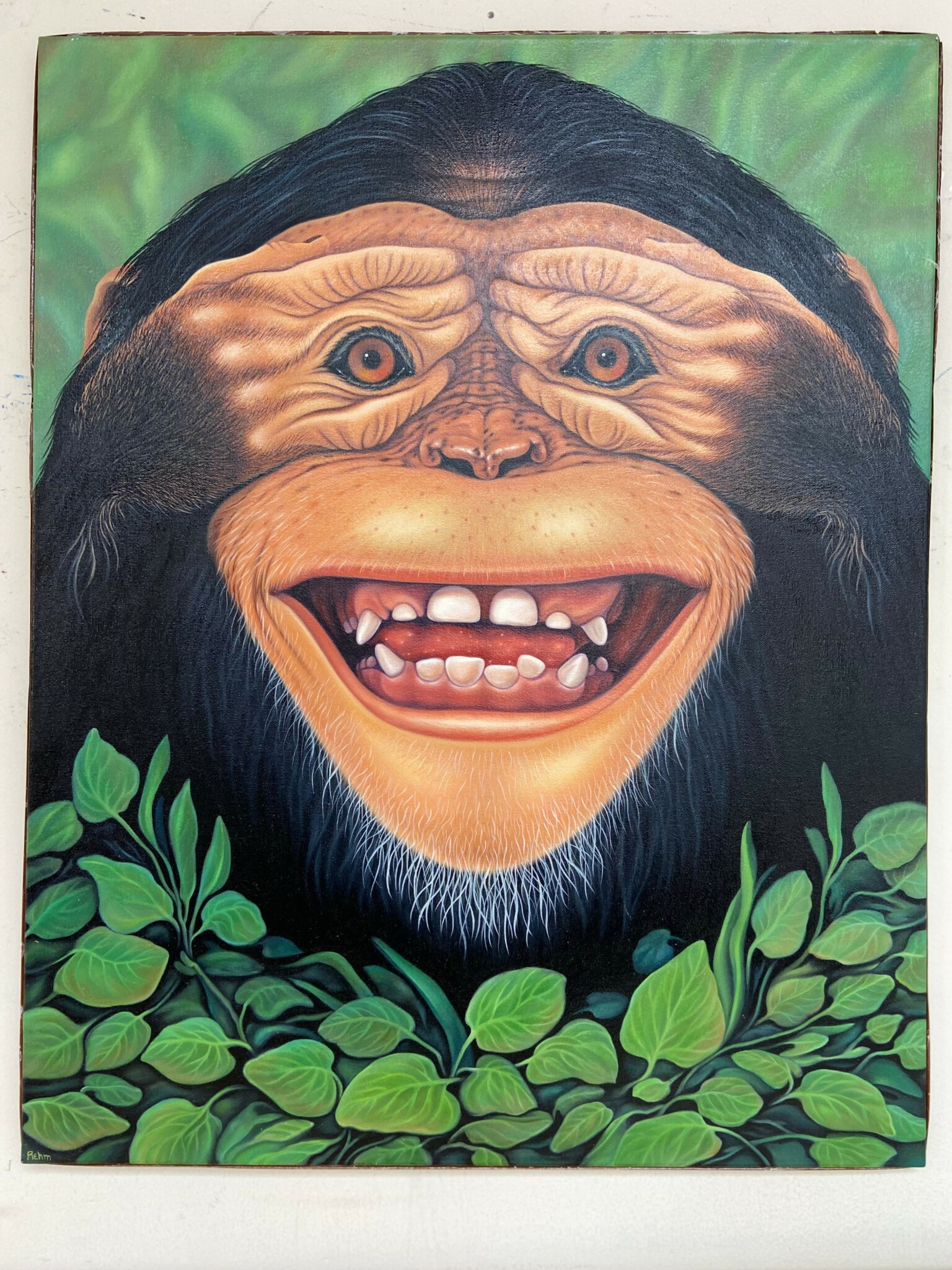
“Monkey See” 30”x24” 2002
This painting shows a chimpanzee with her hands over her eyes but with a twist. Her eyes are painted on the outside of her hands suggesting that she can see “beyond”. Can she can see the terrible things that humans often do to chimpanzees – entrapment, experimentation, incarceration in zoos, and so on? I first pained the image of “transparent hands” back in the early 1970s at a time when everyone was talking about women’s liberation. I used the image of a young woman to show that she could “see through” things that people might try to hide from her. So initially this image was really about the female gender having the ability to see beyond the restrictions that woman might face in society. Young females are often protected by their families to keep them from seeing the real evils of the world, a projection that they do not put on their male children who are allowed to explore more freely. I projected this same feeling on to the chimpanzee. When I thought of “The Animal Gaze” series I wanted to find an animal to symbolize an “all-seeing animal”. Seeing parallels between the oppressions of women and animals, I decided to re-invent this image one more time using the chimpanzee as my subject. The question I asked was, “What would it look like if an animal could epitomize the gaze of all animals?” I chose the chimpanzee to do this.
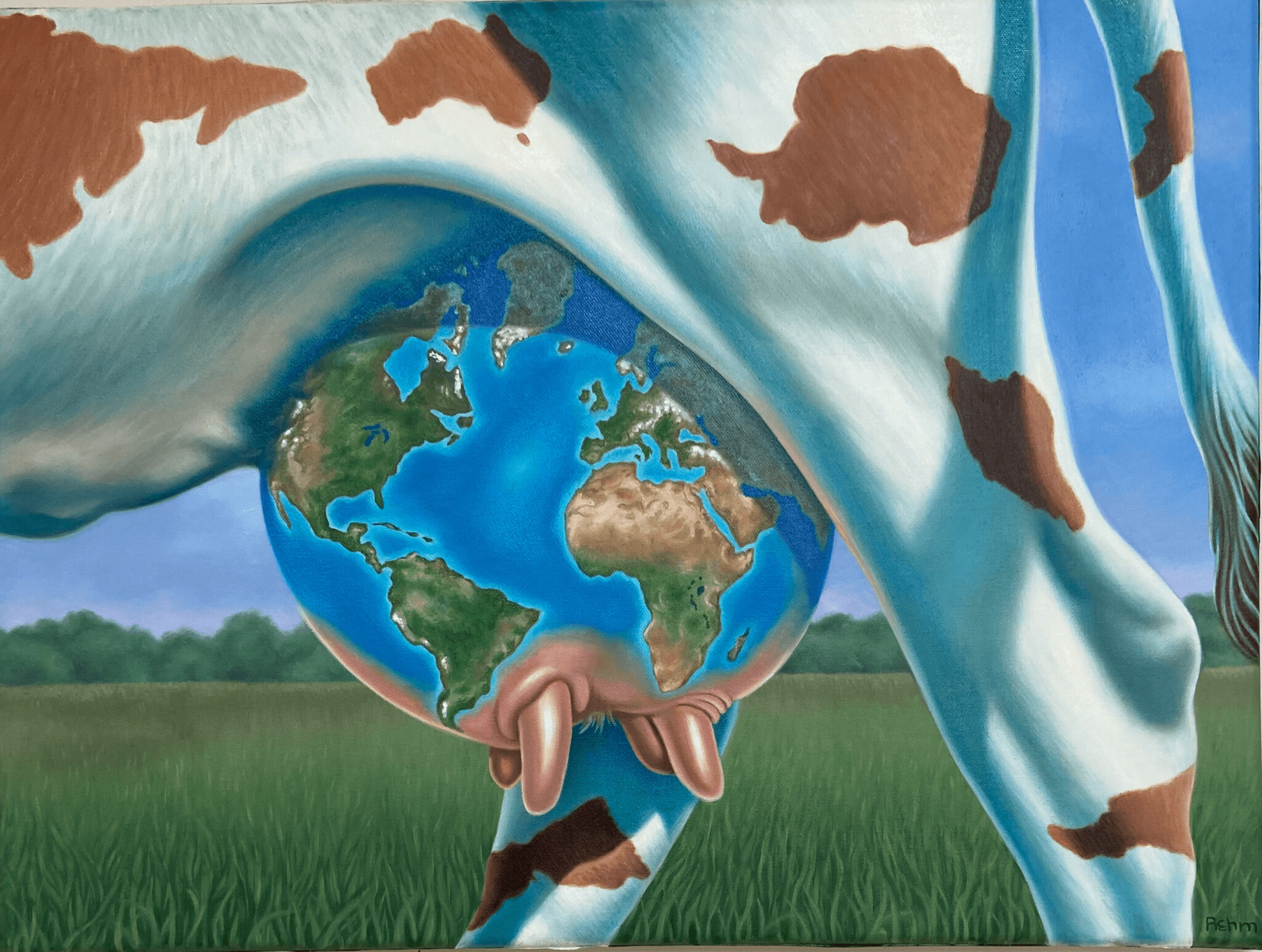
“Feed The World” 18”x24” 2025
This painting shows a milk cow with the image of the Earth superimposed on its utter. Sadly, millions of children in the the world go to bed hungry including many who live in America. Does milk have a role in global nutrition? The nutrients in milk can sustain human life and feed the world. Milk has tremendous benefits to help develop an immature immune system and foster childhood growth and development. I have read that dairy production can have a negative impact on the environment. But I believe that it may not be so important when looked at from the perspective of saving malnourished populations. So I decided to paint a picture that includes most of the continents of the world too because hunger is a global concern. I used the brown shapes on the cow’s fur to include additional continents that were not clearly visible on the image of the Earth – Eastern China, Australia, Antarctica and so on. The question I asked was, ”Can cows provide enough milk to feed all the children of the world so that hunger could be a thing of the past?”
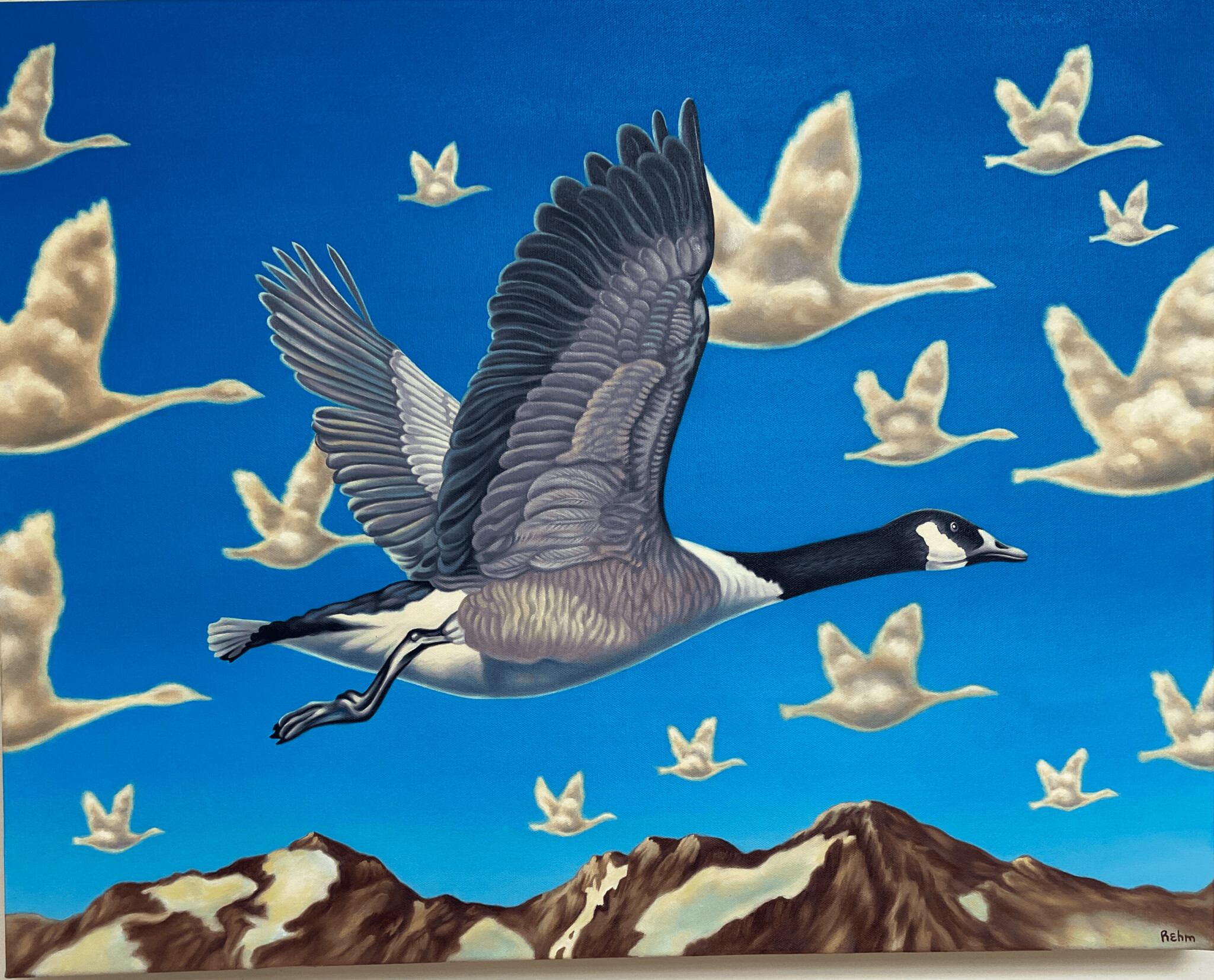
“You Are Never Alone” 22”x28” 2025
This painting shows a Canadian goose flying amongst a group of clouds that mimic its shape and direction. Besides an obvious spiritual interpretation, there is the reality that we all see clouds almost every day. Many of us, if not all, have looked at clouds and imagined seeing animals and other things. For me, they inspire imagination, foretell weather conditions, and even influence how I feel. On a sunny day when I see billowy white clouds juxtaposed against a bright blue sky, I feel good. On a wintry day when the clouds are hazy and transparent with pale colors I feel depressed and cold. I’ve often wondered how much seeing different clouds might affect animals too. Besides seeing clouds, I often look to the sky to see geese flying over our house. One day I was sitting at the kitchen table and looking out the back window imagining all sorts of images in the clouds – elephants, dogs, and so on. The clouds were moving as if they were flying and I remembered seeing a skein of geese that had flown by recently. The question I asked was, “What would it look like if these clouds were shaped like geese and flying along side a real goose?” That question gave me the idea for this painting.
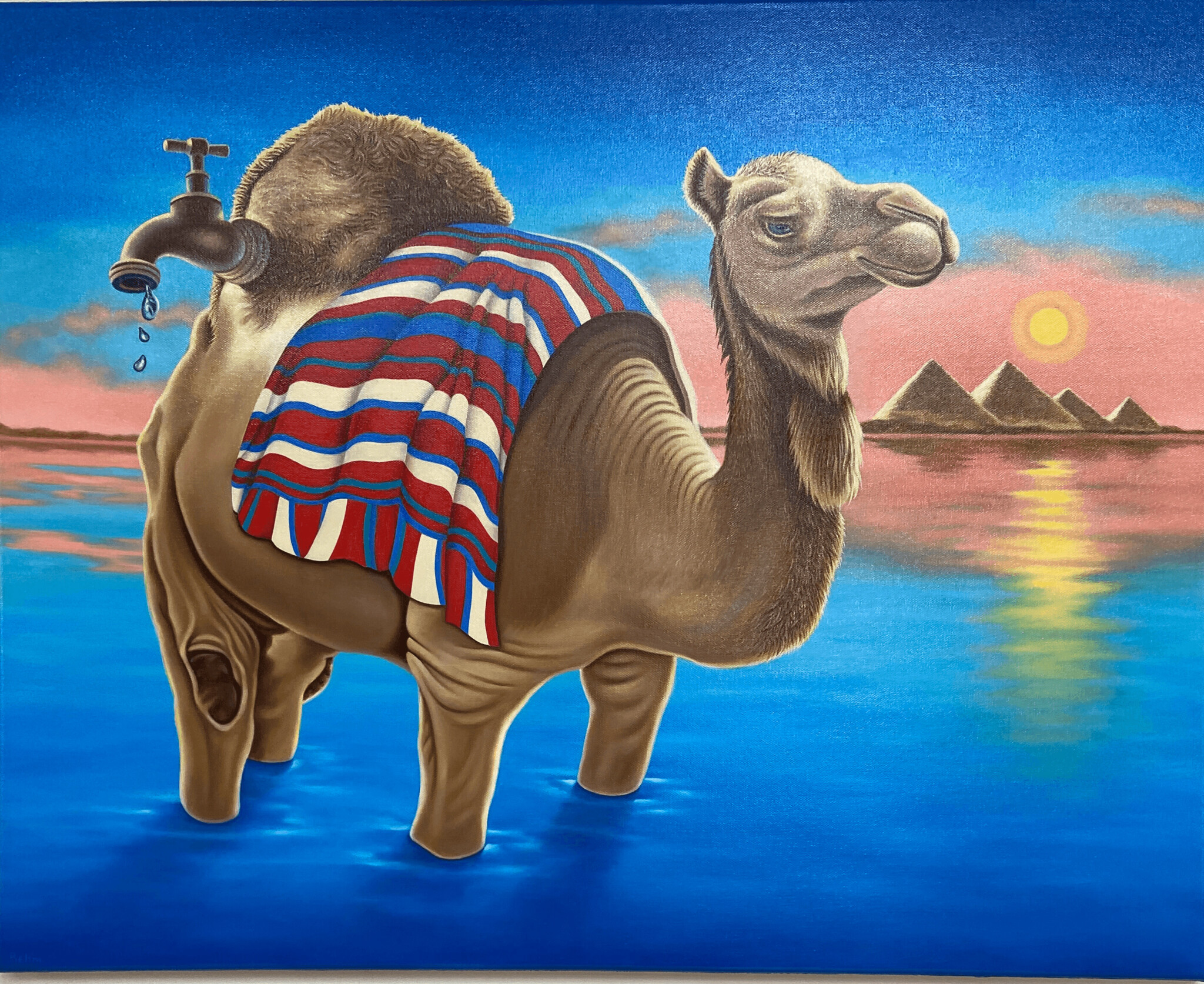
“Leaky Faucet” 24”x30” 2024
This painting shows a camel in what used to be a desert. It is now a flooded area due to a leaky faucet that protrudes from the camel’s hump. One day while riding my trike in our neighborhood I saw a fake rock in a neighbor’s landscape. Close by was a faucet sticking out of the ground and from one angle it looked as if the faucet was attached to the rock. I recall thinking to myself that sometimes I see unusual juxtapositions that actually exist in real life. I rode by that site for years without pushing the idea further. But recently our city was put under water restrictions and I wondered if I could put the restrictive feelings I was having about not being able to use water freely into a painting. A leaky faucet wastes water, which I see as a valuable resource. With that in mind I suddenly saw the rock as a camel’s hump and decided to create a humorous juxtaposition. When I researched information about camels I learned that they can store water in their humps for as long as eight months! The question I asked was, “Could a faucet attached to camel’s hump be a useful source of water?” So with that in mind, I filled the desert in the background with life saving water from the leaky camel’s faucet.
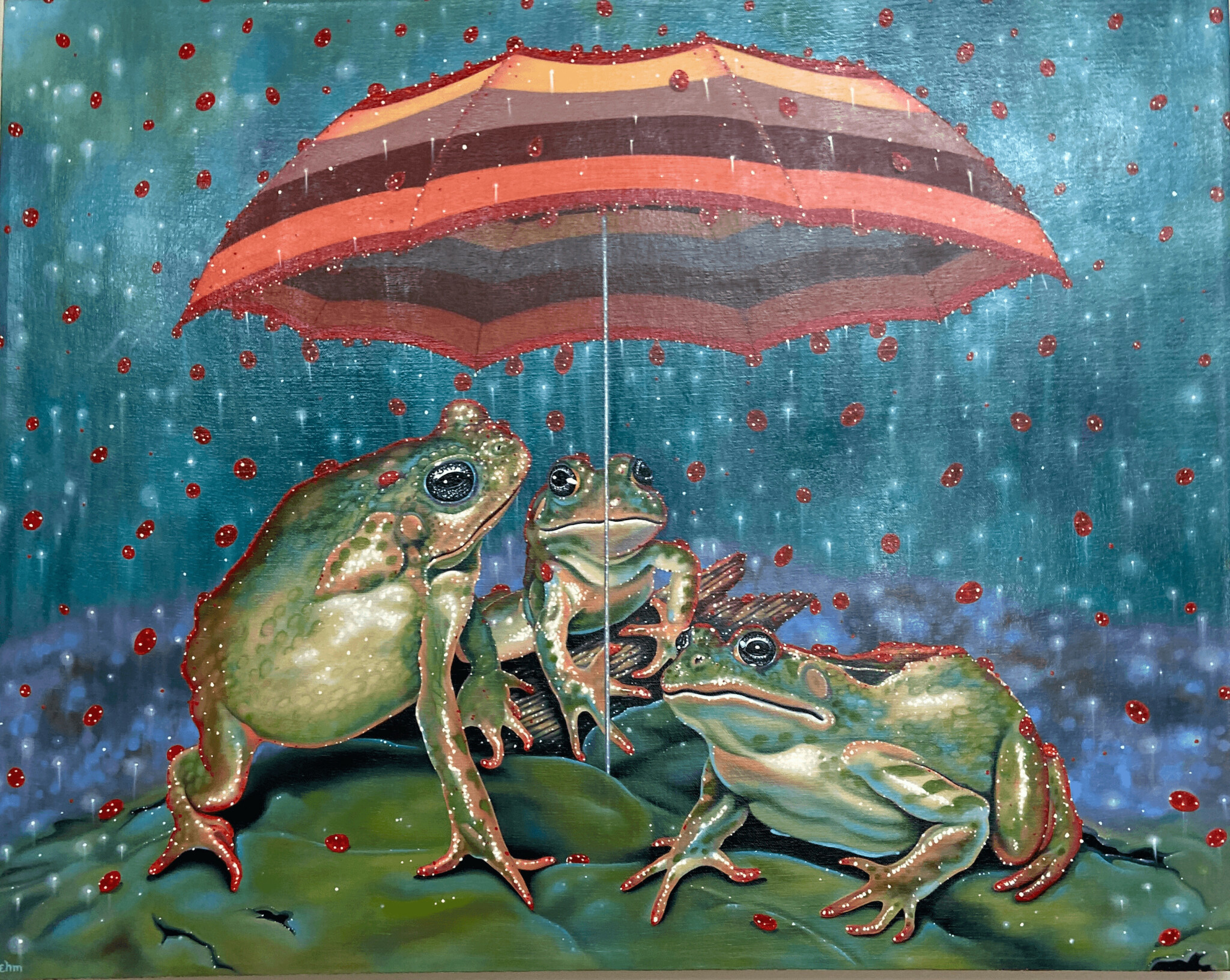
“Blood Rain” 24”x30” 2002
This painting shows a group of frogs trying to protect themselves from red drops of blood that look like rain by huddling under an umbrella. The red drops are meant to symbolize acid rain. Ironically, when one thinks of rain, one usually thinks of purified water. But rainfall can be toxic as a result of human activity like burning fossil fuels or from car emissions that pollute the air. Although acid rain is often clear in color, I decided to make the droplets bright red as if the sky was bleeding after being injured. This painting is about pollution and the destruction it can cause to the quality of the air, the nutrients in the soil, life that exists in bodies of water, animals, plants, and even buildings since it can corrode building materials. But the real effects are those on humans causing a variety of lung and respiratory problems, heart disease, and even low birth weights of human babies. Thankfully since I painted this painting the impact of acid rain is far less due to stronger air pollution laws. The question I asked was, “How can living creatures protect themselves from acid rain?” From my research, the answer was to “stay indoors and to use an umbrella” for protection like the frogs do in this painting. Really? This painting shows how ludicrous is it to think that an umbrella could offer protection. I think the real solution is to address the environmental issues that cause acid rain.
“Taking The Law Into Your Own Horns” 38”x28” 2000
This painting shows a young buck with the ends of its horns turning into guns as a form of self-defense. For me, hunting animals is unacceptable but I realize that many hunters do so out of necessity. I have no intention of upsetting hunters by condemning them if they hunt responsibly. But I find gratuitous hunting for sport unnecessary since animals are vulnerable and defenseless against guns. But beyond the obvious goal of not wanting to kill animals, this painting is also meant by inference to raise questions about guns in our society. Too many Americans die from gun violence. When I was thinking about hunting deer and other exotic animals the question I asked was, “How would an irresponsible hunter feel if a buck could defend itself and shoot back?” The same question pertains to humans. If a criminal wants to rob a house, will knowing the owner has a gun deter a crime from happening? My hope is that this painting raises questions about gun ownership, the laws that support it, self-defense, gun responsibility, and other questions that need to be continually asked and answered in any society that supports gun ownership.
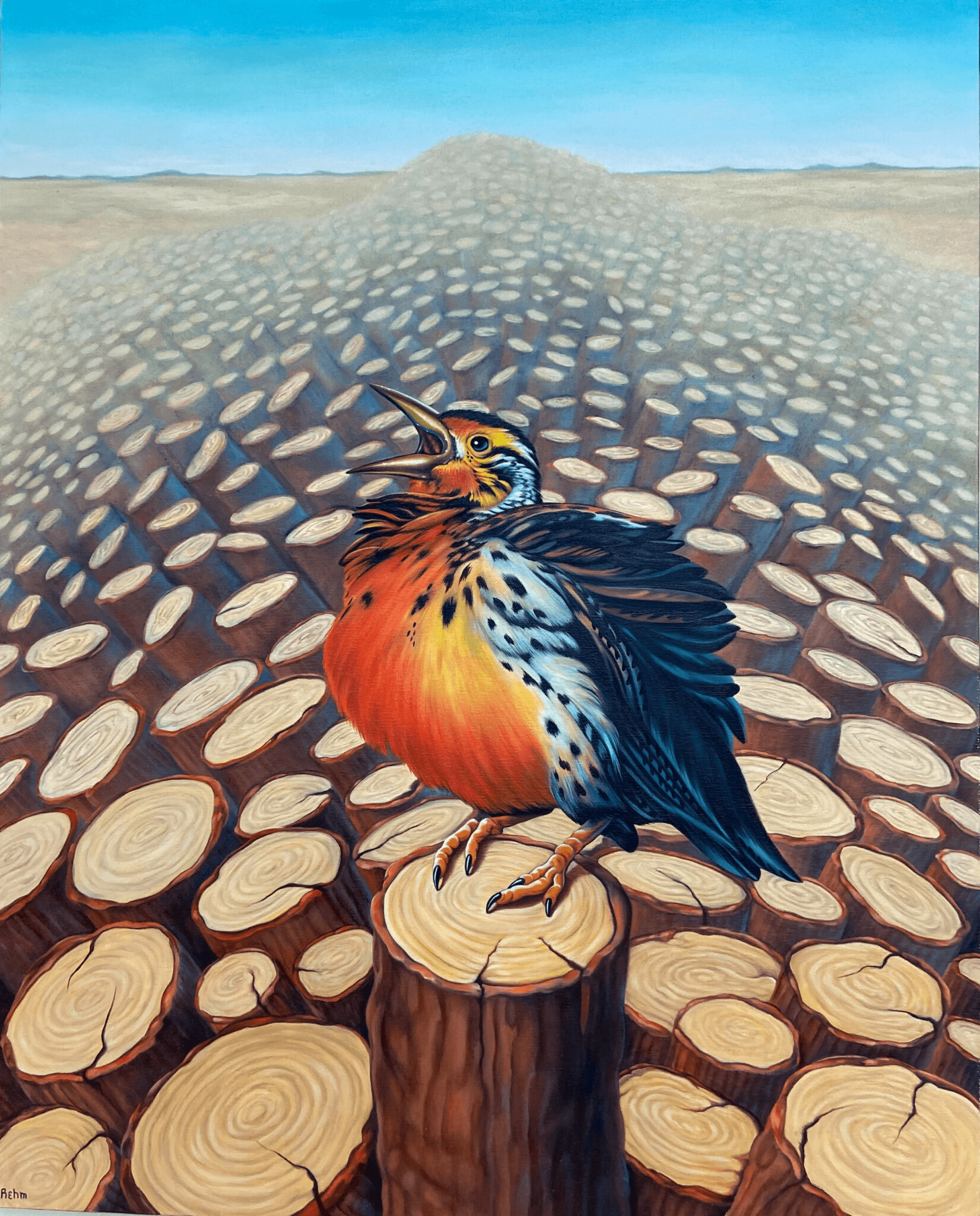
“Deforestation” 30”x24” 2003
This painting shows a young chick that has been displaced from its home. All of the trees have been cut down and the nest where it was born is gone too. The chick is homeless. Cutting down forests creates stress on the environment especially if it is done without replanting trees. Sadly, large areas of trees are often cleared for human development for infrastructure, agriculture, or to harvest timber for profit. This can lead to significant ecological damage including soil erosion, disruption of water resources, and even climate change. Plundering the rainforest without replacing it will lead to increased carbon in the air, the destruction of many exotic plants, and leave many animals homeless. I wanted to show the shock of a young chick who suddenly has no place to live. This feeling is not unlike what humans feel who have suddenly been displaced by tornadoes, hurricanes, fire, and other natural disasters. By analogy humans can be seen as threatening other species like natural disasters threaten humans. To create this painting, the question I asked was, “If forests are depleted by cutting down trees, can programs be put into place to always replant them?” Conservation must always prioritize protection, preservation, and management of natural resources. When it is applied as a continual nurturing process it can save habitats, enhance the eco-system, protect bio-diversity, and even protect many species from becoming extinct, including humans.
“No More Cities” 36”x48” 2000
This painting shows the universal sign of “this is not allowed”. It is a graphic symbol of a bright red circle with a red bar across it. On the inside of the circle is the image of an ugly city. It is meant to symbolically stop the building of cities that ruin the environment. Surrounding the image of the red circle are animals in the forest who suffer displacement when cities are built. Building cities for future humanity will be a necessity, of course. But can they be built without sacrificing the habitats of precious animals? If humans encroach on their space, where will they go? I created this painting to show an unattractive city that deteriorates as it ages. Along side this image is a forest of bight green leaves that harbor animals. The bright green leaves contrast the ugliness of the city and are meant to symbolize life, beauty, and safety for the animals. The question I asked was, “Can humans create beautiful lasting cities without having to ravage the landscape and displace animals?”
“Carving Big Horn II” 48”x36” 2008
This painting shows a bighorn sheep in an overpopulated environment where buildings and houses grow on the mountain side like cancerous growths. As the urbanization pushes out the bighorn sheep, the buildings also grow on to the horns of the animal suggesting out of control overpopulation. What happens when the population of a city increases to the point of exhausting all the resources of the area and surrounding land where no more room exists? Cities, if well managed, can provide many positive assets for humans by offering more services that are easily accessible, more job opportunities, a sense of community, better quality of life, varied entertainment, better healthcare and better education. But they can also have negative effects including plundering natural habitats, deforestation, damaging the eco-system, and destroying plants and animal habitats. If poorly planned there can be detrimental issues that commonly plague large cities such as pollution, overcrowding, congestion, higher crime rates, loss of bio-diversity, alteration of the environment, housing shortages, unemployment, water sanitation problems, and even the spread of disease. The question I asked was “What does ultimate urbanization look like?”
Contact Info:
- Facebook: Facebook Celeste Rehm Fine Artist
- Other: [email protected]
www.Etsy.com/Shop/CelesteRehmFineArt
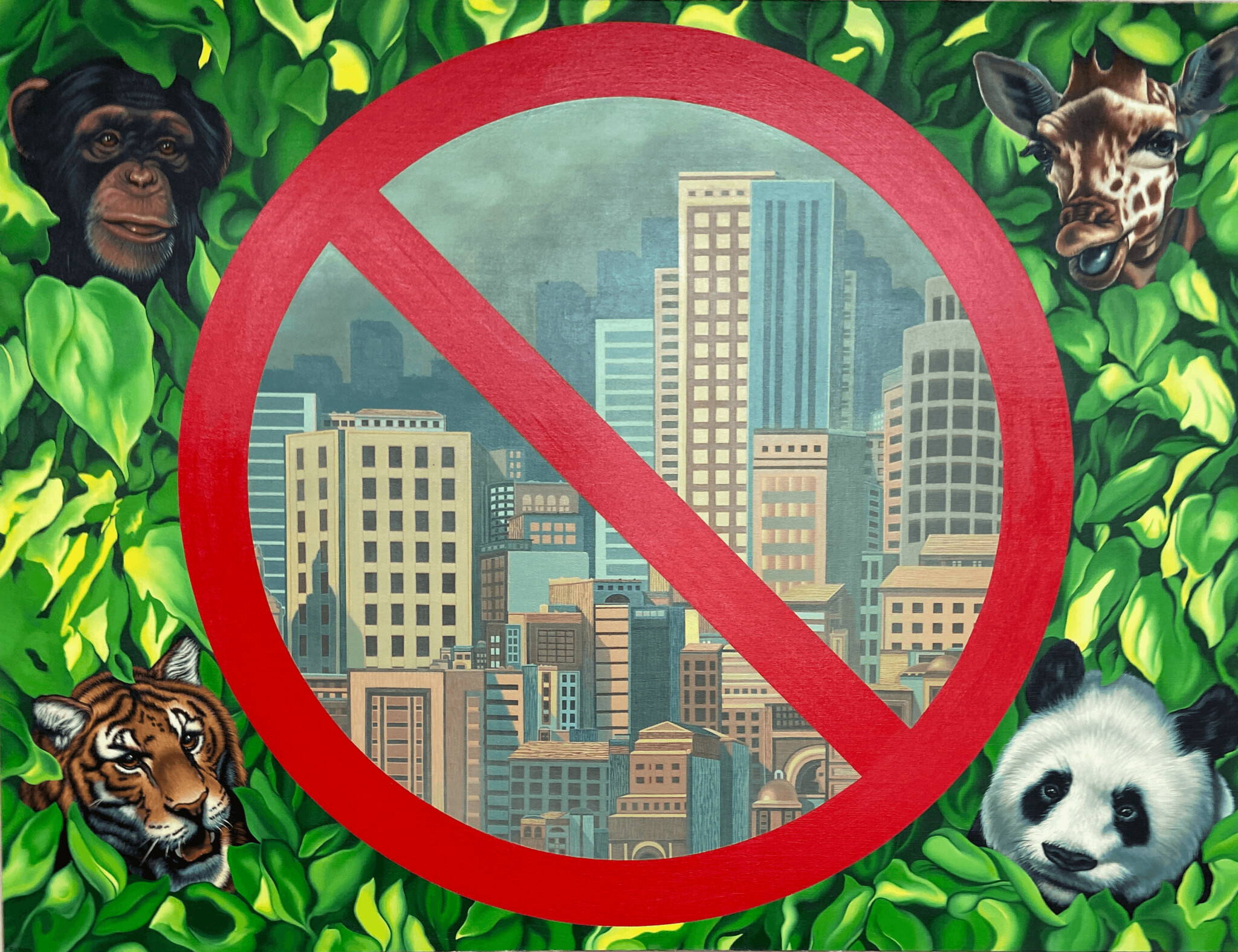
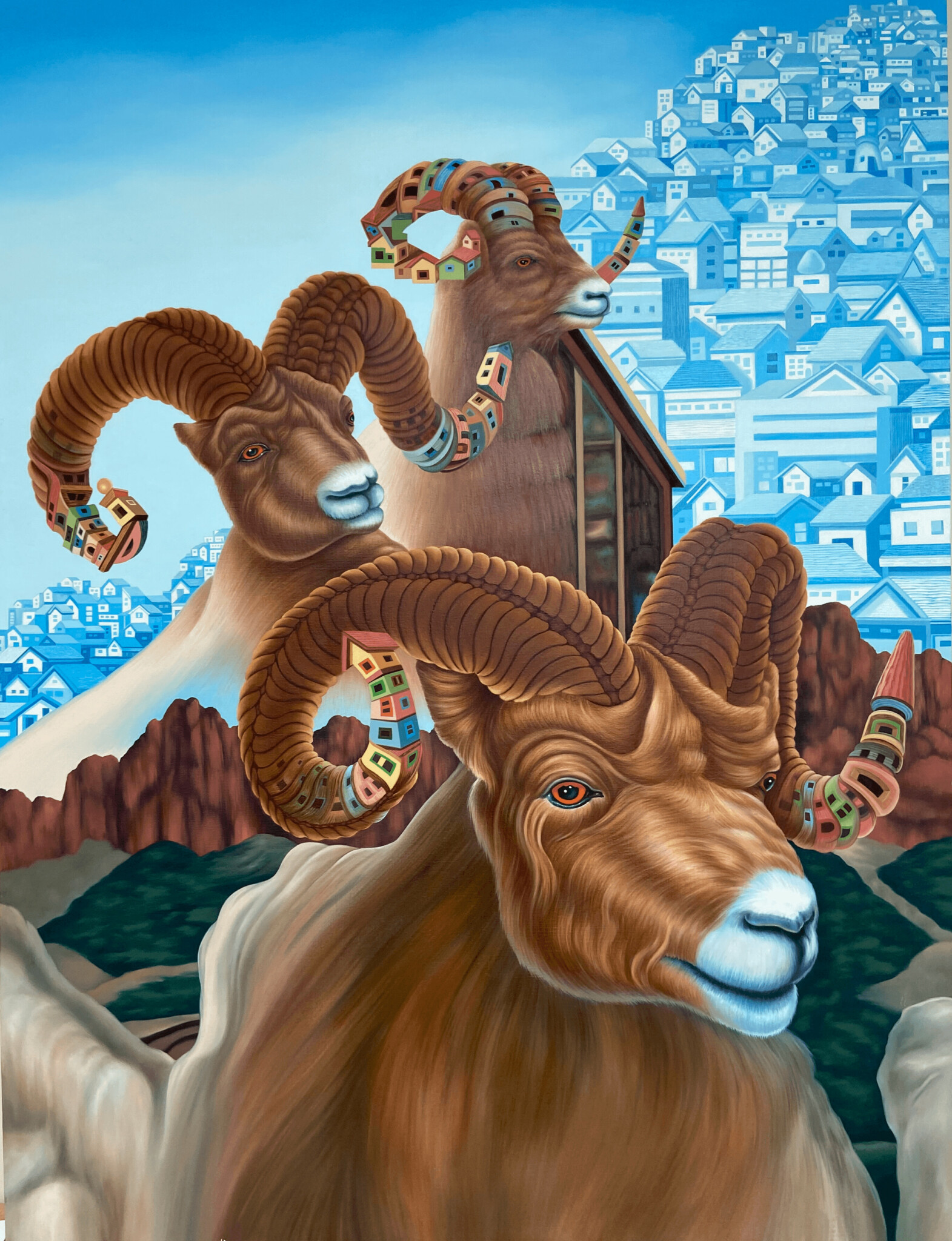
Image Credits
Celeste Rehm