

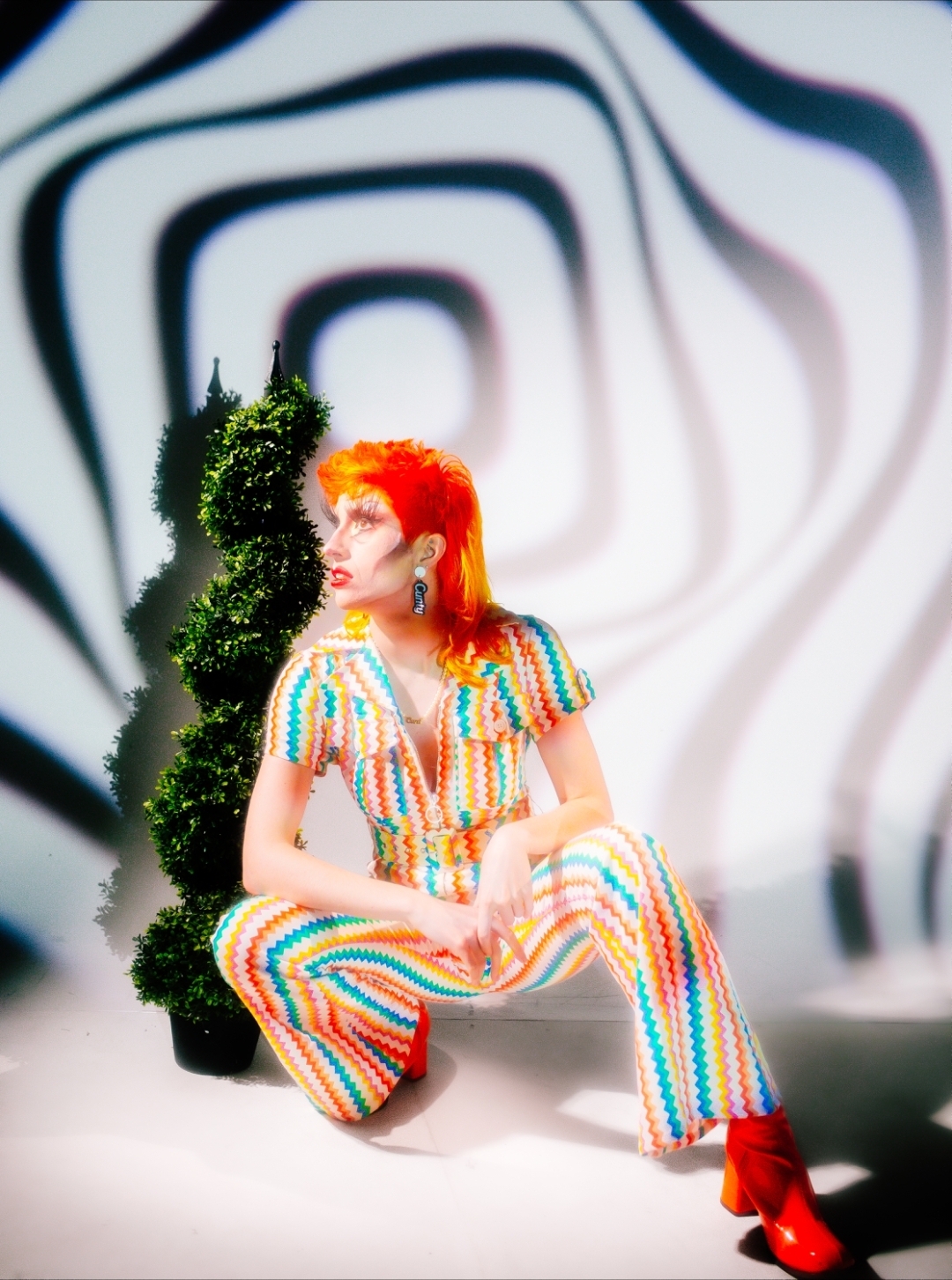

We were lucky to catch up with Cassandra Harner recently and have shared our conversation below.
Cassandra , thanks for taking the time to share your stories with us today What did your parents do right and how has that impacted you in your life and career?
My parents divorced when I was a baby, and I have no memory of when they were married. My mom was in real estate and my dad was a percussionist. My mom remarried to a man in real estate, and my dad remarried a painter. The story I was told growing up was that my dad wasn’t able to get a practical job to support a child.
Both my parents love the arts, but both were insistent on my pursuit of a “practical” education in addition to art. My love of art and music was inevitable, and they both encouraged that. My dad made sure I practiced piano, the flute, and the drums. My mom and stepdad produced a haunted house in a historic theater where I was designing sets and performing.
I understand their perspective on my college education to be in something I could use to help support myself, rather than something I’d otherwise be self motivated to learn with or without college. Teaching me this measured practicality alongside encouraging the arts was a crucial balance to my life that I still value today. I managed to get a job I enjoy in a field related to my BFA in digital art. Ironically, the “practical” degree I also pursued was in East Asian studies and linguistics, which I find has a much less direct impact on my life now, even if at the time it felt like that was my future. Of the many varied interests I’ve cultivated in my life, the one that has been most consistent has been in art, and I still managed to find a way to apply those skills in a practical way to support a sustainable career, even if it took a little over a decade to get there. I’m grateful that I’ve found a place that values my varied, eclectic skills, and I’m always in pursuit of making links between all I’ve learned to apply it all to what I’m working on.

Cassandra , before we move on to more of these sorts of questions, can you take some time to bring our readers up to speed on you and what you do?
As an artist with a video & social media day job, I have built a library of media projects on my social media accounts, but have resisted applying what I know “works” on algorithms to my personal art projects, because I don’t want those formulas to influence how I make my art. When talking about a brand, I know the tools to build interest through a narrative, to have a strong “hook,” to optimize SEO, to have a cohesive visual brand, etc. Those skills are truly valuable, but separate from artmaking.

Have any books or other resources had a big impact on you?
I was trained on “They Ask, You Answer,” and I find that these ideas are a strong framework to building a brand through video, which is my current role at a small law firm. The idea of “TAYA” is not creating a sales pitch, it’s building trust. You want to answer all the questions a potential client might have, be transparent, and an educational resource that provides real value regardless of whether they sign up or buy something. It comes down to authenticity.
I think remaining authentic is becoming more essential by the day, and people can intuit authenticity, or lack thereof. It can be hard to pull off on camera, even when the intention is there. It takes practice.
But what is authenticity? How do you know if you have it? Follow me as we go off the rails a bit.
A video essay, “Your phone is not the problem” by Crimes New Roman, pointed me to a book called Technopoly. Alongside this book I was also reading Escape From Freedom by Erich Fromm. The ideas in the essay and the books point toward how using technology comes at the cost of human thinking, and without a practice of our active thinking, we lose our sense of purpose. When this happens, we seek to fill the void with products, with gods, with relationships, with power, etc. Technology is like a brick through a window with a note attached, “Need window repair? Call 555…”
We live in an era of AI where the opportunity to practice thinking is sidelined, and this has sinister consequences. When talking about authenticity, that’s something AI can never have. Technopoly describes a culture where instead of technology existing to serve humanity, humanity is at the service of technology. It assumes that tech is superior and more trustworthy than human intuition, experience, labor, or thought. This is a dangerous road we are on today.
AI is not just burning natural resources, but is eclipsing our opportunities for original thought. It claims to speed up processes for us, but that “free time” never stays free. The void is filled by more labor, distractions, or vices. We have become allergic to silence and boredom, from which original thought can occur.
Escape From Freedom describes how thinking as “reasoning” is distinct from remembering, or parroting, what we heard from another (perhaps forgotten) source, and attribute it to having thought of it ourselves. Something I intentionally practice in my work, especially writing, is reasoning with what I’m reading and learning, and trying to apply it to my life or other things I’ve learned. I remember the sources of info as best I can, and I engage critically with what I read, and am wary of bias along the way. This way I achieve “original thought” as in, I came to my own conclusions or formed my own opinions.
Perhaps it’s a blessing I’ve never been good at memorizing, because this deeper reasoning has always been a necessary process for me to truly learn anything. This made grade school difficult at times, because we have been on the path away from original thought for a long time, evident in the structure of modern education. Fromm wrote his book in 1941, Postman wrote Technopoly in 1992. But as an adult I see that my art practice is the extension of my criticality, my curiosity, my pattern recognition, my need for a “why” and a “so what.” This is the human thinking that resists Technopoly, resists the appeal of totalitarianism, resists falling under the spell of dogma, rhetoric, or malevolent marketing that sells a belief or even an identity.
Authenticity, I believe, comes from knowing that your thoughts, opinions, and beliefs are your own. Knowing this isn’t always easy, and comes with practice and intention, original thought, and reasoning. AI erases this opportunity, as it is the terminus of the pressure of profit over all else, trust of technology over humanity, and a false promise that the tech is the solution to a problem that the tech itself created. If we lose authenticity and the practice of thinking, those ever-merging tech giants have the ability to decide what we believe and who we are.

What do you find most rewarding about being a creative?
I find collaboration has been the most rewarding. Producing shows with other artists and allowing for critique or brainstorming works in progress builds stronger relationships and stronger work. We are more and more isolated culturally, and combating this takes effort and time. It takes risk, too. I’ve had collaborations that go wrong, or friendships dissolve over artistic disagreement. But to make something meaningful and find what truly feels like a purpose, that authenticity, happens when people can combine various skills to create something bigger than what one person can. I crave projects with many specialists. I crave mentorship. Instead of trying to do everything on my own or reinvent the wheel or take shortcuts, I know there must be someone out there who knows more about what I’m trying to do, and how exciting when I find them and they’re just as motivated as me to make something together.
Contact Info:
- Website: https://Dvstybvcket.com
- Instagram: @dvstybvcket
- Linkedin: https://LinkedIn.com/in/CassandraHarner
- Other: https://Deadweightdate.bandcamp.com

Image Credits
Photos by Drella Darko, Jasmine Golphin, Ohio Burlesque Festival, Deadweight Date at the Winchester, and glitch art by Tokyo_Nomad.