



Alright – so today we’ve got the honor of introducing you to Carolina Dulanto of Candy Girl Piñatas. We think you’ll enjoy our conversation, we’ve shared it below.
Carolina, appreciate you joining us today. Learning the craft is often a unique journey from every creative – we’d love to hear about your journey and if knowing what you know now, you would have done anything differently to speed up the learning process.
My piñata making journey started in the Spring of 2022. I had been caring for a friend’s little boy once a week since he was 4 months old. He was about to turn 2 and was obsessed with garbage, recycling, and compost bins. I have dozens of pictures of him in my phone smiling next to bins in the neighborhood. I wanted to make him a recycling bin piñata for his birthday so I called my mom for advice. She used to make piñatas for us growing up. And this is a true story- she took a piñata making class when she was pregnant with me. It’s a great origin story, I know.
On that call, she corrected some construction assumptions I had and explained the method she was taught. After I made my first piñata I immediately wanted to make another. I was curious about the potential with cartoneria, or cardboard and papier-mache construction. Soon after I started to meet people and get custom orders- it was a series of saying yes and figuring it out as I went. I started an Instagram account and an LLC. Making every piñata made me a little better. During this time I also made a conscious decision not to look at other piñata artists’ work. I didn’t want to be discouraged from continuing by seeing how far I still had to go, or worse- by comparing myself to others.
One thing that makes my piñatas unique is the sculpted forms and precise decoration. Each piece takes 25+ hours of work. There’s always a scary moment during the construction phase where I’m not sure if it’s going to work, if it’ll all collapse or not shape right. Often it’s not until 6 or more hours of work before I know for sure. That’s been a big lesson for me. I call it ‘Keeping Going.’ So far none have failed and I continue to fine tune my technique.
What I realize now is that in following my curiosity and having a vision for each piece, I developed my own voice. What’s more, not overthinking the leap into business ownership took perfectionism mostly out of the equation. All the details of running a business I figured out as I went too. Don’t get me wrong- I have been strategic about every step but I never paused to think “maybe I’m not ready.” If I had sat down and decided to start a piñata business versus the way it all happened organically I would probably still be waiting to launch. I don’t regret the unusual path I took because it served my creativity most.
Awesome – so before we get into the rest of our questions, can you briefly introduce yourself to our readers.
My family is originally from Peru but I was born in Venezuela. After my brother was born our family moved back to Peru and we immigrated to the US when I was 9, my brother 7 and our little sister a few months old.
All through childhood I was artistic- painting, drawing, ceramics. I attended a magnet high school for art and design in Miami, in college I studied art history & photo journalism. I ended up working in healthcare which is what I still do part time. I didn’t have much creative output for 18 years besides some stints of drawing and collaging, and more recently dance. At the start of my piñata making journey, the imposter syndrome was familiarly under the surface but I avoided giving it attention. There was a real fear that if I did I would stop. I continued to put myself out there, which was scary but contributed to my growth. I think I had integrated the fact that it takes time and practice to get better, I was ok with the discomfort of the clumsy beginnings. In a big way I’ve been learning in public, and it’s all been well received.
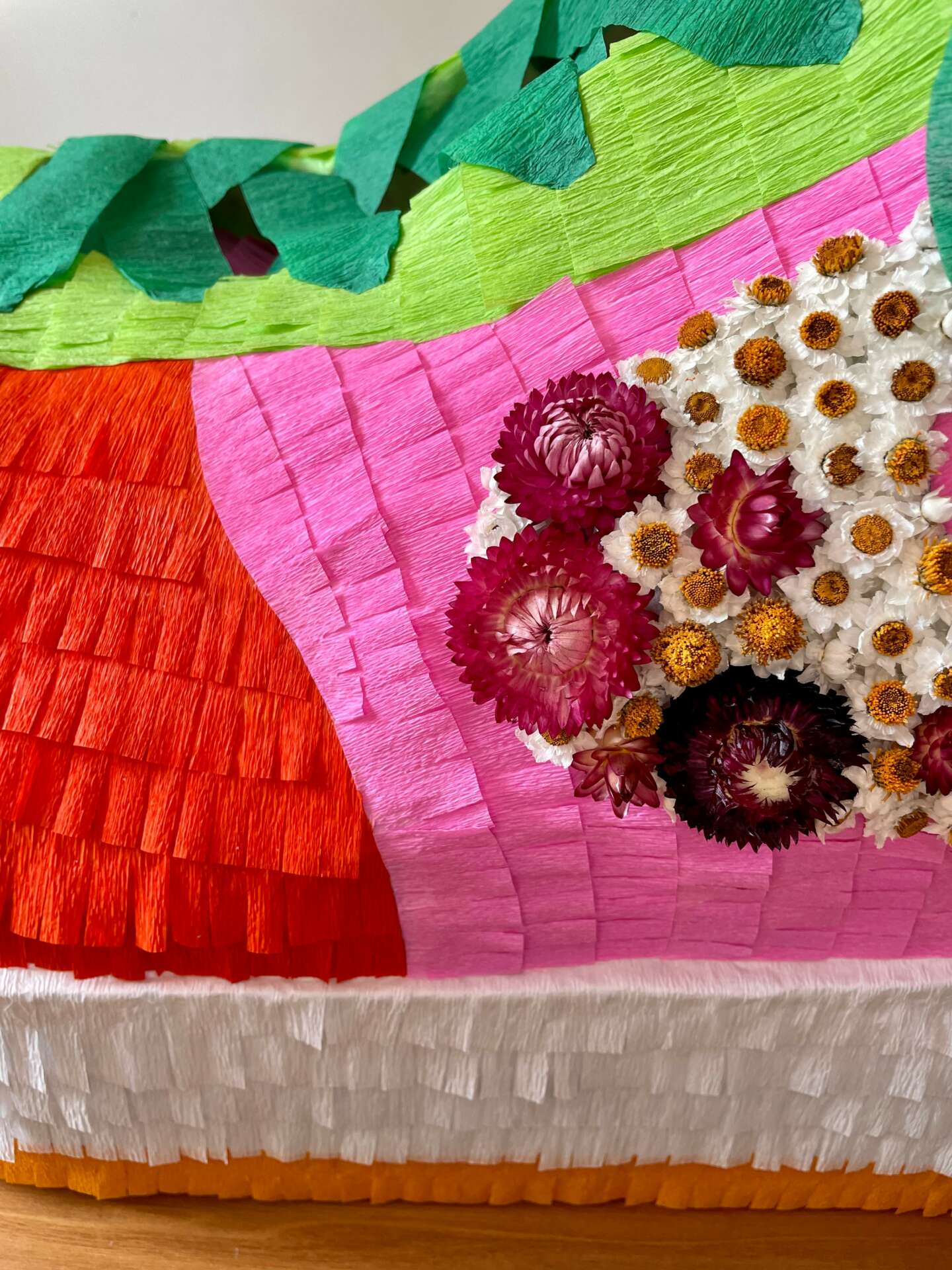
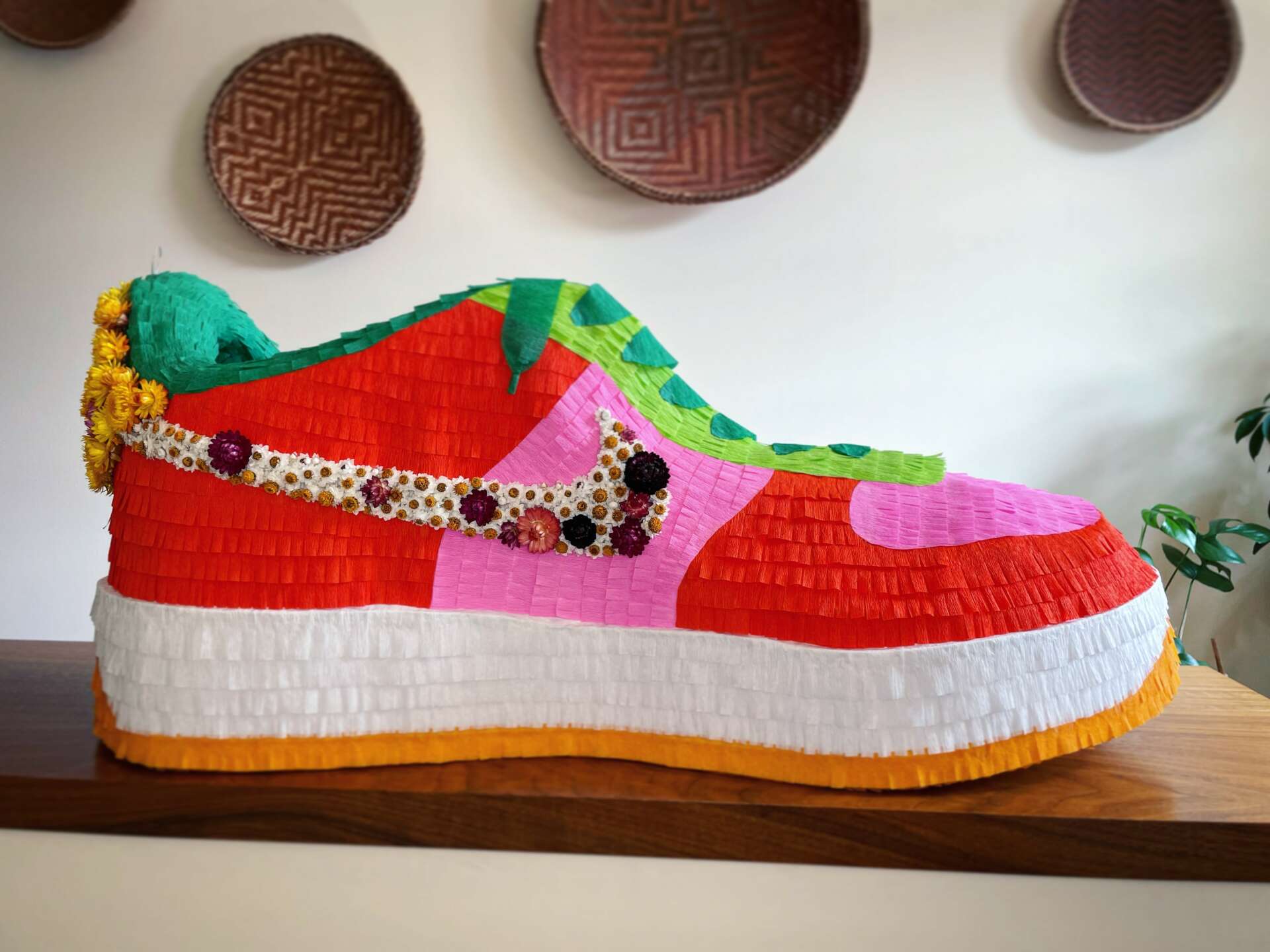
By summer 2023, a year after I began, I felt I had leveled up. I took the summer off from taking orders and started on a larger piece, a Nike AF1 sneaker that took me about 70 hours to complete. It was a personal challenge, I wanted to replicate the proportions of the sneaker, with attention to the smallest details. I live in Portland, Oregon, a huge sneakerhead city. I consider dance my other art form and the sneaker was a chance to pay homage to that journey too. I’ve had the opportunity to showcase that piece a handful of times and it’s provided a chance to talk to people about my work.
The impermanence of the piñata is a powerful characteristic. Despite the hours of detailed work I put into each piece, I believe the life cycle of the piñata includes its eventual destruction. Of course that’s up to whoever purchases my work. Personally this impermanence liberates me from perfectionism, an old limiting factor in my life.
In consultations I recommend considering the piñata as a work of art you can decorate your space with, like a sculpture or painting on a wall.
I suggest using the piñata as a vessel- to hold our hopes, intentions, to serve as a time capsule or journal. Burning or smashing it later provides a personal ritual, catharsis.
The piñatas I’ve made are on display in several latinx-identifying businesses around Portland. It’s a unique way for a business to express their identity, to tell a story.
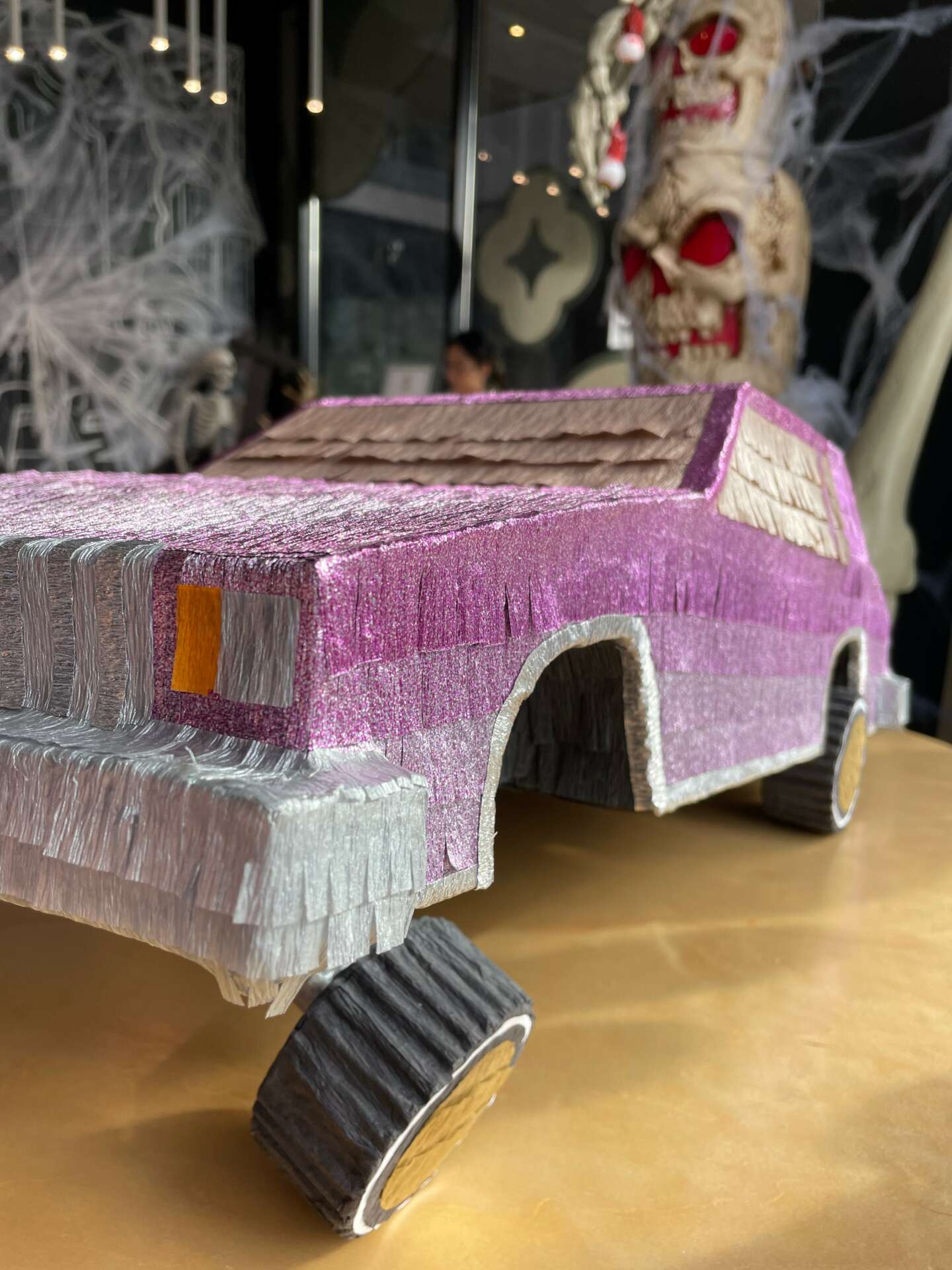
I recently made an anniversary piñata for a local business- a 1978 cutlass supreme lowrider, hydraulics engaged, candy paint (achieved with Italian metallic crepe). This was meaningful to the business owner because it was the car her dad, who was a great supporter and has since passed, owned and loved. At the anniversary, she invited customers to write well-wishing notes and put them in the piñata. It will be displayed on the shop’s wall for a few years, after which she plans to take it to her father’s grave to break open with him. To me, this is an exceptionally beautiful way to engage with my work.
This of course is not the only way. A piñata, like the AF1 sneaker, could be purchased and displayed in a glass case out of direct sunlight and never be broken. Ultimately, I want people to see the piñata for more than just something to break at a party.
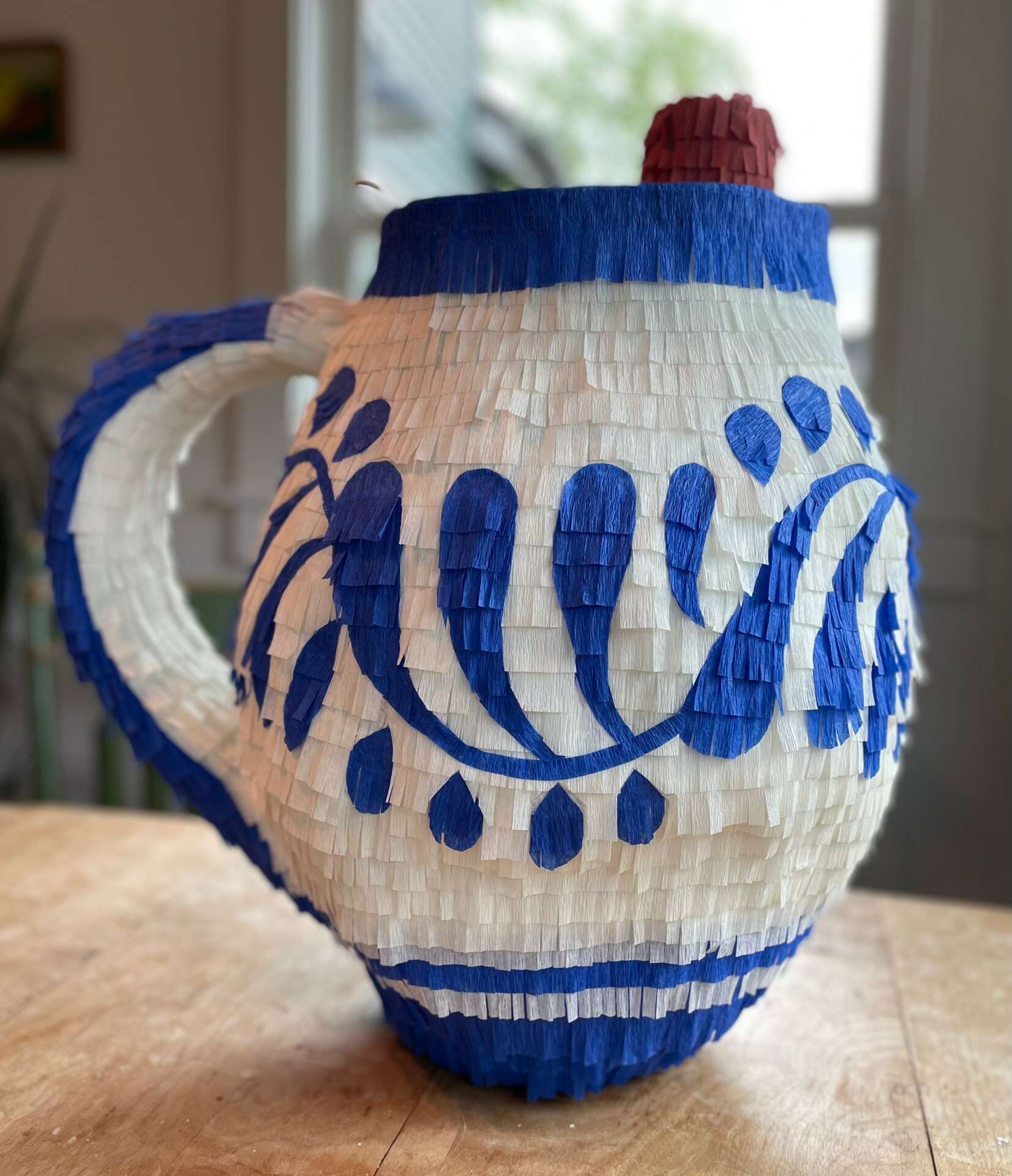
I myself have another piñata maker’s piece- a leek- hanging on a wall in my kitchen. I also have a beautiful vase piñata I made for myself for my birthday last year. I’ve been filling it with notes, memories, and ‘treasures’- tiny rocks, shells, ticket stubs. I may or may not break it this year.
Is there something you think non-creatives will struggle to understand about your journey as a creative? Maybe you can provide some insight – you never know who might benefit from the enlightenment.
Over the last year and a half I’ve had the experience of people misunderstanding what I’m trying to do with my work. Part of it is definitely due to people having a limiting view of piñatas and thinking this is just a cute craft business. But what non-creatives may struggle to understand is that there is a lot of work, crappy work, required before you improve, before you can fully tell the story you are trying to tell. The journey is messy and sometimes discouraging and we don’t get credit for continuing, which is a feat.
As creatives we immerse ourselves in our work within a context of something greater- art history, craft traditions, current events, our own histories. It’s a lot to work out, and highly personal. I am especially grateful for the work I’ve done with my therapist.
At the start of the journey you can sometimes only truly address one idea at a time- form, texture, materials, concept- to work out that problem and figure out its place in your work. For an art form that is extremely time consuming it takes discipline and patience. Something few people besides my husband recognize. That means for the most part you are the one sustaining you. It’s at once lonely and a thrill to recognize the journey as such.

Let’s talk about resilience next – do you have a story you can share with us?
I’ve known resilience all my life. As an immigrant, that is not uncommon. My parents personified the ‘Keeping Going’ because there was no other option. Both my dad and brother have been successful entrepreneurs. My mom has literally faked it till she made it, and well deserved as she was very capable if not experienced at the start of her career. My sister is outstanding in her field. Being an entrepreneur myself for the first time has felt never ending. I’m self taught but I also learned from watching them. I think it’s an immigrant’s legacy, being resilient and resourceful. We can make something out of very little.
I have also been lucky to find a wide community of BIPOC artists, makers, and entrepreneurs in Portland and beyond who have played a big role in my resilience. Many have become close friends and collaborators, and I’ve experienced an incredible level of mutual support and admiration. I owe that to putting myself out there and showing up genuinely. Being a cheerleader for others is important too, knowing the hard work it takes to do what we do and keep doing it. My community’s successes create room for me to succeed, in that way my resilience is interwoven with my community’s resilience.

Contact Info:
- Instagram: @candygirlpinatas
Image Credits
Carolina Dulanto