

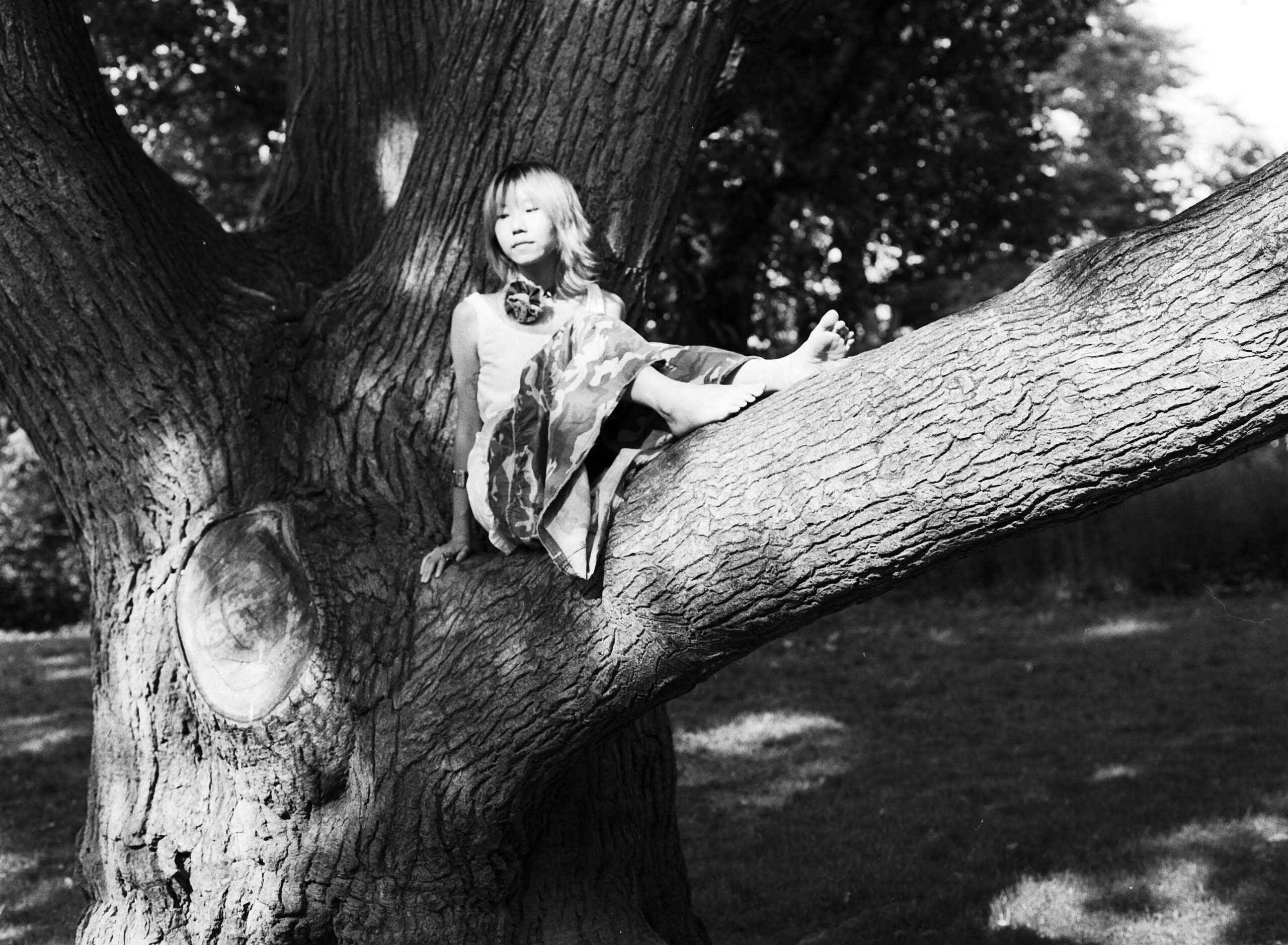

We caught up with the brilliant and insightful Boyi Xu a few weeks ago and have shared our conversation below.
Boyi, thanks for joining us, excited to have you contributing your stories and insights. We’d love to hear about a project that you’ve worked on that’s meant a lot to you.
I’m working on an experimental documental about the soundscape in New York right now. This is meaningful for me because I am always obsessed with both sound and films, but most mainstream films focus more on visuals, plots, and dialogues. Additionally, my taste in music and films has changed a lot in recent years. My parents are very strict with me and I didn’t have a chance to use the phone until I graduated from high school. It was after high school I started to immerse myself in all kinds of films, music, and arts. I was craving to listen to more experimental music and then I realized that the conventional concept of music is so narrow, it only concludes a limited part of sounds. Besides pop songs, rock, jazz, etc, there are field recordings or sound collages – a piece of music could be the sound of waiting for the bus, or it could be everything being put together. That’s a fascinating world for me. Meanwhile, I am also studying Cinema Studies in graduate school, and I noticed that in most situations, people’s voices in films are more important than other sound resources – however, that’s not how I sense sounds in reality. For example, in a very noisy bar, my friend and I could hardly hear each other clearly, yet in narrative films, the conversation is always clear while the noise in the bar becomes the background. There are considerations and also a whole history behind it (recording technology, film production, etc), but sometimes I feel pity that the intense soundscape in our daily lives is neglected. So, the reason why this project is meaningful for me is also because I am trying to create a world that can represent what I sense when I live in New York. It is not only a short film, a medium, but a practice and experiment of how my sensibilities and my way of feeling and thinking about the urban environment can be embodied through media. Moreover, it is also a perfect way for me to combine my interets in films and experimental music.
Boyi, love having you share your insights with us. Before we ask you more questions, maybe you can take a moment to introduce yourself to our readers who might have missed our earlier conversations?
I write film reviews, critic essays, and poems, and I also make films and videos. I majored in Chinese language & literature in undergraduate school, and reading and writing are always my passions. I learned photography by self-taught. I learned skills in filmmaking while I was at NYU. Very luckily, through the Cinema Studies program at Tisch, I participated in Culture & Media certificate program where I was trained in making documentaries. I think because of my background in literature and film studies, I am more sensitive to the differences between those mediums and I also try to produce more creative works that are multi-media, interdisciplinary, mobile, employing different mediums from poems, videos, images, and music. Also, I pay attention to a bigger social and cultural dimension of arts, as an East Asian female, I would more care about gender and race issues. for instance, in my documentary project about the soundscape in New York, the political economy behind sounds is part of the theme, I would like my works to be beautiful. personal and sensual, but I hold the idea that personal is political and also aesthetic is political.
For you, what’s the most rewarding aspect of being a creative?
I think the most rewarding aspect of being an artist is that I have more opportunities to see this world from different perspectives and transfer those perspectives, those unique ways of viewing this world into sensory experiences. One very insightful moment for me happened when I shot a garment studio in New York. Since my project that I mentioned in another question is about the soundscape in New York, and inspired by one of my classmates who studies fashion, I think the sound of sewing machines would be very interesting. It is a kind of sound that relates to the human labor and fashion industry but is not very common to hear in daily lives. So, when I reached out to my friend and asked him to introduce some studios that I could shoot, I was shocked that all those studios were located in Midtown (from 33rd street to Time Square). I’ve passed by those streets many times, yet I’ve never thought that those studios are hidden inside those modern, high-rise buildings, in the center of the city. Those studios are not very fancy. Instead, they are piled with all kinds of fabrics, and the workers sewing and ironing the clothes are Chinese immigrants from their late 30 to maybe 50. The scene was highly contrasted with the huge screens and boutique stores outside. I can’t help imagining how they work and earn their living every day in this metropolitan, and seeing these people making beautiful dresses from tiny pieces of cloth is very meaningful to me. If I’m not making films, I might never get the chance to encounter them and reveal the hidden layers of urban life. And it would be very rewarding if I could show other people this part of the world.
What do you think is the goal or mission that drives your creative journey?
I think that art is a form of love, a way of connecting people. Usually, the value of creative works is less obvious and direct, yet it is very important to us. While many people nowadays pay a lot of money for therapies, I don’t mean that they are not helpful or worthwhile, but literature, films, and music are always my “medicine”. Agnes Varda is my role model. Her works such as The gleaners and I and Vagabond focus on the people on the margins of society. And the most moving part is that in the gleaners and I, you can see she is really talking with ordinary people, she never treats herself as a prestigious, famous director. So one thing is that film is a way of representing people’s lives and connect people through the screens, but the other thing is, during the production we connect with different people and after viewing the films, that audiences can be affected and when they are back to their lives they understand more about themselves and other people. This is also especially important for me, as a female grown up in Mainland China, living here is great, I made friends from different countries and ethnic groups, but sometimes I also meet misunderstandings or feel I belong to minor groups here. Cultural differences, languages and so on are very difficult and complicated, but while sometimes we can identify the aesthetics or characteristics from one nation, I am thinking, why couldn’t I make films about my identities, dealing with the experiences of the people outside the mainstream culture and open access to other people?
Contact Info:
- Instagram: lxthlx_
- Other: https://posthumanboyi.wordpress.com/
Image Credits
Shu Wang (ins: @shuniverse__)