

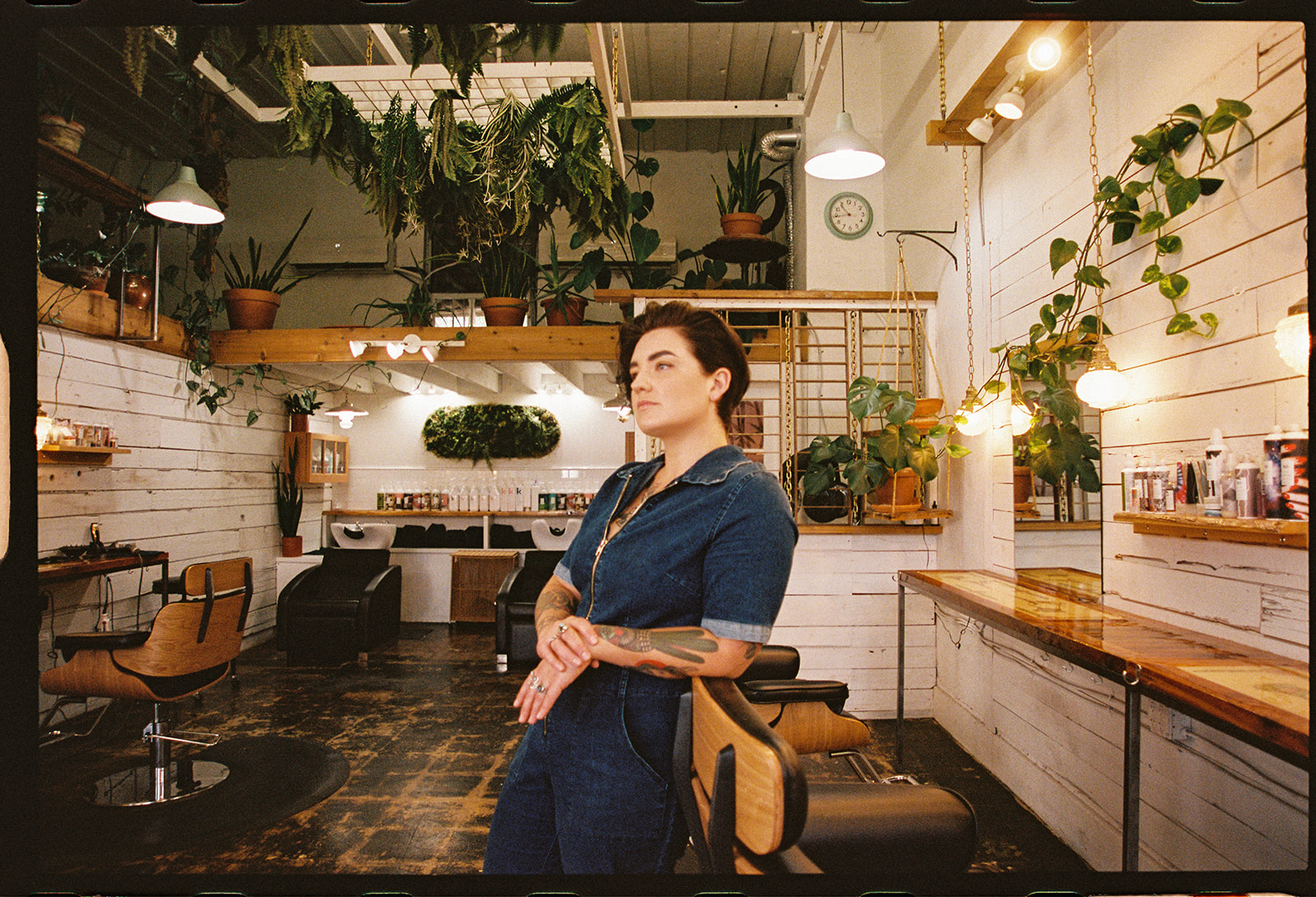

Alright – so today we’ve got the honor of introducing you to Bethaney Tucker. We think you’ll enjoy our conversation, we’ve shared it below.
Bethaney, thanks for taking the time to share your stories with us today What’s the backstory behind how you came up with the idea for your business?
I have been a hairstylist for 15 years, and I came out as a lesbian about 16 years ago.
I come from a very large conservative Christian family of 9, and we grew up in extreme poverty. Getting your hair cut was not something my parents could afford their kids, or themselves.
I started cutting my own hair when I was 14, and basically never stopped. When I was 21, I went to beauty school and became a hairdresser.
About 6 years into my career, something clicked…. I started noticing that all haircut pricing was gendered. Women with short hair were getting charged twice as much as men’s haircuts. Not only that, but queer women were having a really hard time finding someone to cut their hair that wasn’t just cookie cutter men’s cuts, or a feminine pixie.
My girlfriend at this time had a short androgynous haircut. And she was my pickiness client. It made me really good at finding the medium between masculinity and femininity in hair, and learning to tailor it and the subtle tweaks of what can make a haircut work for an androgynous queer person.
After some time, her friends with short hair also started coming to see me, until one by one I was getting referrals and building up a client base full of amazing short haired queer women.
At the time, it was 2014, and I realized this was an untapped market that not many hairdressers or barbers were specializing in , especially in Portland, which is crazy because Portland is full of short haired lesbians.
So I started really focusing on taking the fundamentals of both men’s traditional barbering and women’s hairstyling, and blending them to create queer hair.
Clients started telling me that they couldn’t find anyone else in Portland who could do the work I was doing , while also making them feel so safe and seen in a salon space. A space where queer people notoriously feel out of place, awkward and uncomfortable.
I then started getting clients with long hair who wanted to cut it off into their first short haircut, because the for the first time they trusted someone to do it and felt empowered enough.
I loved the human connection of these appointments! Getting to listen and ask questions, learning why my clients waited so long, usually due to fear or homophobia in their families, and then getting to set them free by cutting off their hair and giving them their fist queer and gender affirming haircuts… I felt like I had finally found my calling and it was honestly like therapy for myself.
My own experience and pain was being turned into a gift along with my craft, to help other people express themselves to their fullest extent.
After about 4 years of building up my queer clientele, I decided to only work with queer people.
15 years into my career today, I now own a salon in Portland called Strange Powers, I would say 90% of my clients are all queer women, non binary or trans masc folks.

Great, appreciate you sharing that with us. Before we ask you to share more of your insights, can you take a moment to introduce yourself and how you got to where you are today to our readers.
I think I accidentally just did that on the last page. Lol
Cutting hair for queer people has never been taught in schools. Any education around this has come from other hairdressers breaking barriers and trying to get out and advocate and educate. I can think of only two people who are queer themselves who teach how to cut queer hair. One of them lives here in Portland, Jules Haron.
I’m so glad that this is starting to exist today.
To create androgynous hair, there has to be a blend of masculinity and femininity. Shapes aren’t just angular or soft, the tools aren’t just own size fits all. I don’t only use clippers or shears or a razor. I use a blend of all of these things to try and create hair that is tailored exactly to what my clients are asking me, and working with how they see themselves and try to help them feel comfortable in their own hair and identity.
Queer androgynous hair for non binary, trans masc and lesbian clients is still barely being taught in mainstream education, which is so crazy.

Let’s move on to buying businesses – can you talk to us about your experience with business acquisitions?
In 2022, I decided to take my skill and love for my community and open my own salon.
It had always been my dream to own a salon. I wanted to focus on the queer experience, without it feeling like a barbershop – which most queer focused spaces are. I wanted the space to be an inclusive salon experience.
I was about to sign a contract for a building, when the owner of the salon I worked for told me he was selling the business to move.
I ended up buying Strange Powers from him and have made it into my dream queer salon.

Can you open up about how you funded your business?
To purchase the business, I needed to take out a loan.
Fortunately, I have worked my entire life to make sure my finances were in good shape and my credit was good. But taking out a loan for the amount I needed , turned out to be harder than I thought it would be. I had many banks turn me down, I didn’t have a co signer and I had pretty much no money to put down, and not very many assets. But I found one who was willing to work with me! And I was able to secure my loan.
I now own my beautiful salon in the neighborhood I grew up in, Irvington.
It feels so full circle that my childhood self was struggling to figure out her queerness and identity, just blocks away from where I now own a business that empowers queer people every day.
Contact Info:
- Website: https://Www.strangepowerspdx.com
- Instagram: Beth.tucker.hair and also strangepowerspdx


Image Credits
The photo of myself, was taken by @filmbykait_ , a queer photographer based out of Portland Oregon