

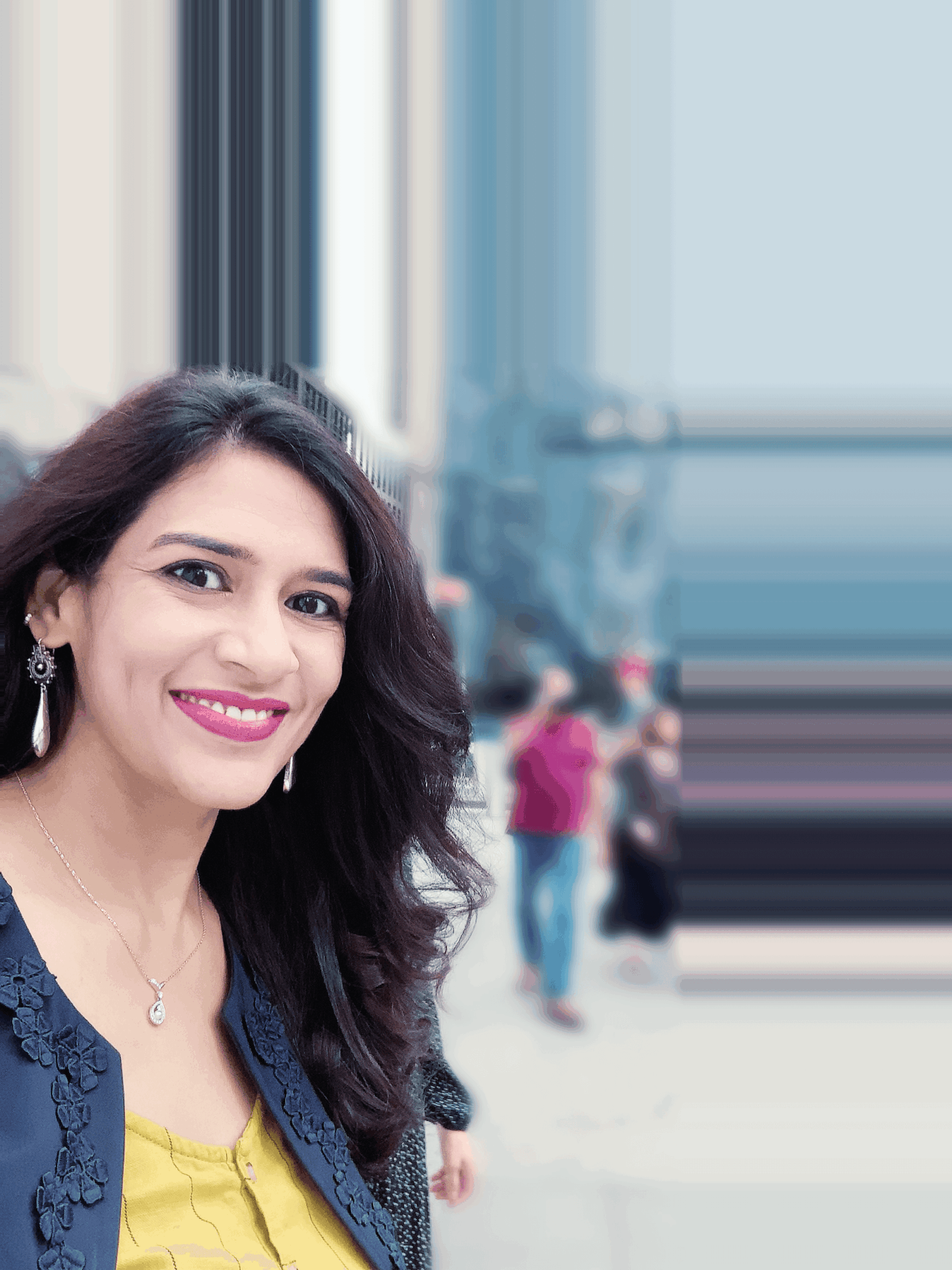

Alright – so today we’ve got the honor of introducing you to Aprajita Lal. We think you’ll enjoy our conversation, we’ve shared it below.
Aprajita, appreciate you joining us today. What’s the backstory behind how you came up with the idea for your business?
Honestly? Out of my own frustration.
I’m an artist, but I also spent over seventeen years in technology. So when I finally decided to quit my corporate job and paint full time, I had this beautiful picture in my head — me, my easel, painting my heart out all day. That was the dream.
What actually happened was very different.
The deeper I got into treating my art as an actual business, the more I realized how much of it had nothing to do with painting. I was spending hours in front of my laptop instead of my canvas. Because here’s the thing nobody tells you when you start out: an online presence isn’t optional anymore. It’s a necessity. And it’s not just a website or an Instagram account — it’s getting your name, your brand, and your work out there in a dozen different ways, each one needing the right story, the right description, the right keywords. The list never ends.
And that’s before you get to the actual business side. More than ninety percent of artists I talk to are still confused about how to even price their work. There’s no real guidance out there on how to run this whole thing — inventory, sales, invoicing, labels, Certificates of Authenticity, and on and on.
So what did I do? What every artist does — I started stacking up subscriptions. One platform to catalog my artworks. Another to make mockups. A separate one for emails. Something else for SEO. Another for the website. A different vendor for prints. Piece by piece, I was duct-taping together this messy system just to keep my business running. And slowly, it was burning me out.
That was the moment it hit me. I became an artist to stand in front of my easel — but I was turning into someone who lived in front of a laptop screen.
That gap, between the dream and the reality, is exactly where the idea for Brushly was born.

Great, appreciate you sharing that with us. Before we ask you to share more of your insights, can you take a moment to introduce yourself and how you got to where you are today to our readers.
Sure! I’m Aprajita Lal — an artist, and one half of the team behind Brushly.art.
My path here wasn’t a straight line. I spent over seventeen years in the technology world before I made the leap to becoming a full-time artist. And I’ll be honest, leaving a stable corporate career to chase a paintbrush felt terrifying and freeing all at once. But art was always the thing pulling at me, and one day I finally decided to stop ignoring that pull.
What I didn’t expect was that my two worlds — technology and art — would eventually come together in a way I never planned.
When I became a full-time artist, I quickly learned that making the art is only half the job. The other half is running it like a business — cataloging your work, pricing it, marketing it, building an online presence, handling invoices, certificates of authenticity, prints, emails, SEO, and a hundred other little things. I found myself drowning in scattered tools and subscriptions, spending more time at my laptop than my easel. And I kept thinking, there has to be a better way.
That’s what led to Brushly.
Brushly.art is an all-in-one platform built for artists, by an artist. Instead of juggling ten different subscriptions to run your art business, Brushly brings it all under one roof — managing your artwork inventory, creating mockups, pricing guidance, your online presence and SEO, emails, certificates of authenticity, prints, and more. It’s designed to take the messy, exhausting “business stuff” off your plate so you can get back to doing what you actually love — making art.
And I think that’s what sets us apart. Brushly wasn’t dreamed up in a boardroom by people guessing at what artists need. It was built by someone who lived the problem every single day. I know the frustration of midnight invoicing. I know the confusion of pricing your own work. I know what it feels like to love your craft but dread the admin. So every feature we build comes from a real place — not a spreadsheet of “market opportunities.”
What am I most proud of? Honestly, it’s when an artist tells me Brushly gave them their time back. That they’re painting more and stressing less. Because that was the whole point. I didn’t want to just build software — I wanted to give artists their easel back.
If there’s one thing I’d want your readers to know, it’s this: you don’t have to choose between being an artist and being good at business. You became an artist to create — and the business side shouldn’t cost you your creativity. That’s the belief Brushly is built on, and that’s the promise I make to every artist who uses it.

Let’s talk about resilience next – do you have a story you can share with us?
Oh, I have a good one — and it still makes me laugh a little, even though it stung at the time.
My cofounder and I had been working incredibly hard on Brushly. Brainstorming every idea, mapping out the workflows, obsessing over the user experience, trying to make everything feel just right. We poured ourselves into it. And finally, we were ready to do a beta launch. The free version, out into the world. I was so excited to share it.
So I started reaching out to all the artists and art-world folks I knew, inviting them to try it out. But here’s the thing we’d missed — we launched the beta only for laptops and desktops.
Now think about how I was reaching out to these artists. Over WhatsApp. Over Instagram. Through direct messages. And every single one of those messages gets opened on a phone.
So someone would get my excited little message, click the link, and the very first screen they’d see said: “Brushly works best on a laptop or desktop and isn’t supported on your mobile device.”
That was it. First impression — landed flat on its face. And right there, we’d lose the lead.
It was a tight slap on our face, honestly. We’d done all this careful work and tripped on something so basic. We built the whole thing for the screen artists work on, and forgot the screen they actually live on.
But here’s where you have a choice — you either let that sink you, or you fix it. So we made a hard call. We held everything off, went back, and rebuilt the entire Brushly interface to fully support mobile. And yes, that meant doing the whole beta all over again. We did lose a few users in that stretch. And when I started reaching out to my warm leads a second time, there was a bit of hesitation, a little hiccup to win them back.
But we kept going. And within just a few weeks, we had over two hundred artists trying the platform on our free trial — and the feedback was incredible.
Looking back, I’m almost grateful for that stumble. It taught us to think like our artists, not just build for them. In the art business, your first impression is your brushstroke — and we learned to make ours count.

What’s a lesson you had to unlearn and what’s the backstory?
The biggest thing I had to unlearn? That you can clock out.
For most of my corporate life, my days had edges. Chase deadlines, hop from meeting to meeting, wrap up by five or six, head home — and disconnect. The work stayed at work. And if a ball dropped, someone was always there to catch it. There was a safety net.
Then I became a business owner, and that belief fell apart.
Suddenly I couldn’t switch off — not even for a second. The questions just live in your head now: What’s next? How do I make this work? Will it succeed? I work every weekday, every weekend. Holidays are the only time I force myself to step away. Because when it’s your business, you wear so many hats that one’s always at risk of slipping — and there’s no backup anymore.
So the lesson I unlearned was that rest comes from disconnecting. At this stage, it doesn’t. What I’ve learned instead is that my energy doesn’t come from clocking out — it comes from why I’m doing this.
In corporate, I worked for a paycheck. Now I’m building something I truly believe will make other artists’ lives better — an ecosystem that helps them run their businesses without burning out the way I did. That sense of purpose is what gets me out of bed and lets me give my best every day. In corporate I worked to live; now I live for the work — and somehow that’s lighter, not heavier.
So no, I don’t disconnect like I used to. But for the first time, I don’t really want to. I’m doing what I love, for a reason bigger than a paycheck — and that changes everything.
Contact Info:
- Website: Https:://brushly.art
- Instagram: https://www.instagram.com/brushly.art/
- Linkedin: https://www.linkedin.com/company/brushly-art/?viewAsMember=true

Image Credits
No credits