



We recently connected with Andres Dewayne Rischer and have shared our conversation below.
Hi Andres Dewayne, thanks for joining us today. Let’s kick things off with your mission – what is it and what’s the story behind why it’s your mission?
As a former middle school Math teacher, each year I found the mastery of basic Math skills declining. The simple computation of addition, subtraction, multiplication, and division are the fundamental practices for excelling high levels of Math standards. I would say to students, “Math is Money. If you can do Math, then you can put money in your pocket!” The reason for saying this was to inform the students that the basic skills are your ticket to wealth. Being able to compute these simple Mathematical concepts will help understand how to calculate your paycheck, budget your monthly funds, calculate the cost of taxes, and much more. Therefore, my new mission is to teach and inform students, especially those that have not mastered the basic facts, how mastering those operations will help guide you to building wealth.

Andres Dewayne, before we move on to more of these sorts of questions, can you take some time to bring our readers up to speed on you and what you do?
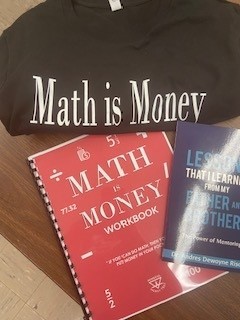
Math is Money is a financial education program designed to teach students the relationship between Math (standards) and building wealth. I taught middle school Math for over 10 years. During my last year in the classroom, I realized that none of the standards that we are required to teach, specifically teach students to build wealth, especially in middle school. Once school norms became more about student data versus relationship (building), I knew it was time for me to exit. First, I started by publishing my first book, Lessons that I Learned from My Father and Brother. After conducting a few book studies, I spent the majority of my instruction discussing my last chapter about finances and money. Although I was not in the classroom, I was repeating my old quote, “Math is Money. If you can do Math, then you can put money in your pocket!” The lightbulb in my head lit up, as I knew that I needed to start teaching financial education to young people. My mission then was to educate students between 13 and 18 on the various strategies for building wealth. What started with a few worksheets, thus turned into a 38-page Math is Money workbook. Math is Money teaches about assets, liabilities, wealth vs rich, monthly budgeting, buying a 4-plex, securities, the Rule of 72, and the importance of investing versus (bank) saving. Each lesson involves connected activities that show the connection between basic Math operations to the lessons that I teach.
Learning and unlearning are both critical parts of growth – can you share a story of a time when you had to unlearn a lesson?
I had to learn that managing a business account is different from my personal funds. With my business, the first thing that I budget for is taxes. Then, I pay myself and business. Generally, when I outline my personal budget, I am paying myself first and sometimes, last. But with the business, it is important to have a savings set aside for Uncle Sam. For each dollar, I account 30% of my revenue to taxes. That money then goes into an account to be on reserve for tax season. In the event that I owe money, then funds are readily available to pay. Thus, if I do not owe any money, then I can reinvest the money back into the business or just leave it in my tax savings account.

Can you share a story from your journey that illustrates your resilience?
n/a
Contact Info:
- Website: www.mathismoney.net
- Instagram: @mathismoney888
- Youtube: https://www.youtube.com/results?search_query=dewayne+rischer
- Other: www.mindfulinergy.com
Image Credits
482 Marketing