
We caught up with the brilliant and insightful Amy Feind Reeves a few weeks ago and have shared our conversation below.
Amy, appreciate you joining us today. Alright, let’s take a stroll on memory lane, back to when you were an apprentice or intern. What’s a memorable story from that time that you can share with us?
I officially became a banker, my first professional role, after completing a training program where I had both rotated through all of my bank’s major product and service areas and completed a raft of accounting and financial analysis courses. That same week, the price of oil fell by about 75%.
The oil and gas division of the bank’s portfolio took a big hit, and many of the existing bankers were let go. “Why not,” the powers that be decided, “backfill those roles with a new graduate of the training program? Let’s just put the person who scored the highest on the cash flow accounting exam in charge of some of the oil and gas clients that we still have.”
And so, at the age of 24 I became the primary account officer for a collection of oil, gas and mining clients in a 10-state area of the West Coast. I had never been west of Pennsylvania. There had never been a woman in the division before, and there were very few women in the ranks of our customers or partnering financial institutions. I had no experience other than learning about companies from the financials in their annual and quarterly reports. I had no experience hauling myself around the country. And I was blonde.
Suddenly, the Treasurers of some major oil companies and those of some small copper, gold and zinc producers needed to meet with me once a quarter about their financial position. I traveled one full week a month, identifying opportunities to sell products and provide financing at both clients and prospects. I learned to expand the definition of what my division could cover – non-regulated energy, mining – while the oil and gas industry recovered.
It was kind of a wild ride the next five years. I learned about solvent extraction electrowinning as a methodology for mining copper, I visited literal gold mines and got to witness how they configured operations. I earned a certificate in Petroleum Engineering. I got a private tour of Armand Hammer’s art collection, housed on the top floor of Occidental Petroleum’s Los Angeles headquarters. I visited geothermal sites and co-generation facilities and financed alternative energy projects.
And I enjoyed the opportunity to travel. I visited the Continental divide (many times), found the only traffic light (blinking) at that time on a highway that goes across the country (it was in Hecla, Nevada for trivia fans), and spent weekends exploring Los Angeles, San Francisco and Denver.
The good news? I had no idea what a crazy anomaly it was to be given that kind of responsibility at such a young age. Did I mis-step? Of course, there were things I just didn’t know about the field, from technical issues to protocols. But I learned them. Fast. It never occurred to me that the challenge was too great or that there would be some obstacle in my way to success that I could not overcome. I really, in retrospect, was pretty clueless.
That said, I focused on the goals in front of me and grew some profitable business during my five-year tenure instead of just being a placeholder. I learned early that everything complicated could be figured out with common sense and some dedicated self-education. Most importantly, I learned that people are willing to teach you if you are willing to learn. Throughout my career, I generally assumed that nothing was going to be too challenging to overcome.
My story is not how all entrepreneurs are made, but it made me a better one. I approached both of the businesses I subsequently started with the idea that, of course, I could learn what I needed. Absolutely, I could pivot if one path closed. Certainly, I could do more than what was expected of me because….why wouldn’t I?
Great, appreciate you sharing that with us. Before we ask you to share more of your insights, can you take a moment to introduce yourself and how you got to where you are today to our readers.
My business is the result of a long-held passion to help new college graduates avoid what happened to me after graduation. I learned the hard way that even if you are smart, hardworking, and have a good GPA from a good college, you can fail at a career job search. I wanted to become the resource I did not have when I first started out and really needed guidance.
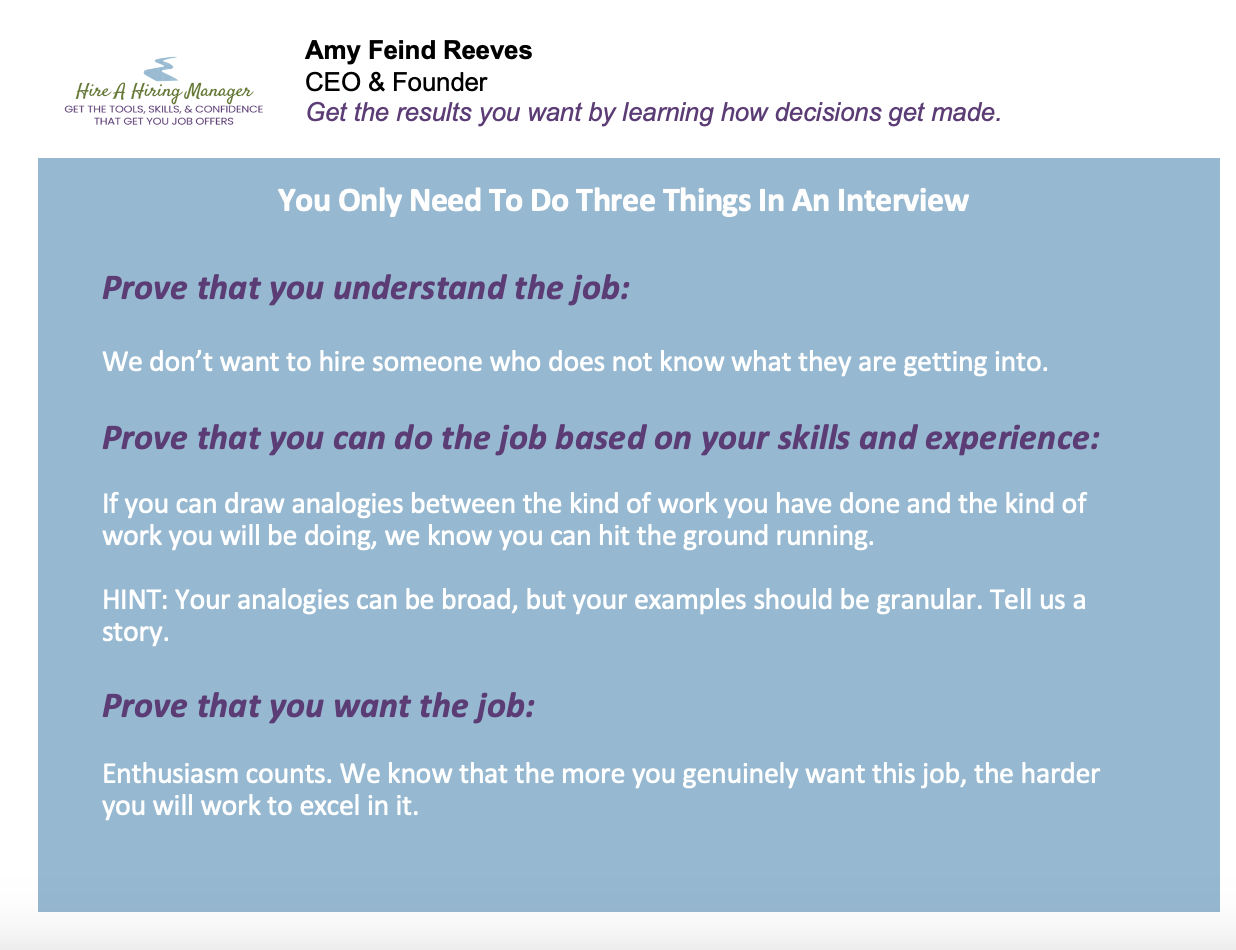
People often think of job searching as a black box: you put in an application and cross your fingers. However, the hiring process is actually quite clear, follows a pretty basic set of rules and can be learned. Throughout my highly enjoyable 25+ year career, most of them spent as a hiring manager, I continuously saw even experienced and high-level candidates who just did not understand how to present themselves and the value they could add.
Here’s my story: When I graduated late last century, my fellow classmates were flocking to Wall Street training programs, so that was where I figured I would go as well. “How hard could getting a job be?” I thought. A few months after graduation, I watched my friends take their empty briefcases off to their first days of work while I remained jobless. I was crushed, miserable, and in utter disbelief that for the first time in my life I had been a complete failure at something—a job search at which I had worked hard and done everything I had been told to do. And I had great skirt suits! I had no idea where to turn, nor did my family or friends who wanted to help but didn’t know how. Eventually, I got a job as an admin out of the New York Times classifieds (ask your parents)..
While I was working as an admin, I learned from my friends who had gotten the jobs that I wanted. I began to understand, what they were doing every day and how they had presented themselves to get hired. The following year, I got one of those jobs easily. Turns out I was good at that job and really liked the work. What was the difference from the year before? I didn’t understand what the job was and I didn’t understand how I could bring value to the role. As a result, I had no idea what the hiring managers were looking for in a candidate.
Knocking the interview out of the park was not rocket science. I just didn’t know how to do it before. I have been a keen student and teacher of that understanding ever since..
I now provide tools to clients at all stages of their career. My tools provide clients with what they need to get noticed and hired in today’s workforce. And all the information is applicable to any job search in any industry. My clients have been successful finding work in sports marketing, financial services, high-tech sales, start-ups of all sorts, management consulting, nonprofit management, and the NSA, to name just a few representative fields.
These tools include:
An understanding of how you can add value to an organization
Skills to research what jobs may be available to you
A step-by-step guide for creating an effective résumé, cover letter, and elevator pitch
Networking skills and advice
Interview preparation guides that teach you what and how to understand what hiring managers want
Tips for starting your new role on the right foot, and common mistakes to avoid.
Any stories or insights that might help us understand how you’ve built such a strong reputation?
There is no question that the best marketing tool for personal services, which is the category of work I do, is word-of mouth from satisfied clients. My business is a little unusual because I don’t want repeat business from my clients. I want them to find jobs they love and stay in them! However, the good news is that satisfied clients do talk.
While I have worked with PR and social media professionals, the category of services I provide does not fit into a neat pre-established “bucket.” The best source of leads and future business I have are satisfied clients. They tell their friends and family and those people reach out to me. My services are specific and fill a specific need, so I often get client “clusters:” job seekers from the same school, neighborhood, or company that has recently had a reduction in force, or RIF, that are looking for job search and career support at the same time.
I have had both successes and failures in establishing more formal channels that could increase my pipeline of leads.
Initially, I thought the plethora of universities around me would be areas where I could provide support and gain marketing reach. My campaign focused on college advising departments at nearby universities and provided them with an overview of my services, and an offer to share insights from corporate experience directly to either counselors or students. However my offers were largely rebuffed. When I dug in a little more to understand the pressures on these departments as a potential customer segment, I learned that the statistics provided by the New York Federal reserve that 40% of new college grads end up in jobs that do not require a college degree. This was roughly equal, I knew, to the statistic that 40% of college seniors never visit their career office. It seemed that these departments were also having issues reaching elusive college seniors.
A far more successful partnership has been with the network of counselors who provide services to high school seniors in helping them find a college they love. Having worked with a few of these counselors directly as well as with their own kids and clients, I am now included in multiple databases as a great resource for counselors whose clients return four-years later for help with the job market. The work these counselors do IS a well-defined market segment or “bucket.” It has been a great network for me because parents who understand the benefits of hiring a third-party to help with the transition to college for their kids also understand the benefits of hiring a third-party at the next key transition stage. It makes me happy that I can support these providers in turn with some applicable wisdom regarding how to discuss potential careers.
Can you share a story from your journey that illustrates your resilience?
There are two things about the work I do that really make me feel like it has been a calling. The first is, unsurprisingly, the value that I have been able to add for clients and how rewarding it is to be a part of someone’s life in such a positive way. The second is that I get to leverage every aspect of my own journey in the work that I do. My career, like most people’s has had ups and downs. The downs seem to make sense now that I often work with clients after they have had a bump in their career road. I can empathize as well as provide a role model for how to turn those negative experiences into valuable learning tools.
The most difficult lesson for me was being fired early in my career. The short story is that I was lured from a big name-brand consulting firm to a small boutique consulting firm that was owned and led by one individual with a Big Personality. I got on the other side of him unfortunately, after a few short weeks. I like to say now that it happened because “we had a difference of opinion. I thought I was really smart, and he didn’t.” But when it happened, I had full on panic attacks for weeks.
I had always been a high performer. Always been looked to as someone who was going to set the bar high for my peers with grace and humility. To experience a humiliating fall from grace was absolutely not in the cards. In retrospect, I have learned that everyone who stays in the business world long enough has to face a situation like this at some point. But at the time it was hard not to imagine that it was unique to me, hugely personally demoralizing, career-killing, and impossible to overcome.
Yet I went on to spend two more decades as a successful management consultant, entrepreneur, corporate executive, and non-profit executive. I would like to say that I overcame my fear of getting back up and trying again with the support of family and friends, the belief in myself that came from my excellent education and my own personal characteristics of perseverance and hard work. However, that would not be the whole truth. Yes, all of those things helped. But what helped me return to the consulting world at the same level and even increased pay a few months later? The New Coke guy.
At the time, Coke had introduced a formula with a new taste, and it was failing spectacularly. I don’t remember much of the specifics, and I have no interest in doing the research to relive it. What I do remember is that the new Coke guy (aka the CEO who was behind the launch) and the new Coke story were everywhere: magazine covers, news stories, television shows. Consumers were angry that the traditional formula had been changed. The business world was stunned.
Was the news of my career’s early demise out on my own personal network? Yes indeed. Was it out as broadly and comprehensively as the new Coke guy’s colossal failure? Not by a long shot. But what did we have in common? Great schools, a long history of high performance, and the courage to take a risk by trying something new. My setback seems quite small in comparison, and to be honest that is what helped push me forward.
Of course, I now know that good people get fired – I have fired good people who were just not a fit for the role they were in. Hugely successful companies and people take risks that don’t work out. Coke survived and so did I. It is a good message to share with clients because failing at a job search can be so disheartening, but also that failure can lead to a successful pivot. If I had stayed in that long-ago job, I would have been miserable. In retrospect, I got out fast and moved on somewhere that valued what I had to bring to clients.
And I apologize, new Coke guy, wherever you are. I hope that where you are is somewhere good. And I take heart that 90% of the people reading this story never knew there was ever a new Coke formula. May we both inspire those who meet Big Personalities and take risks in their own careers.
Contact Info:
- Website: https://www.hireahiringmanager.com
- Instagram: @hireahiringmanager.com
- Facebook: Hire A Hiring Manager
- Linkedin: https://www.linkedin.com/in/amyfeindreeves/
- Youtube: @hireahiringmanager
- Other: TikTok:: @hireahiringmanager