

We recently connected with Alexx Antaeus and have shared our conversation below.
Alexx, appreciate you joining us today. The first dollar you earn is always exciting – it’s like the start of a new chapter and so we’d love to hear about the first time you sold or generated revenue from your creative work?
My love affair with studio life and equipment truly ignited while I was studying at California State University, Dominguez Hills, one of the few universities in the U.S. with a state-of-the-art recording studio at the time. The experience was captivating—watching the faders on the automated console glide up and down, listening to the rhythmic start and stop of the two-inch analog tape machine, and exploring the intricacies of two-hundred-thousand-dollar Synclavier synthesizer. While still in college, I began working as a club DJ, thanks to the inspiration and mentorship of Mario Gonzalez and Pebo Rodriguez. I am forever grateful to music industry veteran Joe Isgro, who helped me land my first gig.
However, my first dollar as a creative professional came from remixing, and for that, I owe a huge debt of gratitude to Steve Bartels, known for his roles as Clive Davis’ right-hand man at Arista Records and as the former CEO of Island Def Jam. At the time, Steve was at the early stages of his illustrious career, working promotions for A&M Records in Hollywood, and he entrusted me with my very first remix. Despite being completely out of my depth and struggling to figure out the process at Hit City Studio on Pico Boulevard in Los Angelees, I managed to deliver the remix within 48 hours. This was no small feat, especially after I accidentally cut my finger with a razor blade while editing the analog master tape on the splicing block—a far cry from the virtual editing tools we have today like ProTools. That first paycheck of $500 was hard-earned but marked the true beginning of my creative career.

Awesome – so before we get into the rest of our questions, can you briefly introduce yourself to our readers.
My evolution in the music industry followed a natural path, transitioning from club DJ to remixer, and eventually to producer and record label owner. In today’s music industry, which sits at the intersection of creativity and technology, I don’t see myself merely as a problem solver; I am a career enhancer. My role as a music producer is not about imposing my ideas or experiences onto an artist. Instead, it’s about drawing out and amplifying the artist’s own desires and aspirations, using my background to help them realize their vision. My approach extends far beyond the confines of the studio. When I work with an artist, I think in terms of the story we need to tell and how we can market that narrative effectively.
Creating music is just one part of the equation. Building a fan base and promoting that music is even more crucial in today’s saturated market, where over 120,000 songs are released every day. This staggering figure underscores the importance of not just making great music, but also ensuring that it reaches the right audience. A great song without marketing will most likely go unnoticed, while even an average song with strong marketing has a good chance of achieving some level of success. Of course, when you combine a great song with great marketing, you’re setting the stage for significant success.

Can you share a story from your journey that illustrates your resilience?
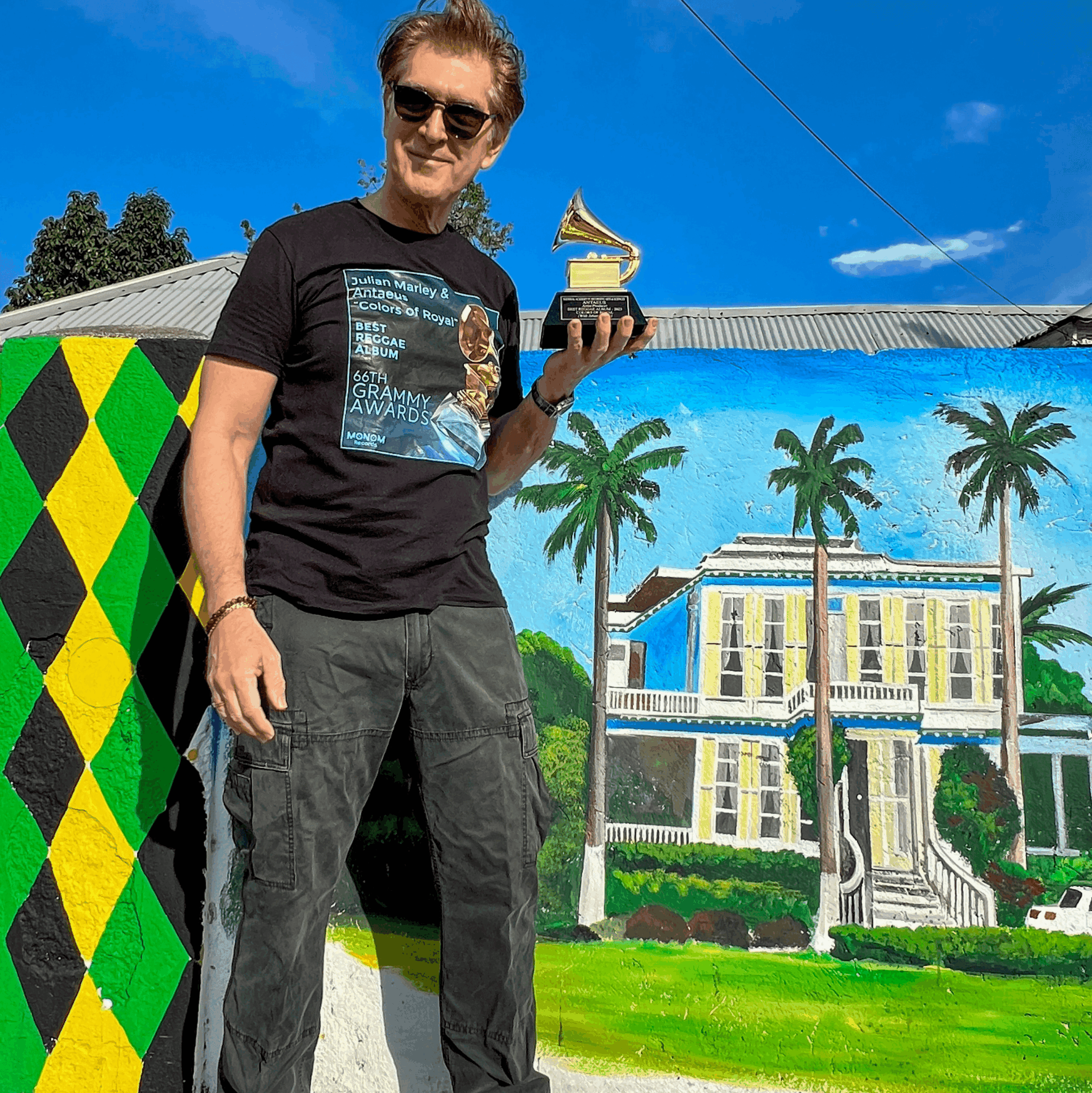
A prime example of my resilience in the music industry is the recent victory at the 66th Grammy Awards, where Julian Marley’s “Colors of Royal” won Best Reggae Album. This achievement was a culmination of relentless effort and determination, especially when considering the competition we faced—artists backed by major labels, with much larger fan bases, budgets, and streaming numbers.
My business partner at Monom Records, Magnus Johansson, and I took on this monumental challenge together. While Magnus concentrated on the financial and executive aspects, I was deeply involved in every other facet of the project. This included co-writing and producing the album, and also leading the charge on promotions and marketing.
Navigating the Grammy Awards process requires more than just creating outstanding music; it demands strategic marketing aimed at the voting members of the Recording Academy. Unlike traditional consumer marketing, this involves raising awareness of your work among industry professionals without directly asking for votes, which is strictly against the rules. Instead, you bring your project to their attention, encouraging them to consider it during the voting process.
From August to December last year, the Grammy voting season, I was fully immersed in this effort. I dedicated countless hours to phone calls, messaging, social media outreach, and attending in-person gatherings, all to ensure that the voting members were aware of our album.
This victory was particularly significant because Julian Marley had been nominated twice before, each time with the strong backing of his family, including his brothers Stephen and Damian, who played key roles as producers and executive producers. Despite the lack of this anticipated support for our release, we persevered, stayed focused, and ultimately achieved our goal, to first get Julian’s third nomination, and eventually winning the Grammy. This accomplishment not only underscores our resilience but also highlights the power of dedication and strategic thinking in the face of overwhelming odds.


How can we best help foster a strong, supportive environment for artists and creatives?
In today’s evolving society and music industry, it’s crucial that inclusivity becomes a standard practice. Individuals should be evaluated based on their creative contributions, not on their race, gender, or lifestyle preferences. This commitment to inclusivity was highlighted during the recent Pride Month and Black Music Month celebrations by the Recording Academy, where I was honored as an “ally to the community.”
When asked how I create space for Black queer creators and professionals, my response was clear: “By ensuring that my work as a producer is all-inclusive in terms of artists, engineers, etc.” This approach is not just theoretical; it’s reflected in my current projects. I’m thrilled to be working with two incredibly talented Black queer artists—Jamaican singer/rapper Marcilli and Berlin-based South African soprano Pumeza Matshikiza. Their unique talents and perspectives enrich our collaborations, proving that diversity is not just a goal but an asset that drives creativity and innovation.
Contact Info:
- Website: https://monomrecords.com/#artist-services
- Instagram: https://www.instagram.com/alexx_antaeus
- Facebook: https://www.facebook.com/alexxantaeus
- Linkedin: https://www.linkedin.com/in/antaeus/
- Twitter: https://x.com/alexx_antaeus
- Youtube: https://www.youtube.com/@MonomRecordsOfficial