



Alright – so today we’ve got the honor of introducing you to Alex Rhodes. We think you’ll enjoy our conversation, we’ve shared it below.
Alex, appreciate you joining us today. Can you talk to us about how you learned to do what you do?
Music was always a big thing in my family. My dad taught me to play guitar. His family is full of talented musicians and every family gathering featured multiple guitars and group sing-a-longs. I assumed everyone’s family did what we did. I never really thought of music as something special. I always enjoyed performing in middle school chorus and talent shows. After my freshman year in high school, I wanted to learn guitar. Like most teenage sons, I was attempting rebellion against my dad in whatever ways I could find, but he was patient enough to teach me guitar, and music kept us bonded – even through the difficult times.
I wish I had pursued music as a major or minor in college. Like most parents, mine tried to steer me towards more stable careers, but they always encouraged me to maintain music as a hobby. Had I challenged myself more in school to learn and progress both in musicianship and songwriting craft, I could have avoided spans of time where I didn’t feel as inspired or good enough to keep performing.
Writing has always been essential. My mother was an English teacher, and while I was never an avid reader, she taught me to find themes. Themes stuck with me, and it’s helped me develop ideas. When a line or topic comes to me, I go into theme mode, find the core meaning behind an idea and expand from there.
After being in a reasonably successful band in college, I struggled to find where music fit in my life. Impostor syndrome, the rat, negative thoughts – whatever you want to call it – is real. I had a pretty good “real job,” and struggled with also being a musician and performing. What would my co workers think? Would full-time musicians dismiss me as a part-time hack? Of course, all of those thoughts are in my head. Some people will like you and your art, some people won’t. It took years to get past that, and I’d be lying if I said I don’t still have bouts with impostor syndrome.

Alex, before we move on to more of these sorts of questions, can you take some time to bring our readers up to speed on you and what you do?
I’m a dad with a full-time job, a side business and a love for writing and performing music. I came from a loving family, have had some great fortune in education and career, and I have real world responsibilities and struggles. That’s what I write about. I look to capture those real life moments and orchestrate them in a way that’s fun to listen to and also meaningful.
I’ve always been interested in music and how people create it. Why do certain songs resonate with people?
After my first kiddo was born, my wife looked at me and said, “If music is important to you, you need to make time for it because our lives are only going to get busier.” She was right…she usually is.
I started attending workshops and songwriting camps, built my website, set lists and started recording.
Like most things in life, I just had to start, then the path became clearer. Sure, some songs stunk, and even some I wrote last week stink, but I just keep trying to improve the next time I write and record.
I really want people to know that it’s going to be alright. Life is hard. Work can be hard. We get pulled in a million different directions, but if we can take 3 minutes and hear a song that makes us feel good, it will be alright. I show up to write those songs for people.
Are there any books, videos or other content that you feel have meaningfully impacted your thinking?
“The War of Art” by Steven Pressfield was a game-changing book for me. I pull it back out or listen to it every few months or when I need motivation. Pressfield does an amazing job of breaking down the struggle artists face and ways to face and overcome those struggles.
It’s been helpful in every aspect of my life to identify issues that may be holding me back and assess if they are valid reasons to not move forward. (Hint: It’s usually not a valid reason, and the way to get past it is almost always to just GET STARTED.)
Pressfield’s prose is much more eloquent than the above, and I get inspiration from his words consistently. I highly recommend it to anyone trying anything new or out of their comfort zone.
What’s the most rewarding aspect of being a creative in your experience?
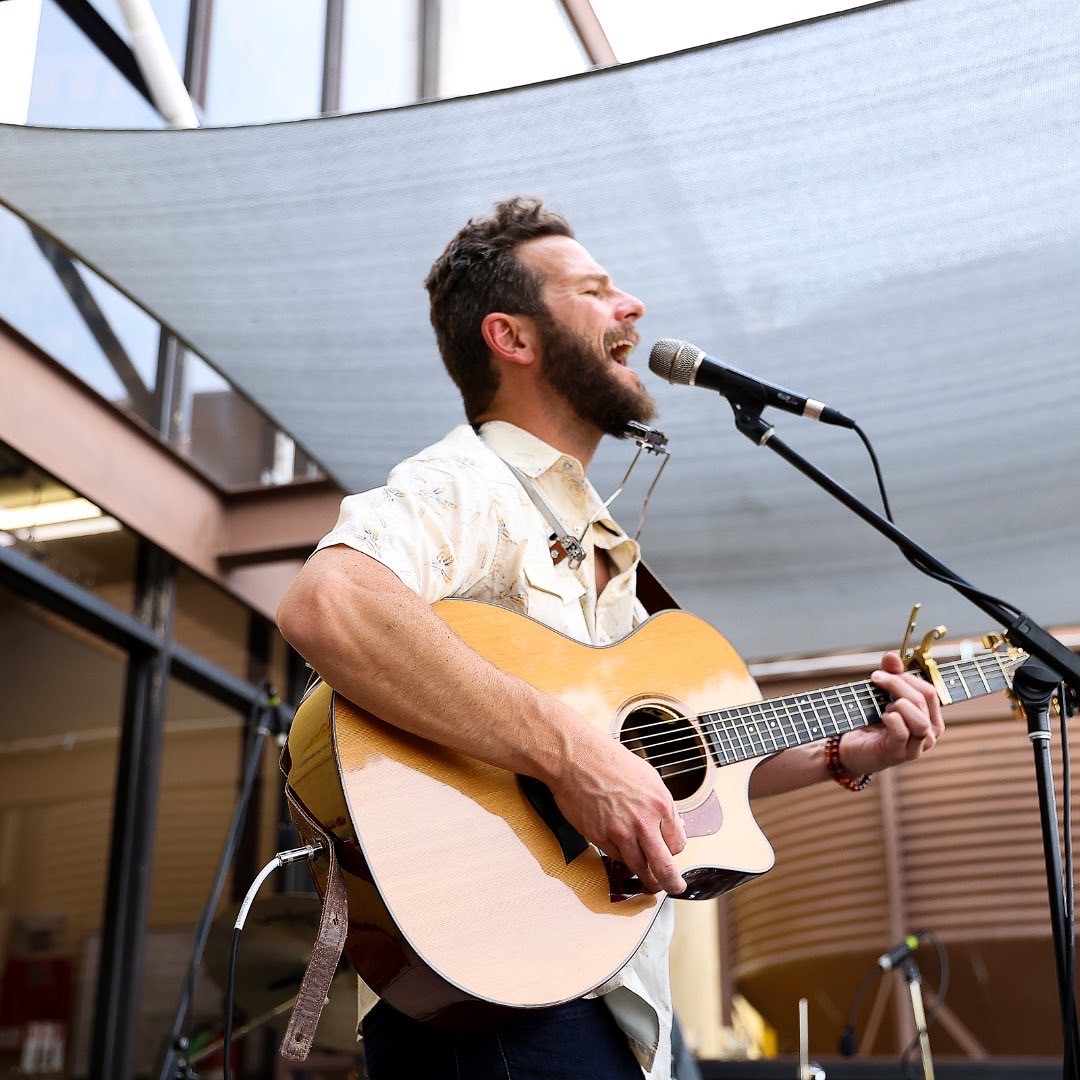
The most rewarding aspect of music to me is when people get it. That person who hangs out after the show or sends an email to say, “I really like what you said in this song. It relates to my situation.” For me, it’s a shared moment that cannot be matched.
I think all artists are looking to understand and be understood. When someone identifies with your art’s point of view, it’s validating. It’s as if your feelings are legitimate, and you’re doing the correct thing.
Contact Info:
- Website: alexrhodesshow.com
- Instagram: @alexrhodesshow
- Facebook: Facebook.com/alexrhodesshow
- Linkedin: https://www.linkedin.com/in/alexrhodesunc
- Youtube: https://youtube.com/channel/UCEgrGGI5RdY6HdQcEM09EeA
Image Credits
B&W photo – Malissa Chapman Brown Jacket head shot – Mark Houseman Brown jacket bas background – Mark Houseman Yellow live – Marlee Smith