

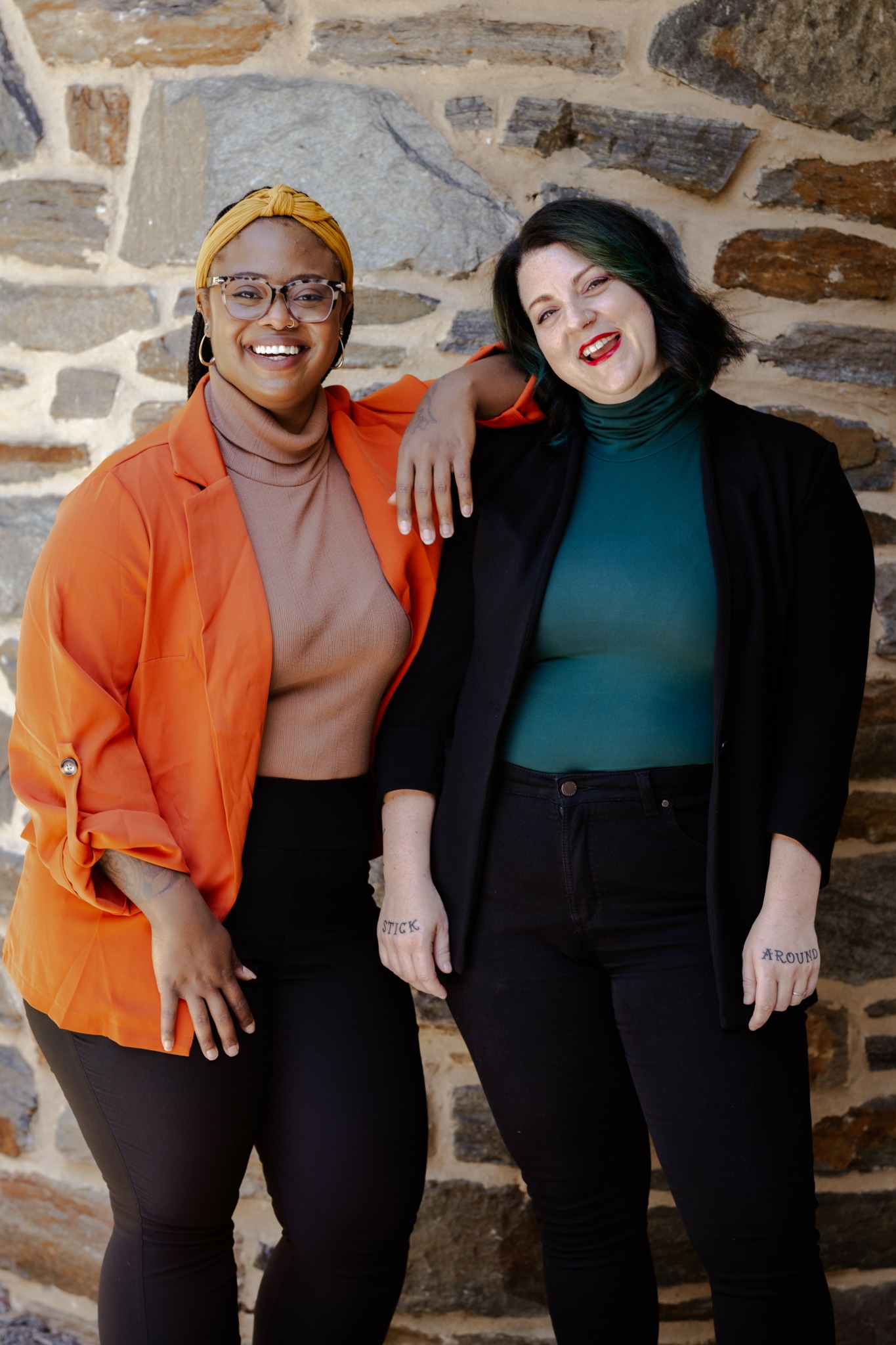

Today we’d like to introduce you to Caroline (carly) Falk & Sharnise Hendrick N/a
Hi Caroline (carly) Falk & Sharnise Hendrick, so excited to have you on the platform. So before we get into questions about your work-life, maybe you can bring our readers up to speed on your story and how you got to where you are today?
Carly: I was a cannonball of a child. Intense, driven, and definitely destructive at times. It felt like the world didn’t move fast enough and there was never enough time. I craved deep questions and conversations while chasing the most fun I could squeeze out of each day. I loved being in my own thoughts and ideas and also jumping out of trees. When I had to be still, I read. I remember being overjoyed and grateful that I could read as many books as I wanted. In fifth grade, I read my entire school library. I simply ran out of books (to be fair it wasn’t a huge library). I failed math too many times to count though.
My life has been devastating at times but with deep pockets of joy. The throughline from third grade to grad school was a fascination with stories. I have been chasing stories my entire life. Today I listen to people every day who tell me their stories, those that matter the most. I sit next to people who own their stories, maybe for the first time in their lives. Their grief, their horror, or their joy, I will stay and bear witness. In the most distilled version of my story, I grew up and found my place. It has been the greatest honor of my life.
Sharnise and I met at a group private practice. While I was keeping my head down and rushing home every day, Sharnise and I ran into each other in the break room one afternoon. I’ll never forget that lunch. Our connection was instant and we continued, what felt to me like a rather brilliant conversation. We ducked into each other’s offices to consult, catch up, and generally just make fun of each other. Sharnise and I sought out the most complicated cases and always seemed to connect on what we felt was missing from the standard talk therapy approach to treatment. We explored our growth as clinicians and the desire to work with acute trauma survivors. It was a natural collaboration from the start. The bonus was that we found each other simply hilarious. We work difficult jobs, with distressing content, and being a therapist can be incredibly isolating. Our friendship withstood the stressors inside and outside of work. We established our own successful private practices and launched new projects rapidly. We started developing the curriculum for trainings and workshops together. While our vision evolved to prepare the next generation of trauma-informed clinicians, it began to make little sense to have two separate companies. Sharnise had a powerful brand with a clear vision and we chose to maintain Lotus Embodied Counseling while closing my private practice. We merged our businesses on July 1st, 2023.
Sharnise: Since then, we’ve been able to put our vision into action, offering not only trauma treatment to our clients but advanced trainings and consultation offerings for fellow professionals. We value educating others in the field so that access to quality trauma-informed therapy is more widely available.
We got here by not turning away. We live in a world where suffering and harm and heartache are commonplace, yet we as a society, have such little tolerance of sitting down with it long enough to hold one another’s grief in meaningful ways. Carly and I both have personal histories that brought us closer to the reality of grief and devastation. I’ve always gotten along best with folks who are grounded in reality even when reality sucks.
We’re excited for the future. Our practice is growing; we’ve got phenomenal therapists that we are continuously impressed by. Carly and I are venturing into new creative territories like writing and podcasting. I know, I know, not another therapy podcast. Ours is slightly different, so stay tuned!
Would you say it’s been a smooth road, and if not what are some of the biggest challenges you’ve faced along the way?
Carly: Putting aside raising a two-year-old during this transition, the hardest thing for me has been the piecemeal learning of what I don’t know. I like to move fast, gather my own research, and take action as much as possible. Running this business has helped me slow down and use a bit more of an investigative approach to decisions. It has been a challenge to identify the right questions, to get to the answers we need. For example, envisioning everything in your head and anticipating outcomes is not the same as developing an effective business plan. What is probably a very simple learning moment for most, was huge growth for me. Rather than always leaning on the trial and error approach, why not lean on the entire wealth of knowledge that is the business administration field? Asking for help from my local organizations has been the greatest victory in the past year. I cannot overstate the amount of support we have received from our Small Business Development Center and SCOPE.
The merger has had its headwinds. Sharnise and I had to hit the ground running
( Also, we haven’t stopped, we are really out of breath) learning business administration and strategy. From hiring to managing rapid growth, we’ve had to be willing to fail and learn. We have worked with heart and soul to offer a clear vision in our community. Our employees have voiced their approval and we take pride in also being a safe employer. Sharnise and I trade books, articles, podcasts, and TikToks as we grow as entrepreneurs. This part of the journey can be exciting and also tough to balance. Task prioritization and ongoing needs require consistent communication and delegation. Again, it’s super helpful that we really, really like each other. We have to talk A LOT. The trust, while always strong, has had to grow deeper roots.
What I (Carly) have observed since has been a willingness to shoulder both our partnership’s gifts and its inherent challenges. We have also felt the impact of launching a small business into an environment that is changing, lacks equity, and presents significant barriers for those without financial buffering. Our business is our main source of income and the risk of our well-being and the financial stability for our employees is heavy to shoulder.
Sharnise: I would love to meet someone who could answer, “yes” to this question. No, it absolutely has not been a smooth road but, thankfully, we didn’t take this path because it was paved. I don’t believe in romanticizing struggles, so I won’t say that they’ve all been worth it. They’ve all been unavoidable, and they have all required us to create processes and identify resources within our relationship as friends and business partners, as well as external resources that we didn’t even know we would need. One of the hardest things thus far has been the need to consistently wear so many hats as business owners while navigating daily operations, surprise challenges, and our personal lives. Our conviction and unwillingness to be beaten by the systems that weren’t set up with us in mind, along with the absolute joy we have in doing this work, have enabled us to keep finding solutions.
Appreciate you sharing that. What should we know about Lotus Embodied Counseling?
Sharnise: This is our favorite thing to talk about! Lotus Embodied Counseling offers therapy to adult survivors of interpersonal harm. We work with adults who have a history of childhood abuse and/or neglect. Carly and I take pride in being a practice that honors the impact that dangerous environments have on the nervous system and one’s relationship with self and others. We work with folks who were trapped in high-control, high-demand environments, and relationships, including survivors of cults, incest, intimate partner violence, and sadistic abuse. Our therapists all have advanced training in regards to working with concerns related to complex trauma. We provide a space for folks to begin unpacking their life experiences.
In addition to therapy, we offer trauma-informed yoga, a choice-based approach to yoga that supports a gentle reconnection to one’s body. Everyone deserves to feel safe within themselves and yoga can support this. It is a joy to teach yoga and witness people gain comfort and confidence as they explore movement and stillness. Yoga can be a wonderful adjunct to therapy for many people, especially folks who had to disconnect from their bodies in order to survive harmful relationships and environments.
We have ongoing events, consultation opportunities, and continuing education trainings for therapists and we collaborate with organizations to bring some of these trainings to local agencies, schools, and wellness events. We find great purpose in educating and helping other professionals feel more competent in their work. We’re thankful that our work and marketing endeavors have reached clinicians all over the county.
Carly: When Sharnise and I present or attend networking events, folks are drawn to us. What is extraordinarily marketable about our work, beyond its content, is our relationship. The flow of our conversation, our banter, and our passion is alluring. We offer light in a very dark setting. Working with survivors of ritualistic abuse, incest, sadistic abuse, etc is often beyond what clinicians feel prepared or willing to treat. For clinicians who choose to pursue this skillset, we model an empowered expertise. We offer a message to labored clinicians that not only can you do this, you can continue to have life and spirit in this work. There is always more knowledge to chase down, more books to read, and more trainings to attend. What Sharnise and I offer clinicians and clients alike is the willingness to embrace the grief and also the joy. We offer community to our fellow therapists in effort to support our survivor community. While there is much work to do and the journey is long, let’s take care of each other on the way. No one recovers without a community and we are growing ours.
Where do you see things going in the next 5-10 years?
Carly: The field is experiencing what many professions are at risk of encountering; corporate acquisition. Large firms with expansive funding are monopolizing the market with online subscription-based services. With the rush of increased demand during the pandemic, mental healthcare appeared much more lucrative to medical firms that had largely ignored outpatient services.
With an increased supply of services and ease of access, the quantity of referrals has declined for many group practices and solo therapists. This has pressured many practices to continue accepting insurance in spite of the loss in resources and revenue. In broader contexts, the quality of all mental healthcare can be lowered. The unethical, profit-driven, and quantity-over-quality subscription services involve great risk to client and clinicians alike. Clinicians pursuing a sustainable, consistent income are pressured to accept insurance with lower reimbursement. This requires the clinician to see more clients in a day to make the income they need. Reimbursement rates widely vary and may not be adjusted for years.
AI is also a game changer. With AI, a company can generate content faster and in a more efficient method. A well-managed AI can function as a social media manager, to an extent. We’re also seeing AI creeping into services like note-taking platforms and online mental health chat services
The field is headed backward in the sense of lowered profitability from billing insurance. Private practice treatment was not nearly as accessible before the ACA. The little mental health coverage that existed was overseen by what is known as “managed care.” Managed care requires more paperwork for the provider, less coverage for clients, and more treatment interference throughout care. It has been speculated that mental health care will transition to the “compliance model.” This results in detailed business models that follow a set of rules, such as narrowed use of codes, obligatory adherence to standards, or program guidelines. All of this is in the control of insurance companies.
Mental health treatment providers need a union, yesterday. Some amazing folks are doing some heavy lifting to create movement in this regard, however the challenges are great.
Our practice is buffered by our targeted population. We are an elite trauma treatment provider in which therapists refer the toughest cases. Therapy has never been more accepted, encouraged, and available. There are simply more folks who are seeking therapy. I do believe the field will adjust in time to the corporate “invasion.” I predict that the consumer base will begin to reject the lowered quality of online subscription services. I also see AI beginning to enter a field of options for clients that will quickly be insufficient for their needs. No one recovers in isolation and a safe relationship will forever be the bedrock of all therapy. Clients will seek quality, individualized therapy and pursue specialties local to their community. Word-of-mouth will always be a powerful tool, especially in tertiary services such as mental healthcare. The cookie-cutter corporate offerings will frustrate both clinicians and clients alike. I have met more referrals who have attempted companies such as BetterHelp and were appalled by their experiences.
Sharnise: We’re going to continue to see an influx of these third-party companies seeking to acquire therapists. We definitely get bombarded by them on LinkedIn as it is. The commodification of wellness services and providers for the sake of lining corporate pockets is disturbing and ongoing. More therapists are going to be frustrated and pushed towards terminating their contracts with insurance providers, diversifying the services they offer, or joining a third-party company that makes promises to navigate insurance challenges on behalf of the clinician while taking a significant cut. Insurance companies have too much say in how we practice, and this needs to change so that we as a field can continue to offer this work while receiving adequate compensation and so that our clients can continue to access services. The power and decision-making about how to offer services ought to be in the hands of the clinician, not insurance companies but that isn’t the case. We’re ill-equipped to navigate these corporations and they know it.
Contact Info:
- Website: https://www.lotusembodiedcounseling.com
- Instagram: https://www.instagram.com/lotusembodiedcounseling
- Facebook: https://www.facebook.com/lotusembodiedcounseling


Image Credits
Kay Harrod Photos