

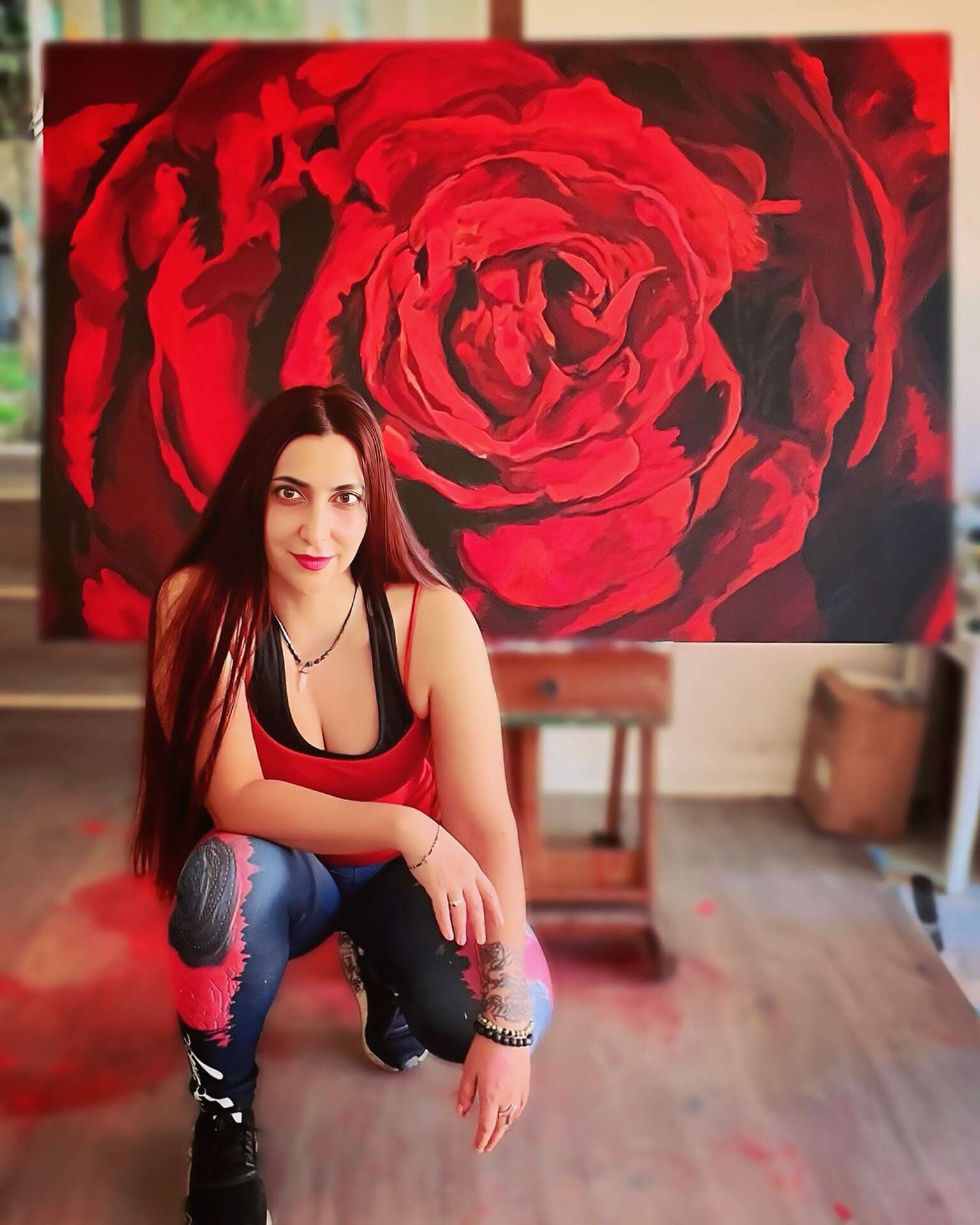

We recently connected with Golareh and have shared our conversation below.
Golareh, looking forward to hearing all of your stories today. Can you talk to us about how you learned to do what you do?
There are various aspects to being an artist. On the one hand, there is the physical ability, which, if you ask me, exists in everyone, and is not necessarily an ability, but rather a desire. If you want to be an artist, you can. I often hear my friends say things like “I could never be an artist. I just can’t draw anything,” and my response is always the same. You can be an artist if you want to be one. If you have the creative bug and a part of you is itching to express itself visually, then you owe it to yourself to figure out a way to do so. In your mind, maybe you value a realistic depiction of the world you observe to be a testament to your artistic abilities – in which case you can train yourself to learn how to draw realistically. There are hundreds of books and videos you can watch that can teach you how to draw, and of course, with practice, you can get better.
But, for me, drawing or painting realistically is not what being an artist is about. It is much more important to successfully express my emotions in my pieces – and sometimes, that requires embracing imperfections, or being open to creative accidents that could be subliminal expressions of my soul. It is this aspect of my craft that has taken me the longest to learn and, in fact, I’m still learning.
I’ve had to learn to be more vulnerable and to share more of myself in my pieces. Being open to expressing parts of me that I often try to keep secret or hidden has helped me immensely, not only in using my art as therapy, but also in creating pieces that are more poignant and can, hopefully, resonate more effectively.
I’ve come to realize that my immigrant experiences as a child are a very strong part of my visual expressions and have been for a while. Even when I look back at some of my earlier pieces, I can now see the emotional residues of those experiences in my work, even without me consciously thinking about including them. Now that I’ve come to recognize them as such an important part of my early development and adult identity, I am putting them into my pieces more consciously and deliberately. Interestingly, this inclusion aligns seamlessly with my earlier themes of capturing opposites and depicting the inner struggles of optimism and pessimism. In me, so much of these struggles are the result of my childhood experiences as an immigrant and how I had to adapt to my new environments, learn new languages, and embrace new cultures, while also maintaining my original heritage – all while going through the usual uncertainties and turmoils of growing up. The ups of being positive, hopeful, and welcomed, juxtaposed against the downs of feeling rejected, isolated and alienated are part of my artistic explorations.
How I achieve these emotional expressions is the technical part. Sometimes I do this through my brushwork. I love creating pieces that are heavy impasto with textured knife-work. This technique allows me to pour my feelings into the actual expression of the strokes. I also like to combine mediums and have evolved from creating strictly oil or acrylic on canvas pieces to more pieces that combine digital art, glitching, manipulation, pixelation, and photography with traditional classical analogue brushstrokes. This too, is part of the process of putting more emotions into the work. Some of my most recent sales are of this latter mixed-media style that fuse digital art with classical fine art.
Stylistically, if I had to assign a style to my work, I’d probably say it’s surreal expressionism that combines elements of fantasy and dreamscapes with modernity – but it’s always challenging for me to label my work. It’s funny, because as an artist on Saatchi Art, I have to come up with keywords that potential collectors and buyers use to find art, and one of the most effective keywords are things like “in the style of so and so.” I always have a hard time finding the right artist to use in my keywords, so I end up going with artists that aren’t exactly aligned with my style but rather have color palettes that are similar to mine.
In the end, I hope the learning of my craft never stops and that I can always continue to grow and evolve.


Golareh, before we move on to more of these sorts of questions, can you take some time to bring our readers up to speed on you and what you do?
I was born in Tehran, Iran a few years before the Islamic Revolution of 1979. In Iran, the generation born between 1966 and 1988 is known as the Burnt Generation. We are the generation that, as children, experienced the Iranian Revolution, the Iran-Iraq war, and the political and social consequences of events such as the Iran Hostage Crisis, and the general world view and reaction to Iran and its new extremist government as portrayed by the media and other international governments. Ironically, within our own homes and families, many of these reactions were entirely foreign to us. Many of us grew up in secular households where religion was just not a significant part of our upbringing, so the alienation was two-fold. In my home, for example, my dad was an atheist. He was a science guy, so even though everyone in the home was welcome to have their own spiritual views, the idea of a government with an armed enforcement unit dictating what you should or should not believe was definitely not what we were used to. So, on the one hand, we were completely at odds with what was happening in our country with a new government that didn’t represent us or our views; and on the other hand we were being judged by an international community for being part of a government and an extremist movement that we had nothing in common with, and actually felt completely at odds with.
Each of us from this Burnt Generation experienced our own challenges. Those who remained in Iran after the revolution and during the Iran-Iraq war had most of their personal liberties yanked. Many also had to witness their brothers and sons be drafted to war, with the possibility of death in battle highly likely. Others, like me, who left after the revolution, had to navigate the challenges of adapting to new societies and cultures as children while being portrayed by the media as universal extensions of the new Iranian extremist regime during highly publicized events like the Hostage Crisis and its aftermath. Personally, how these events affected my psyche remained hidden to me until quite recently. What’s more, the effects are ongoing. Recent events like the “Women. Life. Freedom” movement of 2022, and the slaughter, rape and silencing of a whole new generation of women in Iran has had scarring effects not only on the incredibly brave yet oppressed people living in Iran, but also on all of us living in diaspora. And then there is regular life: bills, work, health, family, money, school, mindset, etc. How we each cope with these effects and express our emotions as a result of them is very personal.
I use art, even though for the longest time I didn’t even know I was using it. I have always been keen to present opposites in my work. The battle between positives and negatives, hope and despair, fantasy and reality, optimism and pessimism, euphoria and depression, have all been themes in my pieces for some time. Now I know that the desire to represent these themes is most likely rooted in my experiences as an Iranian child immigrant.
I’m also a Gen-Xer, so technology and the Digital Revolution are part of my existence and identity and something I like to capture and represent in my work, which is the reason why I am so much more interested in creating modern contemporary pieces that are mixed-media and combine digital mediums with analogue ones that use physical brush and knife work to enhance the depiction of my emotions.


How can we best help foster a strong, supportive environment for artists and creatives?
I believe improving discoverability is the greatest way artists and creatives can be supported by friends and the larger community. Often I find that I’m working in a bubble and many of my pieces don’t get enough exposure. It is not always possible or affordable to go to an art fair, put on an exhibit, or take time off to go to an artist’s retreat or do a residency. These are, of course, things that all artists who are committed to their craft love to do. But we often have to balance work with our dedication to being an artist, and so we end up relying mostly on social media to put our work out there. Ever-changing algorithms, and the value placed on your popularity based on what’s trending makes new and innovative art very difficult to be discovered. Sharing an artist’s works on your platforms, talking about their art and the themes they represent, and helping them improve their visibility is one of the most valuable ways communities can help artists.


Alright – so here’s a fun one. What do you think about NFTs?
I was an early adopter of NFTs and created many tokens on platforms like Voice.com. The idea of NFTs was and continues to be very exciting from a digital artist’s perspective. They provided a protected revenue that also offered royalties through secondary sales, and the security of being on a blockchain also protected both the artist and the collector from theft. Also, animation and video artists could now have a way to earn money from their artistic works independent of corporations.
Conceptually, one of the challenges with NFTs was that the average conventional collector had a hard time wrapping their head around collecting a “digital” asset instead of a physical one. Many conversations I had with skeptics during the height of the NFT boom was about them not being willing to spend money on a digital piece of art that lived on their hard drive or phone instead of on their wall. This required an appreciation of art that needed to be more emotional than physical, which wasn’t an easy concept for many to grasp.
Additionally, as is the case with any market that grows, criminality around NFTs started to take a strong root. NFTs soon became a landscape for fraud, money laundering and Ponzi schemes, which devalued the legitimacy of NFTs for those artists and collectors who were using it properly.
All of this combined with the volatility of cryptocurrencies in general didn’t do well in the longevity of NFTs. It is unfortunate, because the promise of it was, and still is, truly exciting for artists, but alas, I’m afraid the bubble may have burst.


Contact Info:
- Website: https://www.golarehsafarian.com
- Instagram: https://www.instagram.com/golareh
- Facebook: https://www.facebook.com/G0lareh
- Linkedin: https://www.linkedin.com/in/golarehsafarian/
- Twitter: @G0lareh
- Other: https://www.saatchiart.com/golareh