

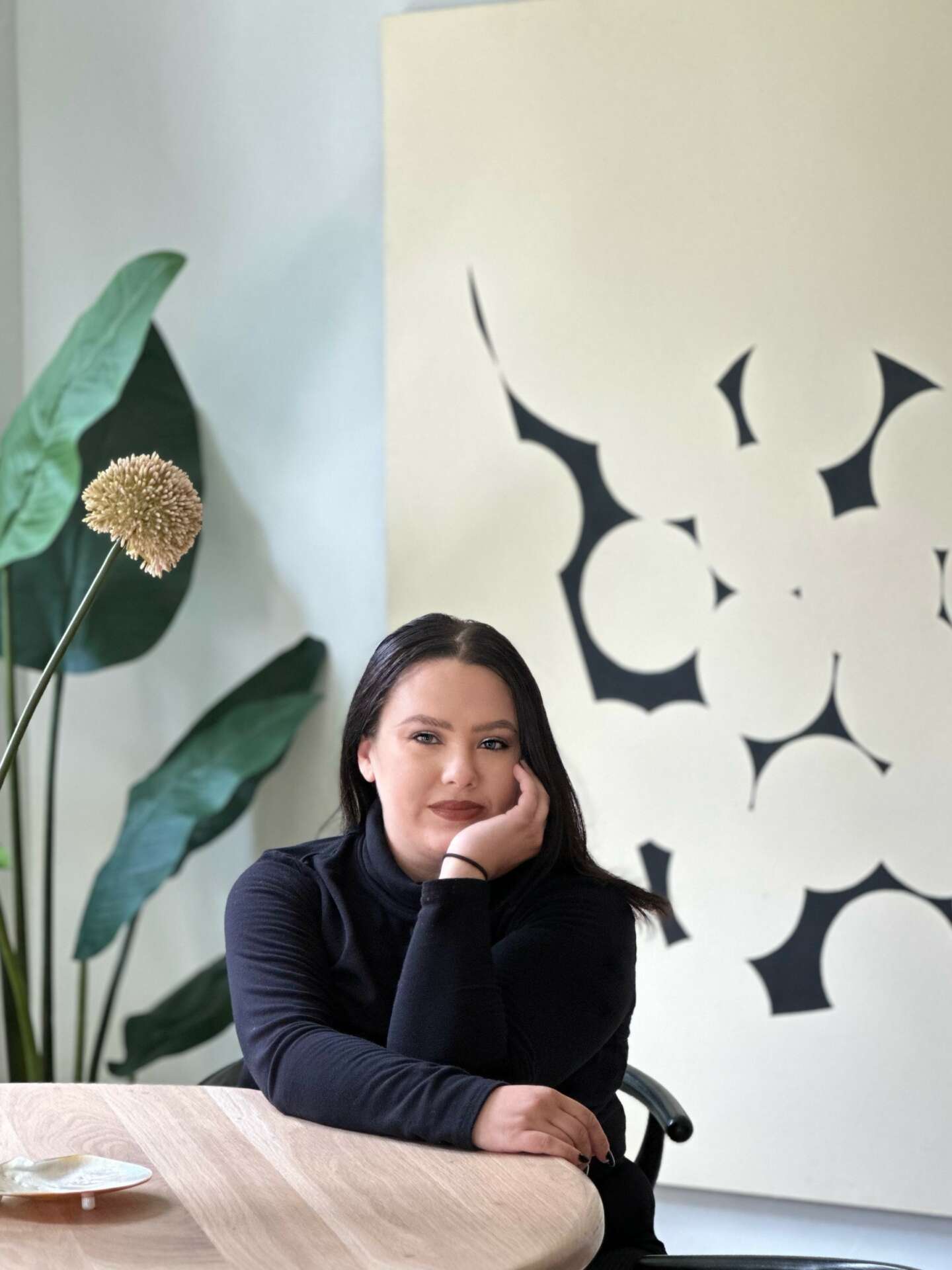

We were lucky to catch up with Alexandra Stefanec recently and have shared our conversation below.
Hi Alexandra, thanks for joining us today. Can you talk to us about how you learned to do what you do?
Happy to be speaking with you! Honestly, as nice as it sounds to have the learning process be expedited, the nuances of trial and error is such a huge part of my perspective and why I paint. It’s like wrestling with my creative intuition is the catalyst for arriving at concepts. My paintings are the result of that wrestling; They are acts of resolution with my memories and traumas, so I don’t know my process without patient and focused emotional excavation. Introspection and self-reflection run on their own time, and visualizing them into a composition takes time too. There was an inherent mystery that came with discovering the role that art would play in my life, and the mystery became more fascinating as I realized that painting was more than a cathartic activity; painting is how I come to understand my emotional landscape. My journey has brought me to a process that can’t be squeezed or forced, as my paintings are both the result of and the audience for my confessions of my greatest vulnerabilities. My firm rule is that I won’t create anything that is contrived or doesn’t feel honest; This is likely because my process is so integrated with my mental health that the idea of making something doesn’t come from a place of sincerity stirs great discomfort within my sense of self as an honest person, as well as my relationship to artmaking.
As I think back to earlier years, I remember being paralyzed with fear of just starting something–it didn’t matter if it was a modest still-life drawing, or simply writing my signature; I was overcome with fear that I would not be able to “convert” everything I felt into a visual format, so I stalled a lot. I was a nightmare to my painting professors because I stalled so much. I would love to tell my younger self that this fear of not being able to translate what’s in my heart, in fact, has become a great strength, so be patient, kind, and curious with the process.


As always, we appreciate you sharing your insights and we’ve got a few more questions for you, but before we get to all of that can you take a minute to introduce yourself and give our readers some of your back background and context?
My name is Alexandra, I live and work in Denver and I’m a painter. Over the past 10 years I have been exploring my perspective as a creative, particularly how art could help me understand the nuances of human connection, and the relationship I have with the concept of self. Through years of experimentation, I found so much freedom when working in large scale formats and within the realm of minimalism and abstraction and haven’t looked back since.
Each painting reflects a specific memory that is difficult to carry mentally and emotionally; the painting then lives a symbol of championship over my traumas, and brings a sense comfort that I might not have achieved without articulating myself in this visual format.
My work uncover themes of connection and proximity; head versus heart; intensity and depravity; phenomenology, and Bergsonian ideas of metaphysics.
My paintings serve as acts of resolution with the cycles of tolerance that no longer serve me, but are observed retrospectively to create a visual model of how I have evolved over time. Painting is where I can tap into my personal truths, my sense of authenticity, and how I feel unlimited amounts of acceptance of self with peace and contentment.

In your view, what can society to do to best support artists, creatives and a thriving creative ecosystem?
The most obvious call to action of course is to start collecting works from local/ independent artists, as most of us are practicing without expectation of making an income solely from our work. Beyond that, however, I feel that there is such a low tolerance for art viewership, wherein-which the viewer only explores what is visually being portrayed in an artist’s work, but there is so much more there that goes unheard possibly due to our decreased attention span for art viewership. As connected as we are today through the digital space, I think the attention span of our society is so brief that we can oftentimes miss the treasure of hearing each other speak. I would be surprised and delighted to see society begin to slow down and listen to voice of those who bring the art to us. We can learn and connect in such beautiful ways when art is treated less as a source of entertainment, but more as a portal for us to step into someone else’s world.

What do you find most rewarding about being a creative?
Being an artist has taught me how to trust myself, trust the process, and how to listen to myself. When I started painting I remember not knowing what my voice sounded like or what I was hoping to achieve by working on my craft. But as I look back now I believe that my practice has taught me how to be the most authentic and sincere person I can be–and becoming insistent that I live this way! Once I started listening to the deepest parts of myself, I came to know myself in a way that I wasn’t expecting, but I am so happy I know her now. There is really no other option for me than to be the person who I have become through painting. I don’t know a greater reward than finding my path that brings my truest self forward everyday.

Contact Info:
- Website: https://www.alexandrastefanec.com/
- Instagram: https://www.instagram.com/alexandrastefanec/