

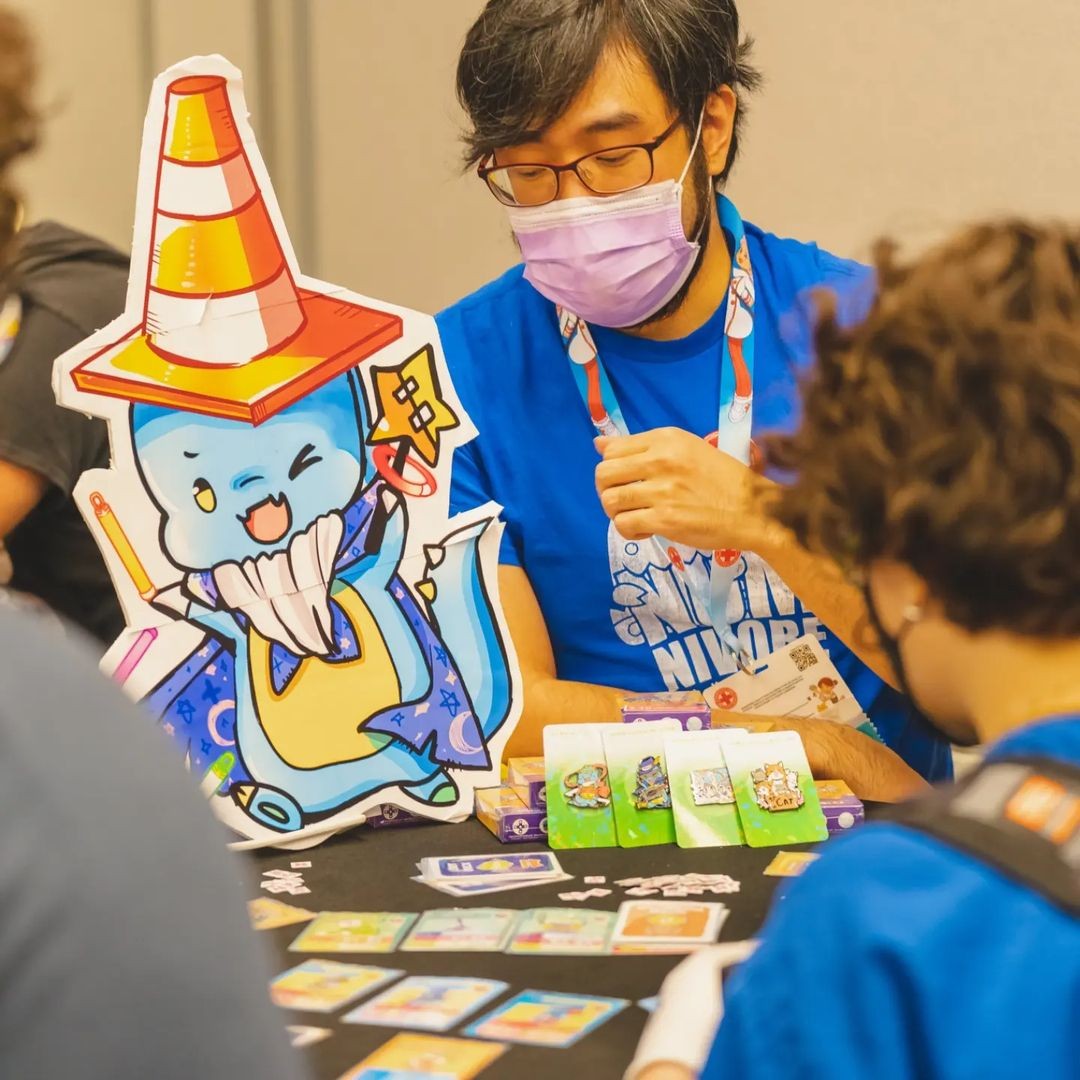

We were lucky to catch up with Derek Chung recently and have shared our conversation below.
Derek, thanks for taking the time to share your stories with us today What’s been the most meaningful project you’ve worked on?
The most meaningful (and ongoing) project that I’ve worked on is the founding of my company, Nomnivore Games Inc. (NOM). While on the tin, NOM is about making ambitious games that tell immersing stories about rich, nuanced worlds that reflect the diversity and complexity of our own, that’s only part of the story. The other half of the reason why I began the company in 2017 was to help alleviate feelings of loneliness, fulfillment, and the growing mental health epidemic plaguing society.
I’ve always cared a great deal for others, and I’ve spent an equally great deal of my life dedicated to tending to the downtrodden, the unfortunate, and really just about anyone who’s having a rough go of it. Even at an exceptionally early age, I volunteered daily at nursing homes and my interest in the human condition eventually blossomed into a fruitful career in psychotherapy. However, it was in the office that I often thought about the limitations of psychotherapy, too. Or more specifically, I often thought about the fact that while there are many people that psychotherapy helps, there are many more that it doesn’t, irrespective of the skill and expertise of the therapist.
When I wondered about why that was the case, I remembered my own past—reminiscing about how many of the most meaningful and touching experiences I had were never with a therapist—but rather organic experiences in the “wild”, from teachers to friends, and even strangers, that just happened to say the right thing at the right time.
I also examined the structure of therapy and considered its ideal outcome: where the client is well enough that they can transition from depending on a therapist to being surrounded by a web of social connections—such as friends, family, and other loved ones—who care for them and they also care about.
Taking those two factors together, I arrived at a humble hypothesis that perhaps there was another way to help the general public to access and foster those transformative epiphanies, moments, and relationships in a manner that psychotherapy currently wasn’t.
It was in that desire that I left one foot in the clinical world and took another and firmly supplanted it in game design and founded NOM. I very much wanted to make mental health and well-being more accessible to everyone, especially those that could never enter a clinician’s office, due to cross-cultural issues, cost, poor access to services, etc.
There are few cultural phenomena as permeating and far-reaching as games. There are even fewer that are designed by principle to welcome and garner new relationships, where the person engaging with the content is simultaneously able to express their identity and construct new meaning. Really, there was no better medium that I could ask for to help people form those meaningful connections with one another than games.
However, there was a surprisingly small amount of work done in this area. There were only a few psychotherapists that were trying to adapt already-existing games for therapeutic purposes, and even fewer products on the market that had been custom-built for that purpose. Games that included psychotherapeutic principles and were meant to be enjoyed without a clinician present at all were practically unheard of, and an even greater issue at hand was that while gaming was more accessible than psychotherapy was, that doesn’t mean that games aren’t plagued with their own accessibility issues (e.g. dyslexia, dyscalculia, ADHD, vision impairment, etc.)!
Suffice it to say, it’s become my (and NOM’s) mission to take on both, spearheading a new path where psychological well-being is more inclusive and accessible to everyone through gaming, and gaming is more inclusive of everyone in general.
Derek, love having you share your insights with us. Before we ask you more questions, maybe you can take a moment to introduce yourself to our readers who might have missed our earlier conversations?
I answered most of this in the previous question, but I’ll take this opportunity to explain a little bit more.
In general, I would love more people to know about my games, just because being informed that another option that can be used as an alternative or in tandem with psychotherapy could be very beneficial to many. However, I don’t really ever lead with that information, as knowing that it’s potentially therapeutic doesn’t necessarily make the games more so. (In fact, sometimes the expectation of it being therapeutic can occasionally block people from having that outcome (e.g. someone adverse to therapy not allowing themselves a chance to play my games because they know it is “therapeutic”)!)
And while I only briefly touched upon the inclusion of accessibility features in my games, the products I create are also good for people who simply want to have a fun night of gaming with their friends that may also struggle with ADHD, Dyslexia, Dyscalculia, and more. It’s really that inclusivity angle—where I believe everyone truly deserves a seat around the gaming table—that I’d like to promote.
Beyond that, two specific audiences that I think deserve a specific mention about my wanting them to know more about my work are fellow clinicians and school boards. I think the area of therapeutic gaming is something that holds a great deal of promise that very few professionals consider or are paying attention to, outside of say, occupational therapists and child psychologists. Of course, the winds are beginning to blow the other way, and if you’re asking me about my most proud accomplishment, I’ll definitely answer with the fact that I’ve now pioneered long enough to garner the notice of large, respectable institutions like John Hopkins University, which are looking into potentially constructing a therapeutic gaming department now!

Learning and unlearning are both critical parts of growth – can you share a story of a time when you had to unlearn a lesson?
Something I had to unlearn was what is considered “therapeutic” and what “treatment” looks like can have vastly different definitions depending on the angle you view it from. It’s not like it is in the media, where it’s something done only in an office, where someone in a sweater vest asks you about your mother.
That’s not to say that nothing matters due to that relativity, but that you need to considerately and respectfully select a point that’s appropriate to frame the paradigm from. This was something that I’ve had to contend with for as long as I can remember, as I am the product of two cultures who’s had the fortune to globetrot through many more. Often, what means something in one culture doesn’t mean the same thing in another; and when something is misapplied, even when well-intentioned, it ends up missing the mark and sometimes causing more harm than good.
Another lesson that took me an even greater deal of time to realize was that there is a world of difference between intelligence and wisdom. Both are valuable, but what one learns from each is vastly different, and no matter the “expertise” I gained from a textbook, nothing substituted for experience. Consequently and with great humility, I’ve also had to unlearn an unspoken assumption of the psychotherapist’s office that the psychotherapist is the expert. Rather, it’s the client (and it is my humble honour that they’re willing to share any of it with me). After all, who knows the subject of themselves best rather than the person who’s actually lived their life?


What’s the most rewarding aspect of being a creative in your experience?
Of course, I really enjoy having the ability to work together with amazing, top-shelf talent, and to create something from nothing that other people can enjoy. But nothing compares to the moment when I receive a heartfelt note from someone who’s played my game(s) and had their lives transformed for the better. Hands down.
For instance, I often recall the e-mail I received from a stranger who developed an anxiety disorder during high school and lost the ability to play the games they loved and grew distant from friends as a result. They happened to come across one of my games, EMBERWIND, and found that they were able to play a role-playing game again, for the first time in a decade, and rekindled those relationships that they thought were long lost!
Seriously powerful stuff! 

Contact Info:
- Website: https://www.nomnivoregames.com, https://www.emberwindgame.com
- Instagram: https://www.instagram.com/NomnivoreGames
- Facebook: https://www.facebook.com/NomnivoreGames
- Twitter: https://www.twitter.com/NomnivoreGames