

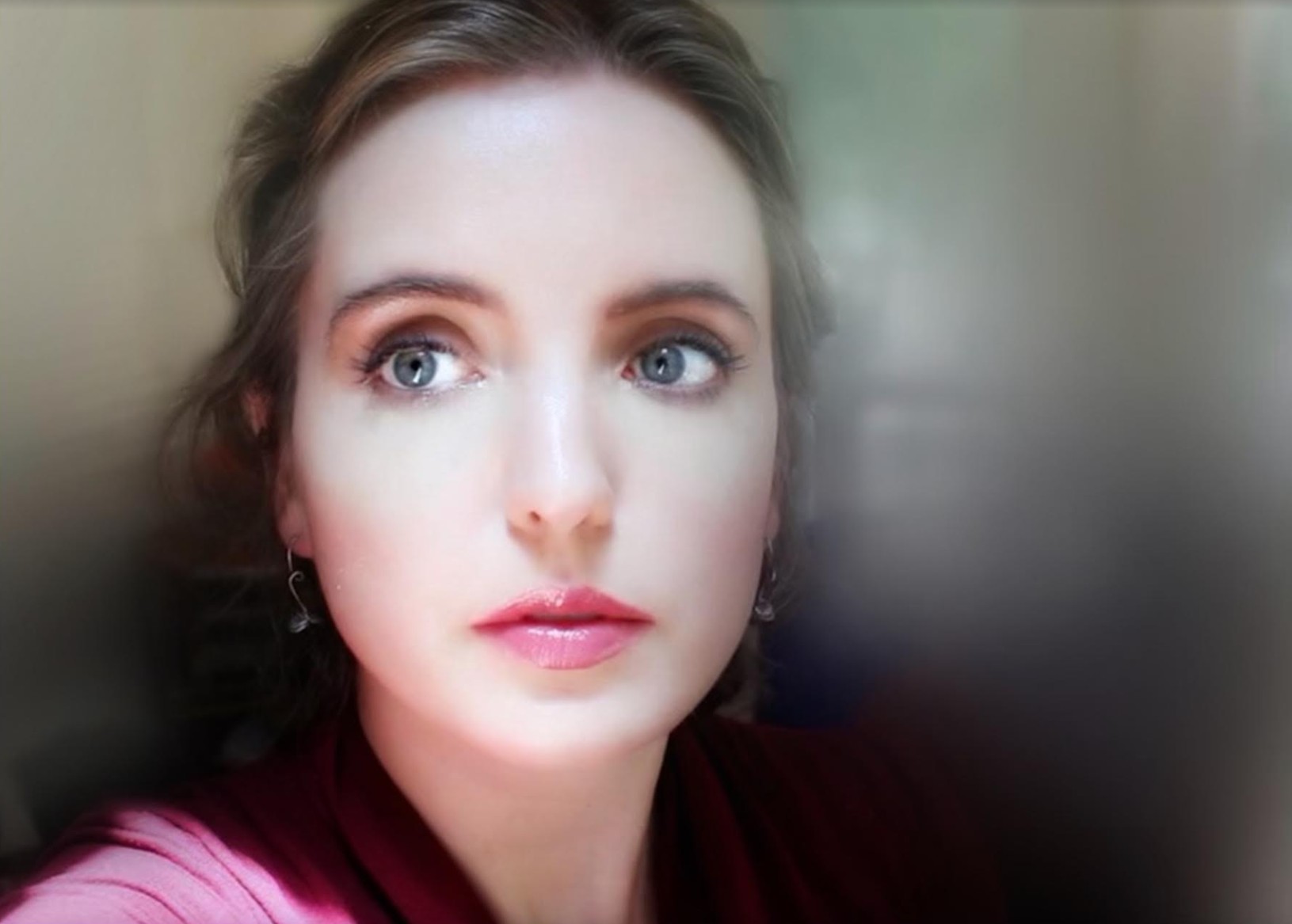

We recently connected with Erin Schalk and have shared our conversation below.
Erin, thanks for taking the time to share your stories with us today We’d love to hear about a project that you’ve worked on that’s meant a lot to you.
Perhaps many artists and creatives find also themselves functioning this way — I am a person who needs to be engaged in meaningful projects in order to generate motivation and experience a sense of fulfillment.
We do not live in a perfect world, so of course, we cannot always be immersed in projects we are passionate about, however, I feel a creative person has an advantage in this arena. We often have the drive to either ferret out hidden opportunities or innovate and build the sort of projects we envision.
This year, I had the opportunity to work with artist-curator Jamie Nakagawa Boley and create a solo exhibition titled, “Ekphrasis: Perceptions of Ability.” Boley, who has recently been hired as full-time faculty at Fresno State University, provided me with the freedom to develop an entirely new body of artwork, using the media and themes of my choosing.
Since 2018, my work in teaching and education have focused on disability-awareness and greater accessibility through mindful instructional design. In recent years, I have opened up my visual arts practice as an extension of this conversation: How do we do a better job discussing and bringing representation to individuals with disabilities, shedding light on strengths and challenges, through visual art?
In my exhibition “Ekphrasis: Perceptions of Ability,” I took portrait photographs and wrote corresponding texts (either poems or short prose) which examine individual and societal perceptions of disability – both visible and invisible – and pose the questions: How do ideas of ability and disability impact a person’s life experiences? How much of the ‘impairments’ or ‘deficits’ often associated with disabilities hinge upon societal preconceptions, misunderstandings, or imposed limitations?
In the photographs, I highlight physical features, expressions that reveal aspects of each artist’s personality, daily challenges, and significant abilities that exist because of disability. In combination with narrative poems, I comment on the immense power of human perception, and ask the viewer strive to better recognize the world through each individual’s frame of reference.
Considering outcomes, the artists with disabilities represented in the show received greater attention and recognition for their work. In terms of viewers, many people spoke out – some for the first time – on how they had masked an invisible disability for many years, or a family member’s experience with disability that was concealed. I feel “Ekphrasis: Perceptions of Ability” remains in early stages but has the potential to spark an outpouring of increased awareness and empowering discussions on disability.
Erin, before we move on to more of these sorts of questions, can you take some time to bring our readers up to speed on you and what you do?
Like many creatives, I have a “slash” career, meaning I fulfill multiple roles simultaneously!
Since childhood, I felt strong pulls toward becoming a visual artist and writer. I grew up in the rural Midwest to a non-creative family, and spent my childhood and teen years hungering for a creative community. My first access to the arts came during college, where I was exposed to traditional subjects such as art history and foundational drawing and painting.
I continued to follow a higher education arts track, completing my MFA at the School of the Art Institute of Chicago in 2017. SAIC professors recognized my natural affinity for writing, propelling me to compose my first poems. In 2021, I published my first collection of poetry and visual art titled: (quiet, space).
Today, I split my creative time between making visual art and continuing to develop my writing practice. I am a working parent of young children, so I have to approach studio time strategically. Media and disciplines that (1) I can tote to a variety of locations, (2) are quick to set up and tear down, and (3) require little storage space are my allies at this life stage! I trained as a painter but paint via less “traditional” means now. I work with digital photography, collage, and video from a painter’s vantage point, focusing on image, composition, scale, and layering.
As a writer, I am primarily self-taught and have never completed an official writing certification or degree program. As of mid-2023, I am a poet and arts-based non-fiction writer with 40+ publications to my credit. I love prose as well, and I am tentatively stretching into short story and novel writing. I have had a handful of prose pieces published, including a chapter of a novel in progress.
Writing remains my tightly guarded secret. I struggle to put my work out into the world as much as I would like; I am both protective and self-conscious of my writing. At the same time, I experience that nagging feeling that there is so much more I yearn to say and accomplish through words.
I also work a day job as an Educational Programs Lead, where I am responsible for creating educational curricula for blind and visually impaired adults, as well as training our educational faculty and staff. I provide our teaching teams with resources to become stronger, more empowered educators. This work also provides me with chances to learn more about and implement Universal Design for Learning (UDL) — how to create educational experiences that support individuals with diverse abilities.
In terms of my brand, I would love readers to know that I am open to projects and collaborations surrounding writing, especially creative writing or arts-based non-fiction, visual arts, accessible education, and higher education.

We’d love to hear a story of resilience from your journey.
Years ago, active duty military life played a major role in determining the trajectory of my life, as well as available options for moving forward as an artist. The situation demanded that many artistic dreams I had were put on hold for years at a time. This was personally challenging for me; I am someone who is driven and who likes to create long-range plans. Ultimately, these years taught me flexibility.
Shortly after finishing undergrad, we were sent to Okinawa, Japan as a duty station. The original term was two years, however, it was extended to three. During the first year, I felt completely unmoored. 3/11 (the Tōhoku earthquake and tsunami, followed by the Fukushima nuclear disaster) happened months after we arrived. Less than two months later, I received a chronic health diagnosis and went through a battery of medical tests that lasted for much of the year. There were days where my anxiety about the future was beyond paralyzing.
When the smoke slowly began to fade from both events, I turned some of my attention back to art as a means of coping, of moving forward. However, there was no clear trajectory — I was a foreigner, and finding and accessing arts opportunities was like navigating without a map. I realized I would have to carve out my own path in some way.
I am proud to say that I dug in, accessing a level of bravery and resilience I didn’t know existed within myself. I worked actively to learn the Japanese language and become involved in the local community. I began an independent visual arts teaching practice, where I taught local and international students. I had the good fortune to participate in Okiten, an annual art exhibition that has taken place in Okinawa, Japan each year since the end of World War II, as well as annual exhibitions at the Okinawa Prefectural Museum of Art. In time, I built a body of artwork that combined elements of painting with low-relief sculpture. By the end of the three years, I could scarcely go anywhere on the island without someone recognizing me or my work.
This time ultimately laid a critical foundation for me, helping me build a body of artwork, as well as a level of internal strength and emotional resilience, that eventually propelled me into the School of the Art Institute of Chicago. I am grateful to have studied in one of the most respected and acclaimed art programs in the United States, which has opened doors for me for art exhibitions, writing opportunities, and to teach in higher education and adult education.

Do you think there is something that non-creatives might struggle to understand about your journey as a creative? Maybe you can shed some light?
I do believe everyone has some measure of creativity, whether they choose to grow that capacity or not. In my experience, those that choose to set their creativity aside or snuff it out altogether, are often the most defensive toward and resistant to someone who has chosen a creative life.
Stereotypes of artists and creatives abound, and sadly, many of these stereotypes are negative. It’s unfortunate that so few people are taught the value of art and arts education, leaving many feeling empowered to dismiss art as frivolity. Sometimes, people assume that an artist has chosen an easy path — that they’ve been given a golden ticket of talent, and that little hard work and sacrifice are required for a creative career. This is far from the case!
I have been immersed in the arts and writing in an intense capacity since 2005, dedicating years of my life to formal study. While I am no longer a student in the traditional sense, I fill as much of my time as I can with intentional practice and disciplined work. People will ask me if I have seen the latest popular film or Netflix series, and my response is almost always no. The downtime many people devote to consumption — social media, television, popular culture, etc. — is precious time for me to continue my creative work. I see being an artist and a creative much like being a world-class athlete. You must put in consistent time and effort, and this does not come without sacrifices.
Another key aspect of the creative life many may not understand: it is often a non-linear path. Many professions have a more predictable “track” to them: achieve a certain level of education or experience, begin with a certain job, progress to the next level, anticipate to earn a particular salary scale per year, expect societal approval or praise for what you do. For many creatives, such measures of predictability do not always exist. In addition to becoming accustomed to uncertainty, I personally struggle to attain a balance between managing family time, making substantial time for my creative work, and incorporating a day job or consistent income stream. A creative life frequently means making tough choices.
One last key element to understanding the creative life — for those who have embraced art as their identity, a critical component of their life’s work — abandoning art is not an option without serious consequences. A creative who is not creating will deal with a tidal wave of negative effects such as discontent, drama, sadness, and regret. For me, this manifests as a constant mental itch, telling me “you need to be making, you need to be writing, there are things you need to say…” If I am able to sit down with my writing notebook, paints, or camera and take quality time to create, an incredible feeling of relief will wash over me. The best way I can describe it is that the voice in my mind quiets, and I feel this full-body sense of peace that I have done what I was supposed to do for the day. I am grounded, I can finally feel at ease. 

Contact Info:
- Website: www.erinschalk.com
- Instagram: @elschalk
- Facebook: https://www.facebook.com/elschalk
- Linkedin: https://www.linkedin.com/in/erinschalk/
- Other: https://bio.site/erinschalk https://www.bridgingart.com
Image Credits
All artworks and photographs of artworks were created by Erin Schalk.