



We were lucky to catch up with Rucha Muley recently and have shared our conversation below.
Rucha, appreciate you joining us today. It’s always helpful to hear about times when someone’s had to take a risk – how did they think through the decision, why did they take the risk, and what ended up happening. We’d love to hear about a risk you’ve taken.
I was born and raised in Mumbai. Since the age of three, I would draw everywhere and on everything. In high school, I lost a textbook at school. My father went to the lost and found and immediately identified my book from the pile. It was the one with elaborate doodles on every page. That story reminds me how drawing was almost my way of communication. My family consists majorly of engineers and doctors. They didn’t perceive art as a lucrative career option. I was strongly encouraged to study a science major. I got admission into Veermata Jijabai Technological Institute, a prestigious engineering school in Mumbai. Between the scramble of labs and classes, I found moments to draw. I would spend my winter vacations hunched over paintings meant for the college art festival. Art remained a big part of my identity. In my senior year, I secured a job at Reliance Industries, one of India’s leading businesses. I was thrilled, albeit a little sad. I wanted to see if I could make something of myself in the animation field. Watching animation always made me feel warm and happy. I wanted to be a part of the animation world. I tried to convince my parents to let me go to art school. It wasn’t easy. My mother was concerned. She told me that a job is just a job at the end of the day and that passion dies away. I sought guidance from a senior animator in the animation industry. This person warned me that I had a great chance of failing. It was hard to stick to my guns when people I trusted were discouraging me.
After graduation, I managed to find a wonderful mentor in the animation industry. My friends moved on to well-paying jobs or world-renowned graduate schools. Meanwhile, I learned to animate a bouncing ball using a makeshift lightbox. My decision weighed me down every time I looked at my peers. Relatives lamented how I had let go of a promising career in engineering to become a starving artist. But when I was animating, all the self-doubts and snide remarks melted away.
A year later, I got into my dream school, Savannah College of Art and Design, with an academic honors scholarship. Moving to another country was overwhelming. Keeping up with seasoned artists in the classroom was intimidating. Despite the struggle, I felt belongingness. I loved my classwork so much that I gladly gave up sleep. In 2017, I got my first internship with Hi-Rez Studios. Post graduation, Hi-Rez transitioned me to a full-time role. I learned a lot and met a lot of great people. Hi-Rez felt like home. However, I didn’t let myself get complacent. I would take on challenging tasks at work. Growth comes outside our comfort zone. So I kept stepping outside mine. In 2020, I was asked to interview for a role at Firewalk Studios. When I got the job, I was in disbelief. This was a job I had seen myself get 8-10 years into the industry. I spent a long time fighting the impostor syndrome. I now constantly remind myself to compare myself to a previous version of myself, not to other people. It isn’t fair to measure ourselves against others as everybody has a different journey. Currently, I am a Senior Character Technical Artist at Firewalk Studios, working alongside game dev rockstars. I am very grateful for the people who have mentored me. It’s time for me to pay it forward. So far, I have helped a couple of dozen people make the switch to arts and continue to help students find their footing.
Ten years ago, I was working on my final year project at the Bhabha Atomic Research Center. That was pretty cool. Today I am working on gorgeous characters that will bring friends together on a Friday night. I think that’s pretty cool too! More importantly, it’s what I was meant to do.


Rucha, before we move on to more of these sorts of questions, can you take some time to bring our readers up to speed on you and what you do?
I moved to the US in 2015 to pursue an MFA in Animation from Savannah College of Art and Design. Thanks to the college job fair in 2017, I got asked to test for an internship position at Hi-Rez Studios. A test and interview later, I was accepted into the internship program ‘for Paladins’, a first-person shooter game. I was fortunate enough to have opportunities to get my foot in the door.
There are several specializations in animation and the game dev industry. I specialize in Character Technical Direction, or ‘rigging.’ Character designers design the character on a two-dimensional medium. A character modeler uses a digital content creation program such as Autodesk Maya or ZBrush to turn that art into a virtual three-dimensional sculpture. At this point, the character is like a real-life sculpture – solid and stationary. That’s where we character technical artists come in and assign a skeleton to this model. We then decide which joint will deform the mesh how much. We create a selectable control system for the animators to use. The animators can now click on different parts of the character’s body and ‘move’ them. That’s how a character comes to life! Character technical artists also set up hair, cloth, muscle simulations when required. We also program tools to expedite processes for the modeling and animation teams. It is a very vast and dynamic field. It keeps me on my toes!
I am passionate about connecting with people across different disciplines. In 2022, I was invited to speak at ‘Game Devs of Color Expo.’ I talked about ‘Building Meaningful Professional Relationships.’ It was a wonderful, enriching experience to interact with the attendees. The game dev industry draws folks from a host of backgrounds. It is a kind, eclectic, hard-working bunch.
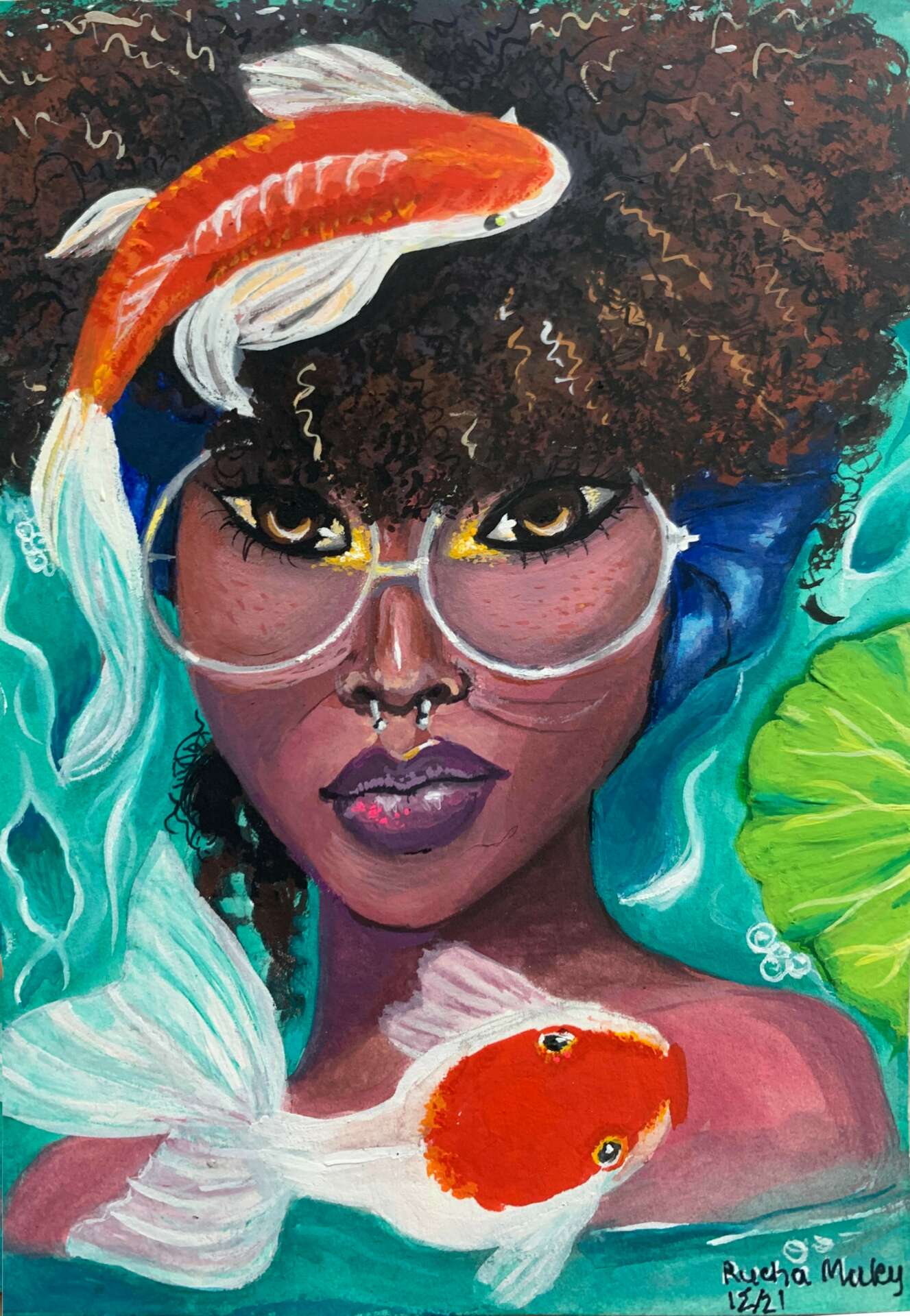
I dabble in many art forms. I love dancing and have taken lessons for hip-hop as well as lindy hop. I am teaching myself to sew clothes and sculpt clay pots. I love painting, whether with gouache colors or on my iPad. I want everyone to try their hand at some art form. Making art scratches that productivity itch without burdening us with deadlines. There is so much joy in making art for no reason at all!
What’s the most rewarding aspect of being a creative in your experience?
Working in the game dev industry means staying in touch with your inner child. The process of making any art has an innocence about it. Sure, I do it for the money and possibly for a bit of glory. But when I am working on my craft, I just want to make something beautiful. I want to tell a story. I want to evoke a reaction. I think that goes for most artists. We put a lot of ourselves into our work. Which is why we artists can be a little sensitive to critiques. The most rewarding aspect of being an artist is seeing your work bring enjoyment to the consumer. Like when a new game character gets released and the players cannot stop playing it. Or when a pudgy character with some jiggle in his tummy brings laughter to the viewers. Something that was created by me can transport people to a unique and adventurous world. It can invoke a childlike wonder and excitement in people. That thought makes me smile wide!


How can we best help foster a strong, supportive environment for artists and creatives?
Art and society are often at odds with each other. But I like to believe that they can thrive in a symbiotic relationship. Society inspires art. Art enriches society. I cannot imagine a society devoid of songs, tales, dances, theater, and paintings. Art brings color and flavor to our routine lives. Hence, artists deserve respect. We are all guilty of looking at a piece of art and thinking, “even I could do that.” When we make such statements, we fuel the fire of discrimination against artists. We do not need to like/ appreciate every artwork that comes our way. However, we need to respect that art is a legitimate profession. It is a profession that warrants monetary compensation. We as members of society should support our local artists and buy art at fairs, markets, or galleries. I understand that buying is not always an option. We could highlight our favorite art/artists through social media. Simply watching a video about the inner workings of an art form can be an act of support. I admire workshops that teach non-artists the joy of different art forms (pottery, glass blowing, oil painting, etc.) Through these workshops, people put themselves in the artists’ shoes and can understand the skill and labor that goes into that art form. Art is an inseparable part of our everyday joys. When our society itself is involved in art in big and small ways, a thriving environment gets created for the artists.
Contact Info:
- Linkedin: https://www.linkedin.com/in/rucha-muley-a7148953
- Youtube: https://youtu.be/IVAamu1pr5w