

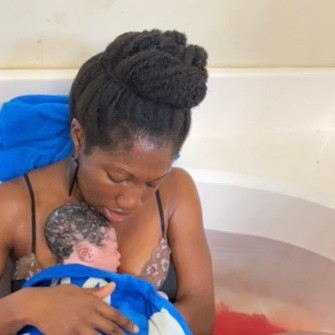

Alright – so today we’ve got the honor of introducing you to Dr. Katherine Sylvester. We think you’ll enjoy our conversation, we’ve shared it below.
Dr. Katherine, thanks for taking the time to share your story with us today We’d love to hear about the best advice you’ve ever given to a client.? (Please note this response is for education/entertainment purposes only and shouldn’t be construed as advice for the reader.)
The best advice I’ve ever given to a mom was to trust in her body’s ability to give birth.
This particular mom delivered her first baby via c-section. Following that delivery, she learned that it is possible that the c-section was unnecessary., I was consulted at the end of her second pregnancy because she wanted to deliver vaginally, and although her doctors seemed supportive for most of her pregnancy, as her pregnancy neared the end, she was subject to comments like the ones below:
“Your placenta is dead. Your body is trying to tell you that this pregnancy needs to be over.”
“Your waters are all dried up and dry births are extremely painful. I don’t recommend them.”
“We know your baby is big and you’re going to have complications. It’s best to just let us get the baby out.”
“Your baby is not responding well to the epidural (within 30 minutes of administering it) so you need to make the decision that is best for the both of you and just let us take the baby.”
“You are only three centimeters dilated even though your contractions are five minutes apart. Your body is telling you that it doesn’t want to have a vaginal delivery.”
Over the course of four days, this mom had to labor while being told the statements above by some of the people on her birthing team in the hospital. Luckily, she had all the information she needed to make informed decisions, other healthcare providers on her team who believed in her body’s ability to deliver vaginally, objective data to assure her that she and her baby were safe, and the resilience to do what she knew was best despite her immediate environment.
She delivered a healthy, average-sized baby vaginally with no complications. Following her delivery, she went on to say she was happy to not have been robbed of the experience of a natural delivery a second time. Because bleeding too much following delivery is one of the top reasons women die following delivery and women bleed twice as much during c-section deliveries as they do during vaginal ones, ensuring that women only have c-sections when they are necessary is extremely important to me.


Great, appreciate you sharing that with us. Before we ask you to share more of your insights, can you take a moment to introduce yourself and how you got to where you are today to our readers?
I am a wife, physical therapist, VBAC-certified doula and mother of two. After the birth of my second child, I experienced a life-threatening complication of pregnancy called postpartum preeclampsia. It was my midwife’s knowledge and use of my blood pressure norms that allowed her to detect it. My blood pressure is normally 100/60 mmHg and when it increased to 128/78, she immediately investigated further.
The OB who took over my care following delivery said that due to my skin color, geographical location and age, and based on people he had encountered like me in the past, he believed that I had high blood pressure pre-pregnancy, would not follow up with a primary care doctor if I had one, would never get off of blood pressure medication or have normal kidneys, and that my body was not fit to have more children. Needless to say, his assumptions could have resulted in him missing the preeclampsia had he been my doctor during my pregnancy.
Despite what he said and believed, through the use of a smart device that helped guide my sleep habits, food consumption, daily activities, exercise regimen and stress management, and with a self-selected dream team that consisted of a physical therapist, kidney doctor, MD, pharmacist, prayer warriors, family members and friends, I was off of blood pressure medicine within a couple of weeks and my kidneys healed within nine months.
Every year, 700-900 women die during delivery and an additional 50,000 experience pregnancy-related, near-death complications like the one I experienced. According to the CDC, over 60% of these deaths and complications could be avoided if early warning signs weren’t missed.
Shortly after my kidneys healed, I wrote for a grant so I could have the funds to provide the additional surveillance I knew was required to catch the early warning signs. After winning the grant, I purchased smart watches and sent them all across the country and I recruited another physical therapist by the name of Dr. Jessica Thompson to monitor pregnant women and help me bring the vision of Operation M.I.S.T. to life.
Through Operation M.I.S.T., healthcare providers daily and remotely monitor the health of women via a smart device and provide them with the team, data, resources, advocacy and education they need to have healthy pregnancies, survive delivery and recover afterwards without complications. We also help women detect issues between office visits, avoid unnecessary medical interventions, and advocate for necessary ones.
We do not give women generalized recommendations or compare them to others; instead, we learn a woman’s baseline health then watch for deviations from it. If her health data deviates from what is normal for her, an outreach is performed via text or phone call to determine if the deviation can be justified or corrected with a lifestyle modification. If it cannot, she is instructed to reach out to her birthing provider immediately so no complications are missed.
Through Operation M.I.S.T, we have helped women:
- get off of blood pressure medications
• get pregnant and detect their pregnancies early
• identify issues that could have led to miscarriage
• identify infections, preeclampsia and heart failure
• get treatment for low hemoglobin, iron, vitamin B and vitamin D levels
• manage their blood pressure to avoid premature deliveries
• recover from postpartum hemorrhage
• add vital healthcare providers to their team
• avoid unnecessary inductions and c-sections
As if the gratification of helping women in this way weren’t enough, we are constantly overwhelmed with joy as women and their families state that they feel safe, heard, seen and empowered as a result of being a part of Operation M.I.S.T.
I do not believe in assumptions, protocol-driven care or generalized interventions. I believe that women’s motherhood journeys are as unique as their fingerprints and should be treated as such. I know that women’s bodies were designed to give birth and that the creation of an internal and external environment where they and their baby can thrive is the best gift I can give them. From the bottom of her heart, I am grateful for every opportunity my team and I are given to shower women with love while empowering them to live!


Can you talk to us about how your funded your firm or practice?
To get the initial capital for Operation M.I.S.T., I wrote for and won a $5,000.00 grant. The funds were used to purchase and ship 40 smart watches to women all across the country; the monitoring of their health data was done without compensation. While supporting those moms, they began referring other women who paid for their own watches and for the monitoring services.
Somewhere along the way, it occurred to me that there would always be groups of people who would need our services, but wouldn’t be able to afford them. That realization led me to apply for other grants and to participate in pitch competitions. In doing so, Operation M.I.S.T. has received over $110,000.00 in funding to date,. and has been able to serve teen moms, moms at risk for low birth weight and women in rural communities as a result.


Do you think you’d choose a different profession or specialty if you were starting now?
If I had to go back, I would choose the physical therapy profession a thousand times over. It has brought me more joy and prepared me in more ways for where I am today than I could have ever imagined.
When I worked in the hospital, I was able to see firsthand the healing capacity of the body especially when it is challenged, fueled and supported appropriately.
Following the delivery of my first child, I became aware of the gaps that exist in the care that is delivered to women and how physical therapists could fill those gaps if we were involved before, during and after pregnancy and delivery.
After the delivery of my second child, I realized that if I paired the knowledge I had accumulated since entering physical therapy school in 2007 with the knowledge of other healthcare providers, together, we could help improve birth outcomes for women all across the world.
Furthermore, I learned how to advocate for our profession while I was a student in physical therapy school so as often as possible, I go to the Georgia State Capitol and speak at conferences to share problems, solutions and stories to improve the way maternal healthcare is delivered.
I love being a physical therapist!
Contact Info:
- Website: https://www.operationmist.org/
- Instagram: https://www.instagram.com/operationmist
- Youtube: https://www.youtube.com/@katherinesylvester1468/