


We were lucky to catch up with Scott Oglesbay recently and have shared our conversation below.
Scott, looking forward to hearing all of your stories today. We’d love to hear about how you went about setting up your own practice and if you have any advice for professionals who might be considering starting their own?
When one goes to massage school the one thing you know for certain is that, after you graduate, you will be a massage therapist. That is to say, there typically isn’t a lot of fore-thought or even schooling for that matter that goes into establishing a business. In fact, most graduates entering the workforce find themselves at the bottom of the rungs, working in spas trying to get their hands on as many people as possible to build on their experience and fine tune their sense of touch. Pleased at what I’d accomplished, I followed suit and landed a job providing massage at a local physical therapy office in Boston. It was the right place for me to start, and in the back of my mind I had two goals that kept pushing me: first was to help as many people as possible, and second—which admittedly came a bit later—was that of being my own boss. For years, both in Boston and later after I moved to Atlanta, I would see a few clients a week out of my home. It was a great way to get my feet wet as an independent therapist while working part-time at another location as an employee, allowing me the time to build up confidence in myself and start calculating my way to a proper brick-and-mortar with a proper sign, living that all-American entrepreneurial dream. When the time came to try to make things official, I had no idea where to start. So, I opened my computer and with my cursor flashing on the Google search bar, I typed “How to start a massage business”. I spent hours sifting through the internet, reading articles, blocking ads, subscribing to various massage newsletters and then blocking more ads. It was tiring, seemed endless, and often left me at several roadblocks, realizing I’d skipped a step and needed to go back and do something else first. So I went all the way back to the beginning— determining who I was.
In 2018, I took my first big step and created my business name, Scott Doss Wellness, and secured it by filing an LLC with the Georgia Secretary of State. What next, though? I’d compiled quite a random list of tasks through my research on starting a business that, until you’re branching out on your own, you don’t realize you need to do. For example, you will need to hire a lawyer to help compose your organizations operating agreement for your LLC, and a Federal Tax ID or Employee Identification Number (EIN), both of which you will need to get a dedicated bank account for your business. (Yes, keep your personal bank separate from your business!) You’ll need a booking calendar or platform for your clients, and a website to make your services are bookable, plus social media profiles on various platforms in order to market yourself. This sounds like a lot, and there’s more. In fact, there will ALWAYS be more as I’ve come to learn — that’s the nature of the beast. That said, being an entrepreneur is worth it not just because of the sense of accomplishment you get from jumping through all these hoops like a circus poodle, but also because you become a part of the community, you develop loyal clientele, and you learn how to partner with other organizations to make amazing opportunities come to life.
As the saying goes, hindsight is 20/20, and it couldn’t be more true. Lots of lessons were learned and if I could have done it differently, my biggest advice would be to lean more on my local AMTA (spell out what AMTA is) chapter, network with colleagues, and find a mentor. It can be a lonely road when you go it alone, and it doesn’t have to be. Mentorships are precious and can really apply in all avenues of life. It was during the brainstorming phase of starting my second business, The Bodyhood, LLC, that I was fortunate to have been selected as a member of the 2021 Emory Goizueta Small Business accelerator program called Start:ME. This program laid it all out in a 15-week program and paired us with mentors and peers to set us up for success. All I can say is, wow, if you’re thinking of starting your own business, try looking locally for an equivalent small business program.
We started with drafting up a business plan, which was always something I’d wanted to do, but didn’t know how. They made it simple by asking 2 questions in each of following four categories:
Who are you (why does your business exist [mission/purpose] and what makes it unique)
What do you sell (what problem does is solve for the customer)
Who do you sell to (age range, where they live, etc, as well as how do they learn about the business)
How much money you need to start and what you project to earn by the end of the year
Answering these questions really helped me nail down specific qualitative and quantitative information to better understand the main components of me and my business. The next step was to flesh out the details, drill deeper to add as much detailed information to each section until I had a business plan. If you’re still hesitant with this step, the biggest advice I can give on getting over the hump to tackling a business plan is to not worry about perfection. It is meant to be a living, breathing document that will forever be in progress as your business shapes itself and faces new and different challenges over time.
One other great piece of advice I can offer is to take your time to build up the items you need to start your business. It took me 1.5 years to finally find my brick and mortar location and open the doors. During that time, every time a sale would come around I would take advantage of the discounts. Black Friday through Cyber Monday? I bought bits of furniture, air purifiers, vibration guns. Back-to-school sale? I bought a printer and paper. I didn’t have a lot of money to start, so this made the most sense for me so I wouldn’t have to get a loan. All I needed was a LOT of closet space until I finally found my forever home for my business.
Starting a new business can be a stressful venture, so set aside dedicated time for self-care. Invest in bath salts, a couple massages a month, meditation services, or whatever you need to keep your headspace clear and focused when it needs to be. And if you need help, don’t be afraid to ask. Aside from mentors and colleagues, there are professional organizations out there like the Massage Mentor Institute, who’s main drive it to support massage therapists at any point along the road in their business journey.


Awesome – so before we get into the rest of our questions, can you briefly introduce yourself to our readers.
After I graduated massage school, I spent many years providing spa-like massages for my clients who enjoyed the break from reality, slipping into a twilight moment of serenity, away from life, work, or whatever. There were times, though, to be honest, that despite my best intentions, I had a couple clients who experienced more pain after a session with me. I didn’t think this could be possible. This really hurt my heart cause I was doing the techniques I was taught and applying my craft to what I thought was the best of my ability. This was when I realized the limitations of relaxation massage and began to ask ‘why’ — seeking out the principals, which are few, rather than the methods, which, in the massage world, are many. One can get lost in the world of continuing education where there are options to incorporate bamboo, hot stones, cupping, energy, lights, color, smells, hot/cold water, or even to massage a client with your feet! While all of them hold value and have their own unique benefits, pairing the right technique with a certain issue takes experience, skill, and most importantly the ability to assess — just knowing the technique isnt enough. One needs to understand deeply the reason you are applying the technique, and to do that, you need to know the body.
The continuing education class that jump-started me into my career as an injury and sports massage specialist is Myoskeletal Alignment Therapy (MAT). For those not familiar with MAT, it’s the brainchild of Erik Dalton Ph.D, who is the founder of the Freedom From Pain Institute. His techniques were developed with the main goal of leveling the head and the pelvis, bringing balance to the body to reduce pain caused by injury and common compensatory patterns. Under Erik, and Paul Kelly, his senior educator at the time, I would take everything I learned and immediately incorporate it into my practice. Client responses to the techniques were immediate and highly favored, which encouraged me to continue to attend as many seminars as I could. You may think this could get boring but let me tell you, the educators were nothing short of inspirational, the attendees were all like-minded individuals who basically became family, and with regular exposure to the lecture content, I began to see beyond the technique. It’s funny, though, that the more I learn, the more I realize we just don’t know!
Through certifications in other modalities like Physiokinetix (PKT) movement therapy and Neurokinetic Therapy (NKT) for its muscle testing component, I get to see things from a different perspective. The layers of education I get from various instructors helps fill in gaps in my mind, or maybe explains something I missed in another class. To further bolster my education, I am currently dedicating my time to earning a diploma in Osteopathic Manual Therapy, which has been a great challenge. It’s definitely a lot, but the byproduct of all this, and what brings me the most joy, is that it all helps me hone in to the main issue for each client with greater skill and finesse.
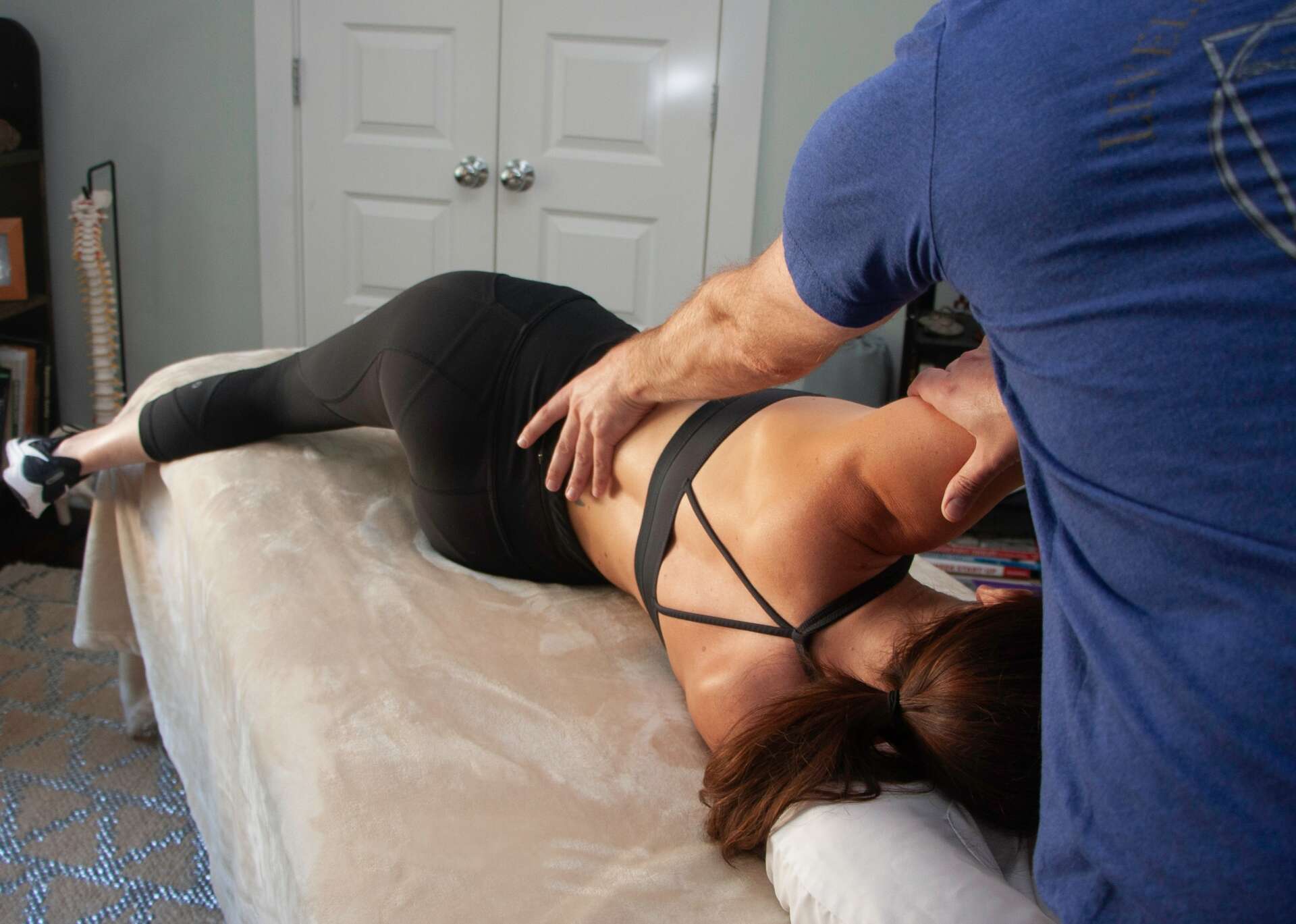
A session with me now looks like this. I follow an Osteopathic approach by starting each session with an assessment of the body in gravity, looking for postural imbalances. Then we move on the table to see how the body performs under continued postural assessment, palpation and passive range of motion and muscle tests. I take all that information in account as I, quite literally, hand-craft the most efficient session to provide pain relief and restore lost movement patterns. This is accomplished through about 45 minutes of manual therapy, with active participation on the part of the client and 15 minutes of movement therapy to get the client back into gravity to check the work and fine tune any areas of discomfort. While client expectations can be high for that quick fix, my experience has told me that it can and will likely take some time if a pain pattern has persisted for months, or even years. To keep clients moving in that positive trajectory for pain-free movement, I share movements or tools they can use at home on their own.
As a licensed massage therapist of over 15 years, I’m proud to say that my business, Scott Doss Wellness, has been in business for 5 years now. I’ve been voted Best in Georgia for massage therapy three years in a row and have grown to two offices in Atlanta, Georgia; one in located within The Bodyhood at 125 E Trinity Place, Decatur and the other at the Saul Office of Chiropractic, 6667 Vernon Woods Drive, Sandy Springs. You can learn more about my practice or book a session at ScottDossWellness.com. Or if you’re a therapist who is looking for a place to work, my co-working business for therapists in Decatur, called The Bodyhood, has some room available. To learn more about or book with any of the therapists operating out of the Bodyhood, visit us at TheBodyhood.com


How about pivoting – can you share the story of a time you’ve had to pivot?
It’s funny how we create barriers sometimes, resisting change, yet when the time comes to sink or swim, we choose to fly instead. This is how I felt when I was facing one of the biggest crises in my life. I had been working for a travel company for 14 years when all of the sudden, I became redundant and was laid off. You could imagine the shock and hurt that comes with a forced and quite dramatic shift away from everything you know. I think I fell into the same mould that most people do in corporate America; the pay and benefits definitely outweighed my own happiness — the stress factor was real. In fact, that’s why 8 years prior to my departure, I had started massage school to set myself up for a smooth exit out of the rat race. I just never had the guts to pull the trigger, that is until I didn’t have the choice. By the time my departure came in late 2016, I had about 6 years of mild, part-time experience in massage. Writing this article today, looking back, I can’t believe I waited all that time before taking the reins to my own life. It had always taken a back seat to my corporate role, yet it was there in my back pocket the whole time.
It took me about 2-3 months of decompression to process the shock of what had happened. During that time, with my future in limbo, I got the rare opportunity to ask myself “what do I want to do with my life”. What a gift to be able to have a moment in your adult life to sit back, take a look around and re-engage in the direction you want to go. Naturally, the decision was pretty simple once I was able to shift away from worry and what-if’s to deciding where I wanted to go from here. I had already laid the foundation for my future so all I had to do was take the first step toward making my own decisions about where and how I wanted to work from that point on.
The rest is history, as they say. I started working for Delta as their lead therapist part-time while I built up my own clientele at my home office, where I eventually launched Scott Doss Wellness in 2018. My advise to anyone out there is that you should always believe in yourself and do what makes you happy. I was “lucky” that I was pushed into making this life altering decision to completely change careers, and still count my blessings today that I get to do what I love and have a passion that continues to drive me deeper into advancing my knowledge and career.
Putting training and knowledge aside, what else do you think really matters in terms of succeeding in your field?
It goes without saying that to be successful, you must always be working to hone your skill. Regularly attending continuing education classes that challenge you, or present you with new science or knowledge are absolutely the best way to grow yourself and your business — and I can assure you that this has been a regular practice of mine. Attending 5-6 seminars per year, there is always something I walk away with that I’m able to incorporate into my life or work. The one thing that I didn’t know that was missing, was having and working with colleagues.
Being a massage therapist can be quite an isolating career, but it doesn’t have to be. If you’re an independent therapist, working for yourself, working by yourself, there is no one who can help hold you up, make you accountable to being your best you. For years, I felt the isolation of just doing the work, making money, studying alone, and wash, rinse, repeating. There can be self-fulfillment, but in this work/life balance, it’s harder to lift yourself up when you’re down, there is no benefit of shared advice or lessons’ learned, and you don’t get to share in the excitement of your successes. Having a spouse or partner is one thing, but they can’t compete with the power of having a colleague in the field.
When covid hit, and I was really feeling the pits of isolation, I realized by working alone I was missing out on all these untapped benefits! That was when I started reaching out, hosting zoom interviews with other therapists around town, talking one-on-one about successes, downfalls, technique differences and similarities. It was awesome. There’s nothing like sharing the success story of a difficult issue you helped a client overcome. And when you have tried everything but can’t figure out how best to help someone, it pays to have a colleague who can either share recommendations on what to try next or to whom you can simply refer your client.
I have several close colleagues now, and an even greater network of other respected colleagues with whom I get excited to talk to about advancements in various modalities and even seek out higher education. Talk about win-win-win situations, they’ve opened my eyes to other ways of learning when I’ve gotten stuck on something and shared different perspectives, making learning all the more enjoyable, which helps me to be better at helping my clients.
Contact Info:
- Website: www.scottdosswellness.com
- Instagram: https://www.instagram.com/scottdosswellness/
- Facebook: https://www.facebook.com/ScottDossWellness
- Linkedin: https://www.linkedin.com/in/scott-oglesbay-969026b/
- Yelp: https://www.yelp.com/biz/scott-doss-wellness-atlanta
Image Credits
Head Shot – Bonnie J Heath Photography All Other Shots – Sarah Clarke