

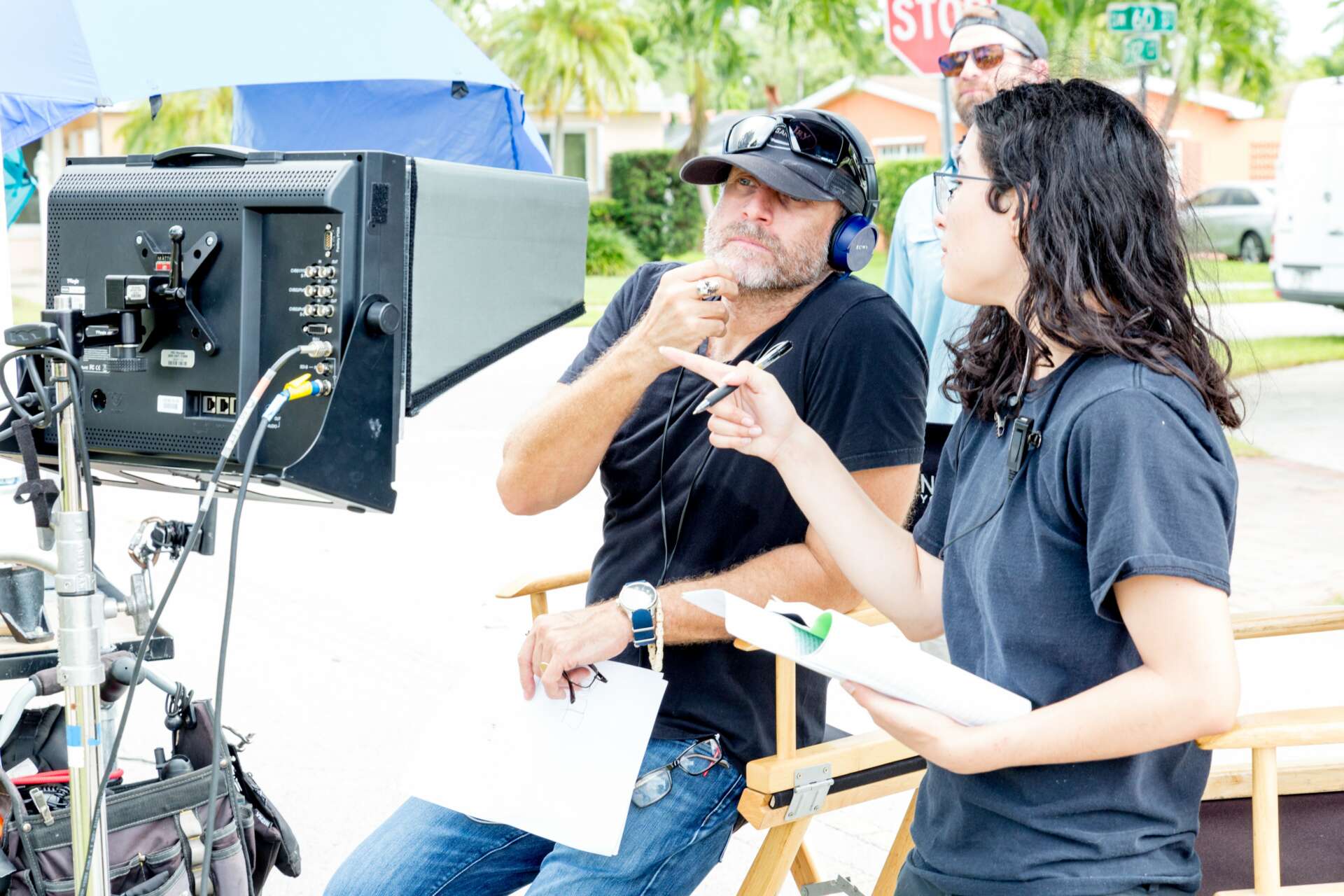

We were lucky to catch up with Damian Fitzsimmons recently and have shared our conversation below.
Damian, thanks for taking the time to share your stories with us today Have you been able to earn a full-time living from your creative work? If so, can you walk us through your journey and how you made it happen? Was it like that from day one? If not, what were some of the major steps and milestones and do you think you could have sped up the process somehow knowing what you know now?
I didn’t realize I was a “creative” until I was in my early twenties although obviously, looking back, I’d been a creative my whole life. When I eventually decided that I wanted to be a filmmaker, I really didn’t think about the financial aspect of it. I guess partly because I was young and naive. I assumed I would figure that stuff out later, which is exactly what happened.
So, it went something like this. I decided I wanted to be a filmmaker having started out as a mix-media artist. I had no money for film school, so I moved to New York City in the Summer of 1993. Back then, there were 40 feature films being shot in NYC every summer. There wasn’t enough crew for all of the productions so I ended up PAing and then became a grip on a low budget production. They desperately needed crew and were more than happy to sacrifice my inexperience for my hard work. I was a grip for three years and loved every minute of it. I got paid to be on set, and huffing sandbags was close enough to the action for me to feel like I was being creative.
Circumstances took me back to the UK and through a couple of lucky breaks, I ended up writing for the BBC. This is really where I began my career as a full-time creative. I had a literary agent, won awards, saw my stuff on TV. It was amazing. I would have quite possibly stayed as a writer for the BBC, if I had taken things more seriously. I took my success for granted and didn’t really plan. Four years later, my career stalled and not knowing what to do, I moved back to the US.
After a couple of years of working sh*tty jobs, I decided to start my own production company, BRAVEMAN Media. By this point, I knew how to write, I had some filmmaking experience and had directed a couple of short films. How hard could it be, right? I was fortunate that my new venture coincided with the release of the Canon 5D, which I consider the beginning of the digital video revolution. We worked hard, took any job that came our way; weddings, bar mitzvahs, you name it; threw all of our money into the productions and slowly made a name for ourselves.
A big mistake that many artists and entrepreneurs make is forgetting or not realizing that they run/own a business. I know how to make films. I had to learn how to run a business. Reading Michael E. Gerber’s The E-Myth would be my recommendation. It’s not my favorite book on business, but it’s a great start.


Damian, love having you share your insights with us. Before we ask you more questions, maybe you can take a moment to introduce yourself to our readers who might have missed our earlier conversations?
I’m the Creative Director and co-owner of BRAVEMAN Media. We are a film and animation studio specializing in visual storytelling and immersive video experiences. We are a team of filmmakers – we focus on what we know – filmmaking. All of our team have had experience on large productions – feature films, TV shows and National Commercials. It’s not a prerequisite, but it helps. We have one award winning feature film, ACROSS THE RAILS, under our belt, two seasons of a TV Show, LIFE’S REWARDS, on Amazon Prime, literally hundreds of commercials, training videos, and hours of 2D and 3D animations. The through line for all of our productions, whether it’s a long form narrative or a 2D animation explaining polymer laminate technology, is our focus on storytelling.
Ultimately, when I think of our achievements, what I’m most proud of is my team. My team just produced a 2.5D animation for a new product for a roofing manufacturer – I f*cking love it. I’m proud of how they tackled a seemingly boring product explainer and made it engaging. Our first feature, ACROSS THE RAILS, was one of the hardest things we have ever done. My Head of Production, Ian LaQua, and I worked 7 days a week at least 12 hours a day for 10 weeks of pre-production; three weeks of filming production and close to a thousand hours in post production. Our Cinematographer, who won an Emmy Award for the Handmaid’s Tale on Hulu, Colin Watkinson, took time out of his already busy schedule and suffered through the heat of the South Florida summer to produce a truly beautiful looking feature film. I’m really proud of the finished product and winning a few awards down the road doesn’t hurt.
The TV show we did, LIFE’S REWARDS, was also a great experience. Shooting one season was amazing but shooting the second season was even more rewarding – I loved being able to take all the lessons I learnt from Season 1 and apply them to the second season. Working with the same team was also a delight, building strong relationships with your collaborators is huge – especially on longer projects.
Recently, we have been concentrating on shorter forms; commercials, music videos, as well as some online courses. The reasons are twofold – the money is better (lol) but more importantly we are in the beginning stages of raising funds for our second feature film.
I started BRAVEMAN as I was tired of being a starving artist. I hoped that it would be a way to keep a roof over my head and allow me to develop as a filmmaker – it’s great to see how we have progressed and I’m really excited to see how this plays out in the next couple of years.


How can we best help foster a strong, supportive environment for artists and creatives?
Forums like this are invaluable. But I think it’s important to remember, society doesn’t owe you sh*t.
Joseph Campbell likened the role of the artist/creative to that of the Shaman in tribal societies. Often the Shaman sits on the edge of the tribe looking in – they observe and then offer their perspective. I think it’s true for creatives – we observe. If you don’t like being the person in the corner at a party you’re probably better at parties than I am, but that kind of behavior has served me as an artist. The best artists, in my opinion, simply hold up a mirror for society to observe itself. If they learn something – great. If they don’t – they don’t. No-one likes preachy. Society isn’t there to support artists; artists are there to support society. That being said, I believe in giving back. I volunteer once a week (schedule permitting) at the Milagro Center in Delray Beach, an after school program for underprivileged kids where I teach storytelling and filmmaking.
Find your tribe. Hang out with other artists – musicians, painters, poets. Hang out with people outside of your immediate circle. SHARE. SHARE. SHARE. Share your work, share other people’s work. People aren’t going to steal your ideas and if they do; well, you demonstrated that you are capable of coming up with ideas worth stealing so just come up with more. You are responsible for building your creative ecosystem – by the time society gets involved, it’s usually too late.


Are there any resources you wish you knew about earlier in your creative journey?
Yes.
ME.
The biggest resource I wish I knew about earlier in my creative journey was myself. So many creatives, including myself, have suffered or suffer from ‘imposter syndrome’. It took me a long time to be comfortable replying “I’m a filmmaker”, when asked what I did for a living. I see this a lot with younger people coming out of film school or just younger people in general. You know, the first short film I made sucked ass, but I made it and it was a film, so I should have been able to call myself a filmmaker. Words are powerful.
I think I held myself back by not being able to recognize my own talent. It didn’t matter that I won awards as a writer or that people sought me out as a director. For me it was a two part process – being comfortable with calling myself a filmmaker and then recognizing that my work was actually pretty good.
If you don’t believe in yourself, no-one else will. There’s also a fine line there, because I don’t think anyone comes out of the gate doing great work – well not many anyway. So, you need to develop an internal meter, to try and assess your work. “To thine own self be true…” as the Bard says. Along with this internal meter, you need to find your inner circle, people you trust who will be honest (but not mean) with your work. This goes back to the idea of building your own creative community.
Once I started believing in myself, I started to invest in myself also – as a writer, as a filmmaker and as a human being. I rediscovered a love for learning that I have been able to apply to everything I do.
Contact Info:
-
Website: https://braveman.media/
-
Instagram: @bravemanmedia
-
Facebook: Braveman Media
-
Linkedin: BRAVEMAN Media
-
Youtube: @bravemanmedia