

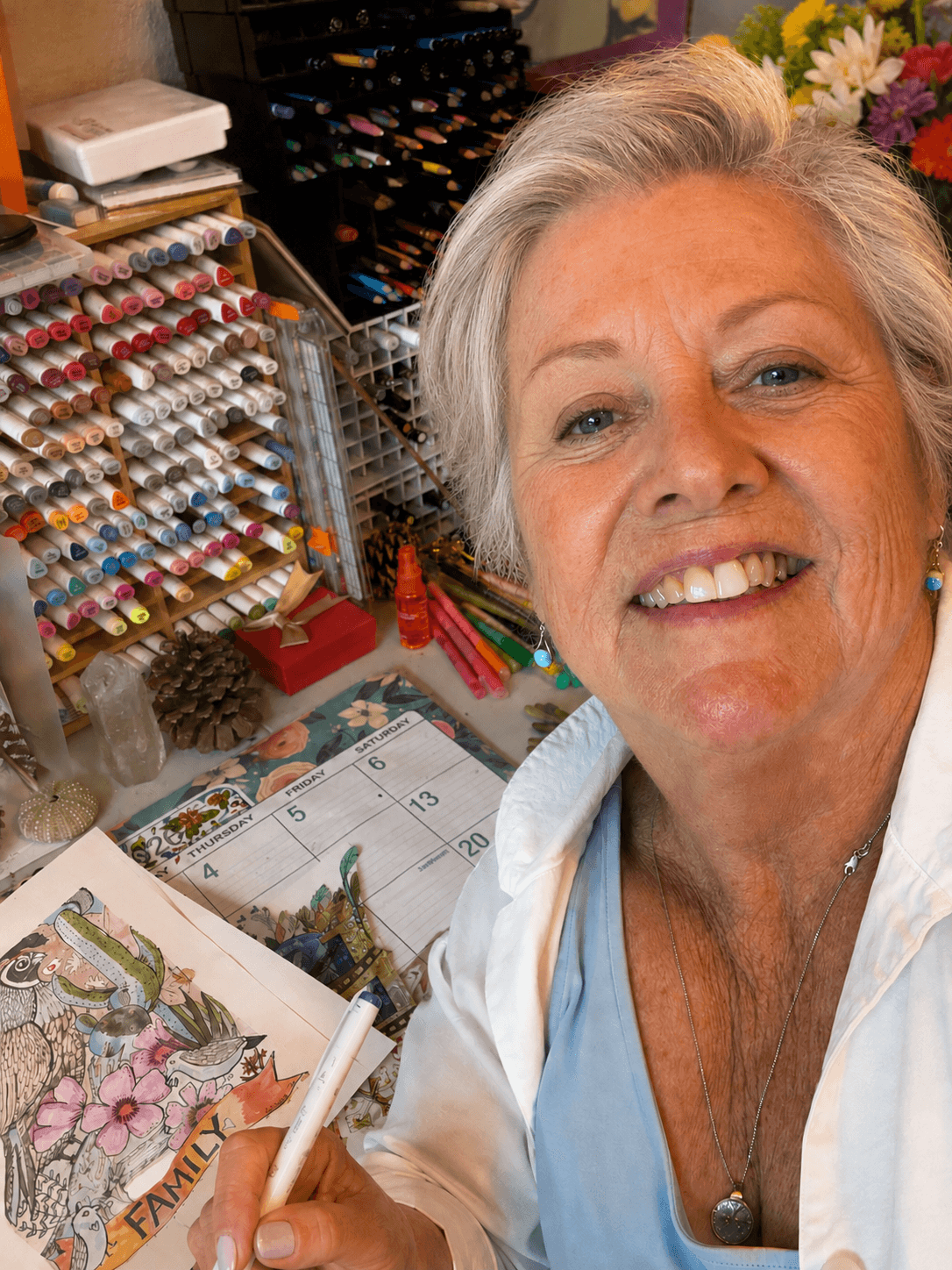

We were lucky to catch up with Beth Wonson recently and have shared our conversation below.
Beth, appreciate you joining us today. We’d love to hear about a project that you’ve worked on that’s meant a lot to you.
The most meaningful project I’ve worked on is a commission for a young girl who had lost her mom to cancer. Her grandfather reached out to me because she was struggling with the loss, and he wanted her to have something visual. A tangible connection point to her mom that she could hold on to.
He shared a few favorite things that felt like signs of her mom to her: dragonflies, manta rays, wildflowers. Small, specific, hers.
Going into a project like that, I felt the weight of it immediately. This wasn’t just a commission — it was someone’s grief, someone’s mother, someone’s way of staying connected to a person they loved. I didn’t want to create something that would just hang on a wall as another sad reminder. I wanted it to feel alive, like a presence rather than an absence.
I started the way I start every piece — with meditation, sitting quietly in front of a blank page until I’m fully present. Putting down the first mark is always the hardest part, so I ask for guidance before I draw. I couldn’t tell you exactly who or what I’m asking. But there’s a thread I feel, almost like it runs from my heart out into something larger, and when I ask, something comes back. It’s not linear or verbal in any clean sense — it arrives more as feeling, and often through color.
While I was working on this piece, something different happened. I started receiving words — not for me, but for her, the daughter. They came in fragments as I painted, and I scribbled them down as fast as they surfaced. Some of them didn’t make complete sense to me in the moment, but I could feel their weight, and I knew they belonged to her.
When the piece was finished, I sent the words to her grandfather in the form of a letter. I suggested that he read it first, before deciding whether to share it with his granddaughter. I wanted him to be the one to judge what felt right for her to receive.
He did, and he shared it with her. Both the illustration and the letter have become something she returns to when she wants to feel close to her mom.
That project forever changed my approach to my artwork and how I think about the purpose of my art. It’s not just a piece of art people own. Often my art becomes that place someone can look to feel connected to a person they’ve lost, a dream they hope to achieve or a reminder of a behavioral change they want to make.
That’s the kind of work I now focus on — pieces that hold space for people’s most tender moments, the kind you can find more of at bethwonsoniscurious.com.

Great, appreciate you sharing that with us. Before we ask you to share more of your insights, can you take a moment to introduce yourself and how you got to where you are today to our readers.
I’ve been creating art my entire life. School report cards tell the story with accolades for artwork, polite confusion about everything else. My parents were startled when I filled my high school schedule with as many art classes as I could and let the academics slide.
I wanted to go to art school after graduation, but my working-class parents had a more practical vision for me, and I ended up in a secretarial training program instead. The skills I learned there set me up for success as a leader and manager.
But art was in my DNA, not a phase I’d outgrow. I kept creating across every medium I could get my hands on — oil painting, sketching, large-scale murals — while building an entirely different career in corporate and nonprofit leadership. Art stayed the side gig for years.
In those leadership roles, I kept noticing the same thing surface again and again: people, individually and in groups, struggled to manage their emotions, especially in conflict and moments of vulnerability. I came to believe that this inability to recognize and self-regulate emotion was quietly blocking organizations from achieving their goals, and making workplaces unhealthy for the humans inside them. That observation led me to develop Navigating Challenging Dialogue® in 2015. NCD a program focused on self-awareness, emotional self-management, and healthier ways to engage in conflict. It’s since been presented and implemented across the United States.
Somewhere in that work, the art started showing up uninvited. As I listened to people talk through difficult moments, images would arrive, and I felt compelled to capture them. One of the clearest examples: I was on a Zoom call, and instead of taking notes, I found myself doodling. I realized partway through that I was channeling a team member who had died suddenly and tragically eight months earlier. I shared the words and the image with the group on the spot. It was a powerful moment, and it told me something about what the impact of my art.
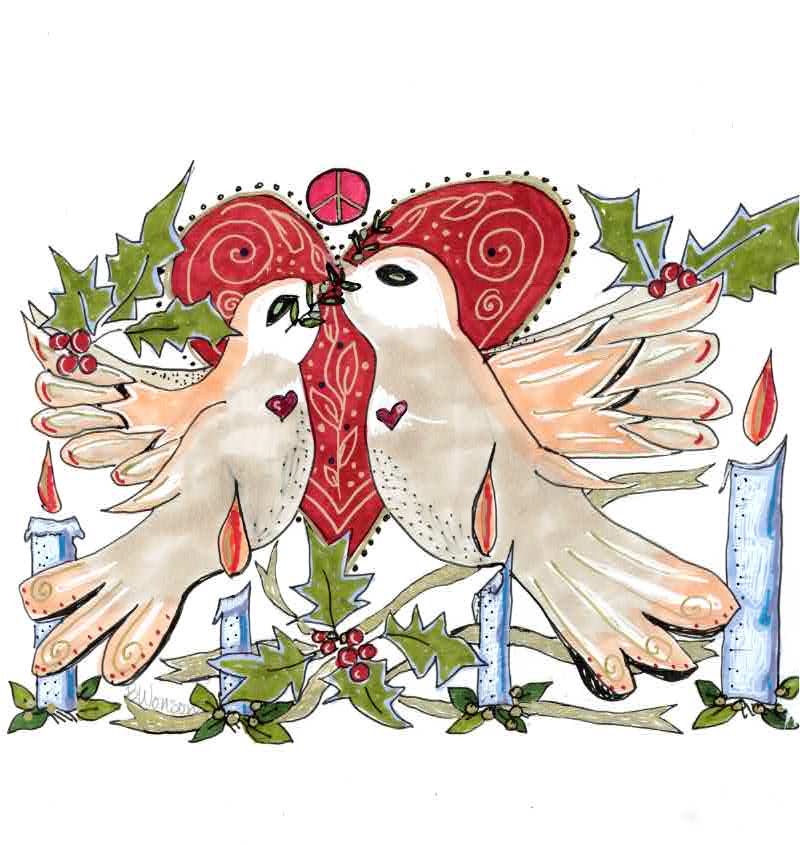
I started formally offering drawings that depict what people want and need more of in their lives as a service in the winter of 2025 through a casual social media offering. I called these “Word of the Year” cards. Each one hand drawn by me.
People sent me a word that represented whatever they wanted more of in 2026. I’d meditate on the word and the person, and draw whatever came through.
The orders came in fast, many from people I’d never met. And when the cards arrived by mail, the responses all carried the same disbelief:
“How did you know this flower is my favorite?”
“How did you know my childhood vacation spot looked like this?”
“How did you know these exact colors are comforting to me?”
“How did you know I long to live in the desert?”
I can’t fully explain how I know. I just know that I receive something, and I trust it enough to put it on paper.
The process itself centers me — it blocks out the noise and harshness of the world long enough for me to be fully present. What comes out the other side feels like my contribution to the greater good: positive energy, hope, and intention, made visible and sent back out into the world. What I want most for the people who receive these pieces is to feel loved, seen, and held by something made uniquely for them, in collaboration with their own spirit and desires. That’s been true of every piece I’ve sent.
There’s one exception worth mentioning. A client once received her piece and felt no connection to it at all — no recognition, nothing. I had to smile, because what I was sensing in that moment wasn’t curiosity, it was fear. Her future wasn’t yet aligned with where she stood in her present, and the image was likely a nudge toward to something she wasn’t ready to face.
That’s okay. I made her a second piece using the colors and images she chose herself. But I have a feeling that first card will mean something to her eventually.
My art is a conduit — for me, and for the people I make it for — to something larger than either of us. It holds the energy of dreams and hopes in a tangible form, a quiet reminder of what someone wants and needs while they’re still living in the reality of now. You can see more of this work at bethwonsoniscurious.com.
What’s a lesson you had to unlearn and what’s the backstory?
The greatest lesson I’ve had to unlearn is questioning myself. It is imperative that I trust the messages I get. To trust that when I share my art, it will be received well. And to trust that despite the thoughts in my head that may be trying to protect my ego, my art (aka my contribution) is worthy and beneficial to the greater good.
Publicly showing creations that come from your spirit, ideas, visions, and dreams is very vulnerable. The fear can be debilitating. It is for me nearly every time. But as I’ve reached my late 60’s, I realize that the time I have left to contribute through art is getting shorter every day. And so the time to be bold, to be authentic, and to offer my gifts for the greater good is NOW.
My parents always taught me to be humble. To stay small. And to be industrious. Working was how they related to the world. And that is what they wanted for my siblings and I. Productive work.
Being an artist means fighting against what my parents socialized me to believe was most important – work. It has taken me years to unwind those tapes in my brain. We are a family of entrepreneurs and I’ve had to work hard to quell my Dad’s voice in my head saying, “You’ve got to have the push, Beth. Stay ahead of other guy.”
I’ve learned that my artistic inspiration comes from the connections that I feel to the magic and complexity of nature. How many colors are in a flower. How birds beaks differ depending on what they eat and their habitat. That a single leaf from a tree can be as awesome as a the whole spread of the tree when you take time to look.
Nature Journaling (check out https://www.wildwonder.org) has helped me to break through the noise and take the time in nature that I need to sit, watch, breathe, internalize and let go of things that are outside of my locus of control.
I love Nature Journaling because it feeds my curiosity and gives me a good excuse to explore nature rather than just exist next to nature.
Pausing to examine the messages we were socialized to believe were truths (you’ve got to have the push) is one of the hardest pieces of work I’ve done. In some ways it feels disloyal to my dad. And sometimes I have an incredibly hard time not creating busy work so I feel productive when I could be resting, creating or spending time in nature. But the payoff of challenging your thoughts, exploring where they came from and if they are relevant to who you authentically are is the first step to creative freedom.

Is there mission driving your creative journey?
The outcome I most desire from this creative journey is simple to say and much harder to live I want people to discover curiosity as a tool. A tool for connection, for peace, for living in harmony with whatever circumstances or challenges they’re facing. Not curiosity as a personality trait, but as a practice. A way back to themselves when life gets loud.
I’ve learned that I can’t hand someone that practice through instruction alone. The only honest way I know to offer it is to be a living example of actually living a curious life by staying open, and letting people watch what that looks like in real time. Art has become my clearest avenue for that. Every piece I make starts with me getting quiet enough to be curious about what wants to come through, rather than deciding in advance what should.
That belief is the same one underneath Navigating Challenging Dialogue®. I love that work deeply, and I love what I’ve watched happen in the people I’ve worked with.
NCD tools give them a way into healthier, deeper relationships across the board, but especially the relationship with themselves. NCD asks people to get curious about their own emotional patterns instead of reacting from them. That shift alone changes everything downstream of it.
But I’m at a point where I feel it’s time to pass that baton. NCD has its own life now, its own momentum, and it doesn’t need me holding every piece of it. What I feel called toward is sinking fully into this creative process and the openings it creates for people. These are the kind of openings that doesn’t come through a workshop or a framework, but through a piece of art that meets someone exactly where they are and asks nothing of them except to stay curious about what they’re feeling when they look at it. That’s the mission now: less teaching curiosity, more modeling and practicing it, out loud and in color.
Contact Info:
- Website: https://www.bethwonsoniscurious.com
- Instagram: https://www.instagram.com/ncdsolution/
- Facebook: https://www.facebook.com/bethwonson
- Linkedin: https://www.facebook.com/bethwonson
- Youtube: @bethwonson
