



We’re excited to introduce you to the always interesting and insightful John Sharvin. We hope you’ll enjoy our conversation with John below.
Alright, John thanks for taking the time to share your stories and insights with us today. Are you happy as a creative professional? Do you sometimes wonder what it would be like to work for someone else?
Being a full-time artist is a struggle. There are definitely times when I wonder what it would be like to have a regular “9 to 5” desk job. That thought has come up several times throughout my career, usually when money is tight. I catch myself fantasizing about that Friday paycheck and the mythical “weekend.” When things are lean, it can seem like a pretty nice alternative.
Recently, I traveled across the country on my own dime to participate in a few exhibitions and teach a workshop. The trip was exhausting, but also really fulfilling. The class went well, and my work even sold out at one of the exhibitions. Still, it was a large investment of time, gas, and materials. That kind of experience can be a rollercoaster: the pressure leading up to the deadline, the excitement of selling work and connecting with a new community, the weight of performing, the waiting game of getting paid, and then finally feeling the payout of all that effort. The whole process can take months from start to finish. Then, somehow, I get back in line for another front-row seat.
But then I think about the life and career I’ve created for myself: the autonomy, the spontaneity, and the ability to choose the direction of my own time. When I’m at gatherings with friends or family, people often make small talk about what’s happening in their lives. When I ask what they’ve been up to, they’ll sometimes write it off as dull or boring. I don’t usually feel that way about my work. I love talking about my art and my career. I’m excited and proud of so many of the projects I get to work on, and I genuinely look forward to sharing them with other people.
There is also something really satisfying about being able to show people what I do as a visual artist. The work becomes the residue of all that effort, problem-solving, and persistence. The hard work allows me the freedom to take exciting opportunities when they arise, whether that’s a residency, a visiting artist position, or a project somewhere across the world. A 9 to 5 job and a steady paycheck might offer stability, but they can’t give me that same kind of freedom.
What I’ve learned is that the ability to dictate my own time is one of the most important things in my life. At the end of the day, I really do enjoy the struggle that comes with being an artist. It presents so many problems that need creative solutions. And if you know me, you know I love fixing things.
As always, we appreciate you sharing your insights and we’ve got a few more questions for you, but before we get to all of that can you take a minute to introduce yourself and give our readers some of your background and context?
I first experienced glassblowing in high school through my ceramics teacher. He took a small group of us to a public glass studio to make paperweights. It was really fun, but at the time I was a senior and already on track to study materials science engineering at Purdue University.
After my freshman year there, I quickly realized engineering was not for me. It felt too rigid. I wanted to explore, build, and work more directly with my hands. Naively, I thought engineering school would be more like building rocket ships, welding together robots, and working on racecars. Instead, it was spreadsheets, computer algorithms, and formulas.
And I couldn’t get that glass studio out of my head.
In 2008, I transferred to The Ohio State University to pursue art education. During a meeting with my advisor, I mentioned the glass class I had taken in high school, and she immediately signed me up for Intro to Glassblowing. The class met on Saturdays at 9 a.m., and I remember thinking, “Well, I’m definitely going to miss every class,” because I was not a morning person. But I made it to the first class on time, and afterward I went right back to my advisor and told her I wanted to change my major to a Bachelor of Fine Arts with a focus in glass. It was the most addicting thing I had ever experienced, and I was immediately hooked.
Over the past 18 years in glass, I’ve found that my strongest skills come from both the right and left sides of my brain. I am an artist and maker, but I am also a problem solver. The engineer in me never left. That has become one of the main things that sets me apart in my field. I am often brought into other artists’ projects to help figure out the logistics of their ideas and turn ambitious concepts into something that can actually be built.
For example, I worked with an artist who had a public art commission at SeaTac Airport. It was their first public art commission, and they needed support with the technical side of the project. They shared their idea with me, and I created a 3D model and rendering to help communicate the concept to the client. That digital model also gave us a way to make changes quickly, work through how the piece would hang, determine what hardware was needed, and provide drafting drawings for the structural engineers to review and approve. Once the design was finalized, we were able to employ robots to help with the manufacturing of CNC cut steel.
That is a big part of what I provide: I help bridge the gap between an idea and a finished object. I am able to think through a project from the visible design to the unseen structural components that make it work. If you could look inside my mind, you would see exploded-view diagrams, with every part pulled apart and labeled. Those hidden pieces are the framework that make the creative vision a reality.
I should also mention that a side hobby I started in 2014 has now turned into a second career. 3D modeling and CNC manufacturing have become crucial skills for me in this industry. Being able to build something digitally first allows for better communication between me and my clients. It also gives me models that I can send directly to my CNC router or mill. This saves time and money, but it also makes the work more adaptable. If a part breaks in the future, needs to be changed, or has to be recreated, I’ve already written the manual with all the detailed specs.
More recently, I started another business creating custom graphite molds for glass artists. I think it is especially helpful for my clients that I am also a glassblower. I understand the nuances of the material, the timing, the heat, and the way glass actually moves in the studio. This is where using both sides of my brain really shines.
At the core of my work, I like helping people solve problems. Whether I am making my own art, helping another artist realize a large-scale project, creating a digital model, or fabricating a custom mold, I am always thinking about how something works and how to make it better. I am proud that my career has allowed me to combine creativity, technical skill, and practical problem solving in a way that supports both my own work and the work of other artists.
Is there something you think non-creatives will struggle to understand about your journey as a creative?
As a full time creative, my work week looks very different from a lot of other careers. Some days are really fun and fulfilling. I get to create new work in the studio, play with glass, experiment, and remember exactly why I chose this path. Those are some of the best days.
Other days are mind-numbingly boring. I am also responsible for answering emails, doing business finances, filing quarterly taxes, applying for commissions, finding funding for projects, ordering materials, scheduling lessons with students, and handling all the paperwork that comes with running a business. I think that part is often overlooked by people outside of creative fields. I don’t just make artwork. I run a full on business by myself.
Then there are the dirty jobs that come with owning and maintaining a glass studio. We recently had to rebuild our glass furnace, which involved wearing a Tyvek suit and respirator for a week straight while swapping out the ceramic fiber insulation blankets around the core of the furnace. It is kind of like fiberglass insulation, but about a million times itchier and much worse for your lungs. We also have to chip out glass that has leaked from the crucible pot by hand. That means squeezing through the tiny door at the front of the furnace with your legs dangling out while awkwardly wielding a hammer and chisel inside a very tight space. It is not exactly the romantic version of being an artist.
Having to wear all of those hats also influences how I price my artwork. The price of a piece is not just a reflection of the time it took to make it. It also has to account for studio maintenance, materials, tools, healthcare, self employment tax, business expenses, and all of the hidden costs that come with being an artist. Something a lot of people may not realize is that when you buy a piece from a gallery or craft fair, there is often a commission taken from the sale. In galleries, that is most often around 50%.
I hear all the time that people imagine creatives just galivanting around the studio, playing with molten glass, daydreaming, and doing the fun parts 100% of the time. But that could not be further from the truth. The actual glassblowing is only one part of what I do. I run a business, maintain a studio, manage clients and students, write applications, keep the equipment alive, and then, somewhere in the middle of all that, I get to create work. And as for work-life balance? I’m still trying to figure out what that is.
How did you build your audience on social media?
Once upon a time, I worked a steady 9 to 5 job. The paychecks were stable, the schedule was predictable, healthcare was provided, and I had built a financial life that was sustainable.
Then my life started to feel like it was crumbling. So many things in the life I had built were not working anymore. I never felt like I had enough time to focus on my artwork, and working a full-time job made it difficult to accept travel opportunities. Around the same time, my long-term relationship fell apart and I lost several family members. All of that happened within the course of a few months. Honestly, I felt stuck.
Then an opportunity came up that felt like it might change the course of my life: reality television. It was completely off the cuff and very risky, but at that point I felt like I had nothing to lose.
The show streamed on Netflix to an international audience, and it became one of those “exposure” opportunities that actually paid off. I went from being a behind-the-scenes studio technician to being seen as a competing artist with a real story. Viewers wanted to know more about me, my work, and what I was doing with my life.
At the time, I had no idea how much the show would change things. It gave me more confidence in my art practice, introduced my work to a much larger audience, and opened doors I didn’t know how to access before. I also met my current partner on the show, which changed my life in a completely unexpected way. When the show finally aired, I suddenly had this much larger audience, and I watched my social media presence grow into what it is now.
After that, everything changed. I quit my job, moved across the country, and started a studio with my partner. That exposure gave me a spotlight, but the opportunities were not simply handed to me. I had to build from that springboard. I reached out to organizations, galleries, and other artists. I introduced myself, proposed events, followed up, and did the work of turning attention into actual opportunities.
I realize that “go on reality TV” is not practical advice for most people. But there are real lessons I took from that experience. The biggest one was confidence. That experience gave me the confidence to pursue the life I actually wanted, to make my work more seriously, and to just be myself unapologetically.
My advice to creatives building a social media presence is to believe in what you are doing and let people see the person behind the work. Share the process, share the failures, share the weird little moments that make your practice yours. Social media is not just about polished finished objects. People connect with the story, the effort, and the person behind the work.
If there is one piece of advice I would give to other creatives, it is this: if you do not believe in yourself, it is hard to expect other people to. For me, helping and supporting others always came easily. What I realized is that if I had invested even 50% of that same energy into believing in myself, I probably would have found my way much sooner.
Contact Info:
- Website: https://www.johnsharvin.com
- Instagram: https://www.instagram.com/yeahsharvin/
- Other: https://www.instagram.com/tophatglassworks/
-Studio
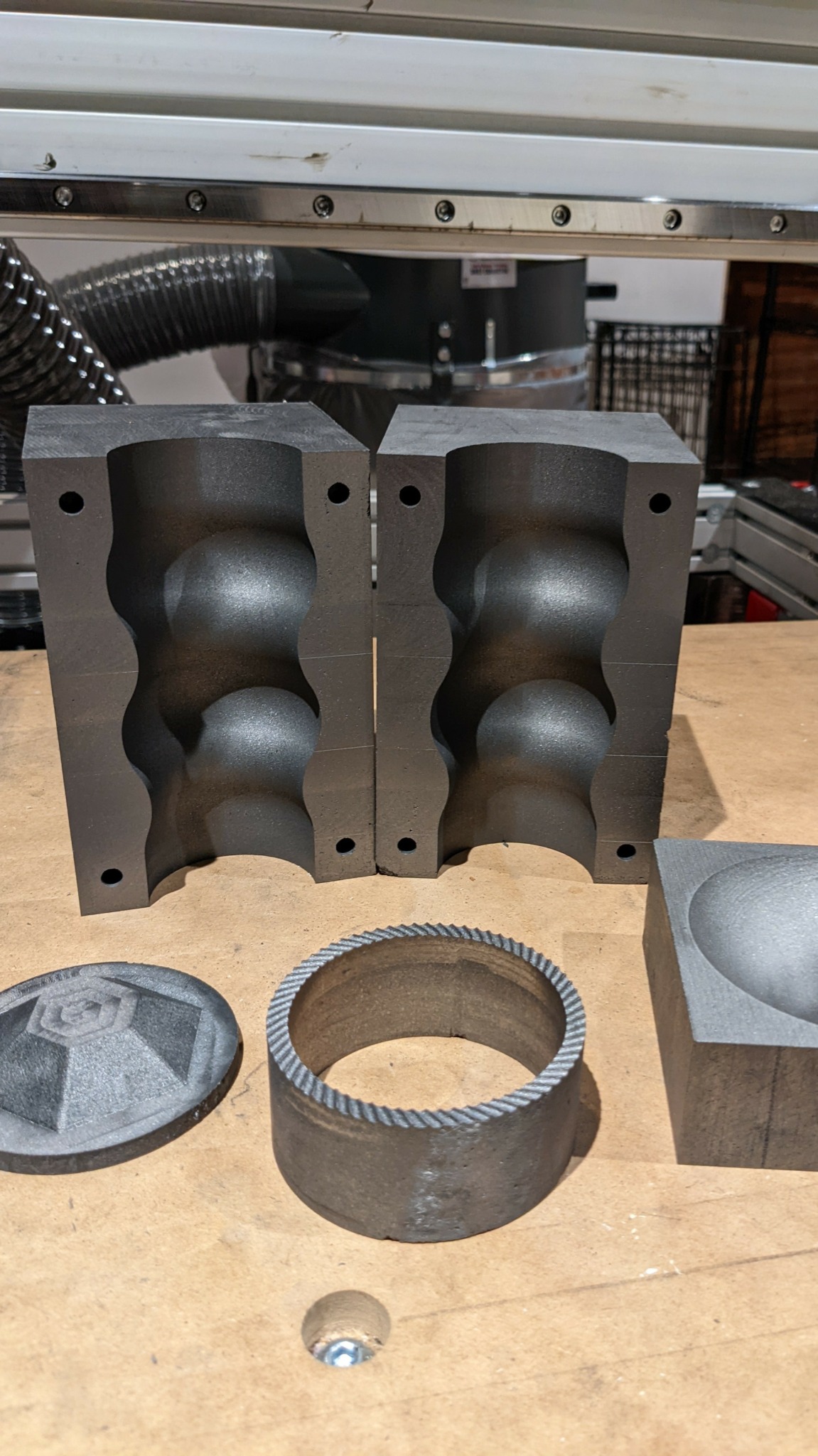
Image Credits
Navid Baraty – photo of me