


We recently connected with Robert Foster and have shared our conversation below.
Robert, thanks for taking the time to share your stories with us today We’d love to have you retell us the story behind how you came up with the idea for your business, I think our audience would really enjoy hearing the backstory.
About twelve years ago, I was running my own e-commerce businesses. I wasn’t a developer back then, but I simply couldn’t afford to pay someone to fix everything that broke. Out of necessity, I started teaching myself to code, and that ended up being the foundation for everything I do now.
As I learned more, I began to see how these stores actually worked under the hood. Whenever a problem came up, the default answer was always to just install an app. I was guilty of it myself because it made sense in the moment. However, most store owners never stop to think about the “ghost code” those apps leave behind, even after they’ve been uninstalled.
I later spent several years working in e-commerce for a company that had been around for over a century. I saw the exact same pattern there, just on a much larger scale. It was a Shopify store that had piled up apps over many years and across multiple different teams. There were scripts loading on every single page from tools that nobody even remembered using anymore.
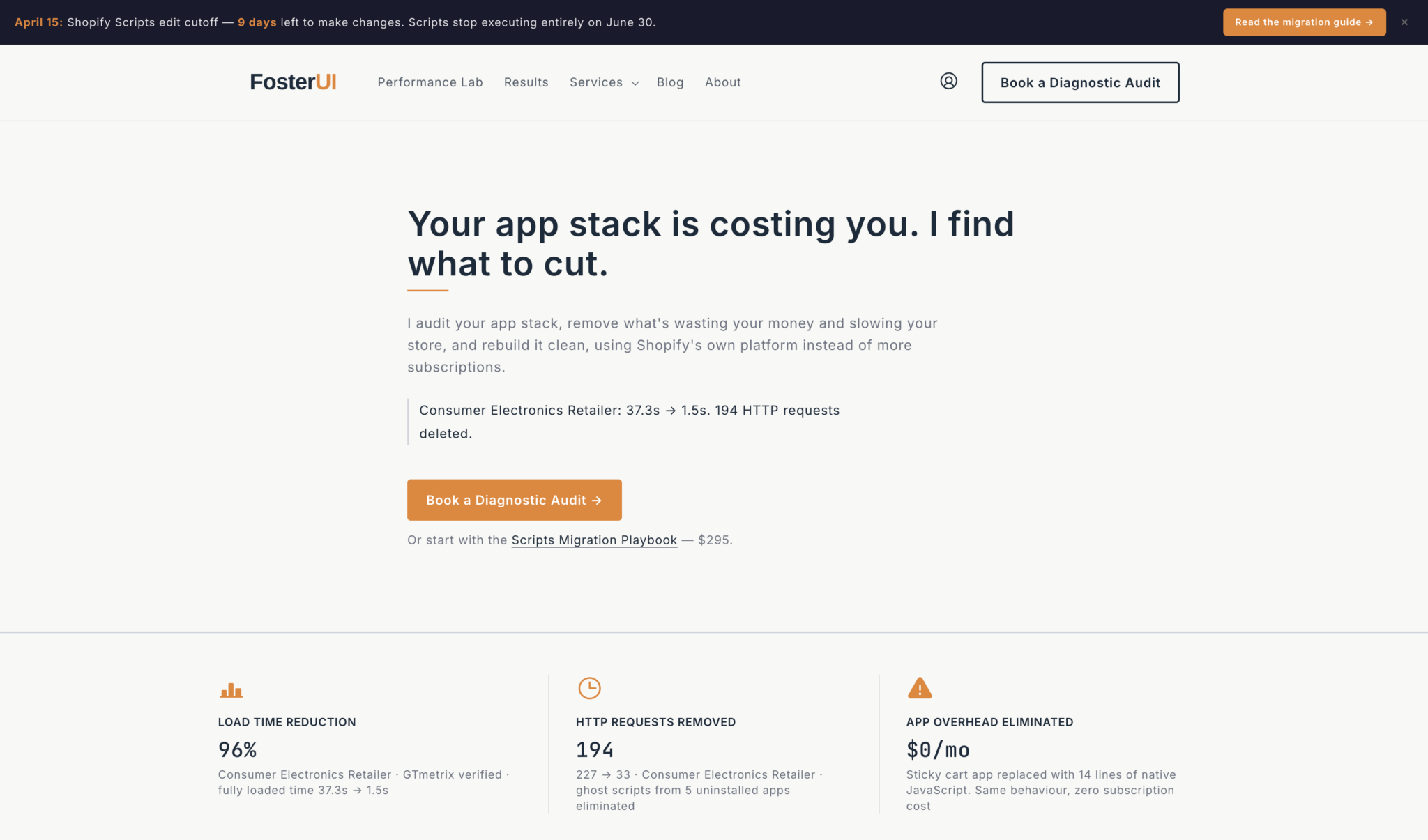
I started stripping away what didn’t belong and replacing those functions with native code. After launching FosterUI, one of my first client engagements really proved the concept. We dropped their load time by 96% and removed 194 unnecessary HTTP requests in a single pass.
That result wasn’t a fluke; it’s actually what you find almost every time you look under the surface. The idea behind FosterUI is pretty straightforward: almost every Shopify store that’s been running for a few years is weighed down by this problem. Apps solve immediate needs, but nobody cleans up the mess they leave behind. I decided to make a business out of being the person who does.

Robert, love having you share your insights with us. Before we ask you more questions, maybe you can take a moment to introduce yourself to our readers who might have missed our earlier conversations?
I’m a Shopify Plus performance consultant based in the Jacksonville area. I run FosterUI as a solo operation, which means when you hire me, you’re getting my hands on the keyboard—not a project manager, a team of juniors, or subcontractors.
The core problem I solve is what I call “app bloat” and the technical debt that piles up in Shopify stores over time. Most stores that have been running for three or more years are weighed down by apps they don’t even use anymore. The tricky part is that when you uninstall a Shopify app, it doesn’t always clean up its own mess. It leaves behind “ghost code”—scripts in the theme and tracking pixels that keep firing even though the app is gone. Over time, that creates a massive drag on load times and makes site maintenance a headache.
My process always starts with a diagnostic audit. I take a deep dive into what is actually executing in the code versus what actually needs to be there. Once we have that roadmap, I replace clunky third-party app functionality with native Shopify tools. The result is a store that is leaner, faster, and ultimately cheaper to run.
This all started about twelve years ago. I was running my own e-commerce businesses and simply couldn’t afford to hire developers every time something broke, so I taught myself to code out of necessity. That gave me a ground-level view of how easily a store can accumulate debt without the owner even noticing. Later, I worked for a brand that had been in business for over a century, and I saw those same patterns play out on a massive scale. Cleaning up that mess and seeing the immediate impact on the bottom line made it clear that this was where I could provide the most value.
What sets me apart is my focus. I don’t do general Shopify development or design. I do one thing: I find what’s slowing a store down and I remove it. Because I specialize like that, my diagnosis is faster and the results are easy to prove.
I’m most proud of the fact that my work is entirely measurable. I don’t deal in estimates or “vibes.” Every project ends with hard, documented numbers—load times, HTTP request counts, and page weight. For example, I recently worked with a consumer electronics retailer where we dropped their load time by 96% and removed 194 unnecessary HTTP requests in one pass. Seeing those results in writing is the best part of the job.
What else should we know about how you took your side hustle and scaled it up into what it is today?
It actually started about twelve years ago while I was running my own e-commerce businesses. I wasn’t really trying to build a consultancy at the time. I was just trying to keep my own stores running without having to pay someone else every time a problem popped up, so I taught myself to code out of pure necessity.
That self-taught foundation stayed with me when I eventually moved into a full-time e-commerce role at a large legacy brand. I was working inside a Shopify store every single day, but by then, I could see what was actually happening under the hood. I saw years of accumulated apps and scripts that were still firing from tools that had been uninstalled long ago, and it was dragging down performance for no obvious reason.
I just started cleaning it up because it needed to be done. When I eventually left to start FosterUI, the “side hustle” label didn’t quite fit. It was more that I had spent over a decade building the specific knowledge that the business runs on today. The learning happened while I was doing other things, and the business was just the natural next step. The biggest milestones for me were teaching myself to code, seeing those problems at scale within a major brand, and finally realizing that the problem I kept solving was something people would actually pay for full-time.
Any stories or insights that might help us understand how you’ve built such a strong reputation?
I think it comes down to being incredibly specific and publishing results with actual numbers attached. Most Shopify developers try to be generalists who can do a little bit of everything. I made a very deliberate choice to only talk about one thing: app bloat and technical debt.
I also make sure to back up every claim with documented measurements. Instead of just saying “I’ll make your store faster,” I can point to a project where load time dropped by 96% or where I removed 194 unnecessary HTTP requests in one go. Having those numbers in writing makes a huge difference. That combination of a narrow focus and verifiable results has been way more effective than trying to be everything to everyone.
The other big factor is that I work solo. The person who scopes out the project and talks to the client is the exact same person doing the actual work. That isn’t very common in this industry, and it really matters to clients who have had frustrating experiences with agencies where the senior person sells the dream and a junior developer delivers the results.
Contact Info:
- Website: https://fosterui.com
- Linkedin: https://www.linkedin.com/in/robert-fosterui/