

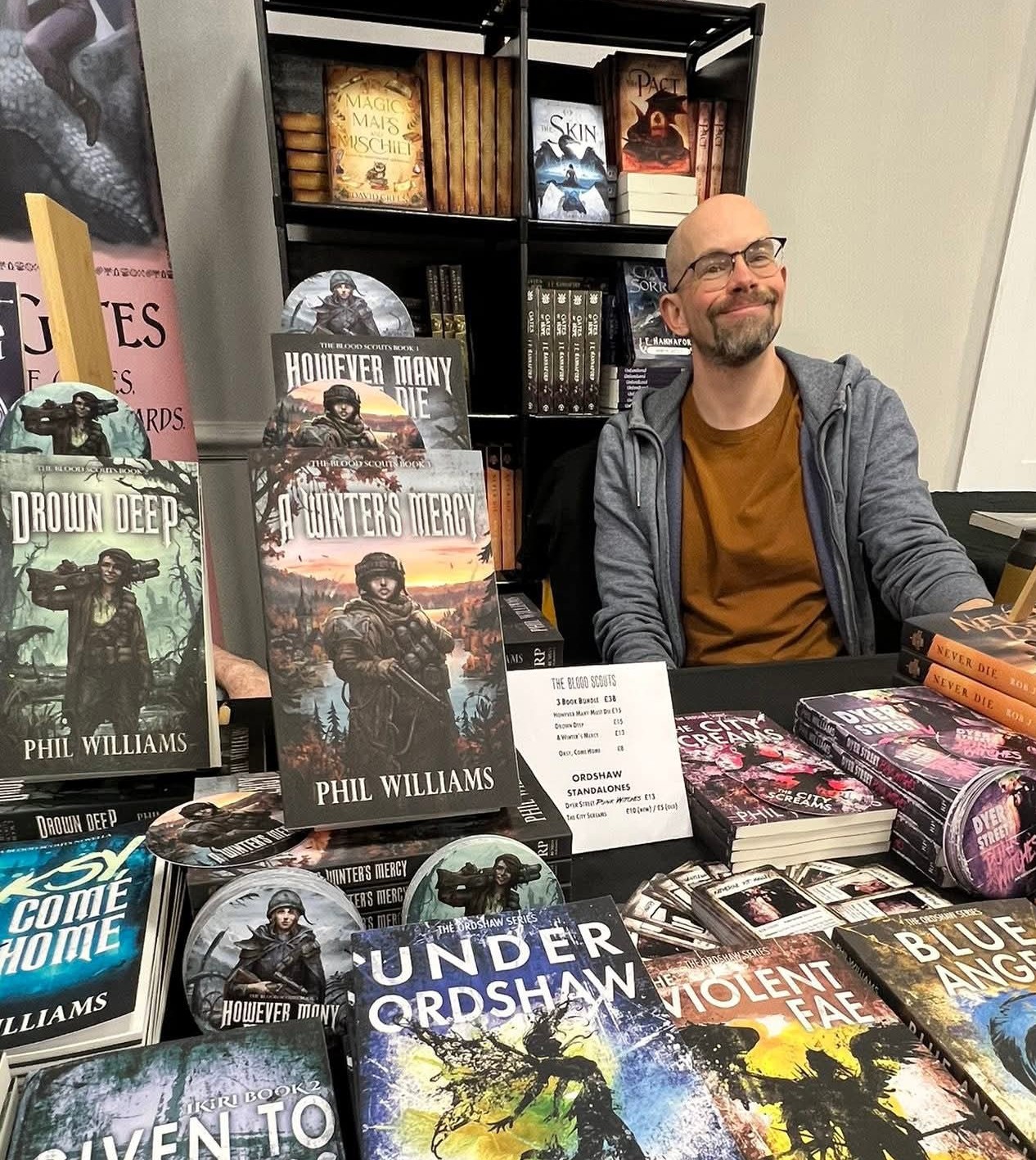

We were lucky to catch up with Phil Williams recently and have shared our conversation below.
Phil, thanks for joining us, excited to have you contributing your stories and insights. Earning a full time living from one’s creative career can be incredibly difficult. Have you been able to do so and if so, can you share some of the key parts of your journey and any important advice or lessons that might help creatives who haven’t been able to yet?
I have been able to earn a full-time living from creative work but it’s a somewhat loaded concept from the outset: in reality, the creative work itself is never really what earns the money, it’s the means or ability to sell that work you need. If you’re not a natural sales person there’s a great deal of luck involved in that, and I had a spell of luck by finding an advertising platform that worked for the right books at the right time.
I had a long journey towards making any money from creative projects: I started writing as a kid back when the only real path to publishing success was to send snail mail to an agent and a publisher and hope for the best. This made it feel like all you could do was write a book, wait months for responses, then write another book. So that’s what I did, on repeat, writing a new book every one or two years – until having written about a dozen or so novels with absolutely no interest, self-publishing started to become a thing.
Around 2012, as the industry changed, I began self-publishing my books, but wasn’t doing great with selling them. I hired a marketing firm to help with one book, and they were useless, which encouraged me to keep hammering at it myself because I knew I could do better than them. In 2016, I finally found an advertising platform that worked for me. Once I got ads working successfully, things went from strength to strength for about four years until that system started to wane, and I’ve been dipping in and out of different ways to keep making that money since.
The thing that really made a difference, at various steps along the way, was meeting the right people who put me onto different insights into the publishing and online marketing industries. This was a two-pronged thing: it was crucial to meet people who made me feel like it was viable to actually make a living from fiction, something I’d been conditioned to think of as a less than serious career path, but equally important was meeting people with more ruthless business-minded approaches to books, from different backgrounds, who helped me understand exactly what it took to sell. Also, I turned a corner getting more feedback on my books, especially from professionals I respected. So, finer specific details aside, while I’d say I absolutely wish I’d known and done a lot sooner, the main thing that was essential to moving things along was generally meeting the right people.
As always, we appreciate you sharing your insights and we’ve got a few more questions for you, but before we get to all of that can you take a minute to introduce yourself and give our readers some of your back background and context?
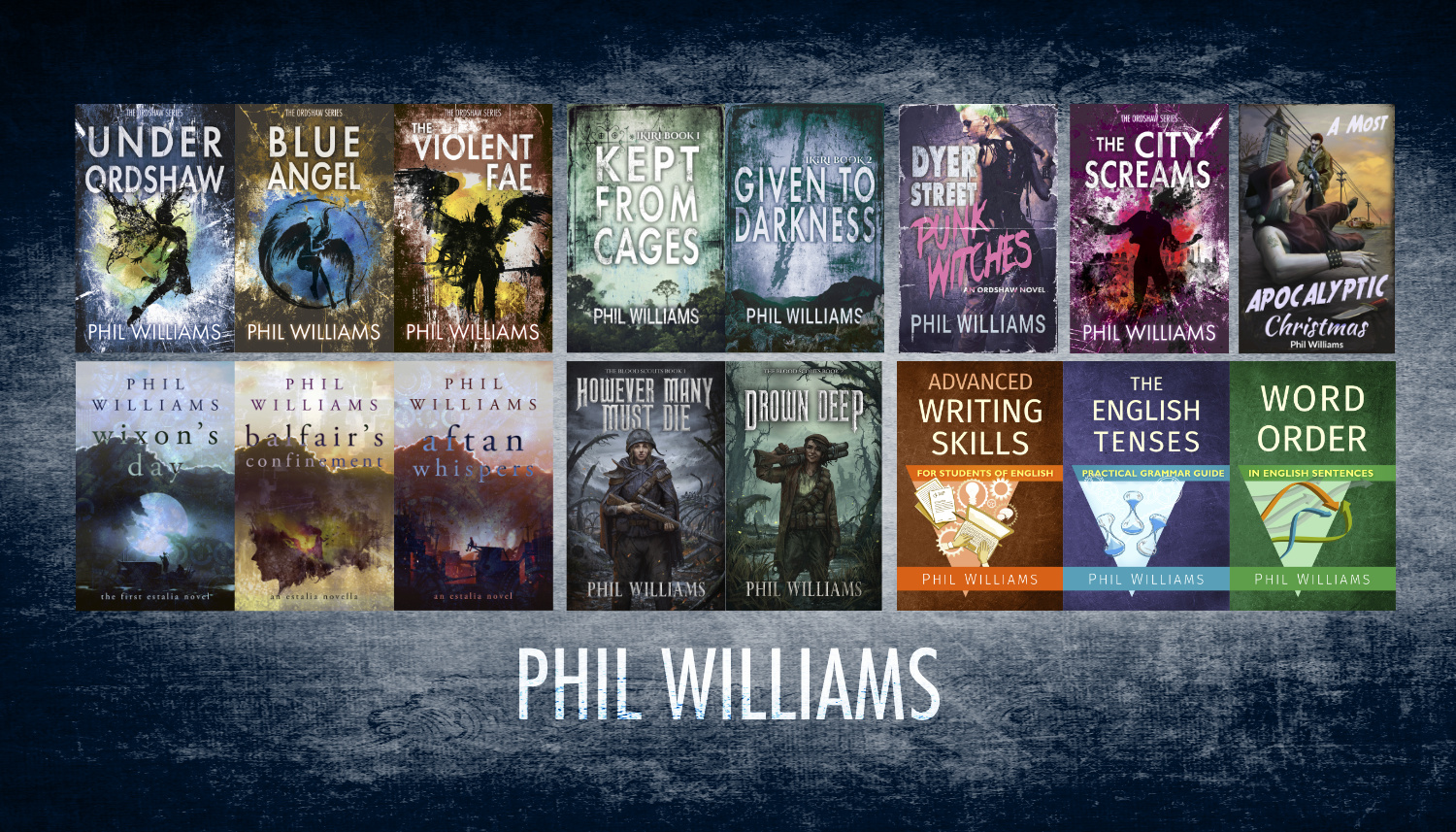
I’m a writer and editor of speculative fiction, generally specialising in dark fantasy and horror, though often with contemporary and thriller elements. I’ve so far got books out in three major series: the Ordshaw urban fantasy thrillers, the Blood Scouts epic military fantasies, with a WW1-era secondary world, and the Estalia post-apocalyptic steampunk adventures. You’d probably notice that I love to blend genres, always trying to come up with something new and unusual in my stories and worlds. This is the sort of writing I’ve always done, and always wanted to share, so it’s where my larger focus goes when I’m being creative.
This hasn’t always been easy to sell, so along the way I’ve done a lot of work in editing for other authors and writing and editing for businesses and professionals. The bulk of my early income came from selling English grammar guides, supported by a website I designed. Through a career of having to dip about and do a lot for myself I’ve also developed and at various times marketed skills in all areas of book production and web design, including cover design. These days I mostly just offer copy/line editing and developmental editing as a service for clients, though I try to give as much help as I can in the wider context of the industry – though I am now also moving increasingly towards 3D modelling and game design.
My aim in working with others is always to help them present their vision in a polished, professional and effective way, whatever that might mean for them.
What can society do to ensure an environment that’s helpful to artists and creatives?
We have quietly walked into a culture that respects wealth above all else, where everything is a commodity valued on monetary worth. To succeed as a creatives in today’s world, you have to reach enormous numbers of people, making thousands if not millions of sales to justify a piece of art. Compounding the problem is that any creative who does demonstrate monetary worth is liable to abuse from bad actors who want a piece of that for themselves, either targeting creatives with predatory business practices or ripping off their work to sell as their own. We have a society that simply doesn’t respect creative work as something that should be valued and protected in and of itself.
Artists should be able to create art without needing it to be so sensational that it might become one of the bestselling things in the world. While we have to be realistic and consider that creative work needs to satisfy some kind of market, it should not be this hard; society as a whole needs to support creatives with smaller audiences – be more willing to pay more for their art, and put in place schemes that recognise creative work can produce other results than just money. We need to stop commodifying everything and start protecting the rights of creatives, remembering how important inspiration and education are, whether that makes money or not, but most of all we have to build an atmosphere where people actually feel comfortable creating for its own sake, and not one where the only art we make is to satisfy greed. And all that, really, requires better funding, education and legislation – what we really need, unfortunately, is people in power who respect art.
What’s the most rewarding aspect of being a creative in your experience?
The most rewarding thing about being creative is connecting unusual and often abstract ideas with a relatable human element. I’m always full of ideas and itching to come up with something new and different, but the projects that work best are always the ones where I can see a way to make that new idea meaningful in a character-setting. That’s what really brings ideas to life, and it shows in responses from the audience; there’s nothing as gratifying as being told by a reader that they connected with something I wrote, and that tends to be where it’s tapped into some element of the human condition. Some shared experience, memory or dream. Likewise, when it helps people to rethink things; sometimes seeing something familiar in a strange setting is just what we need to look at it in a different light, and overcome blocks or better understand emotions.
Contact Info:
- Website: www.phil-williams.co.uk
- Instagram: https://www.instagram.com/ordshawphil/
- Other: https://bsky.app/profile/fantasticphil.bsky.social