



We’re excited to introduce you to the always interesting and insightful Ann Morgan. We hope you’ll enjoy our conversation with Ann below.
Ann, thanks for taking the time to share your stories with us today Can you talk to us about a project that’s meant a lot to you?
My painting series Once When I Was You has been an ongoing project since early 2023, when I began looking forward to shows at the Center for the Arts Crested Butte in March of this year, and at The Art Base in Basalt, CO, which opens on November 15.
Creating art is always a meaningful, intimate, expressive process for me and something I do with my entire heart – and, since I paint so large – physically, too. This series is especially meaningful as I’ve worked on it leading up to and after my fiftieth birthday. It’s a milestone number and has coincided with feelings of loss, review, hope, change – it seems I need to evaluate and examine everything leading up to this moment at once to move forward to the next phase of my life. The name of the series – Once When I Was You – references this feeling. Once when I was a college student, or a child, or working to get ahead in my career in tech, or approaching middle age, or any number of versions of myself that are in my past and in a space that others occupy now.
My work draws from images I prompt from an AI model trained on my own photos and friends’ social media images they have shared – a digital version of my memories and theirs. I treat the model as a sort of Magic Eight Ball, typing in my feelings of the day as text prompts and using the resulting images as layers in Photoshop. I either work from prints or project the digital sketches onto the canvas, often painting over existing paintings in the dark just to see what happens. I often find myself working around bizarre results to try to make a cohesive final work.
The series has followed my thoughts through this year, starting with Sleeper, a painting that encompasses two seasons visually and looks like change. The paintings that follow are emotionally charged, highly pigmented, and visually represent conflicting feelings. Many are unresolved and look like two or three paintings at once because they are – I started paintings, left my studio, and returned to turn them 90 degrees and work them into completely different final pieces.
The process and the finished paintings are representative of my changing internal world throughout the year.
The last installation of the series to be shown at The Art Base in November – so far – is a calmer iteration of the series; a retelling of my history and earliest memories. Having spent much of my year in Michigan and in my childhood home, it makes sense to revisit the earliest version of myself through my work.

Awesome – so before we get into the rest of our questions, can you briefly introduce yourself to our readers.
I was a VP at an association and very burned out by 2019 when I quit that job and instead do web development as a contractor (which I still do) and paint again. It was strange trying to figure out how to be an artist after such a long break that encompassed so much technological change – which I had been a part of from a much different angle during my previous career. Social media, especially Instagram, has changed who is an artist and how, as well as just being able to find opportunities on the internet, and all the new digital tools I have used professionally for years – each of these things changed the landscape since I had graduated with my BFA from Michigan State University.
Something that I’m always asked at my show openings is “what were you thinking when you made this painting” and no matter how prepared I am for the question, I still have issues coming up with the answer. I can tell you why I make my work – I’m compelled to create something out of nothing, whether that is a painting, a website, digital art pieces, or training an AI model. The reason art is more gratifying than any one of the number of things I make is that there isn’t a goal. No one is using it to do anything, it doesn’t accomplish a set of metrics. It just is, and singular to me wanting to make it. By the time I’m putting paint on the canvas, I’m not really thinking of anything. It’s a physical process. Making sketches the way I do – mixing results from my AI model with images and drawing in Photoshop – is more feeling my way through a piece than thinking my way through it. It would seem that using technology in the way I do is a thought-heavy process, but like many others at this point, my digital self is just another state of being and requires no specific thoughts at all.
I love that my finished work takes up so much physical space in the world. Actual objects. It’s a physical challenge to make such large work, from building the canvases – which I do on my own – to plotting how to get the images on the canvas, mixing enough paint, climbing up and down a ladder and moving them around my studio. If my work is in a room, it demands attention by sheer size. My paintings give me a louder voice to tell my story, but I want my work to demand attention from viewers in a way that allows them to bring their own story to the piece. Just recognizable to be something, but abstract enough to be anything.

For you, what’s the most rewarding aspect of being a creative?
The most rewarding and easily most daunting thing, both, about being an artist is to have a part of my life completely under my own control. This doesn’t include displaying my art, but MAKING it is all my own. It can feel like a free fall or be freeing, depending on the day.

We often hear about learning lessons – but just as important is unlearning lessons. Have you ever had to unlearn a lesson?
While I do try to look at painting as a job with set hours, whether that’s painting, preparing images to paint, studying technique or building my digital platforms – I did have to unlearn the mindset of productivity I had.
In the corporate world and of course my contract web development, I am measured by how how productive I have been. How much did I make, sell, how many clicks did it get, what kind of sales were generated directly and indirectly from my work – all of these determined my worth and unfortunately at times, my self-worth. Measurement of successful art is different. While I can try to measure success from how much work I sell or how much work I make, that isn’t what makes me a successful artist. I had to unlearn these external metrics and look internally. Visually, compositionally, is this piece successful? Does anyone else want to look at it, does it invoke emotion from others? All much harder to measure and there’s no professional title I’m working towards or bonuses to earn.
Contact Info:
- Website: https://annmorgan.art
- Instagram: https://www.instagram.com/echopod/
- Facebook: https://www.facebook.com/amjohnsonmorgan
- Linkedin: https://www.linkedin.com/in/ann-marie-morgan-1195032a/

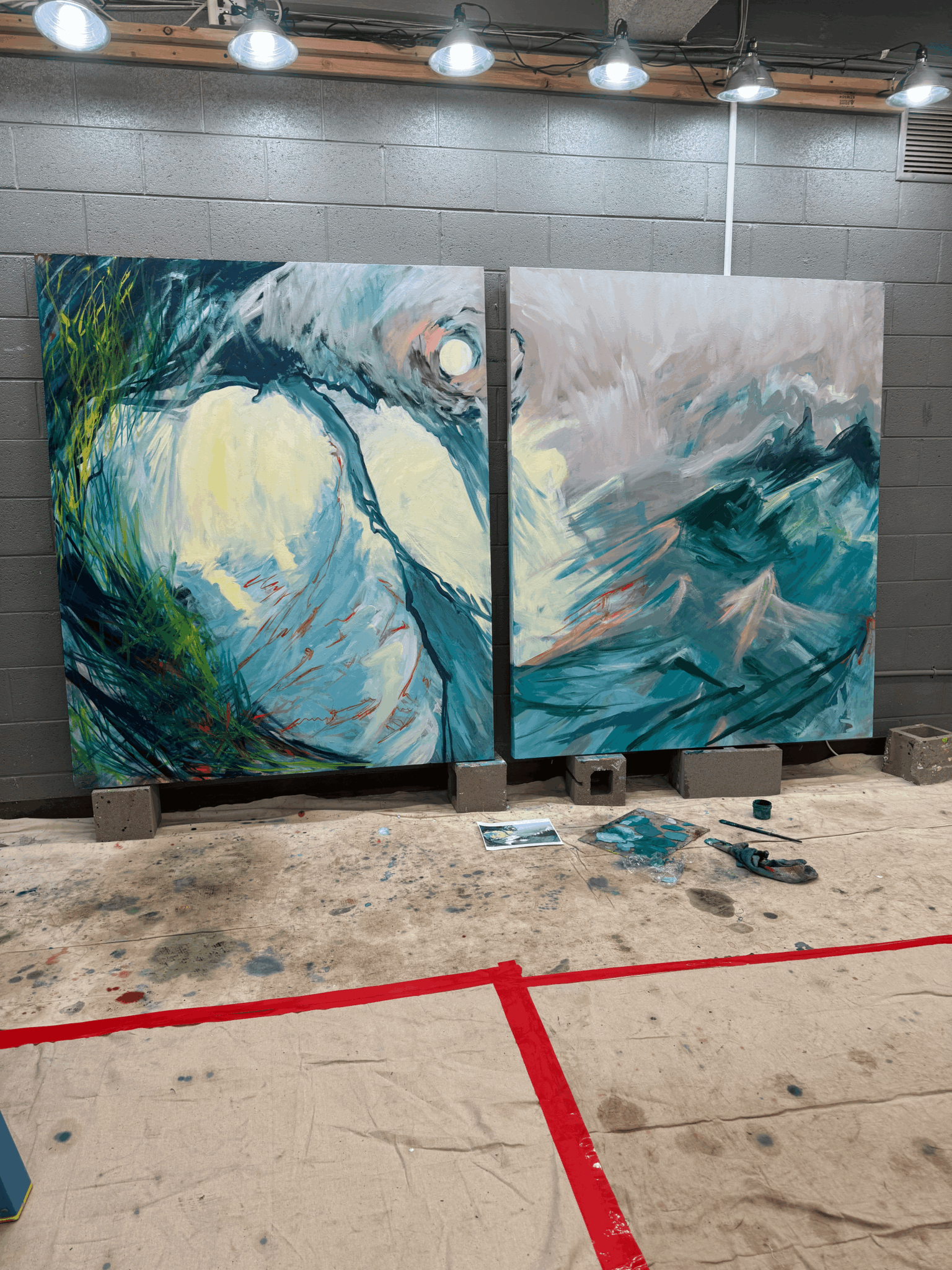

Image Credits
AMM