

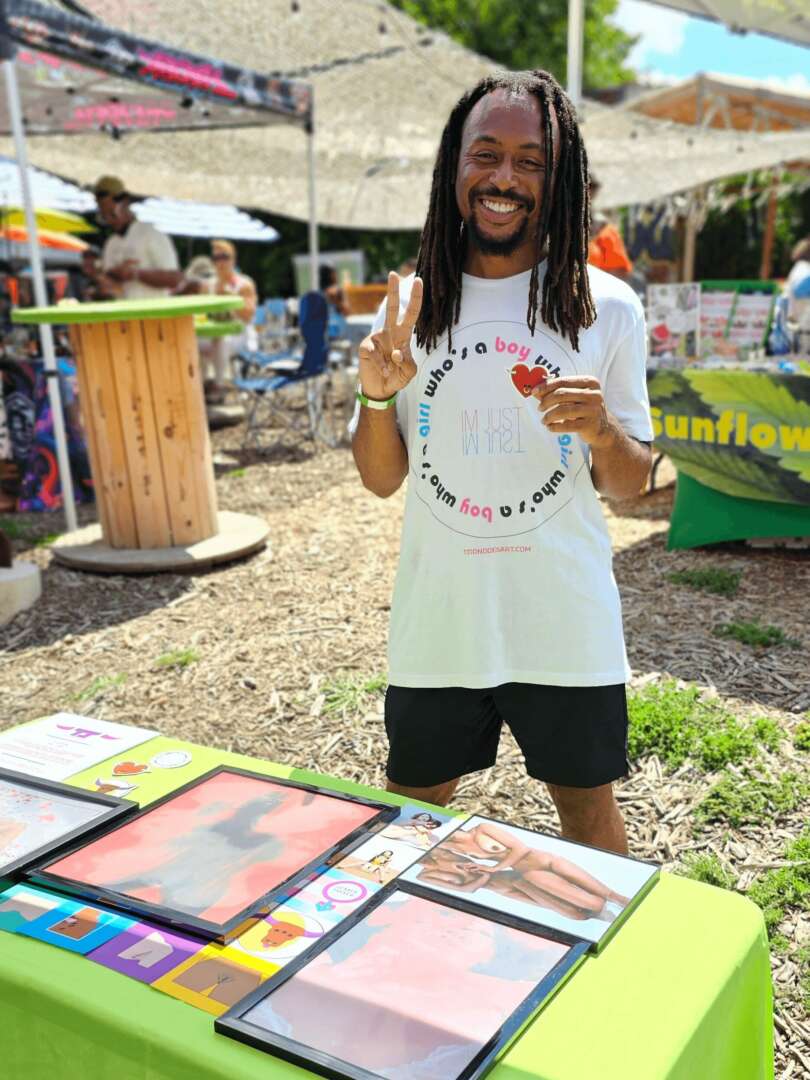

We were lucky to catch up with TJDDN recently and have shared our conversation below.
Alright, TJDDN thanks for taking the time to share your stories and insights with us today. We’d love to hear about a project that you’ve worked on that’s meant a lot to you.
In college, my friend Dakota and I co-founded an arts organization called Art(is) For Kids (A4K, for short). The aim was two-fold: 1) to provide space and resources for children to develop their creative identities and 2) to create spaces for adults to nurture their ‘inner child’ through direct engagement in the arts.
This project meant the world to me because its impact was so palpable. It was deeply communal and brought generations together in a vulnerable, yet playful environment. We would see 4 year-olds and 40 year-olds expressing, celebrating each other, dancing and crying together in the same rooms.
As a visual artist, I tend to feel pretty removed from the experience of those engaging with my works. I spend hours alone at a laptop and share my art primarily online. Producing events with A4K, I saw and felt in real-time how people were experiencing my creative labor. For me, that makes it the most meaningful work I’ve ever produced and I did it with some of my closest friends.

As always, we appreciate you sharing your insights and we’ve got a few more questions for you, but before we get to all of that can you take a minute to introduce yourself and give our readers some of your back background and context?
Growing up in the late 90s, my family always had disposable cameras to document bbqs, beach trips and birthdays. And I always preferred to hold the camera rather than stand in front of it. When I was in 7th grade, my mom purchased a camcorder which I would often borrow, mostly to film my friends rapping.
The week before I entered high school, I lost an older brother to depression at 26. He had been an incredible artist. In coping with this tragedy during a major transition of my own, I soon began creating hazy, color-splotched digital works – often overlaid with music lyrics, ironic use of idioms or my own original writings.
Art gave me the tools at that time to express what I would have otherwise suppressed, birthing my guiding ethos as an artist. To resist any pressure, internal or external, to suppress my true humanness. That includes the pressure to appeal to an audience or potential clients.
While I am no longer religious, there’s a Bible quote that informs much of my approach to creativity. When Adam and Eve hide and cover themselves, God asks “Who told you that you were naked?” As an artist, the idea that shame is an affront to The Creator and to our own humanity has always stuck with me. That it is a uniquely human trait that damns us to uniquely human suffering. I see dogs beg for attention and admire their shamelessness. I ask myself, why shouldn’t we be like that? And so, my art sits at the intersection of shame and truth asking ‘Which human experience will you choose?’

What do you find most rewarding about being a creative?
Life as an artist allows me to constantly foster and indulge my own curiosity. I constantly find beauty and wonder to behold in the world around me. This is a gift that I get to then share with my community each time I reveal a new work. Using my work to help others tap into their own curiosity and wonder is endlessly rewarding.
As a portrait photographer, the most rewarding sessions are when people delight in experiencing themselves in news way. When I get to guide them in poses that introduce them to unfamiliar posture. Gestures that embody emotions they rarely, if ever, express. When they celebrate their self in a space that welcomes them whole. When they uncover new ways to feel themselves. Being a part of moments like that never gets old.

In your view, what can society to do to best support artists, creatives and a thriving creative ecosystem?
Art is an exchange between creator and audience. Our work consists of both emotional and physical labor. It takes time. It’s unpredictable and requires periods of solitude as well as periods of exploration. And time is money.
While people often romanticize the unconventional lifestyles of artists, many artists romanticize the stability of more conventional professions. Uncertainty is inherent to the creative process and, for many of us, there is no steady check at the end of each week.
We need you to put art in your budget and keep it there. Commission us, purchase archived works, join our subscription sites and buy tickets for local shows. Organize ongoing funding for local artists even if you can’t contribute money yourself. Someone you know has a bit of flexible income. Share our work to help others find us. Encourage them to fund us.
Talk to us. Talk about us. The lasting impact of art is largely determined by how much discourse it generates, so please don’t just enjoy us in silence. Even if you can never spend one cent, you can help to keep our art alive at no cost to yourself.
Contact Info:
- Website: https://tjddndoesart.com


